Coulomb's Law


b:FHSST_Physics
-Electrostatic Force
w:Inverse square law
Vectors
Coordinate systems*
Vector calculus*
More math links
Coulomb's law without the electric field[edit | edit source]
Coulomb's law, named after Charles-Augustin Coulomb, is the fundamental law of electrostatic forces. It states that
The magnitude of the electrostatic force between two point charges in vacuum is directly proportional to the magnitudes of each charge and inversely proportional to the square of the distance between the charges.
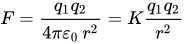
Where:
- is the magnitude of the force exerted,
- is the charge on one body,
- is the charge on the other body,
- is the distance between them,
- is the electric constant or permittivity of free space or permittivity of the vacuum. It is 8.854×10⁻¹² C2 N-1 m-2 (also F m-1)


- The occurrence of with the constant is related to some geometrical considerations that make some formulas (notably Maxwell's Equations) simpler. Ultimately it has to do with the fact that the surface area of a sphere is . Much ink has been spilled over this issue—one sometimes sees equations in "rationalized SI units" instead of the "plain" SI units that we use here.

The force is in the direction of making like charges repel and unlike charges attract. It could be written in vector form as:
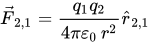
Where:
- is the force vector acting on charge 2, coming from charge 1
- is the unit vector from particle 1 to particle 2, that is, the actual spatial vector divided by its length. Its length is of course . The formula could be written as:


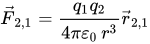
- It is sometimes useful, in investigations of optics and capacitor dielectrics, to use a value of ε other than the standard "vacuum" value, since doing so can automatically handle the behavior of the dielectric. When this is done, it is common to use the symbol ("epsilon-nought") to denote the vacuum value, and to denote the modified value. When this is done, the more common formula is:


The Electric Field Defined[edit | edit source]
Physicists usually reformulate this in terms of an electric field, usually denoted , that every charged object creates and that acts on every other charged object. Viewed this way, Coulomb's law breaks into two parts. The first part says what the field is around every charged object:

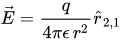
where and give the position at which the field is measured, and is the charge on the object creating the field.


The second parts is:

where in this case is the charge of the particle being acted upon.
The electric field when many charges are present[edit | edit source]
The Electric Field Near a Very Long Uniformly Charged Wire[edit | edit source]
As we have seen, the electric field around a point charge is spherically symmetric and inversely proportional to the square of the distance. There are two other geometrical configurations worth looking at.
If we have an "infinitely long" linear collection of uniformly distributed charge (that is, a long charged wire), we can determine the nearby electric field by integration. Let the charge per unit length be coulombs per meter.


At a given point at distance from the wire, the contribution to the field from an infinitesimal section of wire of length is:


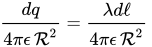
(Here, is linear charge density, so that is the charge on that section of wire.)

The component of that vector pointing perpendicularly away from the wire is:

As we integrate over l from to , the component of the field parallel to the wire cancels to zero, leaving:



The field points perpendicularly away from the wire, and is inversely proportional to the first power of the separation distance.
Does the wire need to be infinitely long? No; this is just an approximation to the infinite limit. The approximation is good as long as one is much closer to the wire than the wire's length.
The Electric Field Near a Very Large Uniformly Charged Plane[edit | edit source]
Another very important geometrical configuration is an "infinitely large" flat plane with uniform charge distribution. We divide the plane into many thin parallel strips of width dl. If the charge density per unit area of the plane is coulombs per square meter, each strip has a linear charge density of


coulombs per meter.
We use the result of the preceding section, and essentially the same diagram. The strips are now running into or out of the page / screen, and the strips' cross sections appear left-to-right on the diagram. The field at the point of interest is:
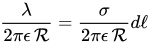
The upward component (by symmetry the total field will point perpendicularly out of the plane) is:

The total upward component of the field is obtained by integrating:

The field points perpendicularly away from the plane, and is independent of the separation distance. That is, it is independent as long as one stays so close to the plane that it appears to be nearly infinite.
Application: The electric field inside a parallel plate capacitor[edit | edit source]

Newton's laws assume that the net force is the sum of all forces, ma=ΣFj (sum over j). Since the electric field, E, is defined through Coulomb's law via F=qE, the simplest possible assumption is that the electric field is the sum of the individual electric fields due to each charge. This is principle is called superposition (or linear superposition) and it holds at least down to the sizes smaller than the atomic nucleus. In fact, we have implicitly assumed superposition by integrating to obtain the electric field due to line and surface charges. As shown in the figure, the electric fields add constructively in the space between the plates. They add destructively (i.e. they subtract) outside the two plates and add to zero electric field. Therefore the electric field between the plates is
(in the limit that the plates are very large and/or very close together)

General formulas for integrating over charge to find electric field[edit | edit source]
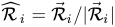
Consider a collection of particles of charge , located at points (called source points), the electric field at (called the field point) is:



where is the displacement vector from a source point to the field point , and is a unit vector that indicates the direction of the field. The fact that the force (and hence the field) can be calculated by summing over all the contributions due to individual source particles is an example of the superposition principle. The electric field produced by a distribution of charges is given by the volume charge density and can be obtained by converting this sum into a triple integral:



If the charge confined to one or two dimensions, then this integral becomes a line or surface integral, respectively. Letting k=1/4πε:
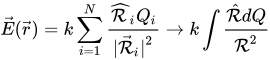
When integrating, one convert this to a single, double, or triple integral by replacing:

to represent a line integral , a surface integral or a volume integral , respectively. The symbols are commonly used to denote linear, surface, and volume density (or charge density), respectively.


Three important displacement vectors used when integrating Coulomb's law[edit | edit source]
When writing such integrals, begin with a careful attention to how the three displacement vectors are to be represented:
- is the field point, i.e., where you want to evaluate the electric field. If no coordinates are specified, it is common to refer to this as a point, using a capital letter, such as or .
- is the source point, which is the variable of integration. Alternatives include , and .
- points from the source point to the field point. To avoid defining a symbol for it, write it as the difference between two vectors, e.g., . In wikitext, one might write or There is no lower case version of this font in wikitext; the lower case cursive r is often used when calculating by hand.





