In the last lecture we talked about norms in inner product spaces. The
induced norm was defined as

We also talked about orthonomal bases and biorthonormal bases. The biorthonormal
bases may be thought of as dual bases in the sense that covariant and
contravariant vector bases are dual.
The last thing we talked about was the idea of a linear operator. Recall that
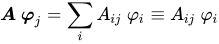
where the summation is on the first index.
In this lecture we will learn about adjoint operators, Jacobi tridiagonalization,
and a bit about the spectral theory of matrices.
Assume that we have a vector space with an orthonormal basis. Then

One specific matrix connected with  is the Hermitian conjugate matrix.
This matrix is defined as
is the Hermitian conjugate matrix.
This matrix is defined as

The linear operator  connected with the Hermitian matrix is called the
adjoint operator and is defined as
connected with the Hermitian matrix is called the
adjoint operator and is defined as

Therefore,
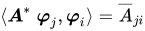
and

More generally, if

then

Since the above relation does not involve the basis we see that the adjoint operator is also basis independent.
Self-adjoint/Hermitian matrices[edit | edit source]
If  we say that is self-adjoint, i.e.,
 in any orthonomal basis, and the matrix
  is said to be Hermitian.
A matrix  is anti-Hermitian if

There is a close connection between Hermitian and anti-Hermitian matrices.
Consider a matrix  . Then

Let be self-adjoint and suppose that we want to solve

where  is constant. We expect that

If  is "sufficiently" small, then

This suggest that the solution should be in the subspace spanned by
 .
.
Let us apply the Gram-Schmidt orthogonalization procedure where

Then we have
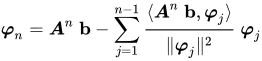
This is clearly a linear combination of  .
Therefore,
.
Therefore,  is a linear combination of
 . This
is the same as saying that is a linear combination of
. This
is the same as saying that is a linear combination of
 .
.
Therefore,

Now,

But the self-adjointeness of implies that

So  is
is  or
or  . This is equivalent to expressing
the operator as a tridiagonal matrix
. This is equivalent to expressing
the operator as a tridiagonal matrix  which has the form
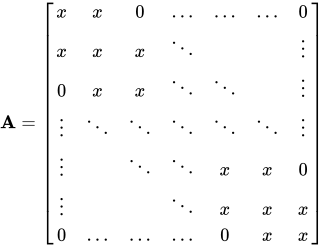
In general, the matrix can be represented in block tridiagonal form.
Another consequence of the Gram-Schmidt orthogonalization is that
Lemma:
Every finite dimensional inner-product space has an orthonormal basis.
Proof:
The proof is trivial. Just use Gram-Schmidt on any basis for that space and
normalize. 
A corollary of this is the following theorem.
Theorem:
Every finite dimensional inner product space is complete.
Recall that a space is complete is the limit of any Cauchy sequence from a
subspace of that space must lie within that subspace.
Proof:
Let  be a Cauchy sequence of elements in the subspace
  with
with
 . Also let
  be an
orthonormal basis for the subspace .
be an
orthonormal basis for the subspace .
Then
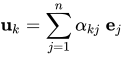
where
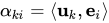
By the Schwarz inequality

Therefore,
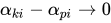
But the  ~s are just numbers. So, for fixed
  ,
,  is
a Cauchy sequence in
is
a Cauchy sequence in  (or
(or  ) and so converges to
a number
) and so converges to
a number  as
as  , i.e.,
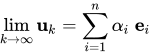
which is is the subspace .
Spectral theory for matrices[edit | edit source]
Suppose  is expressed in coordinates relative to some basis
 , i.e.,

Then

So implies that
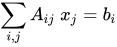
Now let us try to see the effect of a change to basis to a new basis
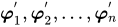 with
with

For the new basis to be linearly independent,  should be invertible so
that
should be invertible so
that
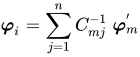
Now,

Hence

Similarly,

Therefore

So we have
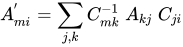
In matrix form,

where the objects here are not operators or vectors but rather the matrices and
vectors representing them. They are therefore basis dependent.
In other words, the matrix equation 
The transformation

is called a similarity transformation. Two matrices are equivalent
or similar is there is a similarity transformation between them.
Suppose we want to find a similarity transformation which makes diagonal,
i.e.,
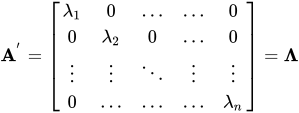
Then,

Let us write (which is a  matrix) in terms of its columns

Then,

i.e.,

The pair  is said to be an eigenvalue pair if
  where
where  is an eigenvector and is an eigenvalue.
Since 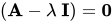 this means that is an
eigenvalue if and only if
this means that is an
eigenvalue if and only if

The quantity on the left hand side is called the characteristic polynomial
and has  roots (counting multiplicities).
In there is always one root. For that root  is singular, i.e., there always exists at least one eigenvector.
We will delve a bit more into the spectral theory of matrices in the next
lecture.
