It helps to a know a bit about curvature when you start learning how to do buckling analysis. The following discussion goes through the derivation of some useful elementary results relating to curvature. You have already learned these in your introductory calculus course. However, you may have forgotten the details. So this is a refresher lesson.
Let  be a vector valued function (curve) of the parameter
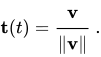
  . The unit tangent vector to the curve traced by the function
  is given by

Note that the "velocity" of a point on the curve is in the direction of the tangent. Therefore, the unit tangent vector and the unit velocity vector have the same value
A straight line has the equation

Taking the derivative with respect to we see that the tangent vector is constant, i.e., it
does not change direction. Alternatively, we may say that the condition  implies that the unit tangent vector does not change direction.
If the curve is not a straight line, then the quantity  measures the tendency of the curve to change direction.
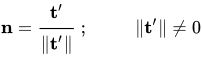
The unit normal to the curve is defined as
Curvature vector of a curve[edit | edit source]
The curvature vector is defined as the rate of change of the unit tangent vector with respect to the arc length. If  measures the arc length, then the curvature vector is given by
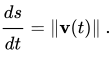
  . Now, the "velocity" is given by
Then

Therefore the curvature vector has the same direction at the unit normal vector.
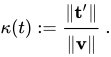
The curvature ( ) of the curve is the length of the curvature vector. That means,
To get a feel for the radius of curvature, consider the equation of a circle

where  is the radius of the circle and
  are the unit basis vectors in the
  directions. Then the "velocity" is given by

and the unit tangent vector is

Differentiating with respect to ,

Therefore, the curvature of the circle is
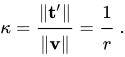
This shows that the radius of the circle is the reciprocal of the curvature of the circle. The radius of curvature of any curve is defined in an analogous manner as the reciprocal of the curvature of the curve at a point.
Let us now consider a curve in a plane  . Let
. Let  be the angle that the tangent vector to the curve makes with the positive
  -axis. Then we can write

where are the unit basis vectors in the directions.
Taking the derivative we have
![{\displaystyle \mathbf {t} '=-\sin \theta ~\theta '~\mathbf {e} _{x}+\cos \theta ~\theta '~\mathbf {e} _{y}=\theta '~[-\sin \theta ~\mathbf {e} _{x}+\cos \theta ~\mathbf {e} _{y}]~;~~\theta ':={\cfrac {d\theta }{dt}}~.}](https://wikimedia.org/api/rest_v1/media/math/render/svg/66d66acb4891d69ab502e61d4bf96e500cd11853)
Therefore

Using the chain rule
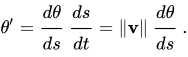
The curvature can then be expressed as
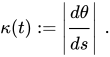
Useful relation for the curvature of plane curves[edit | edit source]
If the plane curve is parameterized as

the curvature of curve can also be expressed as

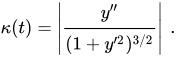
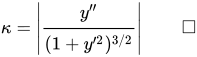
If, in addition,  , we have
Curvature of a plane curve
|
Proof:
The tangent vector to the curve is given by

Therefore

Differentiating both sides with respect to ,
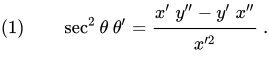
Now,

Plugging (2) back into (1) we get
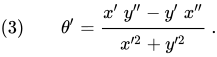
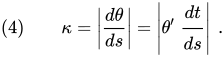
The curvature is given by
Also
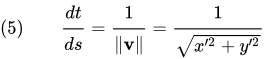
since

Plugging (3) and (5) into (4) gives
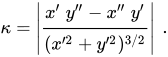
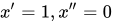
For the situation where  we can parameterize the curve using
  to get
  . Then,
- Varberg and Parcell, Calculus, 7th edition, Prentice Hall, 1997.
- Apostol, T. M., Calculus Vol. I, 2nd edition, Wiley, 1967.