

Numerical Analysis/ODE Exercises
Solve the following differential equations using the given method
[edit | edit source]Euler's Method
[edit | edit source]1) Solve differential equation y' = 3t2y in [0,1] using Euler's method with n=10,y(0)=1.
Solution:
We need to find the solution ODE y' = 3t2y using Euler's method.
yn+1=yn+hf(tn,yn)
We divide time span with number points to find the step size h.
h=tmax-tmin/n=1-0/10=0.1
y1=y0+hf(t0,y0)
=1.000000+.1x3x02x1
=1.000000
y2=y1+hf(t1,y1)
=1.000000+.1x3x0.12x1.000000
=1.003000
y3=y2+hf(t2,y2)
=1.003000+.1x3x0.22x1.003000
=1.0150360
y4=y3+hf(t3,y3)
=1.01503600+.1x3x0.32x1.0150360
=1.0424420
y5=y4+hf(t4,y4)
=1.0424420+.1x3x0.42x1.0424420
=1.0924792
y6=y5+hf(t5,y5)
=1.0924792+.1x3x0.52x1.0924792
=1.1744151
y7=y6+hf(t6,y6)
=1.1744151+.1x3x0.62x1.1744151
=1.3012520
y8=y7+hf(t7,y7)
=1.3012520+.1x3x0.72x1.3012520
=1.4925360
y9=y8+hf(t8,y8)
=1.4925360+.1x3x0.82x1.4925360
=1.7791029
y10=y9+hf(t9,y9)
=1.77910290+.1x3x0.92x1.7791029
=2.2114249
Runge-Kutta Second Order Method (RK2)
[edit | edit source]2) Solve differential equation y' = 2ty in [0,1] using RK2 method yn+1=yn+h/4(k1+3K2) where k1=f(tn,yn),k2=f(tn+2/3h,yn+2/3hk1)with n=5,y(0)=1.
Solution:
We need to find the solution ODE y' = 2ty using RK second order method.
yn+1=yn+h/4(k1+3K2)
k1=f(tn,yn)
k2=f(tn+2/3h,yn+2/3hk1)
y1=y0+h/4(k1+3K2)
k1=f(t0,y0)
=2x0.0x1
=0
k2=f(t0+2/3h,y0+2/3hk1)
=2x2/3x0.2x1
=0.26667
y1=y0+h/4(k1+3K2)
=1+0.2/4(0+3x0.26667)
=1.04
y2=y1+h/4(k1+3K2)
k1=f(t1,y1)
=2x0.2x1.04
=0.416
k2=f(t1+2/3h,y1+2/3hk1)
=f(0.2+0.13333,1.04+0.0554667)
=0.730304
y2=y1+h/4(k1+3K2)
=1.04+.2/4(0.416+3x0.730304)
=1.17035
y3=y2+h/4(k1+3K2)
k1=f(t2,y2)
=2x0.4x1.17035
=0.93648
k2=f(t2+2/3h,y2+2/3hk1)
=f(0.4+2/3(0.2),1.17035+2/3(0.2)(0.93648))
=1.34316
y3=y2+h/4(k1+3K2)
=1.17035+0.2/4(0.93648+3(1.34318))
=1.41865
y4=y3+h/4(k1+3K2)
k1=f(t3,y3)
=f(0.6,1.41865)
= 1.70238
k2=f(t3+2/3h,y3+2/3xhxk1)
=f(.6+.133333,1.41865+2/3(0.2)(1.70238))
=1.64563
y4=y3+h/4(k1+3K2)
=1.41865+.2/4(1.72038+3(1.64563))
=1.75061
y5=y4+h/4(k1+3K)
k1=f(t4,y4)
=f(0.8,1.75061)
= 2.800098
k2=f(t4+2/3h,y4+2/3hk1)
=f(0.8+.133333,1.75061+2/3(0.2)(2.800098))
=3.96472
y5=y4+h/4(k1+3K2)
=1.75061+.2/4(2.800098+3(3.96472))
=2.48532
y6=y5+h/4(k1+3K2)
k1=f(t5,y5)
=f(1,2.48532)
= 4.97064
k2=f(t5+2/3h,y5+2/3hk1)
=f(1+.133333,2.48532+2/3(0.2)(4.97064))
=7.1356
y6=y5+h/4(k1+3K2)
=2.48532+.2/4(4.97064+3(7.1356))
=3.80420
Adams-Bashforth Two Step
[edit | edit source]3) Solve differential equation y' = 2ty in [0,1] using Two step Adams Bashforth method with n=5,y(0)=1.
Solution:
We need to find the solution ODE y' = 2ty using Two step Adams Bashforth method.
yn+2 = yn+1 + 3/2 x hf(tn+1,yn+1)-1/2 x hf(tn,yn)
Calculating h=1-0/5=0.2
We need two approxmations for calculating y2
Calculating y1 using RK second order method.
y1=1.04
y2 = y1 + 3/2 x hf(t1,y1)-1/2 x hf(t0,y0)
=1.04+3/2(.2)f(0.2,1.04)-1/2(0.2)f(0.0,1)
=1.1648
y3 = y2 + 3/2 x hf(t2,y2)-1/2 x hf(t1,y1)
=1.1648+3/2(.2)f(0.4,1.1648)-1/2(0.2)f(0.2,1.04)
=1.40275
y4 = y3 + 3/2 x hf(t2,y2)-1/2 x hf(t2,y2)
=1.40275+3/2(.2)f(0.6,1.40275)-1/2(0.2)f(0.4,1.1648)
=1.81456
y5 = y4 + 3/2 x hf(t4,y4)-1/2 x hf(t3,y3)
=1.81456+3/2(.2)f(0.8,1.81456)-1/2(0.2)f(0.6,1.40275)
=2.21333
y6 = y5 + 3/2 x hf(t5,y5)-1/2 x hf(t4,y4)
=2.21333+3/2(.2)f(1,2.21333)-1/2(0.2)f(0.8,1.81456)
=3.25098
Runge-Kutta Fourth Order (RK4)
[edit | edit source]4) Solve the ODE on the interval , using three steps of the Runge-Kutta 4 method with and .

![{\displaystyle [0,1]}](https://wikimedia.org/api/rest_v1/media/math/render/svg/738f7d23bb2d9642bab520020873cccbef49768d)


Solution:
The RK4 method is given by
-
()

where
- and
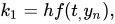



The step size , is found using the interval and and is given by



And we know that so now we can now use the RK4 formula from Eqn.() to find each following iteration.
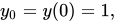

We must first solve for k1, k2, k3, and k4.
k1 = (.5)(2)(0)(1) = 0;
k2 = (.5)(2)(.25)(1) = .25;
k3 = (.5)(.25)(1.125) = .140625;
k4 = (.5)(.5)(1.140625) = .28515625.
Applying these k, and y0 to Eqn.(), we find
y1 = 1 + 1/6(0 + (2)(.25) + (2)(.140625) + .28515625) = 1.177734375.

Similarly, we find k1, k2, k3, and k4.
k1 = (.5)(.5)(1.177734375) = .294433593;
k2 = (.5)(.75)(1.324951172) = .496856689
k3 = (.5)(.75)(1.42616272) = .534811019;
k4 = (.5)(1)(1.712545394) = .856272697.
Applying these k, and y1 to Eqn.(), we find
y2 = 1.177734375 + 1/6(.294433593 + (2)(.496856689) + (2)(.534811019) + .856272697) = 1.713407993

Repeating in a similar fashion, we find y3.
k1 = (.5)(1)(1.713407993) = .856703996;
k2 = (.5)(1.25)(2.141759991) = 1.338599995;
k3 = (.5)(1.25)(2.38270799) = 1.489192494;
k4 = (.5)(1.5)(3.202600487) = 2.401950365.
Applying these k, and y2 to Eqn.(), we find
y3 = 1.713407993 + 1/6(.856703996 + (2)(1.338599995) = (2)(1.489192494) + 2.401950365) = 3.19911455,
with as our final answer.
