

PlanetPhysics/Coulomb's Law
Coulomb's law describes the electrostatic force between Electric Charges. Coulomb was the first scientist to measure the force using a torsion balance and he discovered that the attraction or repulsion force increases or decreases inversely as the square of the distance between the charges. As an equation Coulomb's law is given as

This equation only gives the magnitude of the force, but we must also take into account the direction of the force. Similar to gravity, the force between the charges acts along a line between them. Coulomb's law in vector form is
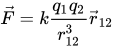
Some explanation is needed for the variables. is the distance between the two charges. The direction of the force is taken into account through the unit vector which will point towards the other charge or in the oppososite direction depending on attraction or repulsion. So to go from the first equation we add the unit vector


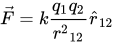
To get a unit vector we divide the vector between the charges by its magnitude

so the unit vector is

repacing the unit vector with the above equation yields the vector form of Colomb's Law.
More to come on how Coulomb used a torsion balance to come up with this relationship...