Suppose that, under the action of external forces, a material point
 in a body is displaced to a new location
 where
where

and  and
and  are constants.
A displacement field is called proper and admissible if the Jacobian ( ) is greater than zero. If a displacement field is proper and admissible, then the deformation of the body is continuous.
Indicate the restrictions that must be imposed upon so that the deformation represented by the above displacement is continuous.
The deformation gradient  is given by
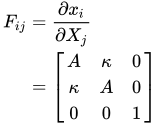
Therefore, the requirement is that  where
where
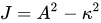
The restriction is

Suppose that  . Calculate the components of the infinitesimal strain tensor
  for the above displacement field.
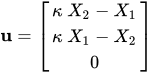
The displacement is given by  . Therefore,
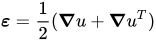
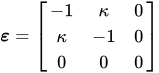
The infinitesimal strain tensor is given by
The gradient of  is given by
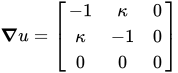
Therefore,
Calculate the components of the infinitesimal rotation tensor  for the above displacement field and find the rotation vector
  .
.
The infinitesimal rotation tensor is given by
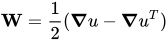
Therefore,
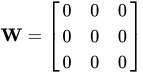
The rotation vector is

Do the strains satisfy compatibility ?
The compatibility equations are
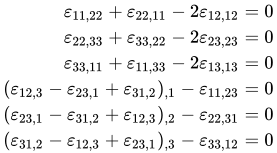
All the equations are trivially satisfied because there is no dependence on  ,
,  , and
, and  .
.

Calculate the dilatation and the deviatoric strains from the strain tensor.
The dilatation is given by

Therefore,

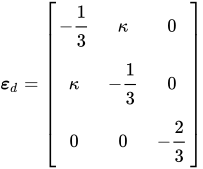
The deviatoric strain is given by
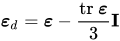
Hence,
What is the difference between tensorial shear strain and engineering shear strain (for infinitesimal strains)?
The tensorial shear strains are  ,
,  ,
,  .
The engineering shear strains are
.
The engineering shear strains are  ,
,  ,
,
 .
.
The engineering shear strains are twice the tensorial shear strains.
Briefly describe the process which you would use to calculate the principal stretches and their directions.
- Compute the deformation gradient (
 ).
).
- Compute the right Cauchy-Green deformation tensor (
 ).
).
- Calculate the eigenvalues and eigenvectors of
 .
.
- The principal stretches are the square roots of the eigenvalues of .
- The directions of the principal stretches are the eigenvectors of .

