Electric Circuit Analysis/Resistors in Series

|
Lesson 2 : ReviewWhat you need to remember from Simple resistive Circuits. If you ever feel lost, do not be shy to go back to the previous lesson & go through it again. You can learn by repetition.
Lesson 3: PreviewThis Lesson is about Resistors in Series. The student/User is expected to understand the following at the end of the lesson:
|
| ||||||||||||||||||||||||||||||||||||||||||||||



Part 1Resistors in SeriesA Series of resistors means resistors connected end to end in a line.
This means that the resistance for the circuit is different from any one resistor. Take two resistors in series in a circuit with a voltage supply.
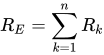
To find the overall resistance of the circuit, add up the individual resistances of the each of the resistors. i.e. () |
Part 2Equation 3.1
|


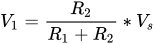
Part 3Voltage DividerThere comes a time when the boss or the project demands that you know what the voltage is between these millions of resistors in series. No need to panic though because it isn't too much harder. Lets take the two-resistor problem first. There is a voltage source with two resistors in series. We know that the overall voltage drop across the two resistors is the same as the voltage the source is supplying in our example world. So the voltage drop across one resistor would be a portion of the overall drop. What proportion would we use to figure out the answer? One resistor over the two added together times the overall voltage drop:
At this point it seems that everything isn't quite as simple as it started. With our example and equation for two resistors in series something else can happen. What if the second resistor was set in the first resistor's place in the equation? Well, we would simply get the other side of the proportion: |
Part 4Equation 3.4
If the resistors are in the middle of the series then it will be necessary to calculate the voltage drop on one of the sides in order to calculate the voltage. |

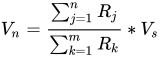

Part 5It becomes clear, then, that two equal resistors will divide the source voltage into two equal voltages (half of the source's voltage is dropped across each resistor). If the ratio of the resistance values is 3 to 1, there will be 3/4 of the source voltage dropped across the higher resistance, and of the source voltage dropped across the lower resistance. Three equal resistances in a series circuit with a single voltage source would drop 1/3 of the source voltage across each resistor. If the three had 1-2-3 proportionality (100,200,300 ohms for instance) they would drop , and of the source voltage each. That is: × VTotal, × VTotal,and × VTotal. |
Part 6CurrentWhere does current come into any of this? Current, in this case, plays a similar role to that of the current in the Simple Resistive Circuits. Once the equivalent resistance of all the resistors in a series is found, effectively making a simple circuit again, then the current can be found with:
|


Part 7More Examples
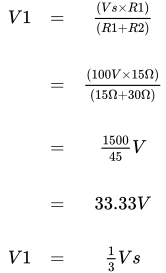
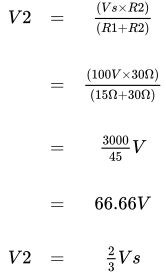
Figure 3.1 shows a Series resistive circuit with the following parameters. Vs=100Volts ; R1=15; R2=30; Find V1 and V2. Solution: from Equation 3.3 we see that. . Similarily: . Thus it can be said that The Supply Voltage has been divided between R1 and R2 by and respectively. Related Topic(s) in WikiversityPlease visit the following page to supplement material covered in this lesson. |
Part 8: Exercise 3Here are some questions to test yourself with.
 Completion listOnce you finish your Exercises you can post your score here!
To post your score just e-mail your course co-ordinator, your name, and score Click Here
|



External Links
- Resistors Series and Parallel: Electronics for Beginners
 |
Resource type: this resource contains a lecture or lecture notes. |