Power Generation/Diesel Power
Review: Lesson 3
The previous lesson was about the hydro power station. The student is expected to remember the following from the lesson 3:
- Basics:
- Arrangements:
- Location:
- Pumped storage scheme:
Definition, advantages and disadvantages.
Components that make up a hydro-power station.
Factors influencing selection of construction site.
Overview and comparison to hydro-power station.
Preview: Lesson 4
This Lesson is about diesel power stations. The student is expected to understand the following at the end of the lesson:
- Basics:
- Arrangements:
- Advantages and disadvantages:
Definition
Components that make up a diesel power station.
How this station compares with other types

|
Figure 1:Trailer from Danish Emergency Management Agency with 40 kVA generator |
Introduction: Diesel Power station
A Diesel power station(also known as Stand-by power station) uses a diesel engine as prime mover for the generation of electrical energy.
This power station is generally compact and thus can be located where it is actually required. This kind of power station can be used to produce limited amounts of electrical energy. In most countries these power stations are used as emergency supply stations.
Operation
The diesel burns inside the engine and the combustion process moves a fluid that turns the engine shaft and drives the alternator. The alternator in turn, converts mechanical energy into electrical energy.
This type of electricity generating power station will probably be used a long time into the future, due to a need for reliable stand-by electrical source for emergency situations.
However, diesel power plants emit green house gases that pollute the environment and also require frequent servicing.
| Advantages | Disadvantages |
|---|---|
| Simple design & layout of plant | High running charges due to costly price of Diesel |
| Occupies less space & is compact | Plant does not work efficiently under prolonged overload conditions |
| Can be started quickly and picks up load in a short time | Generates small amount of power |
| Requires less water for cooling | Cost of lubrication very high |
| Thermal efficiency better that of Steam Power plant of same size | Maintenance charges are generally high |
| Overall cost is cheaper than that of Steam Power plant of same size | . |
| Requires no Operating staff | . |
| No stand-by losses | . |
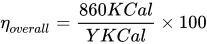
If heat produced by _X kg of oil = Y KCal (where 1kWh = 860 KCal)
Then we can derive the overal power plant efficiency as:
(in %) ... Equation 4.1
Then the engine efficiency becomes:
(in %) ... Equation 4.2
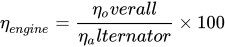
Where:_ is specified by manufacturer

References
- This resource is prepared from Lecture notes by Thuvack.
- V.K Mehta & Rohit Mehta :- Principles of Power systems (1st ed.). S.CHAND .ISBN 81-219-2496-0