The word "topology" has two meanings: it is both the name of a mathematical subject and the name of a mathematical structure. A topology on a set  (as a mathematical strucure) is a collection of what are called "open subsets" of satisfying certain relations about their intersections, unions and complements. In the basic sense, Topology (the subject) is the study of structures arising from or related to topologies.
- The following reading is suggested to help supplement this lesson.
- Wikibooks Topology book:
- Wikipedia articles:
Let be a set. Then a topology on is a set  such that the following conditions hold.
 (where
  denotes the power set of X)
- For
 we have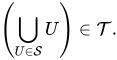
- For finite sets we have
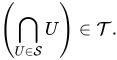
The set together with the topology is called a topological space (or simply a space) and is commonly written as the pair  Or, when is understood it may be omitted and we will simply say that is a topological space.
Here are some very simple examples of topological spaces. For these examples, can be any set.
- Discrete topology
- The collection
 is called the discrete topology on
- Indiscrete topology
- The collection
 is called the indiscrete topology or trivial topology on
- Particular point topology
- Given a point
 the collection
  is called the particular-point topology on
It is left as an exercise to verify that each of these three collections does indeed satisfy the axioms of a topology (conditions 1,2,3 in the definition above).
See also Wikipedia articles:
Definition (open set, closed set,neighborhood)[edit | edit source]
Suppose that  is a topological space.
- Open set
- A set
 is open if
- Closed set
- A set
 is closed if
- Neighborhood
- For a point
 a set
a set  is a neighborhood of
  if there is an open set
  such that
Definition (closed topology)[edit | edit source]
- Alternate definition of a topology
Suppose that  Then
Then  is a closed topology if
- for any
 we have
 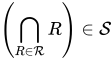 and
and
- for any finite collection we have
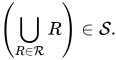
Show that for any set  the collection is a topology on if and only if the collection
  is a closed topology on
Definition (interior, closure)[edit | edit source]
Let be a space and let 
- Interior
- The interior of
 (denoted
  ) is defined to be the union of all open sets contained in
  In other words,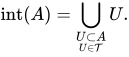
- Closure
- The closure of (denoted
 ) is defined to be the intersection of all closed sets containing That is,
Let be a space. Then a collection  is a basis if for any point and any neighborhood
  of there is a basis element
  such that
The benefit of talking about a basis is that sometimes describing every open set is unwieldy. For example, describing an open set in the Euclidean plane  would be difficult, but describing a basis is very easy. A basis of open sets in the plane is given by "open rectangles". That is
  forms a basis.
Once a basis is determined, a set is open if it is the union of basis elements. That is, if  is a basis, then the topology is given by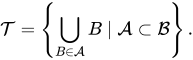
Let be a topological space. Then a set  is compact if and only if every open cover of
  has a finite subcover.
See also Wikipedia articles:
- Let be a three-point set. Then there are
 different subsets of
  How many of these are topologies on
  In other words, how many different 3-point topologies are there?
- Can you find a formula for the number of topologies on an
 -point set?
- Suppose that
 is such that for any
  there is a set containing
  and that for any two sets
  such that
 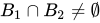 there is a set
  such that
  Show that the collection
 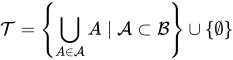 is a topology on and that is a basis for
- Let
 be such that for all there is a set
  which contains
  Then show that the collection
 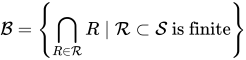 is a basis for a topology on (using the criterion given in exercise 3). In this case, we call a subbasis for
- A basis for a topology is said to be minimal if any proper collection
 is not a basis for Given a set find a minimal basis for the discrete topology
- It is clear from the definition that
 Show that if
  then
then  and
and 
- Show that
 and that
  Use these facts to show that is open if and only if
  and is closed if and only if
- Is it true that for any set that
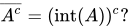 Give a proof or a counterexample.
- Show that the collection
 [1] of open intervals is a basis for a topology on
  This is called the standard topology on
Next Lesson
- ↑ where
