An elastic plate with a circular hole under tension
The BCs are
(124)
at
r
=
a
t
r
=
t
θ
=
0
;
n
^
=
−
e
^
r
⇒
σ
r
r
=
σ
r
θ
=
0
(125)
at
r
→
∞
σ
11
→
T
;
σ
12
→
0
;
σ
22
→
0
{\displaystyle {\begin{aligned}{\text{(124)}}&\qquad {\text{at}}~r=a&&t_{r}=t_{\theta }=0~;~~{\widehat {\mathbf {n} }}=-{\widehat {\mathbf {e} }}~{r}\Rightarrow \sigma _{rr}=\sigma _{r\theta }=0\\{\text{(125)}}&\qquad {\text{at}}~r\rightarrow \infty &&\sigma _{11}\rightarrow T~;~~\sigma _{12}\rightarrow 0~;~~\sigma _{22}\rightarrow 0\end{aligned}}}
The unperturbed part of the Michell solution gives us
φ
=
T
x
2
2
2
=
T
(
r
sin
θ
)
2
2
=
T
r
2
4
−
T
r
2
cos
(
2
θ
)
4
{\displaystyle \varphi ={\cfrac {Tx_{2}^{2}}{2}}={\cfrac {T(r\sin \theta )^{2}}{2}}={\cfrac {Tr^{2}}{4}}-{\cfrac {Tr^{2}\cos(2\theta )}{4}}}
or,
(126)
φ
=
T
r
2
4
−
T
r
2
cos
(
2
θ
)
4
{\displaystyle {\text{(126)}}\qquad \varphi ={\cfrac {Tr^{2}}{4}}-{\cfrac {Tr^{2}\cos(2\theta )}{4}}}
The first term is the axisymmetric term while the second term is the periodic term.
Similar to previous problem, but we simply choose terms from the Michell solution of the same form (i.e. containing
cos
(
2
θ
)
{\displaystyle \cos(2\theta )}
(127)
ln
(
r
)
,
θ
,
r
−
2
+
2
cos
(
2
θ
)
,
r
−
2
cos
(
2
θ
)
{\displaystyle {\text{(127)}}\qquad \ln(r)~,~~\theta ~,~~r^{-2+2}\cos(2\theta )~,~~r^{-2}\cos(2\theta )}
The perturbed solution is
(128)
φ
=
T
r
2
4
−
T
r
2
cos
(
2
θ
)
4
+
A
ln
(
r
)
+
B
θ
+
C
cos
(
2
θ
)
+
D
r
−
2
cos
(
2
θ
)
{\displaystyle {\text{(128)}}\qquad \varphi ={\cfrac {Tr^{2}}{4}}-{\cfrac {Tr^{2}\cos(2\theta )}{4}}+A\ln(r)+B\theta +C\cos(2\theta )+Dr^{-2}\cos(2\theta )}
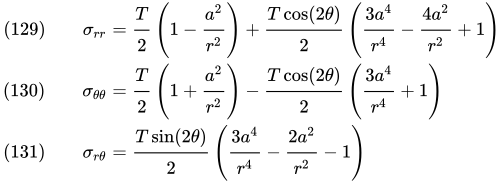
After applying the BCS, we get
(129)
σ
r
r
=
T
2
(
1
−
a
2
r
2
)
+
T
cos
(
2
θ
)
2
(
3
a
4
r
4
−
4
a
2
r
2
+
1
)
(130)
σ
θ
θ
=
T
2
(
1
+
a
2
r
2
)
−
T
cos
(
2
θ
)
2
(
3
a
4
r
4
+
1
)
(131)
σ
r
θ
=
T
sin
(
2
θ
)
2
(
3
a
4
r
4
−
2
a
2
r
2
−
1
)
{\displaystyle {\begin{aligned}{\text{(129)}}\qquad \sigma _{rr}&={\cfrac {T}{2}}\left(1-{\cfrac {a^{2}}{r^{2}}}\right)+{\cfrac {T\cos(2\theta )}{2}}\left({\cfrac {3a^{4}}{r^{4}}}-{\cfrac {4a^{2}}{r^{2}}}+1\right)\\{\text{(130)}}\qquad \sigma _{\theta \theta }&={\cfrac {T}{2}}\left(1+{\cfrac {a^{2}}{r^{2}}}\right)-{\cfrac {T\cos(2\theta )}{2}}\left({\cfrac {3a^{4}}{r^{4}}}+1\right)\\{\text{(131)}}\qquad \sigma _{r\theta }&={\cfrac {T\sin(2\theta )}{2}}\left({\cfrac {3a^{4}}{r^{4}}}-{\cfrac {2a^{2}}{r^{2}}}-1\right)\end{aligned}}}
The stress concentration factor , often referred to as Kt , in this case is
3
{\displaystyle 3}
Consider the elastic plate with a hole subject to uniaxial tension.
Elastic plate with small circular hole under uniaxial tension
Show that the stress function
φ
=
T
r
2
4
−
T
r
2
cos
(
2
θ
)
4
+
A
ln
(
r
)
+
B
θ
+
C
cos
(
2
θ
)
+
D
r
−
2
cos
(
2
θ
)
{\displaystyle \varphi ={\frac {Tr^{2}}{4}}-{\frac {Tr^{2}\cos(2\theta )}{4}}+A\ln(r)+B\theta +C\cos(2\theta )+Dr^{-2}\cos(2\theta )}
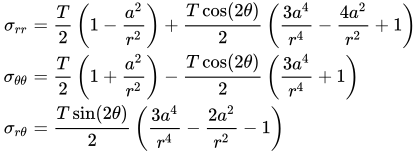
leads to the stresses
σ
r
r
=
T
2
(
1
−
a
2
r
2
)
+
T
cos
(
2
θ
)
2
(
3
a
4
r
4
−
4
a
2
r
2
+
1
)
σ
θ
θ
=
T
2
(
1
+
a
2
r
2
)
−
T
cos
(
2
θ
)
2
(
3
a
4
r
4
+
1
)
σ
r
θ
=
T
sin
(
2
θ
)
2
(
3
a
4
r
4
−
2
a
2
r
2
−
1
)
{\displaystyle {\begin{aligned}\sigma _{rr}&={\frac {T}{2}}\left(1-{\frac {a^{2}}{r^{2}}}\right)+{\frac {T\cos(2\theta )}{2}}\left({\frac {3a^{4}}{r^{4}}}-{\frac {4a^{2}}{r^{2}}}+1\right)\\\sigma _{\theta \theta }&={\frac {T}{2}}\left(1+{\frac {a^{2}}{r^{2}}}\right)-{\frac {T\cos(2\theta )}{2}}\left({\frac {3a^{4}}{r^{4}}}+1\right)\\\sigma _{r\theta }&={\frac {T\sin(2\theta )}{2}}\left({\frac {3a^{4}}{r^{4}}}-{\frac {2a^{2}}{r^{2}}}-1\right)\end{aligned}}}
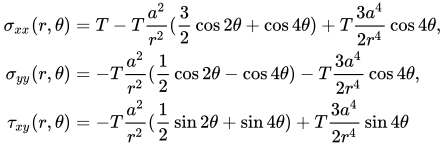
or, in cartesian coordinates:
σ
x
x
(
r
,
θ
)
=
T
−
T
a
2
r
2
(
3
2
cos
2
θ
+
cos
4
θ
)
+
T
3
a
4
2
r
4
cos
4
θ
,
σ
y
y
(
r
,
θ
)
=
−
T
a
2
r
2
(
1
2
cos
2
θ
−
cos
4
θ
)
−
T
3
a
4
2
r
4
cos
4
θ
,
τ
x
y
(
r
,
θ
)
=
−
T
a
2
r
2
(
1
2
sin
2
θ
+
sin
4
θ
)
+
T
3
a
4
2
r
4
sin
4
θ
{\displaystyle {\begin{aligned}\sigma _{xx}(r,\theta )&=T-T{\frac {a^{2}}{r^{2}}}({\frac {3}{2}}\cos 2\theta +\cos 4\theta )+T{\frac {3a^{4}}{2r^{4}}}\cos 4\theta ,\\\sigma _{yy}(r,\theta )&=-T{\frac {a^{2}}{r^{2}}}({\frac {1}{2}}\cos 2\theta -\cos 4\theta )-T{\frac {3a^{4}}{2r^{4}}}\cos 4\theta ,\\\tau _{xy}(r,\theta )&=-T{\frac {a^{2}}{r^{2}}}({\frac {1}{2}}\sin 2\theta +\sin 4\theta )+T{\frac {3a^{4}}{2r^{4}}}\sin 4\theta \end{aligned}}}
Calculate the stress concentration factors at the hole, both in shear and in tension, and show that they are the same. How far from the hole (in units of hole diameters) does the stress reach 95% of the far field (unperturbed) value?
Calculate the displacement field corresponding to this stress field (for plane stress). Plot the deformed shape of the hole. We can use the following Maple code to show the above results.
phi := T*r^2/4*(1 - cos(2*theta)) + A*ln(r) + B*theta + C*cos(2*theta) +
       D/r^2*cos(2*theta);

srr := 1/r*diff(phi,r) + 1/r^2*diff(phi,theta,theta);
stt := diff(phi,r,r);
srt := -diff((1/r*diff(phi,theta)),r);

srra := collect(simplify(eval(srr, r=a)),{cos});
srta := collect(simplify(eval(srt, r=a)),{cos});

eq1 := coeff(srra, cos(2*theta));
eq2 := coeff(srta, sin(2*theta));
eq3 := 1/2*(T*a^4+2*A*a^2)/a^4;
eq4 := 1/a^2*B;

BB  := solve({eq4=0},{B});
AA  := solve({eq3=0},{A});

sol := solve({eq1=0,eq2=0},{C,D});

phi := subs(BB, phi);
phi := subs(AA, phi);
phi := subs(sol, phi);

srr2 := 1/r*diff(phi,r) + 1/r^2*diff(phi,theta,theta);
stt2 := diff(phi,r,r);
srt2 := -diff((1/r*diff(phi,theta)),r);

srr3 := collect(simplify(srr2),{cos});
stt3 := collect(simplify(stt2),{cos});
srt3 := collect(simplify(srt2),{cos});
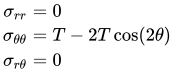
The stresses at the hole (
r
=
a
{\displaystyle r=a}
σ
r
r
=
0
σ
θ
θ
=
T
−
2
T
cos
(
2
θ
)
σ
r
θ
=
0
{\displaystyle {\begin{aligned}\sigma _{rr}&=0\\\sigma _{\theta \theta }&=T-2T\cos(2\theta )\\\sigma _{r\theta }&=0\end{aligned}}}
The maximum hoop stress is given at
θ
=
0
{\displaystyle \theta =0}
θ
=
π
/
2
{\displaystyle \theta =\pi /2}
At
θ
=
0
{\displaystyle \theta =0}
σ
θ
θ
=
−
T
{\displaystyle \sigma _{\theta \theta }=-T}
At
θ
=
π
/
2
{\displaystyle \theta =\pi /2}
σ
θ
θ
=
3
T
{\displaystyle \sigma _{\theta \theta }=3T}
The maximum shear stress at
r
=
a
{\displaystyle r=a}
τ
max
=
1.5
T
{\displaystyle \tau _{\text{max}}=1.5T}
r
=
∞
{\displaystyle r=\infty }
0.5
T
{\displaystyle 0.5T}
Therefore, the stress concentration factor in tension is
3
T
/
T
=
3
{\displaystyle 3T/T=3}
1.5
T
/
0.5
T
=
3
{\displaystyle 1.5T/0.5T=3}
Both stress concentration factors are equal.
θ
=
π
/
2
{\displaystyle \theta =\pi /2}
σ
θ
θ
=
T
/
2
(
1
−
cos
2
θ
)
{\displaystyle \sigma _{\theta \theta }=T/2(1-\cos 2\theta )}
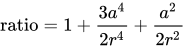
The ratio is
ratio
=
1
+
3
a
4
2
r
4
+
a
2
2
r
2
{\displaystyle {\text{ratio}}=1+{\frac {3a^{4}}{2r^{4}}}+{\frac {a^{2}}{2r^{2}}}}
This ratio is 0.95 when
r
≈
3.5
a
{\displaystyle r\approx 3.5a}
1.75
{\displaystyle 1.75}
φ
=
T
r
2
4
−
T
r
2
cos
(
2
θ
)
4
+
A
ln
(
r
)
+
B
θ
+
C
cos
(
2
θ
)
+
D
r
−
2
cos
(
2
θ
)
{\displaystyle \varphi ={\frac {Tr^{2}}{4}}-{\frac {Tr^{2}\cos(2\theta )}{4}}+A\ln(r)+B\theta +C\cos(2\theta )+Dr^{-2}\cos(2\theta )}
Therefore, the displacement field from the Michell solution is
2
μ
u
r
=
T
4
[
(
κ
−
1
)
r
]
−
T
4
[
−
2
r
cos
(
2
θ
)
]
+
A
[
−
1
r
]
+
C
[
(
κ
+
1
)
r
−
1
cos
(
2
θ
)
]
+
D
[
2
r
−
3
cos
(
2
θ
)
]
2
μ
u
θ
=
−
T
4
[
2
r
sin
(
2
θ
)
]
+
C
[
−
(
κ
−
1
)
r
−
1
sin
(
2
θ
)
]
+
D
[
2
r
−
3
sin
(
2
θ
)
]
{\displaystyle {\begin{aligned}2\mu u_{r}&={\frac {T}{4}}\left[(\kappa -1)r\right]-{\frac {T}{4}}\left[-2r\cos(2\theta )\right]+A\left[-{\frac {1}{r}}\right]+C\left[(\kappa +1)r^{-1}\cos(2\theta )\right]+D\left[2r^{-3}\cos(2\theta )\right]\\2\mu u_{\theta }&=-{\frac {T}{4}}\left[2r\sin(2\theta )\right]+C\left[-(\kappa -1)r^{-1}\sin(2\theta )\right]+D\left[2r^{-3}\sin(2\theta )\right]\end{aligned}}}
From the stress calculation step, we have
A
=
−
T
a
2
2
;
B
=
0
;
C
=
T
a
2
2
;
D
=
−
T
a
4
4
{\displaystyle A=-{\frac {Ta^{2}}{2}}~;~~B=0~;~~C={\frac {Ta^{2}}{2}}~;~~D=-{\frac {Ta^{4}}{4}}}
After substituting the constants and collecting terms,
2
μ
u
r
=
T
r
cos
(
2
θ
)
2
[
1
+
(
κ
+
1
)
a
2
r
2
−
a
4
r
4
]
+
T
r
4
[
(
κ
−
1
)
+
2
a
2
r
2
]
2
μ
u
θ
=
−
T
r
sin
(
2
θ
)
2
[
1
+
(
κ
−
1
)
a
2
r
2
+
a
4
r
4
]
{\displaystyle {\begin{aligned}2\mu u_{r}&={\frac {Tr\cos(2\theta )}{2}}\left[1+(\kappa +1){\frac {a^{2}}{r^{2}}}-{\frac {a^{4}}{r^{4}}}\right]+{\frac {Tr}{4}}\left[(\kappa -1)+2{\frac {a^{2}}{r^{2}}}\right]\\2\mu u_{\theta }&=-{\frac {Tr\sin(2\theta )}{2}}\left[1+(\kappa -1){\frac {a^{2}}{r^{2}}}+{\frac {a^{4}}{r^{4}}}\right]\end{aligned}}}
Replacing
μ
{\displaystyle \mu }
E
2
(
1
+
ν
)
{\displaystyle {\frac {E}{2(1+\nu )}}}
κ
{\displaystyle \kappa }
3
−
ν
1
+
ν
{\displaystyle {\frac {3-\nu }{1+\nu }}}
u
r
=
T
r
cos
(
2
θ
)
2
E
[
(
1
+
ν
)
+
4
a
2
r
2
−
(
1
+
ν
)
a
4
r
4
]
+
T
r
2
E
[
(
1
−
ν
)
+
(
1
+
ν
)
a
2
r
2
]
u
θ
=
−
T
r
sin
(
2
θ
)
2
E
[
(
1
+
ν
)
+
2
(
1
−
ν
)
a
2
r
2
+
(
1
+
ν
)
a
4
r
4
]
{\displaystyle {\begin{aligned}u_{r}&={\frac {Tr\cos(2\theta )}{2E}}\left[(1+\nu )+4{\frac {a^{2}}{r^{2}}}-(1+\nu ){\frac {a^{4}}{r^{4}}}\right]+{\frac {Tr}{2E}}\left[(1-\nu )+(1+\nu ){\frac {a^{2}}{r^{2}}}\right]\\u_{\theta }&=-{\frac {Tr\sin(2\theta )}{2E}}\left[(1+\nu )+2(1-\nu ){\frac {a^{2}}{r^{2}}}+(1+\nu ){\frac {a^{4}}{r^{4}}}\right]\end{aligned}}}
At
r
=
a
{\displaystyle r=a}
u
r
=
T
a
E
[
1
+
2
cos
(
2
θ
)
]
u
θ
=
−
2
T
a
E
sin
(
2
θ
)
{\displaystyle {\begin{aligned}u_{r}&={\frac {Ta}{E}}\left[1+2\cos(2\theta )\right]\\u_{\theta }&=-{\frac {2Ta}{E}}\sin(2\theta )\end{aligned}}}
The deformed shape is shown below:
Deformation of the hole under tension
In cartesian coordinates, the displacement field is given by
u
x
(
r
,
θ
)
=
T
a
8
μ
[
r
a
(
κ
+
1
)
cos
θ
+
2
a
r
(
(
1
+
κ
)
cos
θ
+
cos
3
θ
)
−
2
a
3
r
3
cos
3
θ
]
,
u
y
(
r
,
θ
)
=
T
a
8
μ
[
r
a
(
κ
−
3
)
sin
θ
+
2
a
r
(
(
1
−
κ
)
sin
θ
+
sin
3
θ
)
−
2
a
3
r
3
sin
3
θ
]
{\displaystyle {\begin{aligned}u_{x}(r,\theta )&=&{\frac {Ta}{8\mu }}\left[{\frac {r}{a}}(\kappa +1)\cos \theta +{\frac {2a}{r}}((1+\kappa )\cos \theta +\cos 3\theta )-{\frac {2a^{3}}{r^{3}}}\cos 3\theta \right],\\u_{y}(r,\theta )&=&{\frac {Ta}{8\mu }}\left[{\frac {r}{a}}(\kappa -3)\sin \theta +{\frac {2a}{r}}((1-\kappa )\sin \theta +\sin 3\theta )-{\frac {2a^{3}}{r^{3}}}\sin 3\theta \right]\end{aligned}}}


















![{\displaystyle {\begin{aligned}2\mu u_{r}&={\frac {T}{4}}\left[(\kappa -1)r\right]-{\frac {T}{4}}\left[-2r\cos(2\theta )\right]+A\left[-{\frac {1}{r}}\right]+C\left[(\kappa +1)r^{-1}\cos(2\theta )\right]+D\left[2r^{-3}\cos(2\theta )\right]\\2\mu u_{\theta }&=-{\frac {T}{4}}\left[2r\sin(2\theta )\right]+C\left[-(\kappa -1)r^{-1}\sin(2\theta )\right]+D\left[2r^{-3}\sin(2\theta )\right]\end{aligned}}}](https://wikimedia.org/api/rest_v1/media/math/render/svg/a4235d62c1462d44bd0897863f3cd609478b0902)

![{\displaystyle {\begin{aligned}2\mu u_{r}&={\frac {Tr\cos(2\theta )}{2}}\left[1+(\kappa +1){\frac {a^{2}}{r^{2}}}-{\frac {a^{4}}{r^{4}}}\right]+{\frac {Tr}{4}}\left[(\kappa -1)+2{\frac {a^{2}}{r^{2}}}\right]\\2\mu u_{\theta }&=-{\frac {Tr\sin(2\theta )}{2}}\left[1+(\kappa -1){\frac {a^{2}}{r^{2}}}+{\frac {a^{4}}{r^{4}}}\right]\end{aligned}}}](https://wikimedia.org/api/rest_v1/media/math/render/svg/a705ea96a70034beda80eafbf70d811f121f1a6a)


![{\displaystyle {\begin{aligned}u_{r}&={\frac {Tr\cos(2\theta )}{2E}}\left[(1+\nu )+4{\frac {a^{2}}{r^{2}}}-(1+\nu ){\frac {a^{4}}{r^{4}}}\right]+{\frac {Tr}{2E}}\left[(1-\nu )+(1+\nu ){\frac {a^{2}}{r^{2}}}\right]\\u_{\theta }&=-{\frac {Tr\sin(2\theta )}{2E}}\left[(1+\nu )+2(1-\nu ){\frac {a^{2}}{r^{2}}}+(1+\nu ){\frac {a^{4}}{r^{4}}}\right]\end{aligned}}}](https://wikimedia.org/api/rest_v1/media/math/render/svg/0ffcefecfe0b6fc5bc6c7db9d4b97d630b7fb3a7)
![{\displaystyle {\begin{aligned}u_{r}&={\frac {Ta}{E}}\left[1+2\cos(2\theta )\right]\\u_{\theta }&=-{\frac {2Ta}{E}}\sin(2\theta )\end{aligned}}}](https://wikimedia.org/api/rest_v1/media/math/render/svg/ca4db0a67d3adaa7569e0ea194ab694166a700d7)

![{\displaystyle {\begin{aligned}u_{x}(r,\theta )&=&{\frac {Ta}{8\mu }}\left[{\frac {r}{a}}(\kappa +1)\cos \theta +{\frac {2a}{r}}((1+\kappa )\cos \theta +\cos 3\theta )-{\frac {2a^{3}}{r^{3}}}\cos 3\theta \right],\\u_{y}(r,\theta )&=&{\frac {Ta}{8\mu }}\left[{\frac {r}{a}}(\kappa -3)\sin \theta +{\frac {2a}{r}}((1-\kappa )\sin \theta +\sin 3\theta )-{\frac {2a^{3}}{r^{3}}}\sin 3\theta \right]\end{aligned}}}](https://wikimedia.org/api/rest_v1/media/math/render/svg/3d62f51ddd9d296409abfb77bcf190a34b51ddc9)