Given:
An isotropic material with Young's modulus  and Poisson's ration
  .
.
Find:
The compliance matrix of the material in terms of the Young's modulus and Poisson's ratio.
The strain is related to the stress via the compliance matrix by
the equation
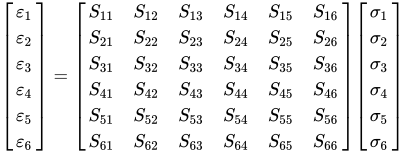
For an isotropic material
![{\displaystyle \varepsilon _{ij}={\frac {1}{E}}\left[(1+\nu )\sigma _{ij}-\nu \sigma _{kk}\delta _{ij}\right]}](https://wikimedia.org/api/rest_v1/media/math/render/svg/e454b334db32ee670a27126821b68f64e05c9f4d)
Therefore,
![{\displaystyle {\begin{aligned}\varepsilon _{11}&={\frac {1}{E}}\left[\sigma _{11}-\nu \sigma _{22}-\nu \sigma _{33}\right]\\\varepsilon _{22}&={\frac {1}{E}}\left[\sigma _{22}-\nu \sigma _{11}-\nu \sigma _{33}\right]\\\varepsilon _{33}&={\frac {1}{E}}\left[\sigma _{33}-\nu \sigma _{11}-\nu \sigma _{22}\right]\\\varepsilon _{23}&={\frac {1}{E}}\left[(1+\nu )\sigma _{23}\right]\\\varepsilon _{31}&={\frac {1}{E}}\left[(1+\nu )\sigma _{31}\right]\\\varepsilon _{12}&={\frac {1}{E}}\left[(1+\nu )\sigma _{12}\right]\end{aligned}}}](https://wikimedia.org/api/rest_v1/media/math/render/svg/fc4c87c8d2923510983dda0e364e7b791d3316d8)
In engineering notation,
![{\displaystyle {\begin{aligned}\varepsilon _{1}&={\frac {1}{E}}\left[\sigma _{1}-\nu \sigma _{2}-\nu \sigma _{3}\right]\\\varepsilon _{2}&={\frac {1}{E}}\left[\sigma _{2}-\nu \sigma _{1}-\nu \sigma _{3}\right]\\\varepsilon _{3}&={\frac {1}{E}}\left[\sigma _{3}-\nu \sigma _{1}-\nu \sigma _{2}\right]\\\varepsilon _{4}&={\frac {1}{E}}\left[2(1+\nu )\sigma _{4}\right]\\\varepsilon _{5}&={\frac {1}{E}}\left[2(1+\nu )\sigma _{5}\right]\\\varepsilon _{6}&={\frac {1}{E}}\left[2(1+\nu )\sigma _{6}\right]\end{aligned}}}](https://wikimedia.org/api/rest_v1/media/math/render/svg/7d5f2f50f39efc4dfab6c537feaea0aa8c253970)
Converting into matrix notation,
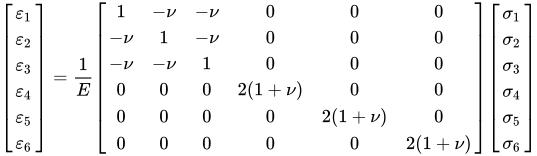
We may also write the above equation as
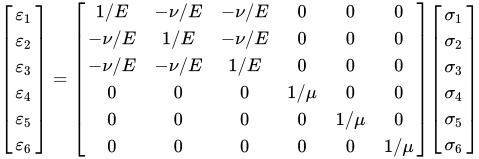
where  is the shear modulus.
