Given:
A long rectangular beam with cross section 
Find:
A solution for the displacement and stress fields, using strong boundary conditions on the edges  and
and
 .
.
[Hint : Assume that the displacement can be expressed as a second degree polynomial (using the Pascal's triangle to determine the terms)  ]
]
Step 1: Boundary conditions
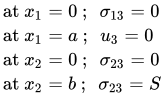
Step 2: Assume a solution
Let us assume antiplane strain

Step 3: Calculate the stresses
The stresses are given by  , and
, and  .
Therefore,
.
Therefore,

Step 4: Satisfy stress BCs
Thus we have,
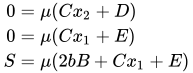
Since  and
and  can be arbitrary,
  .
.
Hence,  which gives us
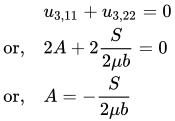
Assume that the body force is zero. Then the equilibrium condition is  . Therefore,
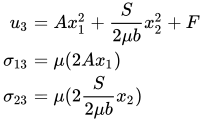
Therefore, the stresses are given by
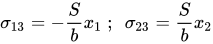
Step 5: Satisfy displacement BCs
The displacement is given by
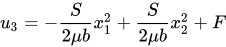
If we substitute  , we cannot determine the constant
  uniquely.
Hence the displacement boundary conditions have to be applied in a weak sense,
![{\displaystyle {\begin{aligned}&\int _{0}^{b}u_{3}(a,x_{2})dx_{2}=0\\{\text{or,}}\quad &\int _{0}^{b}\left(-{\frac {S}{2\mu b}}a^{2}+{\frac {S}{2\mu b}}x_{2}^{2}+F\right)dx_{2}=0\\{\text{or,}}\quad &\left.\left[{\frac {S}{2\mu b}}\left(-a^{2}x_{2}+{\frac {x_{2}^{3}}{3}}\right)+Fx_{2}\right]\right|_{0}^{b}=0\\{\text{or,}}\quad &{\frac {S}{2\mu b}}\left(-a^{2}b+{\frac {b^{3}}{3}}\right)+Fb=0\\{\text{or,}}\quad &{\frac {S}{2\mu }}\left(-a^{2}+{\frac {b^{2}}{3}}\right)+Fb=0\\{\text{or,}}\quad &{\frac {S}{2\mu }}\left(-{\frac {a^{2}}{b}}+{\frac {b}{3}}\right)+F=0\\{\text{or,}}\quad &F={\frac {S}{2\mu b}}\left(a^{2}-{\frac {b^{2}}{3}}\right)\end{aligned}}}](https://wikimedia.org/api/rest_v1/media/math/render/svg/5b6884c02fd5c23402063d88105bd660effd4aad)
Therefore,
