Work and energy
The work done by any force from one location to another is mathematically defined to be:

where F is the component of force parallel to the object's path at that given instant and L is the object's displacement. It follows that a force perpendicular to the path of the object does not do any work, such as the Sun's gravity's pull on Earth. This integral is a line integral along the object's path, and represents the sum of all the dot products of each infinitesimal displacement and the force at that location.
For a constant force acting in one direction, this equation reduces to

A conservative force is one where the work done by it only depends on the starting and ending positions, while a non-conservative force, which comprises the vast majority of everyday forces, does not necessarily do the same work for the same overall displacement.
Energy[edit | edit source]
See the main article, Energy
In this topic we'll use only mechanical energies. There are two kinds of mechanical energies, potential and kinetic. These energies can transform to one to another like all other kinds of energies, but their sum, the total mechanical energy, is constant.
Work-energy principle[edit | edit source]
The work-energy principle states that the work done on an object is equal to the change in its kinetic energy:

Potential energy[edit | edit source]
The potential energy of an object with respect to a conservative force is the work that conservative force could potentially do to it, which would be a change of energy, in accordance with the work-energy principle. Potential energy is a relative concept; we are only concerned with changes in potential energy and not the absolute value of it.
A common example is gravity. The work gravity could potentially do is
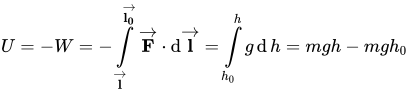
It does not matter what h0 is, as long as gravity can be considered to be a constant, conservative force, and the difference in h is the same.
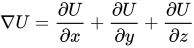
In multiple dimensions, it follows from the gradient theorem that where .

Kinetic energy[edit | edit source]
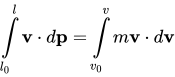
The kinetic energy of an object is the total work that has been done to the object to place it in motion. By the work-energy principle, and Newton's second law:

In classical mechanics, and , so we have:
, and because :



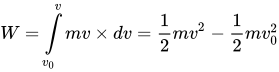
For the total kinetic energy l0=0, and v0=0, so classically,

Total mechanical energy[edit | edit source]
The total mechanical energy of a system, in the absence of external forces, will always be constant. It is the sum of an object's kinetic and potential energies:
