Let us now consider the particular case shown in Figure 2.
The medium consists of three layers. Regions 1 and 3 are isotropic while
the sandwiched region 2 is multilayered. The interface between regions 1 and
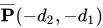
2 is located at while the interface between regions 2 and 3 is located
at . Let the propagator matrix of region 2 be . We
want to find the reflection coefficient and the transmission coefficient of
the system.
Figure 2. A multilayered medium sandwiched between two layers.
In reqion 1, the state vector is given by (see equation (3))
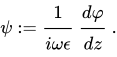
Define
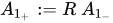
where is like a scalar reflection coefficient. Then
Proceeding as we did in the previous lecture, let us define matrices
Then equation (5) can be written as
In region 3, there is only a transmitted wave. Therefore, the state
vector is given by
Define
where is a factor that acts like a scalar transmission coefficient. Then,
equation (7) can be written in matrix form as
where
Since we have the propagator matrix for region 2, , we
can use it to connect regions 1 and 3. The continuity of the state vector
across the interfaces implies that
Also, using equation (4) we have
Therefore, using equations (9), we can write (10) as
From (6), at , we have
Also, from (8), at , we have
Plugging into (11) gives
or
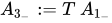
Equation (14) can then be solved to find the reflection and
transmission coefficients and .
Extension to waves in anisotropic layered media[edit | edit source]
In a layer medium where each of the layers is isotropic, the TE and TM
waves are uncoupled at the interface. However, this is not true when
each of the layers is anisotropic and we have to consider the full
Maxwell's equations. The state vector approach can still be used for
anisotropic media by choosing the variables such that they are
continuous across interfaces.
Let us start with Maxwell's equations
Recall that continuity of the fields requires that the tangential components
of and be continuous across material interfaces. Therefore,
an appropriate state vector for anisotropic media is
where and are the tangential components of and
(i.e., the components on the surface normal to the direction).
Let us decompose the vector fields into a sum of the normal and tangential
components:
The gradient operator can also be split along the same lines, i.e.,
where are the unit vectors in the directions,
respectively. Let us express the tensors and in matrix
form (with respect to the basis ) as
where are matrices,
are matrices,
are matrices, and
are matrices, i.e., scalars.
Using the splits of the various quantities and the gradient operator, we
can show ({\Red work this out}) that can be expressed in
terms of as
After some further manipulations, the Maxwell equations may be expressed
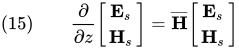
in matrix form as (see ~Chew95 for details)
where is a matrix.
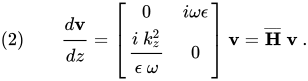
If you compare equation (15) with (2), you will
see that the form of the equations is the same, except that instead of a
matrix for the isotropic case, we now have a
matrix.
Plane wave expansion of sources in a homogeneous medium[edit | edit source]
It is often useful to expand sources in terms of plane waves so that
the results of the previous lectures may be used directly on the basis
of superposition. In this section we look at the expansion of point
sources in terms of plane waves (for a homogeneous medium).
Let us look at the two-dimensional scalar wave equation (which can be used
for acoustics, TE and TM waves, antiplane elasticity, etc.) In the presence
of a point source, the wave equation has the form
Assume that has a small positive
imaginary part (it is a slightly lossy material), i.e.,
Expressed in cylindrical coordinates, equation (16)
becomes (since the equation is symmetric about the origin)
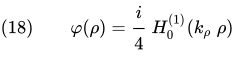
The solution of (17) is
where is a Hankel function of the first kind.
\footnote{
Recall that a Hankel function of the first kind is defined as
where is a Bessel function of the first kind and is a
Bessel function of the second kind.
}
We can also solve (16) using Fourier transforms.
Let us assume that the function has a Fourier transform, i.e.,
Also note that
Plugging (19) and (20) into
(16) gives
or,
Since the above equation holds for all values of , the Fourier components
must agree, i.e.,
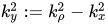
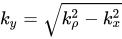
Defining
we get
Note that now the equation has a source only at . Away from the
source (i.e., ), the right hand side of (21) is
zero, and the solution corresponds to the homogeneous part of the
equation. Therefore,
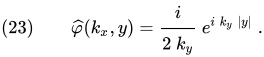
This solution must be matched with the singularity at . This
can be achieved by requiring that the solution have discontinuous second
derivatives at . We then have ({\Red full explanation is needed
here}), considering only waves that are damping away from the source rather
that those growing exponentially,
Plugging (23) into (19) gives
Equation (24) is a plane wave solution for the wave equation
with a point source. So the point source has been converted into a sum of
propagating plane waves and some evanescent terms.
Note that the denominator in (24) contains
. Hence, when the solution
blows up. Hence there are branch points at these locations as
shown in Figure 3. In a lossless medium,
and these points appear as pole on the
real axis. The integral in equation (24) can then be
computed using the residual theorem. The region between the two poles
is where waves are allowed to propagate in the direction while the
region outside the poles is where these waves are evanescent.
Figure 3. Poles and integration path for plane wave solutions corresponding to a point source.
If we now compare the solutions (18) and (24), we
have
which provides a definition for the Hankel function.
Also, differentiating (16) with respect to and ,
we get
Note that the products and
correspond to dipole sources in the
and directions, respectively.
Define
Therefore, from (24), we have
These are the plane wave expansions of dipoles in the and directions
respectively. Taking higher derivatives gives results from quadrupoles and
other multipoles.
![{\displaystyle {\text{(1)}}\qquad \left[\epsilon (z)~{\cfrac {d}{dz}}\left(\epsilon (z)^{-1}~{\cfrac {d}{dz}}\right)+k_{z}^{2}\right]~\varphi =0}](https://wikimedia.org/api/rest_v1/media/math/render/svg/676bb554e670a12a0886a388cde9c2fc4d7ecb22)













































![{\displaystyle {\text{(16)}}\qquad \left[{\frac {\partial ^{2}}{\partial x^{2}}}+{\frac {\partial ^{2}}{\partial y^{2}}}+k_{\rho }^{2}\right]~\varphi (x,y)=-\delta (x)~\delta (y)~.}](https://wikimedia.org/api/rest_v1/media/math/render/svg/cfc6dde46757776a716d93b7840770b0bc60ce55)


![{\displaystyle {\text{(17)}}\qquad \left[{\frac {\partial ^{2}}{\partial \rho ^{2}}}+{\cfrac {1}{\rho }}~{\frac {\partial ^{2}}{\partial \rho ^{2}}}+k_{\rho }^{2}\right]~\varphi (\rho )=-\delta (\rho )~;~~\rho ={\sqrt {x^{2}+y^{2}}}~.}](https://wikimedia.org/api/rest_v1/media/math/render/svg/78e8ee2020e5e463869bd9bb3f30dceac0633b4b)






![{\displaystyle {\cfrac {1}{2\pi }}\int _{-\infty }^{\infty }\left[{\frac {\partial ^{2}}{\partial x^{2}}}+{\frac {\partial ^{2}}{\partial y^{2}}}+k_{\rho }^{2}\right]~\left[{\widehat {\varphi }}(k_{x},y)~e^{i~k_{x}~x}\right]~{\text{d}}k_{x}=-{\cfrac {1}{2\pi }}\int _{-\infty }^{\infty }\delta (y)~e^{i~k_{x}~x}~{\text{d}}k_{x}}](https://wikimedia.org/api/rest_v1/media/math/render/svg/e09f3bea5b6e681e610d6d931c818f2bf6469985)
![{\displaystyle \int _{-\infty }^{\infty }\left[-k_{x}^{2}+{\frac {\partial ^{2}}{\partial y^{2}}}+k_{\rho }^{2}\right]~{\widehat {\varphi }}(k_{x},y)~e^{i~k_{x}~x}~{\text{d}}k_{x}=-\int _{-\infty }^{\infty }\delta (y)~e^{i~k_{x}~x}~{\text{d}}k_{x}~.}](https://wikimedia.org/api/rest_v1/media/math/render/svg/667742917d8de9f0eddbb5b0714d653d214df26b)

![{\displaystyle \left[{\frac {\partial ^{2}}{\partial y^{2}}}+k_{\rho }^{2}-k_{x}^{2}\right]~{\widehat {\varphi }}(k_{x},y)=-\delta (y)~.}](https://wikimedia.org/api/rest_v1/media/math/render/svg/cf8292a6975d543ba379fe5e7efb71d5130c5613)
![{\displaystyle {\text{(21)}}\qquad {\left[{\frac {\partial ^{2}}{\partial y^{2}}}+k_{y}^{2}\right]~{\widehat {\varphi }}(k_{x},y)=-\delta (y)~.}}](https://wikimedia.org/api/rest_v1/media/math/render/svg/5b7caa88270254c071be1708032bb8836fcd40eb)







![{\displaystyle \left[{\frac {\partial ^{2}}{\partial x^{2}}}+{\frac {\partial ^{2}}{\partial y^{2}}}+k_{\rho }^{2}\right]~{\frac {\partial \varphi (x,y)}{\partial y}}=-\delta (x)~{\frac {\partial \delta (y)}{\partial y}}\qquad {\text{and}}\qquad \left[{\frac {\partial ^{2}}{\partial x^{2}}}+{\frac {\partial ^{2}}{\partial y^{2}}}+k_{\rho }^{2}\right]~{\frac {\partial \varphi (x,y)}{\partial x}}=-\delta (y)~{\frac {\partial \delta (x)}{\partial x}}}](https://wikimedia.org/api/rest_v1/media/math/render/svg/11c331b33ac0328f98725872a221db08fc1304d5)



