Recall the sphere shown in Figure 1. We set up our
coordinate system such that the origin is at the center of the sphere. The
sphere has a magnetic permeability of and a permittivity .
The medium outside the sphere has a permittivity and a
permeability . The electric field is oriented parallel to the
axis and the axis points out of the plane of the paper.
Figure 1. Scattering of radiation from a sphere.
Also recall that
where is the relative permittivity of the material inside
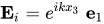
the sphere and that the incident plane wave is given by
where is the unit vector in the direction.
The most widely used superpotentials are the electric and magnetic
Hertz vector potentials and (also known as
polarization potentials).
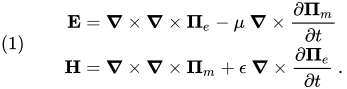
In the last lecture we discussed the Hertz vector potentials and that
the and fields can be expressed as
For spherically symmetric time harmonic problems, such as we find in the
problem of scattering of EM waves by a sphere, we stated that an important
class of Hertz vector potentials are the Debye potentials of the form
Let the time harmonic fields be given by
Plugging these into (1) and dropping the hats gives
the Maxwell equations at fixed frequency:
Recall that the Debye potentials satisfy the homogeneous wave equations
To deal with the problem of scattering by a sphere, let us split the
potentials and (outside the sphere) into incident and scattered
fields:[1]
where the subscript indicates an incident field and the subscript
indicates a scattered field.
Inside the sphere, the potentials are denoted by
where the subscript indicates a refracted + reflected field.
Let us require that these potentials satisfy wave equations
of the form given in (2), i.e.,
Since each of these satisfies a scalar wave equation, we can express each
potential in terms of spherical harmonics.
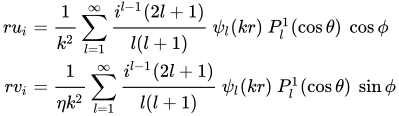
In particular, the Debye potentials associated with the incident field
have the expression
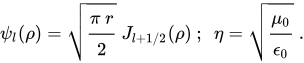
where
Here are the Legendre polynomials which solve
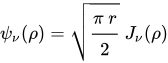
and are the Bessel functions which solve
The functions are chosen such that
is regular at the origin.
The scattered fields have a similar expansion
where
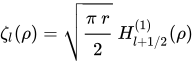
and is one of the Hankel functions solving the same
equation as the Bessel function but decaying at infinity.
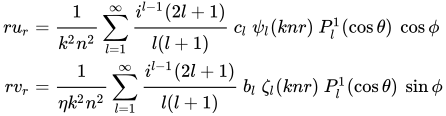
Inside the sphere, the expansion of the fields takes the form
To find the constants we need to apply continuity
conditions across the boundary of the sphere.
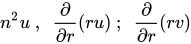
To ensure that (tangential components
of and ) are continuous across the surface of the sphere at
, it is sufficient that
are continuous.
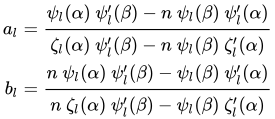
Applying these conditions, we get
where
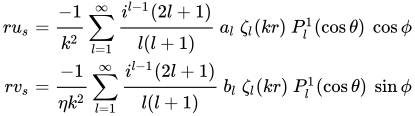
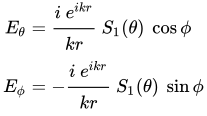
The scattered field , far from the sphere are given by
where
where
Note that the tangential components of fall off as while
the radial component falls off as .
The following discussion is based on Ashcroft76 (p. 133-139). For a
more detailed mathematical treatment see Kuchment93.
Suppose that the medium is such that the permittivity and
the permeability are periodic. Recall that, at fixed
frequency, the Maxwell equations are
Also recall the constitutive relations
Plugging (4) into (3), we get
Equations (5) suggest that we should look for solutions
and in the space of divergence-free fields such that
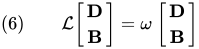
where the operator is given by
Since and are periodic, the operator has the
same periodicity as the medium.
Clearly, equation (6) represents an eigenvalue problem
where is an eigenvalue of and is the
corresponding eigenvector.
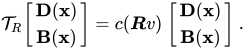
Let define a translation operator which, when acting upon a pair
of the fields shifts the argument by a vector , where
is taken to be a lattice vector (see Figure~2), i.e.,
Figure 2. Lattice vector in a periodic medium.
Periodicity of the medium implies that commutes with , i.e.,
Note that , like , maps divergence-free fields to
divergence-free fields.
Now, consider the space of field pairs which are divergence-free
and which are in the null space of , i.e., they
satisfy
This subspace is closed under the action of which is unitary, i.e.,
Also, the translation operator commutes, i.e.,
Therefore, any solution can be expressed in fields which are simultaneously
eigenstates of all the . These eigenstates have the property
The Bloch condition will be discussed in the next lecture.
















![{\displaystyle {\cfrac {d}{dx}}\left[(1-x^{2})~{\cfrac {dP_{l}^{1}}{dx}}\right]+\left[l(l+1)-{\cfrac {1}{1-x^{2}}}\right]~P_{l}^{1}=0}](https://wikimedia.org/api/rest_v1/media/math/render/svg/943e4bfd4e0c873ca3286e2429b223bf089402bc)

![{\displaystyle {\cfrac {d^{2}J_{\nu }}{d\rho ^{2}}}+{\cfrac {1}{\rho }}~{\cfrac {dJ_{\nu }}{d\rho }}+\left[1-{\cfrac {\nu ^{2}}{\rho ^{2}}}\right]~J_{\nu }=0~.}](https://wikimedia.org/api/rest_v1/media/math/render/svg/2e5cb1218980ddca5091433146e56a13f8698529)








![{\displaystyle {\begin{aligned}S_{1}(\theta )&=\sum _{l=1}^{\infty }{\cfrac {2l+1}{l(l+1)}}\left[a_{l}~\pi _{l}(\cos \theta )+b_{l}~\tau _{l}(\cos \theta )\right]\\S_{2}(\theta )&=\sum _{l=1}^{\infty }{\cfrac {2l+1}{l(l+1)}}\left[a_{l}~\tau _{l}(\cos \theta )+b_{l}~\pi _{l}(\cos \theta )\right]\end{aligned}}}](https://wikimedia.org/api/rest_v1/media/math/render/svg/6e8d2763a911e24b43ada04f3f154896a24842da)











![{\displaystyle [\mathbf {D} ,\mathbf {B} ]}](https://wikimedia.org/api/rest_v1/media/math/render/svg/d57b2f1fd627d21b1b571b4d2b4c91a2da103e74)