The content of these notes is based on the lectures by Prof. Graeme W. Milton (University of Utah) given in a course on metamaterials in Spring 2007.
In the previous lecture we found that, for rank-1 laminates, the effective permittivity can be calculated using the formula of Tartar-Murat-Lurie-Cherkaev. In this lecture we extend the ideas used to arrive at that formula to hierarchical laminates.
[1]
An example of a hierarchical laminate is shown in Figure 1. The idea of such materials goes back to Maxwell. In the rank-2 laminate shown in the figure there are two length scales which are assumed to be sufficiently separated so that the ideas in the previous lecture can be exploited. There has to be a separation of length scales so that the layer material can be replaced by its effective tensor.
Figure 1. A rank-2 hierarchical laminate.
Recall the Tartar-Murat-Lurie-Cherkaev formula for the effective permittivity of a rank-1 laminate:
f
1
[
ϵ
2
1
−
ϵ
eff
]
−
1
=
[
ϵ
2
1
−
ϵ
1
]
−
1
−
f
2
ϵ
2
Γ
1
(
n
)
.
{\displaystyle f_{1}~[\epsilon _{2}~{\boldsymbol {\mathit {1}}}-{\boldsymbol {\epsilon }}_{\text{eff}}]^{-1}=[\epsilon _{2}~{\boldsymbol {\mathit {1}}}-{\boldsymbol {\epsilon }}_{1}]^{-1}-{\cfrac {f_{2}}{\epsilon _{2}}}~{\boldsymbol {\mathit {\Gamma }}}_{1}(\mathbf {n} )~.}
By iterating this formula one gets, for a rank-
m
{\displaystyle m}
(1)
f
1
[
ϵ
2
1
−
ϵ
eff
]
−
1
=
[
ϵ
2
1
−
ϵ
1
]
−
1
−
f
2
ϵ
2
M
{\displaystyle {\text{(1)}}\qquad f_{1}~[\epsilon _{2}~{\boldsymbol {\mathit {1}}}-{\boldsymbol {\epsilon }}_{\text{eff}}]^{-1}=[\epsilon _{2}~{\boldsymbol {\mathit {1}}}-{\boldsymbol {\epsilon }}_{1}]^{-1}-{\cfrac {f_{2}}{\epsilon _{2}}}~{\boldsymbol {M}}}
where
M
:=
∑
j
=
1
m
c
j
Γ
1
(
n
j
)
;
c
j
=
f
(
j
−
1
)
−
f
(
j
)
1
−
f
1
≥
0
{\displaystyle {\boldsymbol {M}}:=\sum _{j=1}^{m}c_{j}~{\boldsymbol {\mathit {\Gamma }}}_{1}(\mathbf {n} _{j})~;~~c_{j}={\cfrac {f^{(j-1)}-f^{(j)}}{1-f_{1}}}\geq 0}
and
m
{\displaystyle m}
f
(
j
)
{\displaystyle f^{(j)}}
1
{\displaystyle 1}
j
{\displaystyle j}
n
j
{\displaystyle \mathbf {n} _{j}}
j
{\displaystyle j}
In particular,
f
(
m
)
=
f
1
;
f
(
0
)
=
1
⟹
f
(
j
−
1
)
>
f
(
j
)
.
{\displaystyle f^{(m)}=f_{1}~;~f^{(0)}=1\qquad \implies \qquad f^{(j-1)}>f^{(j)}~.}
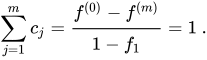
Then,
∑
j
=
1
m
c
j
=
f
(
0
)
−
f
(
m
)
1
−
f
1
=
1
.
{\displaystyle \sum _{j=1}^{m}c_{j}={\cfrac {f^{(0)}-f^{(m)}}{1-f_{1}}}=1~.}
For a rank-3 laminate, if the normals
n
1
{\displaystyle \mathbf {n} _{1}}
n
2
{\displaystyle \mathbf {n} _{2}}
n
3
{\displaystyle \mathbf {n} _{3}}
M
=
c
1
n
1
⊗
n
1
+
c
2
n
2
⊗
n
2
+
c
3
n
3
⊗
n
3
.
{\displaystyle {\boldsymbol {M}}=c_{1}~\mathbf {n} _{1}\otimes \mathbf {n} _{1}+c_{2}~\mathbf {n} _{2}\otimes \mathbf {n} _{2}+c_{3}~\mathbf {n} _{3}\otimes \mathbf {n} _{3}~.}
If we choose the
f
(
j
)
{\displaystyle f^{(j)}}
c
1
=
c
2
=
c
3
=
1
3
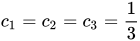
{\displaystyle c_{1}=c_{2}=c_{3}={\frac {1}{3}}}
then
M
=
1
3
(
n
1
⊗
n
1
+
n
2
⊗
n
2
+
n
3
⊗
n
3
)
=
1
.
{\displaystyle {\boldsymbol {M}}={\frac {1}{3}}~(\mathbf {n} _{1}\otimes \mathbf {n} _{1}+\mathbf {n} _{2}\otimes \mathbf {n} _{2}+\mathbf {n} _{3}\otimes \mathbf {n} _{3})={\boldsymbol {\mathit {1}}}~.}
In this case, equation (1) coincides with the solution for the Hashin sphere assemblage!
This implies that different geometries can have the same
ϵ
eff
(
ϵ
2
,
ϵ
1
)
{\displaystyle {\boldsymbol {\epsilon }}_{\text{eff}}(\epsilon _{2},{\boldsymbol {\epsilon }}_{1})}
Is there a formula as simple as the Tartar-Murat-Lurie-Cherkaev formula when ε1 and ε2 are both anisotropic? [ edit | edit source ] The answer is yes.
In this case we use an anisotropic reference material
ϵ
0
{\displaystyle {\boldsymbol {\epsilon }}_{0}}
(2)
P
(
x
)
:=
[
ϵ
(
x
)
−
ϵ
0
]
⋅
E
(
x
)
=
D
(
x
)
−
ϵ
0
⋅
E
(
x
)
.
{\displaystyle {\text{(2)}}\qquad \mathbf {P} (\mathbf {x} ):=[{\boldsymbol {\epsilon }}(\mathbf {x} )-{\boldsymbol {\epsilon }}_{0}]\cdot \mathbf {E} (\mathbf {x} )=\mathbf {D} (\mathbf {x} )-{\boldsymbol {\epsilon }}_{0}\cdot \mathbf {E} (\mathbf {x} )~.}
The volume average of this field is given by
⟨
P
⟩
:=
⟨
ϵ
⋅
E
⟩
−
ϵ
0
⋅
⟨
E
⟩
=
⟨
D
⟩
−
ϵ
0
⋅
⟨
E
⟩
.
{\displaystyle \langle \mathbf {P} \rangle :=\langle {\boldsymbol {\epsilon }}\cdot \mathbf {E} \rangle -{\boldsymbol {\epsilon }}_{0}\cdot \langle \mathbf {E} \rangle =\langle \mathbf {D} \rangle -{\boldsymbol {\epsilon }}_{0}\cdot \langle \mathbf {E} \rangle ~.}
Therefore, the difference between the field and its volume average is
(3)
P
(
x
)
−
⟨
P
⟩
=
[
D
(
x
)
−
⟨
D
⟩
]
−
ϵ
0
⋅
[
E
(
x
)
−
⟨
E
⟩
]
.
{\displaystyle {\text{(3)}}\qquad \mathbf {P} (\mathbf {x} )-\langle \mathbf {P} \rangle =[\mathbf {D} (\mathbf {x} )-\langle \mathbf {D} \rangle ]-{\boldsymbol {\epsilon }}_{0}\cdot [\mathbf {E} (\mathbf {x} )-\langle \mathbf {E} \rangle ]~.}
Let us introduce a new matrix
Γ
(
n
)
{\displaystyle {\boldsymbol {\mathit {\Gamma }}}(\mathbf {n} )}
a
{\displaystyle \mathbf {a} }
(4)
b
=
Γ
(
n
)
⋅
a
if and only if
{
Γ
1
(
n
)
⋅
b
=
b
Γ
1
(
n
)
⋅
(
a
−
ϵ
0
⋅
b
)
=
0
{\displaystyle {\text{(4)}}\qquad \mathbf {b} ={\boldsymbol {\mathit {\Gamma }}}(\mathbf {n} )\cdot \mathbf {a} \qquad {\text{if and only if}}\qquad {\begin{cases}{\boldsymbol {\mathit {\Gamma }}}_{1}(\mathbf {n} )\cdot \mathbf {b} =\mathbf {b} \\{\boldsymbol {\mathit {\Gamma }}}_{1}(\mathbf {n} )\cdot (\mathbf {a} -{\boldsymbol {\epsilon }}_{0}\cdot \mathbf {b} )={\boldsymbol {0}}\\\end{cases}}}
where
Γ
1
(
n
)
=
n
⊗
n
{\displaystyle {\boldsymbol {\mathit {\Gamma }}}_{1}(\mathbf {n} )=\mathbf {n} \otimes \mathbf {n} }
n
{\displaystyle \mathbf {n} }
Γ
1
(
n
)
⋅
b
=
b
⟹
α
n
=
b
{\displaystyle {\boldsymbol {\mathit {\Gamma }}}_{1}(\mathbf {n} )\cdot \mathbf {b} =\mathbf {b} \qquad \implies \qquad \alpha ~\mathbf {n} =\mathbf {b} }
where
α
=
b
⋅
n
{\displaystyle \alpha =\mathbf {b} \cdot \mathbf {n} }
Γ
1
(
n
)
⋅
(
a
−
ϵ
0
⋅
b
)
=
0
⟹
a
⋅
n
−
α
(
n
⋅
ϵ
0
⋅
n
)
=
0
.
{\displaystyle {\boldsymbol {\mathit {\Gamma }}}_{1}(\mathbf {n} )\cdot (\mathbf {a} -{\boldsymbol {\epsilon }}_{0}\cdot \mathbf {b} )={\boldsymbol {0}}\qquad \implies \qquad \mathbf {a} \cdot \mathbf {n} -\alpha ~(\mathbf {n} \cdot {\boldsymbol {\epsilon }}_{0}\cdot \mathbf {n} )=0~.}
Therefore,
α
=
a
⋅
n
n
⋅
ϵ
0
⋅
n
and
b
=
(
a
⋅
n
n
⋅
ϵ
0
⋅
n
)
n
=
(
n
⊗
n
)
⋅
a
n
⋅
ϵ
0
⋅
n
=
Γ
1
(
n
)
⋅
a
n
⋅
ϵ
0
⋅
n
.
{\displaystyle \alpha ={\cfrac {\mathbf {a} \cdot \mathbf {n} }{\mathbf {n} \cdot {\boldsymbol {\epsilon }}_{0}\cdot \mathbf {n} }}\qquad {\text{and}}\qquad \mathbf {b} =\left({\cfrac {\mathbf {a} \cdot \mathbf {n} }{\mathbf {n} \cdot {\boldsymbol {\epsilon }}_{0}\cdot \mathbf {n} }}\right)~\mathbf {n} ={\cfrac {(\mathbf {n} \otimes \mathbf {n} )\cdot \mathbf {a} }{\mathbf {n} \cdot {\boldsymbol {\epsilon }}_{0}\cdot \mathbf {n} }}={\cfrac {{\boldsymbol {\mathit {\Gamma }}}_{1}(\mathbf {n} )\cdot \mathbf {a} }{\mathbf {n} \cdot {\boldsymbol {\epsilon }}_{0}\cdot \mathbf {n} }}~.}
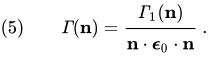
From the definition of
Γ
(
n
)
{\displaystyle {\boldsymbol {\mathit {\Gamma }}}(\mathbf {n} )}
(5)
Γ
(
n
)
=
Γ
1
(
n
)
n
⋅
ϵ
0
⋅
n
.
{\displaystyle {\text{(5)}}\qquad {\boldsymbol {\mathit {\Gamma }}}(\mathbf {n} )={\cfrac {{\boldsymbol {\mathit {\Gamma }}}_{1}(\mathbf {n} )}{\mathbf {n} \cdot {\boldsymbol {\epsilon }}_{0}\cdot \mathbf {n} }}~.}
Taking the projection of both sides of equation (3) we get
Γ
1
(
n
)
⋅
[
P
(
x
)
−
⟨
P
⟩
]
=
Γ
1
(
n
)
⋅
[
D
(
x
)
−
⟨
D
⟩
]
−
Γ
1
(
n
)
⋅
{
ϵ
0
⋅
[
E
(
x
)
−
⟨
E
⟩
]
}
.
{\displaystyle {\boldsymbol {\mathit {\Gamma }}}_{1}(\mathbf {n} )\cdot [\mathbf {P} (\mathbf {x} )-\langle \mathbf {P} \rangle ]={\boldsymbol {\mathit {\Gamma }}}_{1}(\mathbf {n} )\cdot [\mathbf {D} (\mathbf {x} )-\langle \mathbf {D} \rangle ]-{\boldsymbol {\mathit {\Gamma }}}_{1}(\mathbf {n} )\cdot \{{\boldsymbol {\epsilon }}_{0}\cdot [\mathbf {E} (\mathbf {x} )-\langle \mathbf {E} \rangle ]\}~.}
Now continuity of the normal component of
D
{\displaystyle \mathbf {D} }
D
{\displaystyle \mathbf {D} }
Γ
1
(
n
)
⋅
[
D
(
x
)
−
⟨
D
⟩
]
=
[
n
⋅
D
(
x
)
−
n
⋅
⟨
D
⟩
]
n
=
0
.
{\displaystyle {\boldsymbol {\mathit {\Gamma }}}_{1}(\mathbf {n} )\cdot [\mathbf {D} (\mathbf {x} )-\langle \mathbf {D} \rangle ]=[\mathbf {n} \cdot \mathbf {D} (\mathbf {x} )-\mathbf {n} \cdot \langle \mathbf {D} \rangle ]~\mathbf {n} ={\boldsymbol {0}}~.}
Hence we have,
(6)
Γ
1
(
n
)
⋅
{
P
(
x
)
−
⟨
P
⟩
+
ϵ
0
⋅
[
E
(
x
)
−
⟨
E
⟩
]
}
=
0
.
{\displaystyle {\text{(6)}}\qquad {\boldsymbol {\mathit {\Gamma }}}_{1}(\mathbf {n} )\cdot \left\{\mathbf {P} (\mathbf {x} )-\langle \mathbf {P} \rangle +{\boldsymbol {\epsilon }}_{0}\cdot [\mathbf {E} (\mathbf {x} )-\langle \mathbf {E} \rangle ]\right\}={\boldsymbol {0}}~.}
Recall from the previous lecture that
(7)
Γ
1
(
n
)
⋅
E
(
x
)
=
E
(
x
)
−
⟨
E
⟩
+
Γ
1
(
n
)
⋅
⟨
E
⟩
⟹
Γ
1
(
n
)
⋅
[
E
(
x
)
−
⟨
E
⟩
]
=
E
(
x
)
−
⟨
E
⟩
.
{\displaystyle {\text{(7)}}\qquad {\boldsymbol {\mathit {\Gamma }}}_{1}(\mathbf {n} )\cdot \mathbf {E} (\mathbf {x} )=\mathbf {E} (\mathbf {x} )-\langle \mathbf {E} \rangle +{\boldsymbol {\mathit {\Gamma }}}_{1}(\mathbf {n} )\cdot \langle \mathbf {E} \rangle \quad \implies \quad {\boldsymbol {\mathit {\Gamma }}}_{1}(\mathbf {n} )\cdot [\mathbf {E} (\mathbf {x} )-\langle \mathbf {E} \rangle ]=\mathbf {E} (\mathbf {x} )-\langle \mathbf {E} \rangle ~.}
Since the conditions in (4) are satisfied with
a
:=
P
(
x
)
−
⟨
P
⟩
and
b
:=
−
[
E
(
x
)
−
⟨
E
⟩
]
{\displaystyle \mathbf {a} :=\mathbf {P} (\mathbf {x} )-\langle \mathbf {P} \rangle \quad {\text{and}}\quad \mathbf {b} :=-[\mathbf {E} (\mathbf {x} )-\langle \mathbf {E} \rangle ]}
from the definition of
Γ
{\displaystyle {\boldsymbol {\mathit {\Gamma }}}}
(8)
−
[
E
(
x
)
−
⟨
E
⟩
]
=
Γ
(
n
)
⋅
[
P
(
x
)
−
⟨
P
⟩
]
.
{\displaystyle {\text{(8)}}\qquad -[\mathbf {E} (\mathbf {x} )-\langle \mathbf {E} \rangle ]={\boldsymbol {\mathit {\Gamma }}}(\mathbf {n} )\cdot [\mathbf {P} (\mathbf {x} )-\langle \mathbf {P} \rangle ]~.}
Now, from equation (2) we have
E
(
x
)
=
[
ϵ
(
x
)
−
ϵ
0
]
−
1
⋅
P
(
x
)
.
{\displaystyle \mathbf {E} (\mathbf {x} )=[{\boldsymbol {\epsilon }}(\mathbf {x} )-{\boldsymbol {\epsilon }}_{0}]^{-1}\cdot \mathbf {P} (\mathbf {x} )~.}
Plugging this into (8) gives
−
[
ϵ
(
x
)
−
ϵ
0
]
−
1
⋅
P
(
x
)
+
⟨
E
⟩
=
Γ
(
n
)
⋅
[
P
(
x
)
−
⟨
P
⟩
]
{\displaystyle -[{\boldsymbol {\epsilon }}(\mathbf {x} )-{\boldsymbol {\epsilon }}_{0}]^{-1}\cdot \mathbf {P} (\mathbf {x} )+\langle \mathbf {E} \rangle ={\boldsymbol {\mathit {\Gamma }}}(\mathbf {n} )\cdot [\mathbf {P} (\mathbf {x} )-\langle \mathbf {P} \rangle ]}
or,
{
[
ϵ
(
x
)
−
ϵ
0
]
−
1
+
Γ
(
n
)
}
⋅
P
(
x
)
=
⟨
E
⟩
+
Γ
(
n
)
⋅
⟨
P
⟩
.
{\displaystyle \{[{\boldsymbol {\epsilon }}(\mathbf {x} )-{\boldsymbol {\epsilon }}_{0}]^{-1}+{\boldsymbol {\mathit {\Gamma }}}(\mathbf {n} )\}\cdot \mathbf {P} (\mathbf {x} )=\langle \mathbf {E} \rangle +{\boldsymbol {\mathit {\Gamma }}}(\mathbf {n} )\cdot \langle \mathbf {P} \rangle ~.}
Define
V
:=
⟨
E
⟩
+
Γ
(
n
)
⋅
⟨
P
⟩
{\displaystyle \mathbf {V} :=\langle \mathbf {E} \rangle +{\boldsymbol {\mathit {\Gamma }}}(\mathbf {n} )\cdot \langle \mathbf {P} \rangle }
and note that this quantity is constant throughout the laminate. Therefore we can write
{
[
ϵ
(
x
)
−
ϵ
0
]
−
1
+
Γ
(
n
)
}
⋅
P
(
x
)
=
V
{\displaystyle \{[{\boldsymbol {\epsilon }}(\mathbf {x} )-{\boldsymbol {\epsilon }}_{0}]^{-1}+{\boldsymbol {\mathit {\Gamma }}}(\mathbf {n} )\}\cdot \mathbf {P} (\mathbf {x} )=\mathbf {V} }
or
P
(
x
)
=
{
[
ϵ
(
x
)
−
ϵ
0
]
−
1
+
Γ
(
n
)
}
−
1
⋅
V
.
{\displaystyle \mathbf {P} (\mathbf {x} )=\{[{\boldsymbol {\epsilon }}(\mathbf {x} )-{\boldsymbol {\epsilon }}_{0}]^{-1}+{\boldsymbol {\mathit {\Gamma }}}(\mathbf {n} )\}^{-1}\cdot \mathbf {V} ~.}
If we now take a volume average, we get
(9)
⟨
P
⟩
=
⟨
{
[
ϵ
(
x
)
−
ϵ
0
]
−
1
+
Γ
(
n
)
}
−
1
⟩
⋅
V
.
{\displaystyle {\text{(9)}}\qquad \langle \mathbf {P} \rangle =\langle \{[{\boldsymbol {\epsilon }}(\mathbf {x} )-{\boldsymbol {\epsilon }}_{0}]^{-1}+{\boldsymbol {\mathit {\Gamma }}}(\mathbf {n} )\}^{-1}\rangle \cdot \mathbf {V} ~.}
Also, from the definition of
P
(
x
)
{\displaystyle \mathbf {P} (\mathbf {x} )}
⟨
P
⟩
=
[
ϵ
eff
−
ϵ
0
]
⋅
⟨
E
⟩
⟹
⟨
E
⟩
=
[
ϵ
eff
−
ϵ
0
]
−
1
⋅
⟨
P
⟩
.
{\displaystyle \langle \mathbf {P} \rangle =[{\boldsymbol {\epsilon }}_{\text{eff}}-{\boldsymbol {\epsilon }}_{0}]\cdot \langle \mathbf {E} \rangle \qquad \implies \qquad \langle \mathbf {E} \rangle =[{\boldsymbol {\epsilon }}_{\text{eff}}-{\boldsymbol {\epsilon }}_{0}]^{-1}\cdot \langle \mathbf {P} \rangle ~.}
Therefore,
V
=
{
[
ϵ
eff
−
ϵ
0
]
−
1
+
Γ
(
n
)
}
⋅
⟨
P
⟩
{\displaystyle \mathbf {V} =\{[{\boldsymbol {\epsilon }}_{\text{eff}}-{\boldsymbol {\epsilon }}_{0}]^{-1}+{\boldsymbol {\mathit {\Gamma }}}(\mathbf {n} )\}\cdot \langle \mathbf {P} \rangle }
or,
(10)
⟨
P
⟩
=
{
[
ϵ
eff
−
ϵ
0
]
−
1
+
Γ
(
n
)
}
−
1
⋅
V
.
{\displaystyle {\text{(10)}}\qquad \langle \mathbf {P} \rangle =\{[{\boldsymbol {\epsilon }}_{\text{eff}}-{\boldsymbol {\epsilon }}_{0}]^{-1}+{\boldsymbol {\mathit {\Gamma }}}(\mathbf {n} )\}^{-1}\cdot \mathbf {V} ~.}
Comparing equation (9) and (10) and invoking the
arbitrariness of
ϵ
0
{\displaystyle {\boldsymbol {\epsilon }}_{0}}
(11)
{
[
ϵ
eff
−
ϵ
0
]
−
1
+
Γ
(
n
)
}
−
1
=
⟨
{
[
ϵ
(
x
)
−
ϵ
0
]
−
1
+
Γ
(
n
)
}
−
1
⟩
.
{\displaystyle {\text{(11)}}\qquad {\{[{\boldsymbol {\epsilon }}_{\text{eff}}-{\boldsymbol {\epsilon }}_{0}]^{-1}+{\boldsymbol {\mathit {\Gamma }}}(\mathbf {n} )\}^{-1}=\langle \{[{\boldsymbol {\epsilon }}(\mathbf {x} )-{\boldsymbol {\epsilon }}_{0}]^{-1}+{\boldsymbol {\mathit {\Gamma }}}(\mathbf {n} )\}^{-1}\rangle ~.}}
This relation has a simple form and can be used when the phases are anisotropic.
For a simple (rank-1) laminate where
ϵ
0
=
ϵ
2
{\displaystyle {\boldsymbol {\epsilon }}_{0}={\boldsymbol {\epsilon }}_{2}}
f
1
(
ϵ
eff
−
ϵ
2
)
−
1
=
(
ϵ
1
−
ϵ
2
)
−
1
+
f
2
Γ
(
n
)
{\displaystyle {f_{1}~({\boldsymbol {\epsilon }}_{\text{eff}}-{\boldsymbol {\epsilon }}_{2})^{-1}=({\boldsymbol {\epsilon }}_{1}-{\boldsymbol {\epsilon }}_{2})^{-1}+f_{2}~{\boldsymbol {\mathit {\Gamma }}}(\mathbf {n} )}}
where
Γ
(
n
)
=
n
⊗
n
n
⋅
ϵ
2
⋅
n
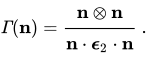
.
{\displaystyle {{\boldsymbol {\mathit {\Gamma }}}(\mathbf {n} )={\cfrac {\mathbf {n} \otimes \mathbf {n} }{\mathbf {n} \cdot {\boldsymbol {\epsilon }}_{2}\cdot \mathbf {n} }}~.}}
For elasticity, exactly the same analysis can be applied. In this case we introduce a reference stiffness tensor
C
0
{\displaystyle {\boldsymbol {\mathsf {C}}}_{0}}
P
(
x
)
=
[
C
(
x
)
−
C
0
]
:
ε
(
x
)
{\displaystyle {\boldsymbol {P}}(\mathbf {x} )=[{\boldsymbol {\mathsf {C}}}(\mathbf {x} )-{\boldsymbol {\mathsf {C}}}_{0}]:{\boldsymbol {\varepsilon }}(\mathbf {x} )}
where the strain
ε
(
x
)
{\displaystyle {\boldsymbol {\varepsilon }}(\mathbf {x} )}
ε
(
x
)
=
1
2
[
∇
u
+
(
∇
u
)
T
]
.
{\displaystyle {\boldsymbol {\varepsilon }}(\mathbf {x} )={\frac {1}{2}}~[{\boldsymbol {\nabla }}\mathbf {u} +({\boldsymbol {\nabla }}\mathbf {u} )^{T}]~.}
Following the same process as before, we can show that the effective elastic stiffness of a hierarchical laminate can be determined from the formula
(12)
{
[
C
eff
−
C
0
]
−
1
+
Γ
(
n
)
}
−
1
=
⟨
{
[
C
(
x
)
−
C
0
]
−
1
+
Γ
(
n
)
}
−
1
⟩
{\displaystyle {\text{(12)}}\qquad {\{[{\boldsymbol {\mathsf {C}}}_{\text{eff}}-{\boldsymbol {\mathsf {C}}}_{0}]^{-1}+{\boldsymbol {\mathit {\Gamma }}}(\mathbf {n} )\}^{-1}=\langle \{[{\boldsymbol {\mathsf {C}}}(\mathbf {x} )-{\boldsymbol {\mathsf {C}}}_{0}]^{-1}+{\boldsymbol {\mathit {\Gamma }}}(\mathbf {n} )\}^{-1}\rangle }}
where (the components are in a rectangular Cartesian basis)
[
Γ
(
n
)
]
i
j
l
m
=
1
4
[
n
i
{
C
−
1
(
n
)
}
j
l
n
m
+
n
i
{
C
−
1
(
n
)
}
j
m
n
l
+
n
j
{
C
−
1
(
n
)
}
i
l
n
m
+
n
j
{
C
−
1
(
n
)
}
i
m
n
l
]
{\displaystyle [{\boldsymbol {\mathit {\Gamma }}}(\mathbf {n} )]_{ijlm}={\cfrac {1}{4}}~\left[n_{i}~\{{\boldsymbol {C}}^{-1}(\mathbf {n} )\}_{jl}~n_{m}+n_{i}~\{{\boldsymbol {C}}^{-1}(\mathbf {n} )\}_{jm}~n_{l}+n_{j}~\{{\boldsymbol {C}}^{-1}(\mathbf {n} )\}_{il}~n_{m}+n_{j}~\{{\boldsymbol {C}}^{-1}(\mathbf {n} )\}_{im}~n_{l}\right]}
and
C
−
1
(
n
)
=
n
⋅
C
0
⋅
n
.
{\displaystyle {\boldsymbol {C}}^{-1}(\mathbf {n} )=\mathbf {n} \cdot {\boldsymbol {\mathsf {C}}}_{0}\cdot \mathbf {n} ~.}
Note that
C
−
1
(
n
)
{\displaystyle {\boldsymbol {C}}^{-1}(\mathbf {n} )}
If
C
0
{\displaystyle {\boldsymbol {\mathsf {C}}}_{0}}
C
0
:
ε
=
λ
0
tr
(
ε
)
1
+
2
μ
0
ε
{\displaystyle {\boldsymbol {\mathsf {C}}}_{0}:{\boldsymbol {\varepsilon }}=\lambda _{0}~{\text{tr}}({\boldsymbol {\varepsilon }})~{\boldsymbol {\mathit {1}}}+2~\mu _{0}~{\boldsymbol {\varepsilon }}}
where
λ
0
{\displaystyle \lambda _{0}}
μ
0
{\displaystyle \mu _{0}}
Γ
(
n
)
{\displaystyle {\boldsymbol {\mathit {\Gamma }}}(\mathbf {n} )}
[
Γ
(
n
)
]
i
j
l
m
=
(
1
λ
0
+
2
μ
0
−
1
μ
0
)
n
i
n
j
n
l
n
m
+
1
4
μ
0
(
n
i
δ
j
l
n
m
+
n
i
δ
j
m
n
l
+
n
j
δ
i
l
n
m
+
n
j
δ
i
m
n
l
)
.
{\displaystyle [{\boldsymbol {\mathit {\Gamma }}}(\mathbf {n} )]_{ijlm}=\left({\cfrac {1}{\lambda _{0}+2~\mu _{0}}}-{\cfrac {1}{\mu _{0}}}\right)~n_{i}~n_{j}~n_{l}~n_{m}+{\cfrac {1}{4~\mu _{0}}}(n_{i}~\delta _{jl}~n_{m}+n_{i}~\delta _{jm}~n_{l}+n_{j}~\delta _{il}~n_{m}+n_{j}~\delta _{im}~n_{l})~.}
The methods discussed above can be generalized if we think in terms
of a Hilbert space formalism. Recall that our goal is to find a
general formula for
ϵ
eff
{\displaystyle {\boldsymbol {\epsilon }}_{\text{eff}}}
C
eff
{\displaystyle {\boldsymbol {\mathsf {C}}}_{\text{eff}}}
Let us consider a periodic material with unit cell
Q
{\displaystyle Q}
Q
{\displaystyle Q}
Consider the Hilbert space
H
{\displaystyle {\mathcal {H}}}
Q
{\displaystyle Q}
(
a
,
b
)
=
∫
Q
a
(
x
)
¯
⋅
b
(
x
)
d
x
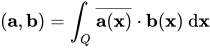
{\displaystyle (\mathbf {a} ,\mathbf {b} )=\int _{Q}{\overline {\mathbf {a} (\mathbf {x} )}}\cdot \mathbf {b} (\mathbf {x} )~{\text{d}}\mathbf {x} }
where
a
{\displaystyle \mathbf {a} }
b
{\displaystyle \mathbf {b} }
(
∙
)
¯
{\displaystyle {\overline {(\bullet )}}}
(
a
,
b
)
=
∫
Q
^
a
^
(
k
)
⋅
b
^
(
k
)
d
k
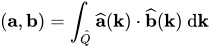
{\displaystyle (\mathbf {a} ,\mathbf {b} )=\int _{\hat {Q}}{\widehat {\mathbf {a} }}(\mathbf {k} )\cdot {\widehat {\mathbf {b} }}(\mathbf {k} )~{\text{d}}\mathbf {k} }
where
k
{\displaystyle \mathbf {k} }
The Hilbert space
H
{\displaystyle {\mathcal {H}}}
The subspace
U
{\displaystyle {\mathcal {U}}}
a
(
x
)
{\displaystyle \mathbf {a} (\mathbf {x} )}
x
{\displaystyle \mathbf {x} }
a
^
(
k
)
=
0
{\displaystyle {\widehat {\mathbf {a} }}(\mathbf {k} )={\boldsymbol {0}}}
k
=
0
{\displaystyle \mathbf {k} ={\boldsymbol {0}}}
The subspace
J
{\displaystyle {\mathcal {J}}}
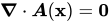
∇
⋅
a
(
x
)
=
0
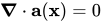
{\displaystyle {\boldsymbol {\nabla }}\cdot \mathbf {a} (\mathbf {x} )=0}
⟨
a
(
x
)
⟩
=
0
{\displaystyle \langle \mathbf {a} (\mathbf {x} )\rangle ={\boldsymbol {0}}}
a
^
(
0
)
=
0
{\displaystyle {\widehat {\mathbf {a} }}({\boldsymbol {0}})={\boldsymbol {0}}}
k
⋅
a
^
(
k
)
=
0
{\displaystyle \mathbf {k} \cdot {\widehat {\mathbf {a} }}(\mathbf {k} )=0}
The subspace
E
{\displaystyle {\mathcal {E}}}
∇
×
a
(
x
)
=
0
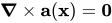
{\displaystyle {\boldsymbol {\nabla }}\times \mathbf {a} (\mathbf {x} )={\boldsymbol {0}}}
⟨
a
(
x
)
⟩
=
0
{\displaystyle \langle \mathbf {a} (\mathbf {x} )\rangle ={\boldsymbol {0}}}
a
^
(
0
)
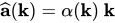
=
0
{\displaystyle {\widehat {\mathbf {a} }}({\boldsymbol {0}})={\boldsymbol {0}}}
a
^
(
k
)
=
α
(
k
)
k
{\displaystyle {\widehat {\mathbf {a} }}(\mathbf {k} )=\alpha (\mathbf {k} )~\mathbf {k} }
Thus we can write
H
=
U
⊕
J
⊕
E
.
{\displaystyle {\mathcal {H}}={\mathcal {U}}\oplus {\mathcal {J}}\oplus {\mathcal {E}}~.}
In Fourier space, we can clearly see that
(
a
,
b
)
=
0
{\displaystyle (\mathbf {a} ,\mathbf {b} )={\boldsymbol {0}}}
if we choose
a
{\displaystyle \mathbf {a} }
U
,
J
,
E
{\displaystyle {\mathcal {U}},{\mathcal {J}},{\mathcal {E}}}
b
{\displaystyle \mathbf {b} }
Similarly, for elasticity,
H
{\displaystyle {\mathcal {H}}}
Q
{\displaystyle Q}
(
A
,
B
)
=
∫
Q
A
(
x
)
¯
:
B
(
x
)
d
x
.
{\displaystyle ({\boldsymbol {A}},{\boldsymbol {B}})=\int _{Q}{\overline {{\boldsymbol {A}}(\mathbf {x} )}}:{\boldsymbol {B}}(\mathbf {x} )~{\text{d}}\mathbf {x} ~.}
In Fourier space, we have
(
A
,
B
)
=
∫
Q
^
A
^
(
k
)
:
B
^
(
k
)
d
k
.
{\displaystyle ({\boldsymbol {A}},{\boldsymbol {B}})=\int _{\hat {Q}}{\widehat {\boldsymbol {A}}}(\mathbf {k} ):{\widehat {\boldsymbol {B}}}(\mathbf {k} )~{\text{d}}\mathbf {k} ~.}
Again we decompose the space
H
{\displaystyle {\mathcal {H}}}
U
{\displaystyle {\mathcal {U}}}
J
{\displaystyle {\mathcal {J}}}
E
{\displaystyle {\mathcal {E}}}
U
{\displaystyle {\mathcal {U}}}
A
(
x
)
{\displaystyle {\boldsymbol {A}}(\mathbf {x} )}
x
{\displaystyle \mathbf {x} }
A
^
(
k
)
=
0
{\displaystyle {\widehat {\boldsymbol {A}}}(\mathbf {k} )={\boldsymbol {\mathit {0}}}}
k
=
0
{\displaystyle \mathbf {k} ={\boldsymbol {0}}}
J
{\displaystyle {\mathcal {J}}}
∇
⋅
A
(
x
)
=
0
{\displaystyle {\boldsymbol {\nabla }}\cdot {\boldsymbol {A}}(\mathbf {x} )={\boldsymbol {0}}}
⟨
A
(
x
)
⟩
=
0
{\displaystyle \langle {\boldsymbol {A}}(\mathbf {x} )\rangle ={\boldsymbol {\mathit {0}}}}
A
^
(
0
)
=
0
{\displaystyle {\widehat {\boldsymbol {A}}}({\boldsymbol {0}})={\boldsymbol {\mathit {0}}}}
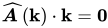
A
^
(
k
)
⋅
k
=
0
{\displaystyle {\widehat {\boldsymbol {A}}}(\mathbf {k} )\cdot \mathbf {k} ={\boldsymbol {0}}}
E
{\displaystyle {\mathcal {E}}}
⟨
A
(
x
)
⟩
=
0
{\displaystyle \langle {\boldsymbol {A}}(\mathbf {x} )\rangle ={\boldsymbol {\mathit {0}}}}
A
^
(
0
)
=
0
{\displaystyle {\widehat {\boldsymbol {A}}}({\boldsymbol {0}})={\boldsymbol {\mathit {0}}}}
A
^
(
k
)
=
k
⊗
u
(
k
)
+
u
(
k
)
⊗
k
{\displaystyle {\widehat {\boldsymbol {A}}}(\mathbf {k} )=\mathbf {k} \otimes \mathbf {u} (\mathbf {k} )+\mathbf {u} (\mathbf {k} )\otimes \mathbf {k} }
Problem of determining the effective tensor in an abstract setting [ edit | edit source ] Let us first consider the problem of determining the effective
permittivity. The approach will be to split relevant fields into
components that belong to orthogonal subpaces of
H
{\displaystyle {\mathcal {H}}}
Since
∇
⋅
D
=
0
{\displaystyle {\boldsymbol {\nabla }}\cdot \mathbf {D} =0}
D
(
x
)
{\displaystyle \mathbf {D} (\mathbf {x} )}
D
(
x
)
=
D
0
+
D
1
(
x
)
{\displaystyle \mathbf {D} (\mathbf {x} )=\mathbf {D} _{0}+\mathbf {D} _{1}(\mathbf {x} )}
where
D
0
∈
U
{\displaystyle \mathbf {D} _{0}\in {\mathcal {U}}}
D
1
∈
J
{\displaystyle \mathbf {D} _{1}\in {\mathcal {J}}}
Also, since
∇
×
E
=
0
{\displaystyle {\boldsymbol {\nabla }}\times \mathbf {E} ={\boldsymbol {0}}}
E
(
x
)
{\displaystyle \mathbf {E} (\mathbf {x} )}
E
(
x
)
=
E
0
+
E
1
(
x
)
{\displaystyle \mathbf {E} (\mathbf {x} )=\mathbf {E} _{0}+\mathbf {E} _{1}(\mathbf {x} )}
where
E
0
∈
U
{\displaystyle \mathbf {E} _{0}\in {\mathcal {U}}}
E
1
∈
E
{\displaystyle \mathbf {E} _{1}\in {\mathcal {E}}}
The constitutive relation linking
D
{\displaystyle \mathbf {D} }
E
{\displaystyle \mathbf {E} }
D
(
x
)
=
ϵ
(
x
)
⋅
E
(
x
)
≡
ϵ
(
E
)
{\displaystyle \mathbf {D} (\mathbf {x} )={\boldsymbol {\epsilon }}(\mathbf {x} )\cdot \mathbf {E} (\mathbf {x} )\equiv {\boldsymbol {\epsilon }}(\mathbf {E} )}
where
ϵ
(
∙
)
{\displaystyle {\boldsymbol {\epsilon }}(\bullet )}
H
{\displaystyle {\mathcal {H}}}
H
{\displaystyle {\mathcal {H}}}
D
0
+
D
1
=
ϵ
(
E
0
+
E
1
)
.
{\displaystyle \mathbf {D} _{0}+\mathbf {D} _{1}={\boldsymbol {\epsilon }}(\mathbf {E} _{0}+\mathbf {E} _{1})~.}
The effective permittivity
ϵ
eff
{\displaystyle {\boldsymbol {\epsilon }}_{\text{eff}}}
D
0
=
ϵ
eff
(
E
0
)
.
{\displaystyle \mathbf {D} _{0}={\boldsymbol {\epsilon }}_{\text{eff}}(\mathbf {E} _{0})~.}
Let
Γ
1
{\displaystyle {\boldsymbol {\mathit {\Gamma }}}_{1}}
H
{\displaystyle {\mathcal {H}}}
E
{\displaystyle {\mathcal {E}}}
b
(
x
)
=
Γ
1
⋅
a
(
x
)
{\displaystyle \mathbf {b} (\mathbf {x} )={\boldsymbol {\mathit {\Gamma }}}_{1}\cdot \mathbf {a} (\mathbf {x} )}
then
b
^
(
k
)
=
Γ
^
1
(
k
)
⋅
a
^
(
k
)
{\displaystyle {\widehat {\mathbf {b} }}(\mathbf {k} )={\boldsymbol {\mathit {\widehat {\Gamma }}}}_{1}(\mathbf {k} )\cdot {\widehat {\mathbf {a} }}(\mathbf {k} )}
where
Γ
^
1
(
k
)
=
{
k
⊗
k
|
k
|
2
=
Γ
1
(
n
)
with
n
=
k
|
k
|
if
k
≠
0
0
if
k
=
0
.
{\displaystyle {\boldsymbol {\mathit {\widehat {\Gamma }}}}_{1}(\mathbf {k} )={\begin{cases}{\cfrac {\mathbf {k} \otimes \mathbf {k} }{|\mathbf {k} |^{2}}}={\boldsymbol {\mathit {\Gamma }}}_{1}(\mathbf {n} )&\qquad {\text{with}}~~\mathbf {n} ={\cfrac {\mathbf {k} }{|\mathbf {k} |}}~~{\text{if}}~~\mathbf {k} \neq 0\\{\boldsymbol {\mathit {0}}}&\qquad {\text{if}}~~\mathbf {k} =0~.\end{cases}}}
More generally, if we choose some reference matrix
ϵ
0
{\displaystyle {\boldsymbol {\epsilon }}_{0}}
Γ
{\displaystyle {\boldsymbol {\mathit {\Gamma }}}}
b
(
x
)
=
Γ
⋅
a
(
x
)
{\displaystyle \mathbf {b} (\mathbf {x} )={\boldsymbol {\mathit {\Gamma }}}\cdot \mathbf {a} (\mathbf {x} )}
if and only if
b
∈
E
and
a
−
ϵ
0
(
b
)
∈
U
⊕
J
⟹
∇
⋅
(
a
−
ϵ
0
(
b
)
)
=
0
.
{\displaystyle \mathbf {b} \in {\mathcal {E}}\qquad {\text{and}}\qquad \mathbf {a} -{\boldsymbol {\epsilon }}_{0}(\mathbf {b} )\in {\mathcal {U}}\oplus {\mathcal {J}}\implies {\boldsymbol {\nabla }}\cdot (\mathbf {a} -{\boldsymbol {\epsilon }}_{0}(\mathbf {b} ))=0~.}
In Fourier space,
b
^
(
k
)
=
Γ
^
(
k
)
⋅
a
^
(
k
)
{\displaystyle {\widehat {\mathbf {b} }}(\mathbf {k} )={\boldsymbol {\mathit {\widehat {\Gamma }}}}(\mathbf {k} )\cdot {\widehat {\mathbf {a} }}(\mathbf {k} )}
where
Γ
^
(
k
)
=
{
k
⊗
k
k
⋅
ϵ
0
(
k
)
=
Γ
(
n
)
with
n
=
k
|
k
|
if
k
≠
0
0
if
k
=
0
.
{\displaystyle {\boldsymbol {\mathit {\widehat {\Gamma }}}}(\mathbf {k} )={\begin{cases}{\cfrac {\mathbf {k} \otimes \mathbf {k} }{\mathbf {k} \cdot {\boldsymbol {\epsilon }}_{0}(\mathbf {k} )}}={\boldsymbol {\mathit {\Gamma }}}(\mathbf {n} )&\qquad {\text{with}}~~\mathbf {n} ={\cfrac {\mathbf {k} }{|\mathbf {k} |}}~~{\text{if}}~~\mathbf {k} \neq 0\\{\boldsymbol {\mathit {0}}}&\qquad {\text{if}}~~\mathbf {k} =0~.\end{cases}}}
In the next lecture we will derive relations for the effective tensors
using these ideas.
↑ The discussion in this lecture is
based on Milton02 . Please consult that book for more details
and references.
[Milton02] Theory of Composites . Cambridge University Press, New York, 2002.
![{\displaystyle f_{1}~[\epsilon _{2}~{\boldsymbol {\mathit {1}}}-{\boldsymbol {\epsilon }}_{\text{eff}}]^{-1}=[\epsilon _{2}~{\boldsymbol {\mathit {1}}}-{\boldsymbol {\epsilon }}_{1}]^{-1}-{\cfrac {f_{2}}{\epsilon _{2}}}~{\boldsymbol {\mathit {\Gamma }}}_{1}(\mathbf {n} )~.}](https://wikimedia.org/api/rest_v1/media/math/render/svg/51cccc49e0a22f6aaff75e2f2cff2a018f6b2bcc)

![{\displaystyle {\text{(1)}}\qquad f_{1}~[\epsilon _{2}~{\boldsymbol {\mathit {1}}}-{\boldsymbol {\epsilon }}_{\text{eff}}]^{-1}=[\epsilon _{2}~{\boldsymbol {\mathit {1}}}-{\boldsymbol {\epsilon }}_{1}]^{-1}-{\cfrac {f_{2}}{\epsilon _{2}}}~{\boldsymbol {M}}}](https://wikimedia.org/api/rest_v1/media/math/render/svg/2205b1790645eec2f5c7be6995e02f1473a4ca44)










![{\displaystyle {\text{(2)}}\qquad \mathbf {P} (\mathbf {x} ):=[{\boldsymbol {\epsilon }}(\mathbf {x} )-{\boldsymbol {\epsilon }}_{0}]\cdot \mathbf {E} (\mathbf {x} )=\mathbf {D} (\mathbf {x} )-{\boldsymbol {\epsilon }}_{0}\cdot \mathbf {E} (\mathbf {x} )~.}](https://wikimedia.org/api/rest_v1/media/math/render/svg/34d644eb914c2f8a1b3312d37ea58327e9472973)

![{\displaystyle {\text{(3)}}\qquad \mathbf {P} (\mathbf {x} )-\langle \mathbf {P} \rangle =[\mathbf {D} (\mathbf {x} )-\langle \mathbf {D} \rangle ]-{\boldsymbol {\epsilon }}_{0}\cdot [\mathbf {E} (\mathbf {x} )-\langle \mathbf {E} \rangle ]~.}](https://wikimedia.org/api/rest_v1/media/math/render/svg/ce16f86a3c25be1b77f640ce1256cbe06bd92e83)









![{\displaystyle {\boldsymbol {\mathit {\Gamma }}}_{1}(\mathbf {n} )\cdot [\mathbf {P} (\mathbf {x} )-\langle \mathbf {P} \rangle ]={\boldsymbol {\mathit {\Gamma }}}_{1}(\mathbf {n} )\cdot [\mathbf {D} (\mathbf {x} )-\langle \mathbf {D} \rangle ]-{\boldsymbol {\mathit {\Gamma }}}_{1}(\mathbf {n} )\cdot \{{\boldsymbol {\epsilon }}_{0}\cdot [\mathbf {E} (\mathbf {x} )-\langle \mathbf {E} \rangle ]\}~.}](https://wikimedia.org/api/rest_v1/media/math/render/svg/fa1b8bf1d30722814e635c9f59971963f191e736)

![{\displaystyle {\boldsymbol {\mathit {\Gamma }}}_{1}(\mathbf {n} )\cdot [\mathbf {D} (\mathbf {x} )-\langle \mathbf {D} \rangle ]=[\mathbf {n} \cdot \mathbf {D} (\mathbf {x} )-\mathbf {n} \cdot \langle \mathbf {D} \rangle ]~\mathbf {n} ={\boldsymbol {0}}~.}](https://wikimedia.org/api/rest_v1/media/math/render/svg/751de75fafe45cf59f8860ac1dd626e244d69edf)
![{\displaystyle {\text{(6)}}\qquad {\boldsymbol {\mathit {\Gamma }}}_{1}(\mathbf {n} )\cdot \left\{\mathbf {P} (\mathbf {x} )-\langle \mathbf {P} \rangle +{\boldsymbol {\epsilon }}_{0}\cdot [\mathbf {E} (\mathbf {x} )-\langle \mathbf {E} \rangle ]\right\}={\boldsymbol {0}}~.}](https://wikimedia.org/api/rest_v1/media/math/render/svg/21301fab00a903754a2b090afc96d3bda85f8485)
![{\displaystyle {\text{(7)}}\qquad {\boldsymbol {\mathit {\Gamma }}}_{1}(\mathbf {n} )\cdot \mathbf {E} (\mathbf {x} )=\mathbf {E} (\mathbf {x} )-\langle \mathbf {E} \rangle +{\boldsymbol {\mathit {\Gamma }}}_{1}(\mathbf {n} )\cdot \langle \mathbf {E} \rangle \quad \implies \quad {\boldsymbol {\mathit {\Gamma }}}_{1}(\mathbf {n} )\cdot [\mathbf {E} (\mathbf {x} )-\langle \mathbf {E} \rangle ]=\mathbf {E} (\mathbf {x} )-\langle \mathbf {E} \rangle ~.}](https://wikimedia.org/api/rest_v1/media/math/render/svg/fd8fdcb125f378e6f1ca9c33ff2e7e908b05a463)
![{\displaystyle \mathbf {a} :=\mathbf {P} (\mathbf {x} )-\langle \mathbf {P} \rangle \quad {\text{and}}\quad \mathbf {b} :=-[\mathbf {E} (\mathbf {x} )-\langle \mathbf {E} \rangle ]}](https://wikimedia.org/api/rest_v1/media/math/render/svg/c96b25f7795b87d2be6eea895c6331ffb97df6d1)

![{\displaystyle {\text{(8)}}\qquad -[\mathbf {E} (\mathbf {x} )-\langle \mathbf {E} \rangle ]={\boldsymbol {\mathit {\Gamma }}}(\mathbf {n} )\cdot [\mathbf {P} (\mathbf {x} )-\langle \mathbf {P} \rangle ]~.}](https://wikimedia.org/api/rest_v1/media/math/render/svg/35baea20101d8d6952ba221b7491bbd81b2998cd)
![{\displaystyle \mathbf {E} (\mathbf {x} )=[{\boldsymbol {\epsilon }}(\mathbf {x} )-{\boldsymbol {\epsilon }}_{0}]^{-1}\cdot \mathbf {P} (\mathbf {x} )~.}](https://wikimedia.org/api/rest_v1/media/math/render/svg/cc0560ed0b3fb6c8ea84fa8da19ce4b8b75e9bd0)
![{\displaystyle -[{\boldsymbol {\epsilon }}(\mathbf {x} )-{\boldsymbol {\epsilon }}_{0}]^{-1}\cdot \mathbf {P} (\mathbf {x} )+\langle \mathbf {E} \rangle ={\boldsymbol {\mathit {\Gamma }}}(\mathbf {n} )\cdot [\mathbf {P} (\mathbf {x} )-\langle \mathbf {P} \rangle ]}](https://wikimedia.org/api/rest_v1/media/math/render/svg/f969811df3f9aa48ba7969ddc4af8f0f1f453df2)
![{\displaystyle \{[{\boldsymbol {\epsilon }}(\mathbf {x} )-{\boldsymbol {\epsilon }}_{0}]^{-1}+{\boldsymbol {\mathit {\Gamma }}}(\mathbf {n} )\}\cdot \mathbf {P} (\mathbf {x} )=\langle \mathbf {E} \rangle +{\boldsymbol {\mathit {\Gamma }}}(\mathbf {n} )\cdot \langle \mathbf {P} \rangle ~.}](https://wikimedia.org/api/rest_v1/media/math/render/svg/af679ab5a9bf0be125990d5fa92d7a6da834221e)

![{\displaystyle \{[{\boldsymbol {\epsilon }}(\mathbf {x} )-{\boldsymbol {\epsilon }}_{0}]^{-1}+{\boldsymbol {\mathit {\Gamma }}}(\mathbf {n} )\}\cdot \mathbf {P} (\mathbf {x} )=\mathbf {V} }](https://wikimedia.org/api/rest_v1/media/math/render/svg/02b978cc718c52302d42d95a8a8e6b6d2ba4ece7)
![{\displaystyle \mathbf {P} (\mathbf {x} )=\{[{\boldsymbol {\epsilon }}(\mathbf {x} )-{\boldsymbol {\epsilon }}_{0}]^{-1}+{\boldsymbol {\mathit {\Gamma }}}(\mathbf {n} )\}^{-1}\cdot \mathbf {V} ~.}](https://wikimedia.org/api/rest_v1/media/math/render/svg/b3ab02626618e85805e171f79519d75a1fc180a9)
![{\displaystyle {\text{(9)}}\qquad \langle \mathbf {P} \rangle =\langle \{[{\boldsymbol {\epsilon }}(\mathbf {x} )-{\boldsymbol {\epsilon }}_{0}]^{-1}+{\boldsymbol {\mathit {\Gamma }}}(\mathbf {n} )\}^{-1}\rangle \cdot \mathbf {V} ~.}](https://wikimedia.org/api/rest_v1/media/math/render/svg/90465ad4f5d9ef6f18952770faa878a2aaffe710)

![{\displaystyle \langle \mathbf {P} \rangle =[{\boldsymbol {\epsilon }}_{\text{eff}}-{\boldsymbol {\epsilon }}_{0}]\cdot \langle \mathbf {E} \rangle \qquad \implies \qquad \langle \mathbf {E} \rangle =[{\boldsymbol {\epsilon }}_{\text{eff}}-{\boldsymbol {\epsilon }}_{0}]^{-1}\cdot \langle \mathbf {P} \rangle ~.}](https://wikimedia.org/api/rest_v1/media/math/render/svg/0d090aba9d51030bb1a42963f4cc88a2ce00c064)
![{\displaystyle \mathbf {V} =\{[{\boldsymbol {\epsilon }}_{\text{eff}}-{\boldsymbol {\epsilon }}_{0}]^{-1}+{\boldsymbol {\mathit {\Gamma }}}(\mathbf {n} )\}\cdot \langle \mathbf {P} \rangle }](https://wikimedia.org/api/rest_v1/media/math/render/svg/05bbc1c65b8e85abbffa670a17b4d86857082561)
![{\displaystyle {\text{(10)}}\qquad \langle \mathbf {P} \rangle =\{[{\boldsymbol {\epsilon }}_{\text{eff}}-{\boldsymbol {\epsilon }}_{0}]^{-1}+{\boldsymbol {\mathit {\Gamma }}}(\mathbf {n} )\}^{-1}\cdot \mathbf {V} ~.}](https://wikimedia.org/api/rest_v1/media/math/render/svg/a11b66cad63707ba72171698f0851bc0307e90cf)
![{\displaystyle {\text{(11)}}\qquad {\{[{\boldsymbol {\epsilon }}_{\text{eff}}-{\boldsymbol {\epsilon }}_{0}]^{-1}+{\boldsymbol {\mathit {\Gamma }}}(\mathbf {n} )\}^{-1}=\langle \{[{\boldsymbol {\epsilon }}(\mathbf {x} )-{\boldsymbol {\epsilon }}_{0}]^{-1}+{\boldsymbol {\mathit {\Gamma }}}(\mathbf {n} )\}^{-1}\rangle ~.}}](https://wikimedia.org/api/rest_v1/media/math/render/svg/30c4fd72244753f9e87347feb28eccd5f0fa2c28)



![{\displaystyle {\boldsymbol {P}}(\mathbf {x} )=[{\boldsymbol {\mathsf {C}}}(\mathbf {x} )-{\boldsymbol {\mathsf {C}}}_{0}]:{\boldsymbol {\varepsilon }}(\mathbf {x} )}](https://wikimedia.org/api/rest_v1/media/math/render/svg/e4b92b08adc881954eb32ef46f3e81fdefd63673)

![{\displaystyle {\boldsymbol {\varepsilon }}(\mathbf {x} )={\frac {1}{2}}~[{\boldsymbol {\nabla }}\mathbf {u} +({\boldsymbol {\nabla }}\mathbf {u} )^{T}]~.}](https://wikimedia.org/api/rest_v1/media/math/render/svg/9126b015352af107f4e895d0dfc579a026b17994)
![{\displaystyle {\text{(12)}}\qquad {\{[{\boldsymbol {\mathsf {C}}}_{\text{eff}}-{\boldsymbol {\mathsf {C}}}_{0}]^{-1}+{\boldsymbol {\mathit {\Gamma }}}(\mathbf {n} )\}^{-1}=\langle \{[{\boldsymbol {\mathsf {C}}}(\mathbf {x} )-{\boldsymbol {\mathsf {C}}}_{0}]^{-1}+{\boldsymbol {\mathit {\Gamma }}}(\mathbf {n} )\}^{-1}\rangle }}](https://wikimedia.org/api/rest_v1/media/math/render/svg/26149d325e98385c58f1ab58cf558d3e6df6463f)
![{\displaystyle [{\boldsymbol {\mathit {\Gamma }}}(\mathbf {n} )]_{ijlm}={\cfrac {1}{4}}~\left[n_{i}~\{{\boldsymbol {C}}^{-1}(\mathbf {n} )\}_{jl}~n_{m}+n_{i}~\{{\boldsymbol {C}}^{-1}(\mathbf {n} )\}_{jm}~n_{l}+n_{j}~\{{\boldsymbol {C}}^{-1}(\mathbf {n} )\}_{il}~n_{m}+n_{j}~\{{\boldsymbol {C}}^{-1}(\mathbf {n} )\}_{im}~n_{l}\right]}](https://wikimedia.org/api/rest_v1/media/math/render/svg/c20a35ff527ad0661bb77a279c5419e8785720f9)





![{\displaystyle [{\boldsymbol {\mathit {\Gamma }}}(\mathbf {n} )]_{ijlm}=\left({\cfrac {1}{\lambda _{0}+2~\mu _{0}}}-{\cfrac {1}{\mu _{0}}}\right)~n_{i}~n_{j}~n_{l}~n_{m}+{\cfrac {1}{4~\mu _{0}}}(n_{i}~\delta _{jl}~n_{m}+n_{i}~\delta _{jm}~n_{l}+n_{j}~\delta _{il}~n_{m}+n_{j}~\delta _{im}~n_{l})~.}](https://wikimedia.org/api/rest_v1/media/math/render/svg/aac6f15b76865c9203d86a92104eed901458b512)