The content of these notes is based on the lectures by Prof. Graeme W. Milton (University of Utah) given in a course on metamaterials in Spring 2007.
A brief excursion into homogenization [ edit | edit source ] One of the first questions that arise in the homogenization of composites
is whether determining the effective behavior of the composite by some
averaging process is the right thing to do. At this stage we ignore such
questions and assume that there is a representative volume element (RVE) over
which such an average can be obtained.
Let
E
{\displaystyle \mathbf {E} }
E
{\displaystyle \mathbf {E} }
B
{\displaystyle \mathbf {B} }
B
{\displaystyle \mathbf {B} }
∇
×
E
=
i
ω
μ
(
x
,
ω
)
⋅
H
(
x
)
;
∇
×
H
=
−
i
ω
ϵ
(
x
,
ω
)
⋅
E
(
x
)
.
{\displaystyle {\boldsymbol {\nabla }}\times \mathbf {E} =i\omega ~{\boldsymbol {\mu }}(\mathbf {x} ,\omega )\cdot \mathbf {H} (\mathbf {x} )~;~~{\boldsymbol {\nabla }}\times \mathbf {H} =-i\omega ~{\boldsymbol {\epsilon }}(\mathbf {x} ,\omega )\cdot \mathbf {E} (\mathbf {x} )~.}
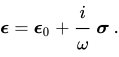
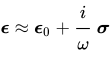
For some conductors, at low frequencies, the permittivity tensor is
given by
ϵ
≈
ϵ
0
+
i
ω
σ
{\displaystyle {\boldsymbol {\epsilon }}\approx {\boldsymbol {\epsilon }}_{0}+{\cfrac {i}{\omega }}~{\boldsymbol {\sigma }}}
where
ϵ
0
{\displaystyle {\boldsymbol {\epsilon }}_{0}}
σ
{\displaystyle {\boldsymbol {\sigma }}}
[1]
A mixture of conductors and dielectric materials may have properties which are
quite different from those of the constituents. For example, consider the
checkerboard material shown in Figure 1 containing an
isotropic conducting material and an isotropic dielectric material.
Figure 1. Checkerboard material containing conducting and dielectric phases.
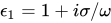
The conducting material has a permittivity of
ϵ
1
=
1
+
i
σ
/
ω
{\displaystyle \epsilon _{1}=1+i\sigma /\omega }
ϵ
2
=
1
{\displaystyle \epsilon _{2}=1}
ϵ
eff
=
ϵ
1
ϵ
2
=
1
+
i
σ
ω
≈
i
σ
ω
(
for small
ω
)
≠
a
+
i
b
for any
a
,
b
.
{\displaystyle \epsilon _{\text{eff}}={\sqrt {\epsilon _{1}~\epsilon _{2}}}={\sqrt {1+{\cfrac {i~\sigma }{\omega }}}}\approx {\cfrac {{\sqrt {i}}{\sqrt {\sigma }}}{\sqrt {\omega }}}~~~({\text{for small}}~\omega )\neq a+i~b~~{\text{for any}}~~a,b~.}
Let us assume that the material is isotropic. Then,
R
T
⋅
ϵ
⋅
R
=
ϵ
and
R
T
⋅
μ
⋅
R
=
μ
∀
rotations
R
T
⋅
R
=
R
⋅
R
T
=
1
.
{\displaystyle {\boldsymbol {R}}^{T}\cdot {\boldsymbol {\epsilon }}\cdot {\boldsymbol {R}}={\boldsymbol {\epsilon }}\qquad {\text{and}}\qquad {\boldsymbol {R}}^{T}\cdot {\boldsymbol {\mu }}\cdot {\boldsymbol {R}}={\boldsymbol {\mu }}\qquad \forall ~~{\text{rotations}}~~{\boldsymbol {R}}^{T}\cdot {\boldsymbol {R}}={\boldsymbol {R}}\cdot {\boldsymbol {R}}^{T}={\boldsymbol {\mathit {1}}}~.}
Therefore, we can write
ϵ
=
ϵ
1
and
μ
=
μ
1
.
{\displaystyle {\boldsymbol {\epsilon }}=\epsilon ~{\boldsymbol {\mathit {1}}}\qquad {\text{and}}\qquad {\boldsymbol {\mu }}=\mu ~{\boldsymbol {\mathit {1}}}~.}
The Maxwell equations then take the form
(2)
∇
×
E
=
i
ω
μ
(
x
,
ω
)
H
(
x
)
;
∇
×
H
=
−
i
ω
ϵ
(
x
,
ω
)
E
(
x
)
.
{\displaystyle {\text{(2)}}\qquad {\boldsymbol {\nabla }}\times \mathbf {E} =i\omega ~\mu (\mathbf {x} ,\omega )~\mathbf {H} (\mathbf {x} )~;~~{\boldsymbol {\nabla }}\times \mathbf {H} =-i\omega ~\epsilon (\mathbf {x} ,\omega )~\mathbf {E} (\mathbf {x} )~.}
If we assume that
μ
{\displaystyle \mu }
ϵ
{\displaystyle \epsilon }
μ
≡
μ
(
ω
)
{\displaystyle \mu \equiv \mu (\omega )}
ϵ
≡
ϵ
(
ω
)
{\displaystyle \epsilon \equiv \epsilon (\omega )}
∇
×
(
∇
×
E
)
=
i
ω
μ
∇
×
H
=
ω
2
ϵ
μ
E
(
x
)
;
∇
×
(
∇
×
H
)
=
−
i
ω
ϵ
∇
×
E
=
ω
2
ϵ
μ
H
(
x
)
.
{\displaystyle {\boldsymbol {\nabla }}\times ({\boldsymbol {\nabla }}\times \mathbf {E} )=i\omega ~\mu ~{\boldsymbol {\nabla }}\times \mathbf {H} =\omega ^{2}~\epsilon ~\mu ~\mathbf {E} (\mathbf {x} )~;~~{\boldsymbol {\nabla }}\times ({\boldsymbol {\nabla }}\times \mathbf {H} )=-i\omega ~\epsilon ~{\boldsymbol {\nabla }}\times \mathbf {E} =\omega ^{2}~\epsilon ~\mu ~\mathbf {H} (\mathbf {x} )~.}
Using the identity
∇
×
(
∇
×
A
)
=
∇
(
∇
⋅
A
)
−
∇
2
A
{\displaystyle {\boldsymbol {\nabla }}\times ({\boldsymbol {\nabla }}\times \mathbf {A} )={\boldsymbol {\nabla }}({\boldsymbol {\nabla }}\cdot \mathbf {A} )-\nabla ^{2}\mathbf {A} }
(3)
∇
(
∇
⋅
E
)
−
∇
2
E
=
ω
2
ϵ
μ
E
(
x
)
;
∇
(
∇
⋅
H
)
−
∇
2
H
=
ω
2
ϵ
μ
H
(
x
)
.
{\displaystyle {\text{(3)}}\qquad {\boldsymbol {\nabla }}({\boldsymbol {\nabla }}\cdot \mathbf {E} )-\nabla ^{2}\mathbf {E} =\omega ^{2}~\epsilon ~\mu ~\mathbf {E} (\mathbf {x} )~;~~{\boldsymbol {\nabla }}({\boldsymbol {\nabla }}\cdot \mathbf {H} )-\nabla ^{2}\mathbf {H} =\omega ^{2}~\epsilon ~\mu ~\mathbf {H} (\mathbf {x} )~.}
Since
∇
⋅
B
=
0
;
∇
⋅
D
=
0
;
H
(
x
)
=
μ
−
1
(
ω
)
B
(
x
)
;
D
(
x
)
=
ϵ
(
ω
)
E
(
x
)
{\displaystyle {\boldsymbol {\nabla }}\cdot \mathbf {B} =0~;{\boldsymbol {\nabla }}\cdot \mathbf {D} =0~;~~\mathbf {H} (\mathbf {x} )=\mu ^{-1}(\omega )~\mathbf {B} (\mathbf {x} )~;~\mathbf {D} (\mathbf {x} )=\epsilon (\omega )~\mathbf {E} (\mathbf {x} )}
we have
∇
⋅
H
=
μ
−
1
∇
⋅
B
=
0
and
∇
⋅
E
=
ϵ
−
1
∇
⋅
D
=
0
.
{\displaystyle {\boldsymbol {\nabla }}\cdot \mathbf {H} =\mu ^{-1}~{\boldsymbol {\nabla }}\cdot \mathbf {B} =0\qquad {\text{and}}\qquad {\boldsymbol {\nabla }}\cdot \mathbf {E} =\epsilon ^{-1}~{\boldsymbol {\nabla }}\cdot \mathbf {D} =0~.}
Therefore, from equation (3), we have
∇
2
E
+
ω
2
ϵ
μ
E
(
x
)
=
0
;
∇
2
H
+
ω
2
ϵ
μ
H
(
x
)
=
0
.
{\displaystyle \nabla ^{2}\mathbf {E} +\omega ^{2}~\epsilon ~\mu ~\mathbf {E} (\mathbf {x} )={\boldsymbol {0}}~;~~\nabla ^{2}\mathbf {H} +\omega ^{2}~\epsilon ~\mu ~\mathbf {H} (\mathbf {x} )={\boldsymbol {0}}~.}
We can also write the above equations in the form
(4)
∇
2
E
+
κ
2
E
(
x
)
=
0
;
∇
2
H
+
κ
2
H
(
x
)
=
0
where
κ
2
=
ω
2
c
2
and
c
2
=
1
ϵ
μ
{\displaystyle {\text{(4)}}\qquad {\nabla ^{2}\mathbf {E} +\kappa ^{2}~\mathbf {E} (\mathbf {x} )={\boldsymbol {0}}~;~~\nabla ^{2}\mathbf {H} +\kappa ^{2}~\mathbf {H} (\mathbf {x} )={\boldsymbol {0}}\qquad {\text{where}}\quad \kappa ^{2}={\cfrac {\omega ^{2}}{c^{2}}}~~{\text{and}}~~c^{2}={\cfrac {1}{\epsilon ~\mu }}}}
where
c
{\displaystyle c}
c
{\displaystyle c}
ϵ
{\displaystyle \epsilon }
μ
{\displaystyle \mu }
Figure 2. Transparency and opacity of a material as a function of
μ
{\displaystyle \mu }
ϵ
{\displaystyle \epsilon }
(5)
E
(
x
)
=
E
0
e
i
(
k
⋅
x
)
{\displaystyle {\text{(5)}}\qquad \mathbf {E} (\mathbf {x} )=\mathbf {E} _{0}~e^{i~(\mathbf {k} \cdot \mathbf {x} )}}
where
|
k
|
=
1
/
(
2
π
λ
)
{\displaystyle |\mathbf {k} |=1/(2~\pi ~\lambda )}
λ
{\displaystyle \lambda }
(6)
H
(
x
)
=
−
i
ω
μ
∇
×
E
=
1
ω
μ
k
×
E
0
e
i
(
k
⋅
x
)
=
H
0
e
i
(
k
⋅
x
)
{\displaystyle {\text{(6)}}\qquad \mathbf {H} (\mathbf {x} )=-{\cfrac {i}{\omega ~\mu }}~{\boldsymbol {\nabla }}\times \mathbf {E} ={\cfrac {1}{\omega \mu }}~\mathbf {k} \times \mathbf {E} _{0}~e^{i~(\mathbf {k} \cdot \mathbf {x} )}=\mathbf {H} _{0}~e^{i~(\mathbf {k} \cdot \mathbf {x} )}}
where
H
0
=
1
/
(
ω
μ
)
k
×
E
0
{\displaystyle \mathbf {H} _{0}=1/(\omega \mu )~\mathbf {k} \times \mathbf {E} _{0}}
Since
∇
⋅
E
=
0
{\displaystyle {\boldsymbol {\nabla }}\cdot \mathbf {E} =0}
∇
⋅
E
=
∂
∂
x
m
[
E
0
m
e
i
(
k
l
x
l
)
]
=
i
k
l
∂
x
l
∂
x
m
E
0
m
e
i
(
k
l
x
l
)
=
i
k
m
E
0
m
e
i
(
k
l
x
l
)
=
i
(
k
⋅
E
0
)
e
i
(
k
⋅
x
)
=
0
.
{\displaystyle {\boldsymbol {\nabla }}\cdot \mathbf {E} ={\frac {\partial }{\partial x_{m}}}\left[E_{0m}~e^{i(k_{l}~x_{l})}\right]=i~k_{l}~{\frac {\partial x_{l}}{\partial x_{m}}}~E_{0m}~e^{i(k_{l}~x_{l})}=i~k_{m}~E_{0m}~e^{i(k_{l}~x_{l})}=i~(\mathbf {k} \cdot \mathbf {E} _{0})~e^{i(\mathbf {k} \cdot \mathbf {x} )}=0~.}
Hence,
k
⋅
E
0
=
0
.
{\displaystyle {\mathbf {k} \cdot \mathbf {E} _{0}=0~.}}
Similarly, since
∇
⋅
H
=
0
{\displaystyle {\boldsymbol {\nabla }}\cdot \mathbf {H} =0}
∇
⋅
H
=
1
ω
μ
[
∂
∂
x
m
(
E
m
p
q
k
p
E
0
q
e
i
(
k
l
x
l
)
)
]
=
i
ω
μ
[
E
m
p
q
k
p
E
0
q
k
m
e
i
(
k
l
x
l
)
]
=
i
ω
μ
k
⋅
(
k
×
E
0
)
e
i
(
k
⋅
x
)
.
{\displaystyle {\boldsymbol {\nabla }}\cdot \mathbf {H} ={\cfrac {1}{\omega \mu }}\left[{\frac {\partial }{\partial x_{m}}}\left({\mathcal {E}}_{mpq}~k_{p}~E_{0q}~e^{i(k_{l}~x_{l})}\right)\right]={\cfrac {i}{\omega \mu }}\left[{\mathcal {E}}_{mpq}~k_{p}~E_{0q}~k_{m}~e^{i(k_{l}~x_{l})}\right]={\cfrac {i}{\omega \mu }}~\mathbf {k} \cdot (\mathbf {k} \times \mathbf {E} _{0})~e^{i(\mathbf {k} \cdot \mathbf {x} )}~.}
Hence,
k
⋅
H
0
=
0
.
{\displaystyle {\mathbf {k} \cdot \mathbf {H} _{0}=0~.}}
Plugging equation (5) into the first of equations
(4) we get
[
∇
2
E
+
κ
2
E
(
x
)
]
n
=
∂
∂
x
m
[
∂
∂
x
m
(
E
0
n
e
i
k
l
x
l
)
]
+
κ
2
E
0
n
e
i
k
l
x
l
=
∂
∂
x
m
[
E
0
n
(
i
k
l
∂
x
l
∂
x
m
)
e
i
k
l
x
l
]
+
κ
2
E
0
n
e
i
k
l
x
l
=
i
E
0
n
k
m
∂
∂
x
m
(
e
i
k
l
x
l
)
+
κ
2
E
0
n
e
i
k
l
x
l
=
i
E
0
n
k
m
(
i
k
l
∂
x
l
∂
x
m
)
e
i
k
l
x
l
+
κ
2
E
0
n
e
i
k
l
x
l
=
−
E
0
n
k
m
k
m
e
i
k
l
x
l
+
κ
2
E
0
n
e
i
k
l
x
l
.
{\displaystyle {\begin{aligned}\left[\nabla ^{2}\mathbf {E} +\kappa ^{2}~\mathbf {E} (\mathbf {x} )\right]_{n}&={\frac {\partial }{\partial x_{m}}}\left[{\frac {\partial }{\partial x_{m}}}\left(E_{0n}~e^{ik_{l}x_{l}}\right)\right]+\kappa ^{2}~E_{0n}~e^{ik_{l}x_{l}}\\&={\frac {\partial }{\partial x_{m}}}\left[E_{0n}~\left(i~k_{l}~{\frac {\partial x_{l}}{\partial x_{m}}}\right)~e^{ik_{l}x_{l}}\right]+\kappa ^{2}~E_{0n}~e^{ik_{l}x_{l}}\\&=i~E_{0n}~k_{m}~{\frac {\partial }{\partial x_{m}}}\left(e^{ik_{l}x_{l}}\right)+\kappa ^{2}~E_{0n}~e^{ik_{l}x_{l}}\\&=i~E_{0n}~k_{m}~\left(i~k_{l}~{\frac {\partial x_{l}}{\partial x_{m}}}\right)~e^{ik_{l}x_{l}}+\kappa ^{2}~E_{0n}~e^{ik_{l}x_{l}}\\&=-E_{0n}~k_{m}~k_{m}~e^{ik_{l}x_{l}}+\kappa ^{2}~E_{0n}~e^{ik_{l}x_{l}}~.\end{aligned}}}
Reverting back to Gibbs notation, we get
−
(
k
⋅
k
)
E
0
e
i
(
k
⋅
x
)
+
κ
2
E
0
e
i
(
k
⋅
x
)
=
0
.
{\displaystyle -(\mathbf {k} \cdot \mathbf {k} )~\mathbf {E} _{0}~e^{i~(\mathbf {k} \cdot \mathbf {x} )}+\kappa ^{2}~\mathbf {E} _{0}~e^{i~(\mathbf {k} \cdot \mathbf {x} )}={\boldsymbol {0}}~.}
Therefore,
k
⋅
k
=
κ
2
.
{\displaystyle {\mathbf {k} \cdot \mathbf {k} =\kappa ^{2}~.}}
Plugging the solution (6) into the second of equations
(4) (and using index notation as before) we get
[
∇
2
H
+
κ
2
H
(
x
)
]
n
=
1
ω
μ
{
∂
∂
x
m
[
∂
∂
x
m
(
E
n
p
q
k
p
E
0
q
e
i
k
l
x
l
)
]
+
κ
2
E
n
p
q
k
p
E
0
q
e
i
k
l
x
l
}
=
1
ω
μ
{
∂
∂
x
m
[
E
n
p
q
k
p
E
0
q
(
i
k
l
∂
x
l
∂
x
m
)
e
i
k
l
x
l
]
+
κ
2
E
n
p
q
k
p
E
0
q
e
i
k
l
x
l
}
=
1
ω
μ
{
i
E
n
p
q
k
p
k
m
E
0
q
[
i
k
l
∂
x
l
∂
x
m
]
e
i
k
l
x
l
+
κ
2
E
n
p
q
k
p
E
0
q
e
i
k
l
x
l
}
=
1
ω
μ
{
−
E
n
p
q
k
p
k
m
k
m
E
0
q
e
i
k
l
x
l
+
κ
2
E
n
p
q
k
p
E
0
q
e
i
k
l
x
l
}
{\displaystyle {\begin{aligned}\left[\nabla ^{2}\mathbf {H} +\kappa ^{2}~\mathbf {H} (\mathbf {x} )\right]_{n}&={\cfrac {1}{\omega \mu }}\left\{{\frac {\partial }{\partial x_{m}}}\left[{\frac {\partial }{\partial x_{m}}}\left({\mathcal {E}}_{npq}~k_{p}~E_{0q}~e^{ik_{l}x_{l}}\right)\right]+\kappa ^{2}~{\mathcal {E}}_{npq}~k_{p}~E_{0q}~e^{ik_{l}x_{l}}\right\}\\&={\cfrac {1}{\omega \mu }}\left\{{\frac {\partial }{\partial x_{m}}}\left[{\mathcal {E}}_{npq}~k_{p}~E_{0q}~\left(i~k_{l}~{\frac {\partial x_{l}}{\partial x_{m}}}\right)~e^{ik_{l}x_{l}}\right]+\kappa ^{2}~{\mathcal {E}}_{npq}~k_{p}~E_{0q}~e^{ik_{l}x_{l}}\right\}\\&={\cfrac {1}{\omega \mu }}\left\{i~{\mathcal {E}}_{npq}~k_{p}~k_{m}~E_{0q}~\left[i~k_{l}~{\frac {\partial x_{l}}{\partial x_{m}}}\right]~e^{ik_{l}x_{l}}+\kappa ^{2}~{\mathcal {E}}_{npq}~k_{p}~E_{0q}~e^{ik_{l}x_{l}}\right\}\\&={\cfrac {1}{\omega \mu }}\left\{-{\mathcal {E}}_{npq}~k_{p}~k_{m}~k_{m}~E_{0q}~e^{ik_{l}x_{l}}+\kappa ^{2}~{\mathcal {E}}_{npq}~k_{p}~E_{0q}~e^{ik_{l}x_{l}}\right\}\end{aligned}}}
In Gibbs notation, we then have
∇
2
H
+
κ
2
H
(
x
)
=
1
ω
μ
(
−
k
⋅
k
+
κ
2
)
k
×
E
0
e
i
(
k
⋅
x
)
=
0
.
{\displaystyle \nabla ^{2}\mathbf {H} +\kappa ^{2}~\mathbf {H} (\mathbf {x} )={\cfrac {1}{\omega \mu }}~(-\mathbf {k} \cdot \mathbf {k} +\kappa ^{2})~\mathbf {k} \times \mathbf {E} _{0}~e^{i(\mathbf {k} \cdot \mathbf {x} )}={\boldsymbol {0}}~.}
Therefore, once again, we get
k
⋅
k
=
κ
2
.
{\displaystyle {\mathbf {k} \cdot \mathbf {k} =\kappa ^{2}~.}}
Reflection at an Interface [ edit | edit source ] The following is based on the description given in [Lorrain88] .
Figure 3 shows an electromagnetic wave that is
incident upon an interface separating two mediums.
Figure 3. Reflection of an electromagnetic wave at an interface.
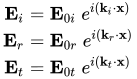
We ignore the time-dependent component of the electric fields and assume
that we can express the waves shown in Figure 3 in the
form
E
i
=
E
0
i
e
i
(
k
i
⋅
x
)
E
r
=
E
0
r
e
i
(
k
r
⋅
x
)
E
t
=
E
0
t
e
i
(
k
t
⋅
x
)
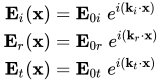
{\displaystyle {\begin{aligned}\mathbf {E} _{i}&=\mathbf {E} _{0i}~e^{i(\mathbf {k} _{i}\cdot \mathbf {x} )}\\\mathbf {E} _{r}&=\mathbf {E} _{0r}~e^{i(\mathbf {k} _{r}\cdot \mathbf {x} )}\\\mathbf {E} _{t}&=\mathbf {E} _{0t}~e^{i(\mathbf {k} _{t}\cdot \mathbf {x} )}\end{aligned}}}
where
k
i
,
k
r
,
k
t
{\displaystyle \mathbf {k} _{i},\mathbf {k} _{r},\mathbf {k} _{t}}
Since the oscillations at the interface must have the same period (the
requirement of continuity), we must have
k
i
⋅
x
=
k
r
⋅
x
=
k
t
⋅
x
∀
x
on the interface
.
{\displaystyle \mathbf {k} _{i}\cdot \mathbf {x} =\mathbf {k} _{r}\cdot \mathbf {x} =\mathbf {k} _{t}\cdot \mathbf {x} \qquad \forall \mathbf {x} ~~{\text{on the interface}}~.}
This means that the tangential components of
k
i
,
k
r
,
k
t
{\displaystyle \mathbf {k} _{i},\mathbf {k} _{r},\mathbf {k} _{t}}
|
k
i
|
sin
θ
i
=
|
k
r
|
sin
θ
r
=
|
k
t
|
sin
θ
t
.
{\displaystyle |\mathbf {k} _{i}|~\sin \theta _{i}=|\mathbf {k} _{r}|~\sin \theta _{r}=|\mathbf {k} _{t}|~\sin \theta _{t}~.}
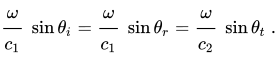
Now,
|
k
i
|
=
κ
i
=
ω
c
1
;
|
k
r
|
=
κ
r
=
ω
c
1
;
|
k
t
|
=
κ
t
=
ω
c
2
{\displaystyle |\mathbf {k} _{i}|=\kappa _{i}={\cfrac {\omega }{c_{1}}}~;~~|\mathbf {k} _{r}|=\kappa _{r}={\cfrac {\omega }{c_{1}}}~;~~|\mathbf {k} _{t}|=\kappa _{t}={\cfrac {\omega }{c_{2}}}}
where
c
1
{\displaystyle c_{1}}
c
2
{\displaystyle c_{2}}
ω
c
1
sin
θ
i
=
ω
c
1
sin
θ
r
=
ω
c
2
sin
θ
t
.
{\displaystyle {\cfrac {\omega }{c_{1}}}~\sin \theta _{i}={\cfrac {\omega }{c_{1}}}~\sin \theta _{r}={\cfrac {\omega }{c_{2}}}~\sin \theta _{t}~.}
This implies that
θ
i
=
θ
r
and
sin
θ
i
sin
θ
t
=
c
1
c
2
.
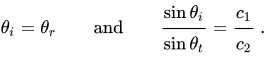
{\displaystyle \theta _{i}=\theta _{r}\qquad {\text{and}}\qquad {\cfrac {\sin \theta _{i}}{\sin \theta _{t}}}={\cfrac {c_{1}}{c_{2}}}~.}
The refractive index is defined as
n
:=
c
0
c
{\displaystyle n:={\cfrac {c_{0}}{c}}}
where
c
0
{\displaystyle c_{0}}
sin
θ
i
sin
θ
t
=
n
2
n
1
(Snells Law)
.
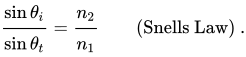
{\displaystyle {\cfrac {\sin \theta _{i}}{\sin \theta _{t}}}={\cfrac {n_{2}}{n_{1}}}\qquad {\mbox{(Snells Law)}}~.}
Polarized wave with the Ei parallel to the plane of incidence [ edit | edit source ] Consider the
p
{\displaystyle p}
E
i
{\displaystyle \mathbf {E} _{i}}
Figure 4. Infinite wave polarized with the
E
i
{\displaystyle \mathbf {E} _{i}}
Let us define
κ
1
:=
|
k
i
|
=
|
k
r
|
and
κ
2
:=
|
k
t
|
.
{\displaystyle \kappa _{1}:=|\mathbf {k} _{i}|=|\mathbf {k} _{r}|\qquad {\text{and}}\qquad \kappa _{2}:=|\mathbf {k} _{t}|~.}
Recall that,
E
i
(
x
)
=
E
0
i
e
i
(
k
i
⋅
x
)
E
r
(
x
)
=
E
0
r
e
i
(
k
r
⋅
x
)
E
t
(
x
)
=
E
0
t
e
i
(
k
t
⋅
x
)
{\displaystyle {\begin{aligned}\mathbf {E} _{i}(\mathbf {x} )&=\mathbf {E} _{0i}~e^{i(\mathbf {k} _{i}\cdot \mathbf {x} )}\\\mathbf {E} _{r}(\mathbf {x} )&=\mathbf {E} _{0r}~e^{i(\mathbf {k} _{r}\cdot \mathbf {x} )}\\\mathbf {E} _{t}(\mathbf {x} )&=\mathbf {E} _{0t}~e^{i(\mathbf {k} _{t}\cdot \mathbf {x} )}\end{aligned}}}
Let us choose an orthonormal basis (
e
1
,
e
2
,
e
3
{\displaystyle \mathbf {e} _{1},\mathbf {e} _{2},\mathbf {e} _{3}}
e
1
{\displaystyle \mathbf {e} _{1}}
e
2
{\displaystyle \mathbf {e} _{2}}
e
3
{\displaystyle \mathbf {e} _{3}}
k
i
{\displaystyle \mathbf {k} _{i}}
k
r
{\displaystyle \mathbf {k} _{r}}
k
t
{\displaystyle \mathbf {k} _{t}}
k
i
=
κ
1
sin
θ
i
e
1
−
κ
1
cos
θ
i
e
3
k
r
=
κ
1
sin
θ
r
e
1
+
κ
1
cos
θ
r
e
3
k
t
=
κ
2
sin
θ
t
e
1
−
κ
2
cos
θ
t
e
3
.
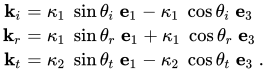
{\displaystyle {\begin{aligned}\mathbf {k} _{i}&=\kappa _{1}~\sin \theta _{i}~\mathbf {e} _{1}-\kappa _{1}~\cos \theta _{i}~\mathbf {e} _{3}\\\mathbf {k} _{r}&=\kappa _{1}~\sin \theta _{r}~\mathbf {e} _{1}+\kappa _{1}~\cos \theta _{r}~\mathbf {e} _{3}\\\mathbf {k} _{t}&=\kappa _{2}~\sin \theta _{t}~\mathbf {e} _{1}-\kappa _{2}~\cos \theta _{t}~\mathbf {e} _{3}~.\end{aligned}}}
Similarly, defining
E
i
:=
|
E
0
i
|
;
E
r
:=
|
E
0
r
|
;
E
t
:=
|
E
0
t
|
{\displaystyle {\mathcal {E}}_{i}:=|\mathbf {E} _{0i}|~;~~{\mathcal {E}}_{r}:=|\mathbf {E} _{0r}|~;~~{\mathcal {E}}_{t}:=|\mathbf {E} _{0t}|}
we get
E
0
i
=
E
i
cos
θ
i
e
1
+
E
i
sin
θ
i
e
3
E
0
r
=
−
E
r
cos
θ
r
e
1
+
E
r
sin
θ
r
e
3
E
0
t
=
E
t
cos
θ
t
e
1
+
E
t
sin
θ
t
e
3
.
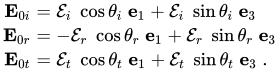
{\displaystyle {\begin{aligned}\mathbf {E} _{0i}&={\mathcal {E}}_{i}~\cos \theta _{i}~\mathbf {e} _{1}+{\mathcal {E}}_{i}~\sin \theta _{i}~\mathbf {e} _{3}\\\mathbf {E} _{0r}&=-{\mathcal {E}}_{r}~\cos \theta _{r}~\mathbf {e} _{1}+{\mathcal {E}}_{r}~\sin \theta _{r}~\mathbf {e} _{3}\\\mathbf {E} _{0t}&={\mathcal {E}}_{t}~\cos \theta _{t}~\mathbf {e} _{1}+{\mathcal {E}}_{t}~\sin \theta _{t}~\mathbf {e} _{3}~.\end{aligned}}}
Using the definition
H
0
:=
1
ω
μ
k
×
E
0
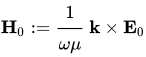
{\displaystyle \mathbf {H} _{0}:={\cfrac {1}{\omega \mu }}~\mathbf {k} \times \mathbf {E} _{0}}
we then get
H
0
i
=
κ
1
ω
μ
1
E
i
e
2
⟹
H
i
:=
|
H
0
i
|
=
κ
1
E
i
ω
μ
1
H
0
r
=
−
κ
1
ω
μ
1
E
r
e
2
⟹
H
r
:=
|
H
0
r
|
=
κ
1
E
r
ω
μ
1
H
0
t
=
κ
2
ω
μ
2
E
t
e
2
⟹
H
t
:=
|
H
0
t
|
=
κ
2
E
t
ω
μ
2
.
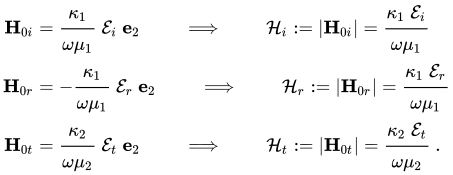
{\displaystyle {\begin{aligned}\mathbf {H} _{0i}&={\cfrac {\kappa _{1}}{\omega \mu _{1}}}~{\mathcal {E}}_{i}~\mathbf {e} _{2}\qquad \implies \qquad {\mathcal {H}}_{i}:=|\mathbf {H} _{0i}|={\cfrac {\kappa _{1}~{\mathcal {E}}_{i}}{\omega \mu _{1}}}\\\mathbf {H} _{0r}&=-{\cfrac {\kappa _{1}}{\omega \mu _{1}}}~{\mathcal {E}}_{r}~\mathbf {e} _{2}\qquad \implies \qquad {\mathcal {H}}_{r}:=|\mathbf {H} _{0r}|={\cfrac {\kappa _{1}~{\mathcal {E}}_{r}}{\omega \mu _{1}}}\\\mathbf {H} _{0t}&={\cfrac {\kappa _{2}}{\omega \mu _{2}}}~{\mathcal {E}}_{t}~\mathbf {e} _{2}\qquad \implies \qquad {\mathcal {H}}_{t}:=|\mathbf {H} _{0t}|={\cfrac {\kappa _{2}~{\mathcal {E}}_{t}}{\omega \mu _{2}}}~.\end{aligned}}}
Hence, with the vector
x
{\displaystyle \mathbf {x} }
x
=
x
1
e
1
+
x
2
e
2
+
x
3
e
3
{\displaystyle \mathbf {x} =x_{1}~\mathbf {e} _{1}+x_{2}~\mathbf {e} _{2}+x_{3}~\mathbf {e} _{3}}
E
i
(
x
)
=
(
E
i
cos
θ
i
e
1
+
E
i
sin
θ
i
e
3
)
e
i
[
κ
1
(
x
1
sin
θ
i
−
x
3
cos
θ
i
)
]
E
r
(
x
)
=
(
−
E
r
cos
θ
r
e
1
+
E
r
sin
θ
r
e
3
)
e
i
[
κ
1
(
x
1
sin
θ
r
+
x
3
cos
θ
r
)
]
E
t
(
x
)
=
(
E
t
cos
θ
t
e
1
+
E
t
sin
θ
t
e
3
)
e
i
[
κ
2
(
x
1
sin
θ
t
−
x
3
cos
θ
t
)
]
.
{\displaystyle {\begin{aligned}\mathbf {E} _{i}(\mathbf {x} )&=({\mathcal {E}}_{i}~\cos \theta _{i}~\mathbf {e} _{1}+{\mathcal {E}}_{i}~\sin \theta _{i}~\mathbf {e} _{3})~e^{i[\kappa _{1}(x_{1}\sin \theta _{i}-x_{3}\cos \theta _{i})]}\\\mathbf {E} _{r}(\mathbf {x} )&=(-{\mathcal {E}}_{r}~\cos \theta _{r}~\mathbf {e} _{1}+{\mathcal {E}}_{r}~\sin \theta _{r}~\mathbf {e} _{3})~e^{i[\kappa _{1}(x_{1}\sin \theta _{r}+x_{3}\cos \theta _{r})]}\\\mathbf {E} _{t}(\mathbf {x} )&=({\mathcal {E}}_{t}~\cos \theta _{t}~\mathbf {e} _{1}+{\mathcal {E}}_{t}~\sin \theta _{t}~\mathbf {e} _{3})~e^{i[\kappa _{2}(x_{1}\sin \theta _{t}-x_{3}\cos \theta _{t})]}~.\end{aligned}}}
Similarly,
H
i
(
x
)
=
−
H
i
e
2
e
i
[
κ
1
(
x
1
sin
θ
i
−
x
3
cos
θ
i
)
]
H
r
(
x
)
=
−
H
r
e
2
e
i
[
κ
1
(
x
1
sin
θ
r
+
x
3
cos
θ
r
)
]
H
t
(
x
)
=
−
H
t
e
2
e
i
[
κ
2
(
x
1
sin
θ
t
−
x
3
cos
θ
t
)
]
.
{\displaystyle {\begin{aligned}\mathbf {H} _{i}(\mathbf {x} )&=-{\mathcal {H}}_{i}~\mathbf {e} _{2}~~e^{i[\kappa _{1}(x_{1}\sin \theta _{i}-x_{3}\cos \theta _{i})]}\\\mathbf {H} _{r}(\mathbf {x} )&=-{\mathcal {H}}_{r}~\mathbf {e} _{2}~~e^{i[\kappa _{1}(x_{1}\sin \theta _{r}+x_{3}\cos \theta _{r})]}\\\mathbf {H} _{t}(\mathbf {x} )&=-{\mathcal {H}}_{t}~\mathbf {e} _{2}~~e^{i[\kappa _{2}(x_{1}\sin \theta _{t}-x_{3}\cos \theta _{t})]}~.\end{aligned}}}
At the interface, continuity requires that the tangential components of
the vectors
E
{\displaystyle \mathbf {E} }
H
{\displaystyle \mathbf {H} }
H
0
{\displaystyle \mathbf {H} _{0}}
x
3
=
0
{\displaystyle x_{3}=0}
x
1
{\displaystyle x_{1}}
H
{\displaystyle \mathbf {H} }
H
i
+
H
r
=
H
t
.
{\displaystyle {\mathcal {H}}_{i}+{\mathcal {H}}_{r}={\mathcal {H}}_{t}~.}
In terms of the electric field, we then have
κ
1
ω
μ
1
E
i
+
κ
1
ω
μ
1
E
r
=
κ
2
ω
μ
2
E
t
.
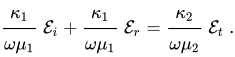
{\displaystyle {\cfrac {\kappa _{1}}{\omega \mu _{1}}}~{\mathcal {E}}_{i}+{\cfrac {\kappa _{1}}{\omega \mu _{1}}}~{\mathcal {E}}_{r}={\cfrac {\kappa _{2}}{\omega \mu _{2}}}~{\mathcal {E}}_{t}~.}
Recall that the refractive index is given by
n
=
c
0
/
c
=
c
0
κ
/
ω
{\displaystyle n=c_{0}/c=c_{0}~\kappa /\omega }
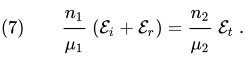
(7)
n
1
μ
1
(
E
i
+
E
r
)
=
n
2
μ
2
E
t
.
{\displaystyle {\text{(7)}}\qquad {{\cfrac {n_{1}}{\mu _{1}}}~({\mathcal {E}}_{i}+{\mathcal {E}}_{r})={\cfrac {n_{2}}{\mu _{2}}}~{\mathcal {E}}_{t}~.}}
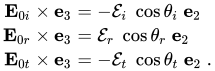
The tangential components of the
E
{\displaystyle \mathbf {E} }
E
×
e
3
{\displaystyle \mathbf {E} \times \mathbf {e} _{3}}
E
0
{\displaystyle \mathbf {E} _{0}}
E
0
i
×
e
3
=
−
E
i
cos
θ
i
e
2
E
0
r
×
e
3
=
E
r
cos
θ
r
e
2
E
0
t
×
e
3
=
−
E
t
cos
θ
t
e
2
.
{\displaystyle {\begin{aligned}\mathbf {E} _{0i}\times \mathbf {e} _{3}&=-{\mathcal {E}}_{i}~\cos \theta _{i}~\mathbf {e} _{2}\\\mathbf {E} _{0r}\times \mathbf {e} _{3}&={\mathcal {E}}_{r}~\cos \theta _{r}~\mathbf {e} _{2}\\\mathbf {E} _{0t}\times \mathbf {e} _{3}&=-{\mathcal {E}}_{t}~\cos \theta _{t}~\mathbf {e} _{2}~.\end{aligned}}}
Using the arbitrariness of
x
1
{\displaystyle x_{1}}
E
{\displaystyle \mathbf {E} }
E
i
cos
θ
i
−
E
r
cos
θ
r
=
E
t
cos
θ
t
.
{\displaystyle {\mathcal {E}}_{i}~\cos \theta _{i}-{\mathcal {E}}_{r}~\cos \theta _{r}={\mathcal {E}}_{t}~\cos \theta _{t}~.}
Since
θ
i
=
θ
r
{\displaystyle \theta _{i}=\theta _{r}}
(8)
(
E
i
−
E
r
)
cos
θ
i
=
E
t
cos
θ
t
.
{\displaystyle {\text{(8)}}\qquad {({\mathcal {E}}_{i}-{\mathcal {E}}_{r})~\cos \theta _{i}={\mathcal {E}}_{t}~\cos \theta _{t}~.}}
From equations (7) and (8), we get two
more relations:
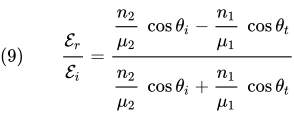
(9)
E
r
E
i
=
n
2
μ
2
cos
θ
i
−
n
1
μ
1
cos
θ
t
n
2
μ
2
cos
θ
i
+
n
1
μ
1
cos
θ
t
{\displaystyle {\text{(9)}}\qquad {{\cfrac {{\mathcal {E}}_{r}}{{\mathcal {E}}_{i}}}={\cfrac {{\cfrac {n_{2}}{\mu _{2}}}~\cos \theta _{i}-{\cfrac {n_{1}}{\mu _{1}}}~\cos \theta _{t}}{{\cfrac {n_{2}}{\mu _{2}}}~\cos \theta _{i}+{\cfrac {n_{1}}{\mu _{1}}}~\cos \theta _{t}}}}}
and
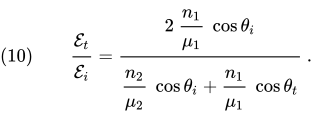
(10)
E
t
E
i
=
2
n
1
μ
1
cos
θ
i
n
2
μ
2
cos
θ
i
+
n
1
μ
1
cos
θ
t
.
{\displaystyle {\text{(10)}}\qquad {{\cfrac {{\mathcal {E}}_{t}}{{\mathcal {E}}_{i}}}={\cfrac {2~{\cfrac {n_{1}}{\mu _{1}}}~\cos \theta _{i}}{{\cfrac {n_{2}}{\mu _{2}}}~\cos \theta _{i}+{\cfrac {n_{1}}{\mu _{1}}}~\cos \theta _{t}}}~.}}
Equations (7), (8), (9),
and (10) are the Fresnel equations for
p
{\displaystyle p}
If we define,
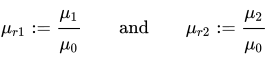
μ
r
1
:=
μ
1
μ
0
and
μ
r
2
:=
μ
2
μ
0
{\displaystyle \mu _{r1}:={\cfrac {\mu _{1}}{\mu _{0}}}\qquad {\text{and}}\qquad \mu _{r2}:={\cfrac {\mu _{2}}{\mu _{0}}}}
where
μ
0
{\displaystyle \mu _{0}}
(11)
E
r
E
i
=
n
2
μ
r
2
cos
θ
i
−
n
1
μ
r
1
cos
θ
t
n
2
μ
r
2
cos
θ
i
+
n
1
μ
r
1
cos
θ
t
;
E
t
E
i
=
2
n
1
μ
r
1
cos
θ
i
n
2
μ
r
2
cos
θ
i
+
n
1
μ
r
1
cos
θ
t
.
{\displaystyle {\text{(11)}}\qquad {\cfrac {{\mathcal {E}}_{r}}{{\mathcal {E}}_{i}}}={\cfrac {{\cfrac {n_{2}}{\mu _{r2}}}~\cos \theta _{i}-{\cfrac {n_{1}}{\mu _{r1}}}~\cos \theta _{t}}{{\cfrac {n_{2}}{\mu _{r2}}}~\cos \theta _{i}+{\cfrac {n_{1}}{\mu _{r1}}}~\cos \theta _{t}}}~;~~{\cfrac {{\mathcal {E}}_{t}}{{\mathcal {E}}_{i}}}={\cfrac {2~{\cfrac {n_{1}}{\mu _{r1}}}~\cos \theta _{i}}{{\cfrac {n_{2}}{\mu _{r2}}}~\cos \theta _{i}+{\cfrac {n_{1}}{\mu _{r1}}}~\cos \theta _{t}}}~.}
Note that
n
2
μ
r
2
cos
θ
i
=
n
1
μ
r
1
cos
θ
t
⟹
E
r
=
0
.
{\displaystyle {\cfrac {n_{2}}{\mu _{r2}}}~\cos \theta _{i}={\cfrac {n_{1}}{\mu _{r1}}}~\cos \theta _{t}\qquad \implies \qquad {\mathcal {E}}_{r}=0~.}
For non-magnetic materials we have
μ
r
1
=
μ
r
2
=
1
{\displaystyle \mu _{r1}=\mu _{r2}=1}
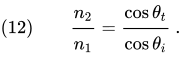
(12)
n
2
n
1
=
cos
θ
t
cos
θ
i
.
{\displaystyle {\text{(12)}}\qquad {\cfrac {n_{2}}{n_{1}}}={\cfrac {\cos \theta _{t}}{\cos \theta _{i}}}~.}
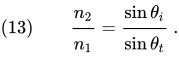
Also, from Snell's law
(13)
n
2
n
1
=
sin
θ
i
sin
θ
t
.
{\displaystyle {\text{(13)}}\qquad {\cfrac {n_{2}}{n_{1}}}={\cfrac {\sin \theta _{i}}{\sin \theta _{t}}}~.}
Combining equations (12) and (13), we get
cos
θ
t
sin
θ
t
−
cos
θ
i
sin
θ
i
=
0
⟹
sin
(
2
θ
t
)
−
sin
(
2
θ
i
)
=
0
⟹
cos
(
θ
t
+
θ
i
)
sin
(
θ
t
−
θ
i
)
=
0
.
{\displaystyle \cos \theta _{t}~\sin \theta _{t}-\cos \theta _{i}~\sin \theta _{i}=0\quad \implies \quad \sin(2~\theta _{t})-\sin(2~\theta _{i})=0\quad \implies \quad \cos(\theta _{t}+\theta _{i})~\sin(\theta _{t}-\theta _{i})=0~.}
If
n
1
≠
n
2
{\displaystyle n_{1}\neq n_{2}}
sin
(
θ
t
−
θ
i
)
≠
0
{\displaystyle \sin(\theta _{t}-\theta _{i})\neq 0}
(14)
cos
(
θ
t
+
θ
i
)
=
0
⟹
θ
t
+
θ
i
=
π
2
.
{\displaystyle {\text{(14)}}\qquad \cos(\theta _{t}+\theta _{i})=0\qquad \implies \qquad {\theta _{t}+\theta _{i}={\cfrac {\pi }{2}}}~.}
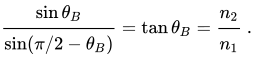
This is the condition that defines Brewster's angle
(
θ
i
=
θ
B
{\displaystyle \theta _{i}=\theta _{B}}
sin
θ
B
sin
(
π
/
2
−
θ
B
)
=
tan
θ
B
=
n
2
n
1
.
{\displaystyle {\cfrac {\sin \theta _{B}}{\sin(\pi /2-\theta _{B})}}=\tan \theta _{B}={\cfrac {n_{2}}{n_{1}}}~.}
This relation can be used to solve for Brewster's angle for various media.
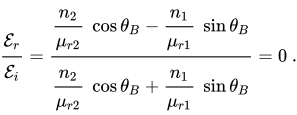
At Brewster's angle, we have
E
r
E
i
=
n
2
μ
r
2
cos
θ
B
−
n
1
μ
r
1
sin
θ
B
n
2
μ
r
2
cos
θ
B
+
n
1
μ
r
1
sin
θ
B
=
0
.
{\displaystyle {\cfrac {{\mathcal {E}}_{r}}{{\mathcal {E}}_{i}}}={\cfrac {{\cfrac {n_{2}}{\mu _{r2}}}~\cos \theta _{B}-{\cfrac {n_{1}}{\mu _{r1}}}~\sin \theta _{B}}{{\cfrac {n_{2}}{\mu _{r2}}}~\cos \theta _{B}+{\cfrac {n_{1}}{\mu _{r1}}}~\sin \theta _{B}}}=0~.}
Hence, the sign of
E
r
/
E
i
{\displaystyle {\mathcal {E}}_{r}/{\mathcal {E}}_{i}}
Also, note that if
n
2
=
−
n
1
{\displaystyle n_{2}=-n_{1}}
μ
2
=
−
μ
1
{\displaystyle \mu _{2}=-\mu _{1}}
n
=
c
0
ϵ
μ
{\displaystyle n=c_{0}~{\sqrt {\epsilon \mu }}}
ϵ
2
=
−
ϵ
1
{\displaystyle \epsilon _{2}=-\epsilon _{1}}
sin
θ
t
sin
θ
i
=
−
1
⟹
θ
t
=
−
θ
i
.
{\displaystyle {\cfrac {\sin \theta _{t}}{\sin \theta _{i}}}=-1\qquad \implies \qquad \theta _{t}=-\theta _{i}~.}
Hence,
E
r
E
i
=
n
1
μ
r
1
cos
θ
i
−
n
1
μ
r
1
cos
θ
i
n
1
μ
r
1
cos
θ
i
+
n
1
μ
r
1
cos
θ
i
=
0
and
E
t
E
i
=
2
n
1
μ
r
1
cos
θ
i
n
1
μ
r
1
cos
θ
i
+
n
1
μ
r
1
cos
θ
i
=
1
.
{\displaystyle {\cfrac {{\mathcal {E}}_{r}}{{\mathcal {E}}_{i}}}={\cfrac {{\cfrac {n_{1}}{\mu _{r1}}}~\cos \theta _{i}-{\cfrac {n_{1}}{\mu _{r1}}}~\cos \theta _{i}}{{\cfrac {n_{1}}{\mu _{r1}}}~\cos \theta _{i}+{\cfrac {n_{1}}{\mu _{r1}}}~\cos \theta _{i}}}=0\qquad {\text{and}}\qquad {\cfrac {{\mathcal {E}}_{t}}{{\mathcal {E}}_{i}}}={\cfrac {2~{\cfrac {n_{1}}{\mu _{r1}}}~\cos \theta _{i}}{{\cfrac {n_{1}}{\mu _{r1}}}~\cos \theta _{i}+{\cfrac {n_{1}}{\mu _{r1}}}~\cos \theta _{i}}}=1~.}
So the radiation is transmitted at the angle
θ
t
=
−
θ
i
{\displaystyle \theta _{t}=-\theta _{i}}
More can be said about the matter. In fact, an interface separating media
with
ϵ
2
=
−
ϵ
1
{\displaystyle \epsilon _{2}=-\epsilon _{1}}
μ
2
=
−
μ
1
{\displaystyle \mu _{2}=-\mu _{1}}
E
{\displaystyle \mathbf {E} }
H
{\displaystyle \mathbf {H} }
∇
×
E
+
i
ω
μ
1
H
=
0
;
∇
×
H
−
i
ω
ϵ
1
E
=
0
.
{\displaystyle {\boldsymbol {\nabla }}\times \mathbf {E} +i\omega ~\mu _{1}~\mathbf {H} ={\boldsymbol {0}}~;~~{\boldsymbol {\nabla }}\times \mathbf {H} -i\omega ~\epsilon _{1}~\mathbf {E} ={\boldsymbol {0}}~.}
Let the solution be of the form
E
(
x
)
=
[
E
1
(
x
)
,
E
2
(
x
)
,
E
3
(
x
)
]
and
H
(
x
)
=
[
H
1
(
x
)
,
H
2
(
x
)
,
H
3
(
x
)
]
.
{\displaystyle \mathbf {E} (\mathbf {x} )=[E_{1}(\mathbf {x} ),E_{2}(\mathbf {x} ),E_{3}(\mathbf {x} )]~~{\text{and}}~~\mathbf {H} (\mathbf {x} )=[H_{1}(\mathbf {x} ),H_{2}(\mathbf {x} ),H_{3}(\mathbf {x} )]~.}
Suppose that the right hand side of the interface has reflected fields,
i.e.,
E
(
x
)
=
[
−
E
1
(
−
x
1
,
x
2
,
x
3
)
,
E
2
(
−
x
1
,
x
2
,
x
3
)
,
E
3
(
−
x
1
,
x
2
,
x
3
)
]
and
H
(
x
)
=
[
−
H
1
(
−
x
1
,
x
2
,
x
3
)
,
H
2
(
−
x
1
,
x
2
,
x
3
)
,
H
3
(
−
x
1
,
x
2
,
x
3
)
]
.
{\displaystyle {\begin{aligned}\mathbf {E} (\mathbf {x} )&=[-E_{1}(-x_{1},x_{2},x_{3}),E_{2}(-x_{1},x_{2},x_{3}),E_{3}(-x_{1},x_{2},x_{3})]~~{\text{and}}~~\\\mathbf {H} (\mathbf {x} )&=[-H_{1}(-x_{1},x_{2},x_{3}),H_{2}(-x_{1},x_{2},x_{3}),H_{3}(-x_{1},x_{2},x_{3})]~.\end{aligned}}}
Figure 5. Reflection at an interface due to negative
ϵ
{\displaystyle \epsilon }
μ
{\displaystyle \mu }
Also, on the right hand side, let
∇
×
E
=
[
F
1
(
x
)
,
F
2
(
x
)
,
F
3
(
x
)
]
.
{\displaystyle {\boldsymbol {\nabla }}\times \mathbf {E} =[F_{1}(\mathbf {x} ),F_{2}(\mathbf {x} ),F_{3}(\mathbf {x} )]~.}
Then, to the right of the interface, we have
∇
×
E
=
{
[
∂
∂
x
2
[
E
3
(
−
x
1
,
x
2
,
x
3
)
]
−
∂
∂
x
3
[
E
2
(
−
x
1
,
x
2
,
x
3
)
]
]
,
[
−
∂
∂
x
3
[
E
1
(
−
x
1
,
x
2
,
x
3
)
]
+
∂
∂
x
1
[
E
3
(
−
x
1
,
x
2
,
x
3
)
]
]
,
[
−
∂
∂
x
1
[
E
2
(
−
x
1
,
x
2
,
x
3
)
]
+
∂
∂
x
2
[
E
1
(
−
x
1
,
x
2
,
x
3
)
]
]
}
{\displaystyle {\begin{aligned}{\boldsymbol {\nabla }}\times \mathbf {E} =&\left\{\left[{\frac {\partial }{\partial x_{2}}}[E_{3}(-x_{1},x_{2},x_{3})]-{\frac {\partial }{\partial x_{3}}}[E_{2}(-x_{1},x_{2},x_{3})]\right],\right.\\&\left[-{\frac {\partial }{\partial x_{3}}}[E_{1}(-x_{1},x_{2},x_{3})]+{\frac {\partial }{\partial x_{1}}}[E_{3}(-x_{1},x_{2},x_{3})]\right],\\&\left.\left[-{\frac {\partial }{\partial x_{1}}}[E_{2}(-x_{1},x_{2},x_{3})]+{\frac {\partial }{\partial x_{2}}}[E_{1}(-x_{1},x_{2},x_{3})]\right]\right\}\end{aligned}}}
or,
∇
×
E
=
[
F
1
(
−
x
1
,
x
2
,
x
3
)
,
−
F
2
(
−
x
1
,
x
2
,
x
3
)
,
−
F
3
(
x
1
,
x
2
,
x
3
)
]
.
{\displaystyle {\boldsymbol {\nabla }}\times \mathbf {E} =[F_{1}(-x_{1},x_{2},x_{3}),-F_{2}(-x_{1},x_{2},x_{3}),-F_{3}(x_{1},x_{2},x_{3})]~.}
Polarized wave with the Ei perpendicular to the plane of incidence [ edit | edit source ] For a plane polarized wave with the
E
i
{\displaystyle \mathbf {E} _{i}}
E
0
i
=
E
i
e
2
E
0
r
=
E
r
e
2
E
0
t
=
E
t
e
2
.
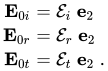
{\displaystyle {\begin{aligned}\mathbf {E} _{0i}&={\mathcal {E}}_{i}~\mathbf {e} _{2}\\\mathbf {E} _{0r}&={\mathcal {E}}_{r}~\mathbf {e} _{2}\\\mathbf {E} _{0t}&={\mathcal {E}}_{t}~\mathbf {e} _{2}~.\end{aligned}}}
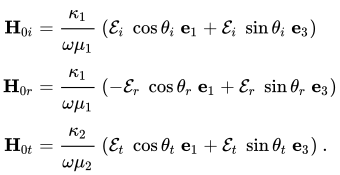
Therefore,
H
0
i
=
κ
1
ω
μ
1
(
E
i
cos
θ
i
e
1
+
E
i
sin
θ
i
e
3
)
H
0
r
=
κ
1
ω
μ
1
(
−
E
r
cos
θ
r
e
1
+
E
r
sin
θ
r
e
3
)
H
0
t
=
κ
2
ω
μ
2
(
E
t
cos
θ
t
e
1
+
E
t
sin
θ
t
e
3
)
.
{\displaystyle {\begin{aligned}\mathbf {H} _{0i}&={\cfrac {\kappa _{1}}{\omega \mu _{1}}}~({\mathcal {E}}_{i}~\cos \theta _{i}~\mathbf {e} _{1}+{\mathcal {E}}_{i}~\sin \theta _{i}~\mathbf {e} _{3})\\\mathbf {H} _{0r}&={\cfrac {\kappa _{1}}{\omega \mu _{1}}}~(-{\mathcal {E}}_{r}~\cos \theta _{r}~\mathbf {e} _{1}+{\mathcal {E}}_{r}~\sin \theta _{r}~\mathbf {e} _{3})\\\mathbf {H} _{0t}&={\cfrac {\kappa _{2}}{\omega \mu _{2}}}~({\mathcal {E}}_{t}~\cos \theta _{t}~\mathbf {e} _{1}+{\mathcal {E}}_{t}~\sin \theta _{t}~\mathbf {e} _{3})~.\end{aligned}}}
Continuity of tangential components of
E
{\displaystyle \mathbf {E} }
(15)
E
i
+
E
r
=
E
t
.
{\displaystyle {\text{(15)}}\qquad {{\mathcal {E}}_{i}+{\mathcal {E}}_{r}={\mathcal {E}}_{t}~.}}
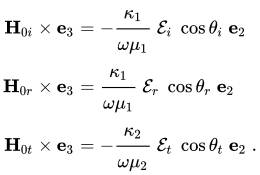
The tangential components of
H
0
{\displaystyle \mathbf {H} _{0}}
H
0
i
×
e
3
=
−
κ
1
ω
μ
1
E
i
cos
θ
i
e
2
H
0
r
×
e
3
=
κ
1
ω
μ
1
E
r
cos
θ
r
e
2
H
0
t
×
e
3
=
−
κ
2
ω
μ
2
E
t
cos
θ
t
e
2
.
{\displaystyle {\begin{aligned}\mathbf {H} _{0i}\times \mathbf {e} _{3}&=-{\cfrac {\kappa _{1}}{\omega \mu _{1}}}~{\mathcal {E}}_{i}~\cos \theta _{i}~\mathbf {e} _{2}\\\mathbf {H} _{0r}\times \mathbf {e} _{3}&={\cfrac {\kappa _{1}}{\omega \mu _{1}}}~{\mathcal {E}}_{r}~\cos \theta _{r}~\mathbf {e} _{2}\\\mathbf {H} _{0t}\times \mathbf {e} _{3}&=-{\cfrac {\kappa _{2}}{\omega \mu _{2}}}~{\mathcal {E}}_{t}~\cos \theta _{t}~\mathbf {e} _{2}~.\end{aligned}}}
From continuity at the interface and using the arbitrariness of
x
1
{\displaystyle x_{1}}
θ
i
=
θ
r
{\displaystyle \theta _{i}=\theta _{r}}
κ
1
ω
μ
1
(
E
i
−
E
r
)
cos
θ
i
=
κ
2
ω
μ
1
E
t
cos
θ
t
.
{\displaystyle {\cfrac {\kappa _{1}}{\omega \mu _{1}}}~({\mathcal {E}}_{i}-{\mathcal {E}}_{r})~\cos \theta _{i}={\cfrac {\kappa _{2}}{\omega \mu _{1}}}~{\mathcal {E}}_{t}~\cos \theta _{t}~.}
Using the relation
κ
=
n
ω
/
c
0
{\displaystyle \kappa =n~\omega /c_{0}}
(16)
n
1
μ
1
(
E
i
−
E
r
)
cos
θ
i
=
n
2
μ
2
E
t
cos
θ
t
.
{\displaystyle {\text{(16)}}\qquad {{\cfrac {n_{1}}{\mu _{1}}}~({\mathcal {E}}_{i}-{\mathcal {E}}_{r})~\cos \theta _{i}={\cfrac {n_{2}}{\mu _{2}}}~{\mathcal {E}}_{t}~\cos \theta _{t}~.}}
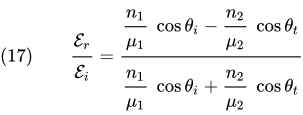
From equations (15) and (16), we get
(17)
E
r
E
i
=
n
1
μ
1
cos
θ
i
−
n
2
μ
2
cos
θ
t
n
1
μ
1
cos
θ
i
+
n
2
μ
2
cos
θ
t
{\displaystyle {\text{(17)}}\qquad {{\cfrac {{\mathcal {E}}_{r}}{{\mathcal {E}}_{i}}}={\cfrac {{\cfrac {n_{1}}{\mu _{1}}}~\cos \theta _{i}-{\cfrac {n_{2}}{\mu _{2}}}~\cos \theta _{t}}{{\cfrac {n_{1}}{\mu _{1}}}~\cos \theta _{i}+{\cfrac {n_{2}}{\mu _{2}}}~\cos \theta _{t}}}}}
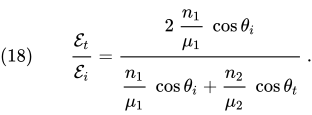
and
(18)
E
t
E
i
=
2
n
1
μ
1
cos
θ
i
n
1
μ
1
cos
θ
i
+
n
2
μ
2
cos
θ
t
.
{\displaystyle {\text{(18)}}\qquad {{\cfrac {{\mathcal {E}}_{t}}{{\mathcal {E}}_{i}}}={\cfrac {2~{\cfrac {n_{1}}{\mu _{1}}}~\cos \theta _{i}}{{\cfrac {n_{1}}{\mu _{1}}}~\cos \theta _{i}+{\cfrac {n_{2}}{\mu _{2}}}~\cos \theta _{t}}}~.}}
Equations (15), (16), (17), and (18) are the Fresnel equations a wave polarized with the
E
i
{\displaystyle \mathbf {E} _{i}}
(19)
E
r
E
i
=
n
1
μ
r
1
cos
θ
i
−
n
2
μ
r
2
cos
θ
t
n
1
μ
r
1
cos
θ
i
+
n
2
μ
r
2
cos
θ
t
;
E
t
E
i
=
2
n
1
μ
r
1
cos
θ
i
n
1
μ
r
1
cos
θ
i
+
n
2
μ
r
2
cos
θ
t
.
{\displaystyle {\text{(19)}}\qquad {\cfrac {{\mathcal {E}}_{r}}{{\mathcal {E}}_{i}}}={\cfrac {{\cfrac {n_{1}}{\mu _{r1}}}~\cos \theta _{i}-{\cfrac {n_{2}}{\mu _{r2}}}~\cos \theta _{t}}{{\cfrac {n_{1}}{\mu _{r1}}}~\cos \theta _{i}+{\cfrac {n_{2}}{\mu _{r2}}}~\cos \theta _{t}}}~;~~{\cfrac {{\mathcal {E}}_{t}}{{\mathcal {E}}_{i}}}={\cfrac {2~{\cfrac {n_{1}}{\mu _{r1}}}~\cos \theta _{i}}{{\cfrac {n_{1}}{\mu _{r1}}}~\cos \theta _{i}+{\cfrac {n_{2}}{\mu _{r2}}}~\cos \theta _{t}}}~.}
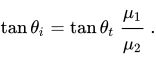
From the above equations, there is no reflected wave only if
tan
θ
i
=
tan
θ
t
μ
1
μ
2
.
{\displaystyle \tan \theta _{i}=\tan \theta _{t}~{\cfrac {\mu _{1}}{\mu _{2}}}~.}
This is only possible if there is no interface. Therefore, in the
presence of a interface, there is always a reflected wave for this situation.
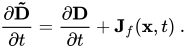
↑ The above relation for the permittivity tensor can be obtained as follows.
Recall that
D
~
(
x
,
t
)
=
D
(
x
,
t
)
+
∫
−
∞
t
J
f
(
x
,
τ
)
d
τ
.
{\displaystyle \mathbf {\tilde {D}} (\mathbf {x} ,t)=\mathbf {D} (\mathbf {x} ,t)+\int _{-\infty }^{t}\mathbf {J} _{f}(\mathbf {x} ,\tau )~{\text{d}}\tau ~.}
∂
D
~
∂
t
=
∂
D
∂
t
+
J
f
(
x
,
t
)
.
{\displaystyle {\frac {\partial \mathbf {\tilde {D}} }{\partial t}}={\frac {\partial \mathbf {D} }{\partial t}}+\mathbf {J} _{f}(\mathbf {x} ,t)~.}
D
~
(
x
,
t
)
=
D
~
^
(
x
)
exp
(
−
i
ω
t
)
;
D
(
x
,
t
)
=
D
^
(
x
)
exp
(
−
i
ω
t
)
;
J
f
(
x
,
t
)
=
J
^
f
(
x
)
exp
(
−
i
ω
t
)
;
E
(
x
,
t
)
=
E
^
(
x
)
exp
(
−
i
ω
t
)
{\displaystyle \mathbf {\tilde {D}} (\mathbf {x} ,t)={\widehat {\mathbf {\tilde {D}} }}(\mathbf {x} )~\exp(-i\omega t)~;~~\mathbf {D} (\mathbf {x} ,t)={\widehat {\mathbf {D} }}(\mathbf {x} )~\exp(-i\omega t)~;~~\mathbf {J} _{f}(\mathbf {x} ,t)={\widehat {\mathbf {J} }}_{f}(\mathbf {x} )~\exp(-i\omega t)~;~~\mathbf {E} (\mathbf {x} ,t)={\widehat {\mathbf {E} }}(\mathbf {x} )~\exp(-i\omega t)}
(
−
i
ω
)
D
~
^
(
x
)
=
(
−
i
ω
)
D
^
(
x
)
+
J
^
f
(
x
)
.
{\displaystyle (-i\omega ){\widehat {\mathbf {\tilde {D}} }}(\mathbf {x} )=(-i\omega ){\widehat {\mathbf {D} }}(\mathbf {x} )+{\widehat {\mathbf {J} }}_{f}(\mathbf {x} )~.}
J
f
{\displaystyle \mathbf {J} _{f}}
D
{\displaystyle \mathbf {D} }
E
{\displaystyle \mathbf {E} }
(1)
J
f
=
σ
⋅
E
;
D
=
ϵ
0
⋅
E
.
{\displaystyle {\text{(1)}}\qquad \mathbf {J} _{f}={\boldsymbol {\sigma }}\cdot \mathbf {E} ~;~~\mathbf {D} ={\boldsymbol {\epsilon }}_{0}\cdot \mathbf {E} ~.}
D
~
^
(
x
)
=
ϵ
0
⋅
E
^
(
x
)
+
i
ω
σ
⋅
E
^
(
x
)
=
ϵ
⋅
E
^
(
x
)
{\displaystyle {\widehat {\mathbf {\tilde {D}} }}(\mathbf {x} )={\boldsymbol {\epsilon }}_{0}\cdot {\widehat {\mathbf {E} }}(\mathbf {x} )+{\cfrac {i}{\omega }}~{\boldsymbol {\sigma }}\cdot {\widehat {\mathbf {E} }}(\mathbf {x} )={\boldsymbol {\epsilon }}\cdot {\widehat {\mathbf {E} }}(\mathbf {x} )}
ϵ
=
ϵ
0
+
i
ω
σ
.
{\displaystyle {\boldsymbol {\epsilon }}={\boldsymbol {\epsilon }}_{0}+{\cfrac {i}{\omega }}~{\boldsymbol {\sigma }}~.}
[Lorrain88] Electromagnetic fields and waves: including electric circuits . Freeman, New York, 1988.



























![{\displaystyle {\boldsymbol {\nabla }}\cdot \mathbf {E} ={\frac {\partial }{\partial x_{m}}}\left[E_{0m}~e^{i(k_{l}~x_{l})}\right]=i~k_{l}~{\frac {\partial x_{l}}{\partial x_{m}}}~E_{0m}~e^{i(k_{l}~x_{l})}=i~k_{m}~E_{0m}~e^{i(k_{l}~x_{l})}=i~(\mathbf {k} \cdot \mathbf {E} _{0})~e^{i(\mathbf {k} \cdot \mathbf {x} )}=0~.}](https://wikimedia.org/api/rest_v1/media/math/render/svg/62b6d85a9752a9b17f07d0b5cd775f07827f08b5)


![{\displaystyle {\boldsymbol {\nabla }}\cdot \mathbf {H} ={\cfrac {1}{\omega \mu }}\left[{\frac {\partial }{\partial x_{m}}}\left({\mathcal {E}}_{mpq}~k_{p}~E_{0q}~e^{i(k_{l}~x_{l})}\right)\right]={\cfrac {i}{\omega \mu }}\left[{\mathcal {E}}_{mpq}~k_{p}~E_{0q}~k_{m}~e^{i(k_{l}~x_{l})}\right]={\cfrac {i}{\omega \mu }}~\mathbf {k} \cdot (\mathbf {k} \times \mathbf {E} _{0})~e^{i(\mathbf {k} \cdot \mathbf {x} )}~.}](https://wikimedia.org/api/rest_v1/media/math/render/svg/014d97c6931f8339c3e03ec7545c52cfa0171253)

![{\displaystyle {\begin{aligned}\left[\nabla ^{2}\mathbf {E} +\kappa ^{2}~\mathbf {E} (\mathbf {x} )\right]_{n}&={\frac {\partial }{\partial x_{m}}}\left[{\frac {\partial }{\partial x_{m}}}\left(E_{0n}~e^{ik_{l}x_{l}}\right)\right]+\kappa ^{2}~E_{0n}~e^{ik_{l}x_{l}}\\&={\frac {\partial }{\partial x_{m}}}\left[E_{0n}~\left(i~k_{l}~{\frac {\partial x_{l}}{\partial x_{m}}}\right)~e^{ik_{l}x_{l}}\right]+\kappa ^{2}~E_{0n}~e^{ik_{l}x_{l}}\\&=i~E_{0n}~k_{m}~{\frac {\partial }{\partial x_{m}}}\left(e^{ik_{l}x_{l}}\right)+\kappa ^{2}~E_{0n}~e^{ik_{l}x_{l}}\\&=i~E_{0n}~k_{m}~\left(i~k_{l}~{\frac {\partial x_{l}}{\partial x_{m}}}\right)~e^{ik_{l}x_{l}}+\kappa ^{2}~E_{0n}~e^{ik_{l}x_{l}}\\&=-E_{0n}~k_{m}~k_{m}~e^{ik_{l}x_{l}}+\kappa ^{2}~E_{0n}~e^{ik_{l}x_{l}}~.\end{aligned}}}](https://wikimedia.org/api/rest_v1/media/math/render/svg/c2824297b0d90bc850059fff860088f3d0e76444)


![{\displaystyle {\begin{aligned}\left[\nabla ^{2}\mathbf {H} +\kappa ^{2}~\mathbf {H} (\mathbf {x} )\right]_{n}&={\cfrac {1}{\omega \mu }}\left\{{\frac {\partial }{\partial x_{m}}}\left[{\frac {\partial }{\partial x_{m}}}\left({\mathcal {E}}_{npq}~k_{p}~E_{0q}~e^{ik_{l}x_{l}}\right)\right]+\kappa ^{2}~{\mathcal {E}}_{npq}~k_{p}~E_{0q}~e^{ik_{l}x_{l}}\right\}\\&={\cfrac {1}{\omega \mu }}\left\{{\frac {\partial }{\partial x_{m}}}\left[{\mathcal {E}}_{npq}~k_{p}~E_{0q}~\left(i~k_{l}~{\frac {\partial x_{l}}{\partial x_{m}}}\right)~e^{ik_{l}x_{l}}\right]+\kappa ^{2}~{\mathcal {E}}_{npq}~k_{p}~E_{0q}~e^{ik_{l}x_{l}}\right\}\\&={\cfrac {1}{\omega \mu }}\left\{i~{\mathcal {E}}_{npq}~k_{p}~k_{m}~E_{0q}~\left[i~k_{l}~{\frac {\partial x_{l}}{\partial x_{m}}}\right]~e^{ik_{l}x_{l}}+\kappa ^{2}~{\mathcal {E}}_{npq}~k_{p}~E_{0q}~e^{ik_{l}x_{l}}\right\}\\&={\cfrac {1}{\omega \mu }}\left\{-{\mathcal {E}}_{npq}~k_{p}~k_{m}~k_{m}~E_{0q}~e^{ik_{l}x_{l}}+\kappa ^{2}~{\mathcal {E}}_{npq}~k_{p}~E_{0q}~e^{ik_{l}x_{l}}\right\}\end{aligned}}}](https://wikimedia.org/api/rest_v1/media/math/render/svg/7d21268a329ee81f3207b79fe379afe4d197c72e)


















![{\displaystyle {\begin{aligned}\mathbf {E} _{i}(\mathbf {x} )&=({\mathcal {E}}_{i}~\cos \theta _{i}~\mathbf {e} _{1}+{\mathcal {E}}_{i}~\sin \theta _{i}~\mathbf {e} _{3})~e^{i[\kappa _{1}(x_{1}\sin \theta _{i}-x_{3}\cos \theta _{i})]}\\\mathbf {E} _{r}(\mathbf {x} )&=(-{\mathcal {E}}_{r}~\cos \theta _{r}~\mathbf {e} _{1}+{\mathcal {E}}_{r}~\sin \theta _{r}~\mathbf {e} _{3})~e^{i[\kappa _{1}(x_{1}\sin \theta _{r}+x_{3}\cos \theta _{r})]}\\\mathbf {E} _{t}(\mathbf {x} )&=({\mathcal {E}}_{t}~\cos \theta _{t}~\mathbf {e} _{1}+{\mathcal {E}}_{t}~\sin \theta _{t}~\mathbf {e} _{3})~e^{i[\kappa _{2}(x_{1}\sin \theta _{t}-x_{3}\cos \theta _{t})]}~.\end{aligned}}}](https://wikimedia.org/api/rest_v1/media/math/render/svg/57412208d9c38be140277870a427f9ee287c098c)
![{\displaystyle {\begin{aligned}\mathbf {H} _{i}(\mathbf {x} )&=-{\mathcal {H}}_{i}~\mathbf {e} _{2}~~e^{i[\kappa _{1}(x_{1}\sin \theta _{i}-x_{3}\cos \theta _{i})]}\\\mathbf {H} _{r}(\mathbf {x} )&=-{\mathcal {H}}_{r}~\mathbf {e} _{2}~~e^{i[\kappa _{1}(x_{1}\sin \theta _{r}+x_{3}\cos \theta _{r})]}\\\mathbf {H} _{t}(\mathbf {x} )&=-{\mathcal {H}}_{t}~\mathbf {e} _{2}~~e^{i[\kappa _{2}(x_{1}\sin \theta _{t}-x_{3}\cos \theta _{t})]}~.\end{aligned}}}](https://wikimedia.org/api/rest_v1/media/math/render/svg/926388d0e81313b403b68190408521a7ad247cfb)
























![{\displaystyle \mathbf {E} (\mathbf {x} )=[E_{1}(\mathbf {x} ),E_{2}(\mathbf {x} ),E_{3}(\mathbf {x} )]~~{\text{and}}~~\mathbf {H} (\mathbf {x} )=[H_{1}(\mathbf {x} ),H_{2}(\mathbf {x} ),H_{3}(\mathbf {x} )]~.}](https://wikimedia.org/api/rest_v1/media/math/render/svg/d304e457c0df105e247ef1e5e2847958758c6900)
![{\displaystyle {\begin{aligned}\mathbf {E} (\mathbf {x} )&=[-E_{1}(-x_{1},x_{2},x_{3}),E_{2}(-x_{1},x_{2},x_{3}),E_{3}(-x_{1},x_{2},x_{3})]~~{\text{and}}~~\\\mathbf {H} (\mathbf {x} )&=[-H_{1}(-x_{1},x_{2},x_{3}),H_{2}(-x_{1},x_{2},x_{3}),H_{3}(-x_{1},x_{2},x_{3})]~.\end{aligned}}}](https://wikimedia.org/api/rest_v1/media/math/render/svg/625cee78d114f79340ca0789db131961c7b39675)

![{\displaystyle {\boldsymbol {\nabla }}\times \mathbf {E} =[F_{1}(\mathbf {x} ),F_{2}(\mathbf {x} ),F_{3}(\mathbf {x} )]~.}](https://wikimedia.org/api/rest_v1/media/math/render/svg/95ed1739ffd5e9f7c9f2022081c94391687f2f47)
![{\displaystyle {\begin{aligned}{\boldsymbol {\nabla }}\times \mathbf {E} =&\left\{\left[{\frac {\partial }{\partial x_{2}}}[E_{3}(-x_{1},x_{2},x_{3})]-{\frac {\partial }{\partial x_{3}}}[E_{2}(-x_{1},x_{2},x_{3})]\right],\right.\\&\left[-{\frac {\partial }{\partial x_{3}}}[E_{1}(-x_{1},x_{2},x_{3})]+{\frac {\partial }{\partial x_{1}}}[E_{3}(-x_{1},x_{2},x_{3})]\right],\\&\left.\left[-{\frac {\partial }{\partial x_{1}}}[E_{2}(-x_{1},x_{2},x_{3})]+{\frac {\partial }{\partial x_{2}}}[E_{1}(-x_{1},x_{2},x_{3})]\right]\right\}\end{aligned}}}](https://wikimedia.org/api/rest_v1/media/math/render/svg/fee80b90725b83c269e69ca60f4c962ae53467c4)
![{\displaystyle {\boldsymbol {\nabla }}\times \mathbf {E} =[F_{1}(-x_{1},x_{2},x_{3}),-F_{2}(-x_{1},x_{2},x_{3}),-F_{3}(x_{1},x_{2},x_{3})]~.}](https://wikimedia.org/api/rest_v1/media/math/render/svg/c3d2a652d2cd049f92749d0d8d35d8cf3ea2d0dd)