In the previous lecture, we discussed viscoelastic materials and
wondered why the Maxwell model works even though
the effective Young's modulus for such materials is
analytic in the entire complex plane (except for a few isolated points).
Recall that the Maxwell model (see Figure 1)
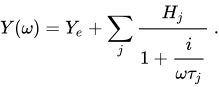
predicts that the frequency dependent Young's modulus of the system
is given by
Figure 1. A generalized Maxwell model for viscoelasticity.
This implies that the function is analytic in the entire
imaginary plane except for poles at . On the
other hand, for the frequency dependent metamaterials that we have discussed
earlier, the effective modulus is generally analytic only in the upper half
plane (see Figure~2). Also, for such materials,
, where indicates the complex
conjugate. Note that we do not consider the mass when we derive the
modulus of the Maxwell model. The relation between viscoelastic models of
the Maxwell type and general frequency dependent materials continues to
be an open question.
Figure 2. Poles for a general frequency-dependent material vs. poles for a generalized Maxwell model.
A justification of the Maxwell model can be provided by considering the
behavior of viscoelastic materials (Christ03). Consider an
experiment where a bar of viscoelastic material of length is deformed
by a fixed amount. We want to see how the stress changes with time.
Recall, that if the bar is extended by an amount where at
one end of the bar, then the one-dimensional strain is defined as
Therefore, the displacement in the bar can be expressed in terms of the
strain as
Also, if is the applied force on the bar and is its cross-sectional
area, then the stress is given by
Let us now apply a strain to the bar at time and hold the strain
fixed. Due to the initial application of the strain, the stress reaches
a value and then relaxes at time increase (due to the relaxation of
polymer chains for instance). Figure 3 shows a
schematic of this situation.
Figure 3. One-dimensional stress relaxation of a viscoelastic material.
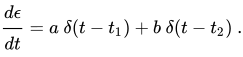
If the strain is applied by the superposition of a two step strains as
shown in the figure, we have
The stress is then given by
If the strain is applied by a series of infinitesimal steps, then we
get a more general form for the stress:
where the integral should be interpreted in the distributional sense.
Integrating by parts (and assuming that at ),
we get
Now, clearly depends on past values of . We
expect should have a stronger dependence on in
the recent past than in the distant past. More precisely, the dependence
should decrease monotonically as increases. This
implies that should decrease at increases, i.e.,
This is the assumption of fading memmory.
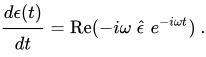
From equation (1) the rate of change of is given by
Again, we expect to have a stronger dependence on
in the recent past than in the far past, i.e,.
Now,
Such functions are said to be completely monotonic. An example is
More generally,
is completely monotonic if for all and
. The function is called the {\bf relaxation
spectrum.}
Conversely, any completely monotonic function can be written in this form
(Bernstein28).
Specifically, if
then
Therefore,
Let . Then
Define
Then we have
If we define
we get
Now, let be a completely monotonic function of the form
Then from equation (2) we get
Assume that has a very small poistive imaginary part (which implies
that increases very slowly as goes to ). Then
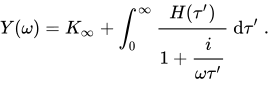
or,
This is the generalized Maxwell model.
This brings up the question: Is the assumption of fading memory always
correct?
Recall the model of the Helmholtz resonator shown in
Figure~4.
Figure 4. A model of the Helmholtz resonator.[hb]
If we apply a strain in the form of a step function to this model, the
resulting stress response is not a monotonically decreasing function
of time. Rather if oscillates around a certain value and may damp out
over time. A similar oscillatory behavior is expected in other spring-mass
systems and will, in general, not be monotonic.
A short interlude: Maxwell's equations in Elasticity Form[edit | edit source]
In this section, we discuss how Maxwell's equation can be reduced to the
form of the elasticity equations. Recall that, at a fixed ,
Maxwell's equation take the form
Therefore,
Recall that, in index notation and using the summation convention, we
have
where is the permutation tensor defined as
Therefore,
or,
This is very similar to the elasticity equation
The permittivity is similar to a negative density and the electric field
is similar to the displacement. The equations also hint at a tensorial
density. However, continuity conditions are
different for the two equations, i.e., at an interface, is
continuous while only the tangential component of is continuous.
Also, the tensor has different symmetries for the two situations.
Interestingly, for Maxwell's equations
A detail exposition of waves in layer media can be found in Chew95.
In this section we examine a few features of electromagnetic waves in
layered media.
Assume that the permittivity and permeability are scalars and are
locally isotropic though not globally so. Then we may write
The TE (transverse electric field) equations are given by
where represents the two-dimensional gradient operator.
Multiplying (3) by , we have
Equation (4) admits solutions of the form
and equation (4) then becomes an ODE:
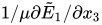
The quantity
can be less than zero, implying that may be complex. Also,
at the boundary, both and
must be continuous.
Similarly, for TM (transverse magnetic) waves, we have











































![{\displaystyle \omega ^{2}~{\boldsymbol {\epsilon }}\cdot \mathbf {E} =i\omega ~{\boldsymbol {\nabla }}\times \mathbf {H} ={\boldsymbol {\nabla }}\times [{\boldsymbol {\mu }}^{-1}\cdot ({\boldsymbol {\nabla }}\times \mathbf {E} )]~.}](https://wikimedia.org/api/rest_v1/media/math/render/svg/806999bbde066ab87649c0f476634bf4e9acfcfa)
![{\displaystyle [{\boldsymbol {\nabla }}\times \mathbf {a} ]_{i}={\mathcal {E}}_{ijk}~{\frac {\partial a_{k}}{\partial x_{j}}}}](https://wikimedia.org/api/rest_v1/media/math/render/svg/8060e47eccff82f6c9fb19e3eb3b87427286b6c1)


![{\displaystyle {\begin{aligned}\left[\omega ^{2}~{\boldsymbol {\epsilon }}\cdot \mathbf {E} \right]_{j}&={\mathcal {E}}_{jim}~{\frac {\partial }{\partial x_{i}}}[{\boldsymbol {\mu }}^{-1}\cdot ({\boldsymbol {\nabla }}\times \mathbf {E} )]_{m}\\&={\mathcal {E}}_{jim}~{\frac {\partial }{\partial x_{i}}}[({\boldsymbol {\mu }}^{-1})_{mn}~({\boldsymbol {\nabla }}\times \mathbf {E} )_{n}]\\&={\mathcal {E}}_{jim}~{\frac {\partial }{\partial x_{i}}}[({\boldsymbol {\mu }}^{-1})_{mn}~{\mathcal {E}}_{nkl}~{\frac {\partial E_{l}}{\partial x_{k}}}]\\&={\frac {\partial }{\partial x_{i}}}[C_{ijkl}{\frac {\partial E_{l}}{\partial x_{k}}}]\quad {\text{where}}\quad C_{ijkl}:={\mathcal {E}}_{jim}~{\mathcal {E}}_{nkl}~[{\boldsymbol {\mu }}^{-1}]_{mn}\end{aligned}}}](https://wikimedia.org/api/rest_v1/media/math/render/svg/51d865282f8dd1d7e8de2df4ee18473c2266117f)









![{\displaystyle {\text{(4)}}\qquad \left[{\frac {\partial }{\partial x_{2}^{2}}}+\mu (x_{3})~{\frac {\partial }{\partial x_{3}}}\left({\cfrac {1}{\mu (x_{3})}}~{\frac {\partial }{\partial x_{3}}}\right)+\omega ^{2}~\epsilon (x_{3})~\mu (x_{3})\right]~E_{1}=0~.}](https://wikimedia.org/api/rest_v1/media/math/render/svg/eb99111b0421ea491898f9e3c8b41c4e25f66bd2)

![{\displaystyle {\text{(5)}}\qquad \left[\mu (x_{3})~{\cfrac {d}{dx_{3}}}\left({\cfrac {1}{\mu (x_{3})}}~{\cfrac {d}{dx_{3}}}\right)+\omega ^{2}~\epsilon (x_{3})~\mu (x_{3})-k_{2}^{2}\right]~{\tilde {E}}_{1}=0~.}](https://wikimedia.org/api/rest_v1/media/math/render/svg/ac8f19f0c96075da338fc6d3db002e3e893fa714)




![{\displaystyle {\text{(6)}}\qquad \left[\epsilon (x_{3})~{\cfrac {d}{dx_{3}}}\left({\cfrac {1}{\epsilon (x_{3})}}~{\cfrac {d}{dx_{3}}}\right)+\omega ^{2}~\epsilon (x_{3})~\mu (x_{3})-k_{2}^{2}\right]~{\tilde {H}}_{1}=0~.}](https://wikimedia.org/api/rest_v1/media/math/render/svg/dca4d329f4f88e869da6a684f86c59d3b75b65db)