The content of these notes is based on the lectures by Prof. Graeme W. Milton (University of Utah) given in a course on metamaterials in Spring 2007.
Recall from the previous lecture that the average rate of work done in a cycle
of oscillation of material with frequency dependent mass is
P
=
ω
2
π
∫
0
2
π
/
ω
F
(
t
)
⋅
V
(
t
)
d
t
=
Re
(
F
^
)
⋅
Re
(
V
^
)
+
Im
(
F
^
)
⋅
Im
(
V
^
)
2
=
ω
[
Re
(
V
^
)
⋅
Im
[
M
(
ω
)
]
⋅
Re
(
V
^
)
+
Im
(
V
^
)
⋅
Im
[
M
(
ω
)
]
⋅
Im
(
V
^
)
]
.
{\displaystyle {\begin{aligned}{\mathcal {P}}&={\cfrac {\omega }{2~\pi }}\int _{0}^{2\pi /\omega }~\mathbf {F} (t)\cdot \mathbf {V} (t)~{\text{d}}t\\&={\cfrac {{\text{Re}}({\widehat {\mathbf {F} }})\cdot {\text{Re}}({\widehat {\mathbf {V} }})+{\text{Im}}({\widehat {\mathbf {F} }})\cdot {\text{Im}}({\widehat {\mathbf {V} }})}{2}}\\&=\omega ~[{\text{Re}}({\widehat {\mathbf {V} }})\cdot {\text{Im}}[{\boldsymbol {M}}(\omega )]\cdot {\text{Re}}({\widehat {\mathbf {V} }})+{\text{Im}}({\widehat {\mathbf {V} }})\cdot {\text{Im}}[{\boldsymbol {M}}(\omega )]\cdot {\text{Im}}({\widehat {\mathbf {V} }})].\end{aligned}}}
This quadratic form will be non-negative for all choices of
V
^
{\displaystyle {\widehat {\mathbf {V} }}}
Im
(
M
(
ω
)
)
{\displaystyle {\text{Im}}({\boldsymbol {M}}(\omega ))}
ω
>
0
{\displaystyle \omega >0}
Im
[
M
(
ω
)
]
≥
0
.
{\displaystyle {{\text{Im}}[{\boldsymbol {M}}(\omega )]\geq 0~.}}
Similarly, for electrodynamics, the average power dissipated into heat
is given by
(1)
P
=
ω
2
π
∫
0
2
π
/
ω
[
E
(
t
)
⋅
∂
D
(
t
)
∂
t
+
H
(
t
)
⋅
∂
B
(
t
)
∂
t
]
d
t
.
{\displaystyle {\text{(1)}}\qquad {\mathcal {P}}={\cfrac {\omega }{2~\pi }}\int _{0}^{2\pi /\omega }~\left[\mathbf {E} (t)\cdot {\frac {\partial \mathbf {D} (t)}{\partial t}}+\mathbf {H} (t)\cdot {\frac {\partial \mathbf {B} (t)}{\partial t}}\right]~dt~.}
In this case, the quantity
E
{\displaystyle \mathbf {E} }
∂
D
/
∂
t
{\displaystyle \partial \mathbf {D} /\partial t}
P
=
V
I
{\displaystyle {\mathcal {P}}=V~I}
Let us assume that the fields can be expressed in harmonic form, i.e.,
E
(
t
)
=
Re
[
E
^
e
−
i
ω
t
]
;
H
(
t
)
=
Re
[
H
^
e
−
i
ω
t
]
{\displaystyle \mathbf {E} (t)={\text{Re}}[{\widehat {\mathbf {E} }}~e^{-i\omega t}]~;~~\mathbf {H} (t)={\text{Re}}[{\widehat {\mathbf {H} }}~e^{-i\omega t}]}
or equivalently as
E
(
t
)
=
Re
(
E
^
)
cos
(
ω
t
)
+
Im
(
E
^
)
sin
(
ω
t
)
;
H
(
t
)
=
Re
(
H
^
)
cos
(
ω
t
)
+
Im
(
H
^
)
sin
(
ω
t
)
.
{\displaystyle \mathbf {E} (t)={\text{Re}}({\widehat {\mathbf {E} }})~\cos(\omega t)+{\text{Im}}({\widehat {\mathbf {E} }})~\sin(\omega t)~;~~\mathbf {H} (t)={\text{Re}}({\widehat {\mathbf {H} }})~\cos(\omega t)+{\text{Im}}({\widehat {\mathbf {H} }})~\sin(\omega t)~.}
Also, recall that,
∂
D
∂
t
=
∇
×
H
=
−
i
ω
ϵ
⋅
E
(
t
)
and
∂
B
∂
t
=
−
∇
×
E
=
−
i
ω
μ
⋅
H
(
t
)
.
{\displaystyle {\frac {\partial \mathbf {D} }{\partial t}}={\boldsymbol {\nabla }}\times \mathbf {H} =-i\omega ~{\boldsymbol {\epsilon }}\cdot \mathbf {E} (t)\qquad {\text{and}}\qquad {\frac {\partial \mathbf {B} }{\partial t}}=-{\boldsymbol {\nabla }}\times \mathbf {E} =-i\omega ~{\boldsymbol {\mu }}\cdot \mathbf {H} (t)~.}
Therefore, for real
ω
{\displaystyle \omega }
P
{\displaystyle {\mathcal {P}}}
z
=
ω
t
{\displaystyle z=\omega t}
P
=
ω
2
π
∫
0
2
π
[
Re
(
E
^
)
cos
z
+
Im
(
E
^
)
sin
z
]
⋅
{
Im
(
ϵ
)
⋅
[
Re
(
E
^
)
cos
z
+
Im
(
E
^
)
sin
z
]
}
+
[
Re
(
H
^
)
cos
z
+
Im
(
H
^
)
sin
z
]
⋅
{
Im
(
μ
)
⋅
[
Re
(
H
^
)
cos
z
+
Im
(
H
^
)
sin
z
]
}
d
z
{\displaystyle {\begin{aligned}{\mathcal {P}}={\cfrac {\omega }{2~\pi }}\int _{0}^{2\pi }~&\left[{\text{Re}}({\widehat {\mathbf {E} }})~\cos z+{\text{Im}}({\widehat {\mathbf {E} }})~\sin z\right]\cdot \left\{{\text{Im}}({\boldsymbol {\epsilon }})\cdot \left[{\text{Re}}({\widehat {\mathbf {E} }})~\cos z+{\text{Im}}({\widehat {\mathbf {E} }})~\sin z\right]\right\}+\\&\left[{\text{Re}}({\widehat {\mathbf {H} }})~\cos z+{\text{Im}}({\widehat {\mathbf {H} }})~\sin z\right]\cdot \left\{{\text{Im}}({\boldsymbol {\mu }})\cdot \left[{\text{Re}}({\widehat {\mathbf {H} }})~\cos z+{\text{Im}}({\widehat {\mathbf {H} }})~\sin z\right]\right\}~{\text{d}}z\end{aligned}}}
Expanding out, and using the fact that
∫
0
2
π
cos
2
z
d
z
=
∫
0
2
π
sin
2
z
d
z
=
π
and
∫
0
2
π
sin
(
2
z
)
d
z
=
0
{\displaystyle \int _{0}^{2\pi }\cos ^{2}z~{\text{d}}z=\int _{0}^{2\pi }\sin ^{2}z~{\text{d}}z=\pi \quad {\text{and}}\quad \int _{0}^{2\pi }\sin(2z)~{\text{d}}z=0}
we have,
(2)
P
=
ω
2
[
Re
(
E
^
)
⋅
Im
(
ϵ
)
⋅
Re
(
E
^
)
+
Im
(
E
^
)
⋅
Im
(
ϵ
)
⋅
Im
(
E
^
)
+
Re
(
H
^
)
⋅
Im
(
μ
)
⋅
Re
(
H
^
)
+
Im
(
H
^
)
⋅
Im
(
μ
)
⋅
Im
(
H
^
)
]
.
{\displaystyle {\text{(2)}}\qquad {\mathcal {P}}={\cfrac {\omega }{2}}\left[{\text{Re}}({\widehat {\mathbf {E} }})\cdot {\text{Im}}({\boldsymbol {\epsilon }})\cdot {\text{Re}}({\widehat {\mathbf {E} }})+{\text{Im}}({\widehat {\mathbf {E} }})\cdot {\text{Im}}({\boldsymbol {\epsilon }})\cdot {\text{Im}}({\widehat {\mathbf {E} }})+{\text{Re}}({\widehat {\mathbf {H} }})\cdot {\text{Im}}({\boldsymbol {\mu }})\cdot {\text{Re}}({\widehat {\mathbf {H} }})+{\text{Im}}({\widehat {\mathbf {H} }})\cdot {\text{Im}}({\boldsymbol {\mu }})\cdot {\text{Im}}({\widehat {\mathbf {H} }})\right]~.}
Since
ω
≥
0
{\displaystyle \omega \geq 0}
P
≥
0
{\displaystyle {\mathcal {P}}\geq 0}
Im
(
ϵ
)
>
0
and
Im
(
μ
)
>
0
.
{\displaystyle {\text{Im}}({\boldsymbol {\epsilon }})>0\qquad {\text{and}}\qquad {\text{Im}}({\boldsymbol {\mu }})>0~.}
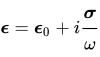
Note that if the permittivity is expressed as
ϵ
=
ϵ
0
+
i
σ
ω
{\displaystyle {\boldsymbol {\epsilon }}={\boldsymbol {\epsilon }}_{0}+i{\cfrac {\boldsymbol {\sigma }}{\omega }}}
the requirement
Im
(
ϵ
)
>
0
{\displaystyle {\text{Im}}({\boldsymbol {\epsilon }})>0}
σ
>
0
{\displaystyle {\boldsymbol {\sigma }}>0}
Brief introduction to elastodynamics [ edit | edit source ] A concise introduction to the theory of elasticity can be found in
Atkin80 . In this section, we consider the linear theory of
elasticity for infinitesimal strains and small displacements.
Consider the body (
Ω
{\displaystyle \Omega }
Γ
{\displaystyle \Gamma }
Ω
{\displaystyle \Omega }
Ω
{\displaystyle \Omega }
t
(
x
,
n
)
{\displaystyle \mathbf {t} (\mathbf {x} ,\mathbf {n} )}
Γ
{\displaystyle \Gamma }
n
{\displaystyle \mathbf {n} }
Γ
{\displaystyle \Gamma }
t
{\displaystyle \mathbf {t} }
Γ
{\displaystyle \Gamma }
Γ
{\displaystyle \Gamma }
Figure 1. Illustration of the concept of stress.
From the balance of forces on a small tetrahedron (
Γ
{\displaystyle \Gamma }
t
(
x
,
n
)
{\displaystyle \mathbf {t} (\mathbf {x} ,\mathbf {n} )}
n
{\displaystyle \mathbf {n} }
t
=
σ
⋅
n
{\displaystyle \mathbf {t} ={\boldsymbol {\sigma }}\cdot \mathbf {n} }
where
σ
{\displaystyle {\boldsymbol {\sigma }}}
stress tensor .
Since the tetrahedron cannot rotate at infinite velocity as its size goes
to zero (conservation of angular momentum), we can show that the stress
tensor is symmetric, i.e.,
σ
=
σ
T
.
{\displaystyle {\boldsymbol {\sigma }}={\boldsymbol {\sigma }}^{T}~.}
In particular, for a fluid,
σ
=
−
p
1
{\displaystyle {\boldsymbol {\sigma }}=-p~{\boldsymbol {\mathit {1}}}}
where
p
{\displaystyle p}
Let us assume that the stress depends only on the strain (and not on strain
gradients or strain rates), where the strain is defined as
(3)
ϵ
=
1
2
[
∇
u
+
(
∇
u
)
T
]
.
{\displaystyle {\text{(3)}}\qquad {\boldsymbol {\epsilon }}={\frac {1}{2}}\left[{\boldsymbol {\nabla }}\mathbf {u} +({\boldsymbol {\nabla }}\mathbf {u} )^{T}\right]~.}
Here
u
(
x
,
t
)
{\displaystyle \mathbf {u} (\mathbf {x} ,t)}
σ
{\displaystyle {\boldsymbol {\sigma }}}
Assume that
σ
{\displaystyle {\boldsymbol {\sigma }}}
ϵ
{\displaystyle {\boldsymbol {\epsilon }}}
σ
(
x
,
t
)
=
∫
d
x
′
[
∫
K
ε
(
x
,
x
′
,
t
′
−
t
)
:
ϵ
(
x
,
t
′
)
d
t
′
]
.
{\displaystyle {\boldsymbol {\sigma }}(\mathbf {x} ,t)=\int {\text{d}}\mathbf {x} '~\left[\int {\boldsymbol {\mathsf {K}}}_{\varepsilon }(\mathbf {x} ,\mathbf {x} ',t'-t):{\boldsymbol {\epsilon }}(\mathbf {x} ,t')~{\text{d}}t'\right]~.}
Note that this assumption ignores preexisting internal stresses such as
those found in prestressed concrete. If the material can be approximated
as being local, then
(4)
σ
(
x
,
t
)
=
∫
K
ε
(
x
,
t
′
−
t
)
:
ϵ
(
x
,
t
′
)
d
t
′
.
{\displaystyle {\text{(4)}}\qquad {\boldsymbol {\sigma }}(\mathbf {x} ,t)=\int {\boldsymbol {\mathsf {K}}}_{\varepsilon }(\mathbf {x} ,t'-t):{\boldsymbol {\epsilon }}(\mathbf {x} ,t')~{\text{d}}t'~.}
Taking the Fourier transforms of equation (4), we get
(5)
σ
^
(
x
,
ω
)
=
C
(
x
,
ω
)
:
ϵ
^
(
x
,
ω
)
{\displaystyle {\text{(5)}}\qquad {\widehat {\boldsymbol {\sigma }}}(\mathbf {x} ,\omega )={\boldsymbol {\mathsf {C}}}(\mathbf {x} ,\omega ):{\widehat {\boldsymbol {\epsilon }}}(\mathbf {x} ,\omega )}
where
C
(
x
,
ω
)
=
∫
K
ε
(
x
,
τ
)
e
−
i
ω
τ
d
τ
;
τ
=
t
′
−
t
.
{\displaystyle {\boldsymbol {\mathsf {C}}}(\mathbf {x} ,\omega )=\int {\boldsymbol {\mathsf {K}}}_{\varepsilon }(\mathbf {x} ,\tau )~e^{-i\omega \tau }~{\text{d}}\tau ~;~~\tau =t'-t~.}
In index notation, equation (5) can be written as
σ
^
i
j
=
C
i
j
k
l
ϵ
^
k
l
.
{\displaystyle {\widehat {\sigma }}_{ij}=C_{ijkl}~{\widehat {\epsilon }}_{kl}~.}
Causality implies that stresses at time
t
{\displaystyle t}
t
′
≤
t
{\displaystyle t'\leq t}
τ
≤
0
{\displaystyle \tau \leq 0}
K
ε
(
x
,
τ
)
=
0
if
τ
>
0
.
{\displaystyle {\boldsymbol {\mathsf {K}}}_{\varepsilon }(\mathbf {x} ,\tau )={\boldsymbol {\mathsf {0}}}\qquad {\text{if}}\qquad \tau >0~.}
This in turn implies that the integral converges only if
Im
(
ω
)
>
0
{\displaystyle {\text{Im}}(\omega )>0}
C
(
x
,
ω
)
{\displaystyle {\boldsymbol {\mathsf {C}}}(\mathbf {x} ,\omega )}
Im
(
ω
)
>
0
{\displaystyle {\text{Im}}(\omega )>0}
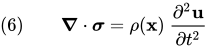
In the absence of body forces, the equation of motion of the body can be
written as
(6)
∇
⋅
σ
=
ρ
(
x
)
∂
2
u
∂
t
2
{\displaystyle {\text{(6)}}\qquad {\boldsymbol {\nabla }}\cdot {\boldsymbol {\sigma }}=\rho (\mathbf {x} )~{\frac {\partial ^{2}\mathbf {u} }{\partial t^{2}}}}
where
ρ
{\displaystyle \rho }
∇
⋅
σ
{\displaystyle {\boldsymbol {\nabla }}\cdot {\boldsymbol {\sigma }}}
∂
2
u
/
∂
t
2
{\displaystyle \partial ^{2}\mathbf {u} /\partial t^{2}}
For a material which has a frequency dependent mass, equation
(6) may be written as
(7)
∇
⋅
σ
=
∫
−
∞
∞
ρ
(
x
,
t
−
t
′
)
∂
2
u
∂
t
2
d
t
′
{\displaystyle {\text{(7)}}\qquad {\boldsymbol {\nabla }}\cdot {\boldsymbol {\sigma }}=\int _{-\infty }^{\infty }\rho (\mathbf {x} ,t-t')~{\frac {\partial ^{2}\mathbf {u} }{\partial t^{2}}}~{\text{d}}t'}
where causality implies that if
t
′
>
t
{\displaystyle t'>t}
ρ
=
0
{\displaystyle \rho =0}
Taking the Fourier transform of equation (7), we get
(8)
∇
⋅
σ
^
(
x
,
ω
)
=
−
ω
2
ρ
^
(
x
,
ω
)
u
^
(
x
,
ω
)
.
{\displaystyle {\text{(8)}}\qquad {\boldsymbol {\nabla }}\cdot {\widehat {\boldsymbol {\sigma }}}(\mathbf {x} ,\omega )=-\omega ^{2}~{\widehat {\rho }}(\mathbf {x} ,\omega )~{\widehat {\mathbf {u} }}(\mathbf {x} ,\omega )~.}
Substituting equation (5) into equation (8)
we get
(9)
∇
⋅
(
C
:
ϵ
^
)
+
ω
2
ρ
^
u
^
=
0
.
{\displaystyle {\text{(9)}}\qquad {\boldsymbol {\nabla }}\cdot ({\boldsymbol {\mathsf {C}}}:{\widehat {\boldsymbol {\epsilon }}})+\omega ^{2}~{\widehat {\rho }}~{\widehat {\mathbf {u} }}=0~.}
Also, taking the Fourier transform of equation (3), we have
(10)
ϵ
^
=
1
2
[
∇
u
^
+
(
∇
u
^
)
T
]
.
{\displaystyle {\text{(10)}}\qquad {\widehat {\boldsymbol {\epsilon }}}={\frac {1}{2}}\left[{\boldsymbol {\nabla }}{\widehat {\mathbf {u} }}+({\boldsymbol {\nabla }}{\widehat {\mathbf {u} }})^{T}\right]~.}
Since
σ
^
{\displaystyle {\widehat {\boldsymbol {\sigma }}}}
ϵ
^
{\displaystyle {\widehat {\boldsymbol {\epsilon }}}}
C
i
j
k
l
=
C
j
i
k
l
=
C
i
j
l
k
.
{\displaystyle C_{ijkl}=C_{jikl}=C_{ijlk}~.}
Because of this symmetry, we can replace
ϵ
^
{\displaystyle {\widehat {\boldsymbol {\epsilon }}}}
∇
u
^
{\displaystyle {\boldsymbol {\nabla }}{\widehat {\mathbf {u} }}}
∇
⋅
(
C
:
∇
u
^
)
+
ω
2
ρ
^
u
^
=
0
.
{\displaystyle {\boldsymbol {\nabla }}\cdot ({\boldsymbol {\mathsf {C}}}:{\boldsymbol {\nabla {\widehat {\mathbf {u} }})}}+\omega ^{2}~{\widehat {\rho }}~{\widehat {\mathbf {u} }}=0~.}
Dropping the hats, we then get the wave equation for elastodynamics
(11)
∇
⋅
(
C
:
∇
u
)
+
ω
2
ρ
u
=
0
.
{\displaystyle {\text{(11)}}\qquad {{\boldsymbol {\nabla }}\cdot ({\boldsymbol {\mathsf {C}}}:{\boldsymbol {\nabla \mathbf {u} )}}+\omega ^{2}~\rho ~\mathbf {u} =0~.}}
Let us now consider the case of antiplane shear. Assume that
C
{\displaystyle {\boldsymbol {\mathsf {C}}}}
C
:
∇
u
=
μ
[
∇
u
+
(
∇
u
)
T
]
+
λ
tr
(
∇
u
)
1
{\displaystyle {\boldsymbol {\mathsf {C}}}:{\boldsymbol {\nabla }}\mathbf {u} =\mu ~[{\boldsymbol {\nabla }}\mathbf {u} +({\boldsymbol {\nabla }}\mathbf {u} )^{T}]+\lambda ~{\text{tr}}({\boldsymbol {\nabla }}\mathbf {u} )~{\boldsymbol {\mathit {1}}}}
where
μ
{\displaystyle \mu }
λ
{\displaystyle \lambda }
Let us assume that
μ
{\displaystyle \mu }
λ
{\displaystyle \lambda }
x
1
{\displaystyle x_{1}}
μ
≡
μ
(
x
2
,
x
3
)
and
λ
≡
λ
(
x
2
,
x
3
)
.
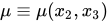
{\displaystyle \mu \equiv \mu (x_{2},x_{3})\qquad {\text{and}}\qquad \lambda \equiv \lambda (x_{2},x_{3})~.}
Let us look for a solution with
u
2
=
u
3
=
0
{\displaystyle u_{2}=u_{3}=0}
u
1
{\displaystyle u_{1}}
x
1
{\displaystyle x_{1}}
u
1
≡
u
1
(
x
2
,
x
3
)
{\displaystyle u_{1}\equiv u_{1}(x_{2},x_{3})}
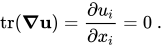
Then, noting that
tr
(
∇
u
)
=
∇
⋅
u
{\displaystyle {\text{tr}}({\boldsymbol {\nabla }}\mathbf {u} )={\boldsymbol {\nabla }}\cdot \mathbf {u} }
tr
(
∇
u
)
=
∂
u
i
∂
x
i
=
0
.
{\displaystyle {\text{tr}}({\boldsymbol {\nabla }}\mathbf {u} )={\frac {\partial u_{i}}{\partial x_{i}}}=0~.}
Therefore,
[
C
:
∇
u
]
i
j
=
μ
[
∂
u
i
∂
x
j
+
∂
u
j
∂
x
i
]
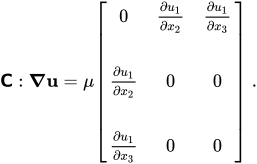
{\displaystyle [{\boldsymbol {\mathsf {C}}}:{\boldsymbol {\nabla }}\mathbf {u} ]_{ij}=\mu ~\left[{\frac {\partial u_{i}}{\partial x_{j}}}+{\frac {\partial u_{j}}{\partial x_{i}}}\right]}
or
C
:
∇
u
=
μ
[
0
∂
u
1
∂
x
2
∂
u
1
∂
x
3
∂
u
1
∂
x
2
0
0
∂
u
1
∂
x
3
0
0
]
.
{\displaystyle {\boldsymbol {\mathsf {C}}}:{\boldsymbol {\nabla }}\mathbf {u} =\mu {\begin{bmatrix}0&{\frac {\partial u_{1}}{\partial x_{2}}}&{\frac {\partial u_{1}}{\partial x_{3}}}\\\\{\frac {\partial u_{1}}{\partial x_{2}}}&0&0\\\\{\frac {\partial u_{1}}{\partial x_{3}}}&0&0\end{bmatrix}}~.}
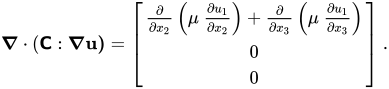
Therefore
∇
⋅
(
C
:
∇
u
)
=
[
∂
∂
x
2
(
μ
∂
u
1
∂
x
2
)
+
∂
∂
x
3
(
μ
∂
u
1
∂
x
3
)
0
0
]
.
{\displaystyle {\boldsymbol {\nabla }}\cdot ({\boldsymbol {\mathsf {C}}}:{\boldsymbol {\nabla \mathbf {u} )}}={\begin{bmatrix}{\frac {\partial }{\partial x_{2}}}\left(\mu ~{\frac {\partial u_{1}}{\partial x_{2}}}\right)+{\frac {\partial }{\partial x_{3}}}\left(\mu ~{\frac {\partial u_{1}}{\partial x_{3}}}\right)\\0\\0\end{bmatrix}}~.}
Plugging into the wave equation (11) we get
∂
∂
x
2
(
μ
∂
u
1
∂
x
2
)
+
∂
∂
x
3
(
μ
∂
u
1
∂
x
3
)
+
ω
2
ρ
u
1
=
0
{\displaystyle {\frac {\partial }{\partial x_{2}}}\left(\mu ~{\frac {\partial u_{1}}{\partial x_{2}}}\right)+{\frac {\partial }{\partial x_{3}}}\left(\mu ~{\frac {\partial u_{1}}{\partial x_{3}}}\right)+\omega ^{2}~\rho ~u_{1}=0}
or (using the two-dimensional gradient operator
∇
¯
{\displaystyle {\overline {\boldsymbol {\nabla }}}}
(12)
∇
¯
⋅
(
μ
∇
u
1
)
¯
+
ω
2
ρ
u
1
=
0
.
{\displaystyle {\text{(12)}}\qquad {{\overline {\boldsymbol {\nabla }}}\cdot (\mu ~{\overline {{\boldsymbol {\nabla }}u_{1})}}+\omega ^{2}~\rho ~u_{1}=0~.}}
TM and TE modes in electromagnetism [ edit | edit source ] Let us now consider the TM (transverse magnetic field) and TE (transverse
electric field) modes in electromagnetism and look for parallels with
antiplane shear in elastodynamics.
Recall the Maxwell equations (with hats dropped)
(13)
∇
×
E
=
i
ω
μ
H
;
∇
×
H
=
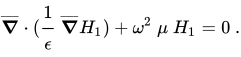
−
i
ω
ϵ
E
.
{\displaystyle {\text{(13)}}\qquad {\boldsymbol {\nabla }}\times \mathbf {E} =i\omega \mu \mathbf {H} ~;~~{\boldsymbol {\nabla }}\times \mathbf {H} =-i\omega \epsilon \mathbf {E} ~.}
Assume that
μ
{\displaystyle \mu }
ϵ
{\displaystyle \epsilon }
x
1
{\displaystyle x_{1}}
μ
≡
μ
(
x
2
,
x
3
)
{\displaystyle \mu \equiv \mu (x_{2},x_{3})}
ϵ
≡
ϵ
(
x
2
,
x
3
)
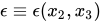
{\displaystyle \epsilon \equiv \epsilon (x_{2},x_{3})}
For the TE case, we look for solutions with
E
2
=
E
3
=
0
{\displaystyle E_{2}=E_{3}=0}
E
1
{\displaystyle E_{1}}
x
1
{\displaystyle x_{1}}
E
1
≡
E
1
(
x
2
,
x
3
)
{\displaystyle E_{1}\equiv E_{1}(x_{2},x_{3})}
Then,
∇
×
E
=
[
0
,
∂
E
1
∂
x
3
,
−
∂
E
1
∂
x
2
]
.
{\displaystyle {\boldsymbol {\nabla }}\times \mathbf {E} =\left[0,{\frac {\partial E_{1}}{\partial x_{3}}},-{\frac {\partial E_{1}}{\partial x_{2}}}\right]~.}
This implies that
H
=
[
0
,
1
i
ω
μ
∂
E
1
∂
x
3
,
−
1
i
ω
μ
∂
E
1
∂
x
2
]
.
{\displaystyle \mathbf {H} =\left[0,{\cfrac {1}{i\omega \mu }}~{\frac {\partial E_{1}}{\partial x_{3}}},-{\cfrac {1}{i\omega \mu }}~{\frac {\partial E_{1}}{\partial x_{2}}}\right]~.}
Therefore,
∇
×
H
=
[
−
∂
∂
x
3
(
1
i
ω
μ
∂
E
1
∂
x
3
)
−
∂
∂
x
2
(
1
i
ω
μ
∂
E
1
∂
x
2
)
,
0
,
0
]
.
{\displaystyle {\boldsymbol {\nabla }}\times \mathbf {H} =\left[-{\frac {\partial }{\partial x_{3}}}\left({\cfrac {1}{i\omega \mu }}~{\frac {\partial E_{1}}{\partial x_{3}}}\right)-{\frac {\partial }{\partial x_{2}}}\left({\cfrac {1}{i\omega \mu }}~{\frac {\partial E_{1}}{\partial x_{2}}}\right),0,0\right]~.}
or,
∇
×
H
=
i
ω
[
∂
∂
x
2
(
1
μ
∂
E
1
∂
x
2
)
+
∂
∂
x
3
(
1
μ
∂
E
1
∂
x
3
)
,
0
,
0
]
=
i
ω
[
∇
¯
⋅
(
1
μ
(
x
2
,
x
3
)
∇
¯
E
1
)
,
0
,
0
]
.
{\displaystyle {\boldsymbol {\nabla }}\times \mathbf {H} ={\cfrac {i}{\omega }}\left[{\frac {\partial }{\partial x_{2}}}\left({\cfrac {1}{\mu }}~{\frac {\partial E_{1}}{\partial x_{2}}}\right)+{\frac {\partial }{\partial x_{3}}}\left({\cfrac {1}{\mu }}~{\frac {\partial E_{1}}{\partial x_{3}}}\right),0,0\right]={\cfrac {i}{\omega }}\left[{\overline {\boldsymbol {\nabla }}}\cdot \left({\cfrac {1}{\mu (x_{2},x_{3})}}{\overline {\boldsymbol {\nabla }}}E_{1}\right),0,0\right]~.}
Plugging into equation (13) we get the TE equation
∇
¯
⋅
(
1
μ
(
x
2
,
x
3
)
∇
¯
E
1
)
+
ω
2
ϵ
(
x
2
,
x
3
)
E
1
=
0
.
{\displaystyle {{\overline {\boldsymbol {\nabla }}}\cdot \left({\cfrac {1}{\mu (x_{2},x_{3})}}{\overline {\boldsymbol {\nabla }}}E_{1}\right)+\omega ^{2}~\epsilon (x_{2},x_{3})~E_{1}=0~.}}
This equation has the same form as equation (12).
More generally, if
μ
=
μ
(
x
2
,
x
3
)
=
[
μ
11
0
0
0
μ
22
μ
23
0
μ
23
μ
33
]
=
[
μ
11
[
0
]
[
0
]
[
M
]
]
where
[
M
]
=
[
μ
22
μ
23
μ
23
μ
33
]
≡
M
{\displaystyle {\boldsymbol {\mu }}={\boldsymbol {\mu }}(x_{2},x_{3})={\begin{bmatrix}\mu _{11}&0&0\\0&\mu _{22}&\mu _{23}\\0&\mu _{23}&\mu _{33}\end{bmatrix}}={\begin{bmatrix}\mu _{11}&\left[{\mathsf {0}}\right]\\\left[{\mathsf {0}}\right]&\left[{\mathsf {M}}\right]\end{bmatrix}}\quad {\text{where}}\quad \left[{\mathsf {M}}\right]={\begin{bmatrix}\mu _{22}&\mu _{23}\\\mu _{23}&\mu _{33}\end{bmatrix}}\equiv {\boldsymbol {M}}}
and
ϵ
=
ϵ
(
x
2
,
x
3
)
=
[
ϵ
11
[
0
]
[
0
]
[
N
]
]
where
[
N
]
=
[
ϵ
22
ϵ
23
ϵ
23
ϵ
33
]
≡
N
{\displaystyle {\boldsymbol {\epsilon }}={\boldsymbol {\epsilon }}(x_{2},x_{3})={\begin{bmatrix}\epsilon _{11}&\left[{\mathsf {0}}\right]\\\left[{\mathsf {0}}\right]&\left[{\mathsf {N}}\right]\end{bmatrix}}\quad {\text{where}}\quad \left[{\mathsf {N}}\right]={\begin{bmatrix}\epsilon _{22}&\epsilon _{23}\\\epsilon _{23}&\epsilon _{33}\end{bmatrix}}\equiv {\boldsymbol {N}}}
we get the TE equation
∇
¯
⋅
[
(
R
⊥
⋅
M
−
1
⋅
R
⊥
T
)
⋅
∇
¯
E
1
]
+
ω
2
ϵ
11
E
1
1
=
0
where
R
⊥
≡
[
R
]
⊥
=
[
0
1
−
1
0
]
.
{\displaystyle {{\overline {\boldsymbol {\nabla }}}\cdot \left[\left({\boldsymbol {R}}_{\perp }\cdot {\boldsymbol {M}}^{-1}\cdot {\boldsymbol {R}}_{\perp }^{T}\right)\cdot {\overline {\boldsymbol {\nabla }}}E_{1}\right]+\omega ^{2}~\epsilon _{11}~E_{1}~\mathbf {1} =\mathbf {0} }\qquad {\text{where}}\qquad {\boldsymbol {R}}_{\perp }\equiv \left[{\mathsf {R}}\right]_{\perp }={\begin{bmatrix}0&1\\-1&0\end{bmatrix}}~.}
Similarly, there is a TM equation with
H
2
=
H
3
=
0
{\displaystyle H_{2}=H_{3}=0}
∇
¯
⋅
[
(
R
⊥
⋅
N
−
1
⋅
R
⊥
T
)
⋅
∇
¯
H
1
]
+
ω
2
μ
11
H
1
1
=
0
{\displaystyle {{\overline {\boldsymbol {\nabla }}}\cdot \left[\left({\boldsymbol {R}}_{\perp }\cdot {\boldsymbol {N}}^{-1}\cdot {\boldsymbol {R}}_{\perp }^{T}\right)\cdot {\overline {\boldsymbol {\nabla }}}H_{1}\right]+\omega ^{2}~\mu _{11}~H_{1}~\mathbf {1} =\mathbf {0} }}
which for the isotropic case reduces to
∇
¯
⋅
(
1
ϵ
(
x
2
,
x
3
)
∇
¯
H
1
)
+
ω
2
μ
(
x
2
,
x
3
)
H
1
=
0
.
{\displaystyle {{\overline {\boldsymbol {\nabla }}}\cdot \left({\cfrac {1}{\epsilon (x_{2},x_{3})}}{\overline {\boldsymbol {\nabla }}}H_{1}\right)+\omega ^{2}~\mu (x_{2},x_{3})~H_{1}=0~.}}
The general solution independent of
x
1
{\displaystyle x_{1}}
(
E
1
,
E
2
,
E
3
)
=
(
E
1
,
0
,
0
)
+
(
0
,
E
2
,
E
3
)
{\displaystyle (E_{1},E_{2},E_{3})=(E_{1},0,0)+(0,E_{2},E_{3})}
where the first term represents the TE solution. We can show that the
second term represents the TM solution by observing that
∇
×
(
0
,
E
2
,
E
3
)
=
[
∂
E
3
∂
x
2
−
∂
E
2
∂
x
3
,
0
,
0
]
{\displaystyle {\boldsymbol {\nabla }}\times (0,E_{2},E_{3})=\left[{\frac {\partial E_{3}}{\partial x_{2}}}-{\frac {\partial E_{2}}{\partial x_{3}}},0,0\right]}
implying that
H
2
=
H
3
=
0
{\displaystyle H_{2}=H_{3}=0}
Consider the periodic geometry shown in Figure 2. The matrix material has a high value of shear modulus (
μ
{\displaystyle \mu }
u
1
{\displaystyle u_{1}}
x
1
{\displaystyle x_{1}}
Figure 2. A periodic geometry containing split hollow cylinders of soft material in a matrix of stiff material. The
x
1
{\displaystyle x_{1}}
Clearly, each periodic component of the system behaves like a mass attached to a spring. This is a resonant structure and the effective density
ρ
11
∗
(
ω
)
{\displaystyle \rho _{11}^{*}(\omega )}
Movchan04 . Note that the governing equation for this problem is
∇
¯
⋅
(
μ
∇
¯
u
1
)
+
ω
2
ρ
u
1
=
0
.
{\displaystyle {\overline {\boldsymbol {\nabla }}}\cdot (\mu ~{\overline {\boldsymbol {\nabla }}}u_{1})+\omega ^{2}~\rho ~u_{1}=0~.}
Let us compare this problem with the TM case where
H
1
{\displaystyle H_{1}}
∇
¯
⋅
(
1
ϵ
∇
¯
H
1
)
+
ω
2
μ
H
1
=
0
.
{\displaystyle {\overline {\boldsymbol {\nabla }}}\cdot ({\cfrac {1}{\epsilon }}~{\overline {\boldsymbol {\nabla }}}H_{1})+\omega ^{2}~\mu ~H_{1}=0~.}
If the value of
1
/
ϵ
{\displaystyle 1/\epsilon }
ϵ
{\displaystyle \epsilon }
σ
{\displaystyle \sigma }
μ
11
∗
{\displaystyle \mu _{11}^{*}}
R. J. Atkin and N. Fox. An introduction to the theory of elasticity . Longman, New York, 1980.
A. B. Movchan and S. Guenneau. Split-ring resonators and localized modes. Physical Review B , 70:125116, 2004. ![{\displaystyle {\begin{aligned}{\mathcal {P}}&={\cfrac {\omega }{2~\pi }}\int _{0}^{2\pi /\omega }~\mathbf {F} (t)\cdot \mathbf {V} (t)~{\text{d}}t\\&={\cfrac {{\text{Re}}({\widehat {\mathbf {F} }})\cdot {\text{Re}}({\widehat {\mathbf {V} }})+{\text{Im}}({\widehat {\mathbf {F} }})\cdot {\text{Im}}({\widehat {\mathbf {V} }})}{2}}\\&=\omega ~[{\text{Re}}({\widehat {\mathbf {V} }})\cdot {\text{Im}}[{\boldsymbol {M}}(\omega )]\cdot {\text{Re}}({\widehat {\mathbf {V} }})+{\text{Im}}({\widehat {\mathbf {V} }})\cdot {\text{Im}}[{\boldsymbol {M}}(\omega )]\cdot {\text{Im}}({\widehat {\mathbf {V} }})].\end{aligned}}}](https://wikimedia.org/api/rest_v1/media/math/render/svg/d30a269b807d10eb9ef9aa0df0de067c6d4bcd21)


![{\displaystyle {{\text{Im}}[{\boldsymbol {M}}(\omega )]\geq 0~.}}](https://wikimedia.org/api/rest_v1/media/math/render/svg/731d0a76576640f966ebdf0f7a25df5358079e10)
![{\displaystyle {\text{(1)}}\qquad {\mathcal {P}}={\cfrac {\omega }{2~\pi }}\int _{0}^{2\pi /\omega }~\left[\mathbf {E} (t)\cdot {\frac {\partial \mathbf {D} (t)}{\partial t}}+\mathbf {H} (t)\cdot {\frac {\partial \mathbf {B} (t)}{\partial t}}\right]~dt~.}](https://wikimedia.org/api/rest_v1/media/math/render/svg/7ff73c348386677068d341f1c8cf61590235ce8d)


![{\displaystyle \mathbf {E} (t)={\text{Re}}[{\widehat {\mathbf {E} }}~e^{-i\omega t}]~;~~\mathbf {H} (t)={\text{Re}}[{\widehat {\mathbf {H} }}~e^{-i\omega t}]}](https://wikimedia.org/api/rest_v1/media/math/render/svg/7dc5cd587168d66ce0c92da95397c1d667689bd0)




![{\displaystyle {\begin{aligned}{\mathcal {P}}={\cfrac {\omega }{2~\pi }}\int _{0}^{2\pi }~&\left[{\text{Re}}({\widehat {\mathbf {E} }})~\cos z+{\text{Im}}({\widehat {\mathbf {E} }})~\sin z\right]\cdot \left\{{\text{Im}}({\boldsymbol {\epsilon }})\cdot \left[{\text{Re}}({\widehat {\mathbf {E} }})~\cos z+{\text{Im}}({\widehat {\mathbf {E} }})~\sin z\right]\right\}+\\&\left[{\text{Re}}({\widehat {\mathbf {H} }})~\cos z+{\text{Im}}({\widehat {\mathbf {H} }})~\sin z\right]\cdot \left\{{\text{Im}}({\boldsymbol {\mu }})\cdot \left[{\text{Re}}({\widehat {\mathbf {H} }})~\cos z+{\text{Im}}({\widehat {\mathbf {H} }})~\sin z\right]\right\}~{\text{d}}z\end{aligned}}}](https://wikimedia.org/api/rest_v1/media/math/render/svg/9e066599f1e0fa4da2dadec229b506267f2d0c02)

![{\displaystyle {\text{(2)}}\qquad {\mathcal {P}}={\cfrac {\omega }{2}}\left[{\text{Re}}({\widehat {\mathbf {E} }})\cdot {\text{Im}}({\boldsymbol {\epsilon }})\cdot {\text{Re}}({\widehat {\mathbf {E} }})+{\text{Im}}({\widehat {\mathbf {E} }})\cdot {\text{Im}}({\boldsymbol {\epsilon }})\cdot {\text{Im}}({\widehat {\mathbf {E} }})+{\text{Re}}({\widehat {\mathbf {H} }})\cdot {\text{Im}}({\boldsymbol {\mu }})\cdot {\text{Re}}({\widehat {\mathbf {H} }})+{\text{Im}}({\widehat {\mathbf {H} }})\cdot {\text{Im}}({\boldsymbol {\mu }})\cdot {\text{Im}}({\widehat {\mathbf {H} }})\right]~.}](https://wikimedia.org/api/rest_v1/media/math/render/svg/a4a3c40440519d33b145f30af695aa3c29cfced5)





![{\displaystyle {\text{(3)}}\qquad {\boldsymbol {\epsilon }}={\frac {1}{2}}\left[{\boldsymbol {\nabla }}\mathbf {u} +({\boldsymbol {\nabla }}\mathbf {u} )^{T}\right]~.}](https://wikimedia.org/api/rest_v1/media/math/render/svg/493d93ea4d9c8c464bb9919f1d1415d4cad53b60)


![{\displaystyle {\boldsymbol {\sigma }}(\mathbf {x} ,t)=\int {\text{d}}\mathbf {x} '~\left[\int {\boldsymbol {\mathsf {K}}}_{\varepsilon }(\mathbf {x} ,\mathbf {x} ',t'-t):{\boldsymbol {\epsilon }}(\mathbf {x} ,t')~{\text{d}}t'\right]~.}](https://wikimedia.org/api/rest_v1/media/math/render/svg/6b90f0935359b79cb2700f1ad4f29f262d8eb593)
















![{\displaystyle {\text{(10)}}\qquad {\widehat {\boldsymbol {\epsilon }}}={\frac {1}{2}}\left[{\boldsymbol {\nabla }}{\widehat {\mathbf {u} }}+({\boldsymbol {\nabla }}{\widehat {\mathbf {u} }})^{T}\right]~.}](https://wikimedia.org/api/rest_v1/media/math/render/svg/be1c073ec6b050ac02504308a40103826078526f)







![{\displaystyle {\boldsymbol {\mathsf {C}}}:{\boldsymbol {\nabla }}\mathbf {u} =\mu ~[{\boldsymbol {\nabla }}\mathbf {u} +({\boldsymbol {\nabla }}\mathbf {u} )^{T}]+\lambda ~{\text{tr}}({\boldsymbol {\nabla }}\mathbf {u} )~{\boldsymbol {\mathit {1}}}}](https://wikimedia.org/api/rest_v1/media/math/render/svg/e2eaa420d71908da7eb454bf9666e7d864a5d901)







![{\displaystyle [{\boldsymbol {\mathsf {C}}}:{\boldsymbol {\nabla }}\mathbf {u} ]_{ij}=\mu ~\left[{\frac {\partial u_{i}}{\partial x_{j}}}+{\frac {\partial u_{j}}{\partial x_{i}}}\right]}](https://wikimedia.org/api/rest_v1/media/math/render/svg/881d9ec920c5b4c842fbe65bfe83a3bed2aa988d)








![{\displaystyle {\boldsymbol {\nabla }}\times \mathbf {E} =\left[0,{\frac {\partial E_{1}}{\partial x_{3}}},-{\frac {\partial E_{1}}{\partial x_{2}}}\right]~.}](https://wikimedia.org/api/rest_v1/media/math/render/svg/36503795368257b1500f63af766ffe35aa464faf)
![{\displaystyle \mathbf {H} =\left[0,{\cfrac {1}{i\omega \mu }}~{\frac {\partial E_{1}}{\partial x_{3}}},-{\cfrac {1}{i\omega \mu }}~{\frac {\partial E_{1}}{\partial x_{2}}}\right]~.}](https://wikimedia.org/api/rest_v1/media/math/render/svg/59bd2d41bf1b5bbe7c046f3ab5c27c662b12bc00)
![{\displaystyle {\boldsymbol {\nabla }}\times \mathbf {H} =\left[-{\frac {\partial }{\partial x_{3}}}\left({\cfrac {1}{i\omega \mu }}~{\frac {\partial E_{1}}{\partial x_{3}}}\right)-{\frac {\partial }{\partial x_{2}}}\left({\cfrac {1}{i\omega \mu }}~{\frac {\partial E_{1}}{\partial x_{2}}}\right),0,0\right]~.}](https://wikimedia.org/api/rest_v1/media/math/render/svg/8b2b00f0e327b2f66ab19217d776ff3ef9546e42)
![{\displaystyle {\boldsymbol {\nabla }}\times \mathbf {H} ={\cfrac {i}{\omega }}\left[{\frac {\partial }{\partial x_{2}}}\left({\cfrac {1}{\mu }}~{\frac {\partial E_{1}}{\partial x_{2}}}\right)+{\frac {\partial }{\partial x_{3}}}\left({\cfrac {1}{\mu }}~{\frac {\partial E_{1}}{\partial x_{3}}}\right),0,0\right]={\cfrac {i}{\omega }}\left[{\overline {\boldsymbol {\nabla }}}\cdot \left({\cfrac {1}{\mu (x_{2},x_{3})}}{\overline {\boldsymbol {\nabla }}}E_{1}\right),0,0\right]~.}](https://wikimedia.org/api/rest_v1/media/math/render/svg/2c4ef5df3b3f156e737150cab996993d25edc245)

![{\displaystyle {\boldsymbol {\mu }}={\boldsymbol {\mu }}(x_{2},x_{3})={\begin{bmatrix}\mu _{11}&0&0\\0&\mu _{22}&\mu _{23}\\0&\mu _{23}&\mu _{33}\end{bmatrix}}={\begin{bmatrix}\mu _{11}&\left[{\mathsf {0}}\right]\\\left[{\mathsf {0}}\right]&\left[{\mathsf {M}}\right]\end{bmatrix}}\quad {\text{where}}\quad \left[{\mathsf {M}}\right]={\begin{bmatrix}\mu _{22}&\mu _{23}\\\mu _{23}&\mu _{33}\end{bmatrix}}\equiv {\boldsymbol {M}}}](https://wikimedia.org/api/rest_v1/media/math/render/svg/5e98c3968d08048706f79300cd8c7305fa82ab84)
![{\displaystyle {\boldsymbol {\epsilon }}={\boldsymbol {\epsilon }}(x_{2},x_{3})={\begin{bmatrix}\epsilon _{11}&\left[{\mathsf {0}}\right]\\\left[{\mathsf {0}}\right]&\left[{\mathsf {N}}\right]\end{bmatrix}}\quad {\text{where}}\quad \left[{\mathsf {N}}\right]={\begin{bmatrix}\epsilon _{22}&\epsilon _{23}\\\epsilon _{23}&\epsilon _{33}\end{bmatrix}}\equiv {\boldsymbol {N}}}](https://wikimedia.org/api/rest_v1/media/math/render/svg/35e60341df6b6cb2d5c7c1e87f2fa061487001a4)
![{\displaystyle {{\overline {\boldsymbol {\nabla }}}\cdot \left[\left({\boldsymbol {R}}_{\perp }\cdot {\boldsymbol {M}}^{-1}\cdot {\boldsymbol {R}}_{\perp }^{T}\right)\cdot {\overline {\boldsymbol {\nabla }}}E_{1}\right]+\omega ^{2}~\epsilon _{11}~E_{1}~\mathbf {1} =\mathbf {0} }\qquad {\text{where}}\qquad {\boldsymbol {R}}_{\perp }\equiv \left[{\mathsf {R}}\right]_{\perp }={\begin{bmatrix}0&1\\-1&0\end{bmatrix}}~.}](https://wikimedia.org/api/rest_v1/media/math/render/svg/62e3b9032d2d9c80603ab827340aa3b8c4874eeb)

![{\displaystyle {{\overline {\boldsymbol {\nabla }}}\cdot \left[\left({\boldsymbol {R}}_{\perp }\cdot {\boldsymbol {N}}^{-1}\cdot {\boldsymbol {R}}_{\perp }^{T}\right)\cdot {\overline {\boldsymbol {\nabla }}}H_{1}\right]+\omega ^{2}~\mu _{11}~H_{1}~\mathbf {1} =\mathbf {0} }}](https://wikimedia.org/api/rest_v1/media/math/render/svg/ef473983ec6fdda09e11cd738095d68fbdc5851d)


![{\displaystyle {\boldsymbol {\nabla }}\times (0,E_{2},E_{3})=\left[{\frac {\partial E_{3}}{\partial x_{2}}}-{\frac {\partial E_{2}}{\partial x_{3}}},0,0\right]}](https://wikimedia.org/api/rest_v1/media/math/render/svg/ecbb06c8e3c361f0bab42d0030a3429290764448)