The content of these notes is based on the lectures by Prof. Graeme W. Milton (University of Utah) given in a course on metamaterials in Spring 2007.
In the previous lecture we discussed Bloch wave solutions for
Maxwell's equations in periodic media in the quasistatic limit.
[1]
η
{\displaystyle \eta }
Figure 1. Periodic medium.
The permittivity and permeability of the medium are periodic functions
of the form
ϵ
(
y
+
a
i
)
=
ϵ
(
y
)
;
μ
(
y
+
a
i
)
=
μ
(
y
)
{\displaystyle {\boldsymbol {\epsilon }}(\mathbf {y} +\mathbf {a} _{i})={\boldsymbol {\epsilon }}(\mathbf {y} )~;~~{\boldsymbol {\mu }}(\mathbf {y} +\mathbf {a} _{i})={\boldsymbol {\mu }}(\mathbf {y} )}
where
a
i
{\displaystyle \mathbf {a} _{i}}
ϵ
η
(
x
)
:=
ϵ
(
x
η
)
;
μ
η
(
x
)
:=
μ
(
x
η
)
;
D
η
(
x
)
:=
D
(
x
η
)
;
B
η
(
x
)
:=
B
(
x
η
)
;
E
η
(
x
)
:=
E
(
x
η
)
;
H
η
(
x
)
:=
H
(
x
η
)
.
{\displaystyle {\begin{aligned}{\boldsymbol {\epsilon }}_{\eta }(\mathbf {x} )&:={\boldsymbol {\epsilon }}\left({\cfrac {\mathbf {x} }{\eta }}\right)~;~~{\boldsymbol {\mu }}_{\eta }(\mathbf {x} ):={\boldsymbol {\mu }}\left({\cfrac {\mathbf {x} }{\eta }}\right)~;~~\\\mathbf {D} _{\eta }(\mathbf {x} )&:=\mathbf {D} \left({\cfrac {\mathbf {x} }{\eta }}\right)~;~~\mathbf {B} _{\eta }(\mathbf {x} ):=\mathbf {B} \left({\cfrac {\mathbf {x} }{\eta }}\right)~;~~\mathbf {E} _{\eta }(\mathbf {x} ):=\mathbf {E} \left({\cfrac {\mathbf {x} }{\eta }}\right)~;~~\mathbf {H} _{\eta }(\mathbf {x} ):=\mathbf {H} \left({\cfrac {\mathbf {x} }{\eta }}\right)~.\end{aligned}}}
We then wrote Maxwell's equations (at fixed frequency) as
(1)
∇
⋅
D
η
=
0
;
∇
⋅
B
η
=
0
;
∇
×
E
η
−
i
ω
B
η
=
0
;
∇
×
H
η
+
i
ω
D
η
=
0
.
{\displaystyle {\text{(1)}}\qquad {{\boldsymbol {\nabla }}\cdot \mathbf {D} _{\eta }=0~;~~{\boldsymbol {\nabla }}\cdot \mathbf {B} _{\eta }=0~;~~{\boldsymbol {\nabla }}\times \mathbf {E} _{\eta }-i\omega ~\mathbf {B} _{\eta }={\boldsymbol {0}}~;~~{\boldsymbol {\nabla }}\times \mathbf {H} _{\eta }+i\omega ~\mathbf {D} _{\eta }={\boldsymbol {0}}~.}}
We also found that the constitutive relations could be expressed as
(2)
d
η
(
x
)
=
ϵ
η
(
x
)
⋅
e
η
(
x
)
;
b
η
(
x
)
=
μ
η
(
x
)
⋅
h
η
(
x
)
.
{\displaystyle {\text{(2)}}\qquad {\mathbf {d} _{\eta }(\mathbf {x} )={\boldsymbol {\epsilon }}_{\eta }(\mathbf {x} )\cdot \mathbf {e} _{\eta }(\mathbf {x} )~;~~\mathbf {b} _{\eta }(\mathbf {x} )={\boldsymbol {\mu }}_{\eta }(\mathbf {x} )\cdot \mathbf {h} _{\eta }(\mathbf {x} )~.}}
Next, we examined solutions to (1) that correspond to
Bloch waves with wavevector
k
{\displaystyle \mathbf {k} }
E
η
(
x
)
=
e
i
k
⋅
x
e
η
(
x
)
;
D
η
(
x
)
=
e
i
k
⋅
x
d
η
(
x
)
;
H
η
(
x
)
=
e
i
k
⋅
x
h
η
(
x
)
;
B
η
(
x
)
=
e
i
k
⋅
x
b
η
(
x
)
.
{\displaystyle \mathbf {E} _{\eta }(\mathbf {x} )=e^{i\mathbf {k} \cdot \mathbf {x} }~\mathbf {e} _{\eta }(\mathbf {x} )~;~~\mathbf {D} _{\eta }(\mathbf {x} )=e^{i\mathbf {k} \cdot \mathbf {x} }~\mathbf {d} _{\eta }(\mathbf {x} )~;~~\mathbf {H} _{\eta }(\mathbf {x} )=e^{i\mathbf {k} \cdot \mathbf {x} }~\mathbf {h} _{\eta }(\mathbf {x} )~;~~\mathbf {B} _{\eta }(\mathbf {x} )=e^{i\mathbf {k} \cdot \mathbf {x} }~\mathbf {b} _{\eta }(\mathbf {x} )~.}
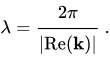
The wavelength of the Bloch waves is
λ
=
2
π
|
Re
(
k
)
|
.
{\displaystyle \lambda ={\cfrac {2\pi }{|{\text{Re}}(\mathbf {k} )|}}~.}
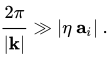
For the quasistatic limit, we look for solutions that satisfy
2
π
|
k
|
≫
|
η
a
i
|
.
{\displaystyle {\cfrac {2\pi }{|\mathbf {k} |}}\gg |\eta ~\mathbf {a} _{i}|~.}
Such a condition is satisfied if
η
→
0
{\displaystyle \eta \rightarrow 0}
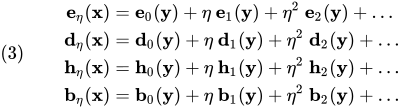
(3)
e
η
(
x
)
=
e
0
(
y
)
+
η
e
1
(
y
)
+
η
2
e
2
(
y
)
+
…
d
η
(
x
)
=
d
0
(
y
)
+
η
d
1
(
y
)
+
η
2
d
2
(
y
)
+
…
h
η
(
x
)
=
h
0
(
y
)
+
η
h
1
(
y
)
+
η
2
h
2
(
y
)
+
…
b
η
(
x
)
=
b
0
(
y
)
+
η
b
1
(
y
)
+
η
2
b
2
(
y
)
+
…
{\displaystyle {\text{(3)}}\qquad {\begin{aligned}\mathbf {e} _{\eta }(\mathbf {x} )&=\mathbf {e} _{0}(\mathbf {y} )+\eta ~\mathbf {e} _{1}(\mathbf {y} )+\eta ^{2}~\mathbf {e} _{2}(\mathbf {y} )+\dots \\\mathbf {d} _{\eta }(\mathbf {x} )&=\mathbf {d} _{0}(\mathbf {y} )+\eta ~\mathbf {d} _{1}(\mathbf {y} )+\eta ^{2}~\mathbf {d} _{2}(\mathbf {y} )+\dots \\\mathbf {h} _{\eta }(\mathbf {x} )&=\mathbf {h} _{0}(\mathbf {y} )+\eta ~\mathbf {h} _{1}(\mathbf {y} )+\eta ^{2}~\mathbf {h} _{2}(\mathbf {y} )+\dots \\\mathbf {b} _{\eta }(\mathbf {x} )&=\mathbf {b} _{0}(\mathbf {y} )+\eta ~\mathbf {b} _{1}(\mathbf {y} )+\eta ^{2}~\mathbf {b} _{2}(\mathbf {y} )+\dots \end{aligned}}}
and that dependence of
ω
{\displaystyle \omega }
η
{\displaystyle \eta }
k
{\displaystyle \mathbf {k} }
(4)
ω
=
ω
η
j
(
k
)
=
ω
0
j
(
y
)
+
η
ω
1
j
(
y
)
+
η
2
ω
2
j
(
y
)
+
…
{\displaystyle {\text{(4)}}\qquad \omega =\omega _{\eta }^{j}(\mathbf {k} )=\omega _{0}^{j}(\mathbf {y} )+\eta ~\omega _{1}^{j}(\mathbf {y} )+\eta ^{2}~\omega _{2}^{j}(\mathbf {y} )+\dots }
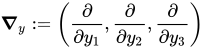
Defining
∇
y
:=
(
∂
∂
y
1
,
∂
∂
y
2
,
∂
∂
y
3
)
{\displaystyle {\boldsymbol {\nabla }}_{y}:=\left({\frac {\partial }{\partial y_{1}}},{\frac {\partial }{\partial y_{2}}},{\frac {\partial }{\partial y_{3}}}\right)}
we then showed that we got the equations in the quasistatic limit
(5)
∇
y
⋅
d
0
(
y
)
=
0
;
∇
y
⋅
b
0
(
y
)
=
0
;
∇
y
×
e
0
(
y
)
=
0
;
∇
y
×
h
0
(
y
)
=
0
{\displaystyle {\text{(5)}}\qquad {{\boldsymbol {\nabla }}_{y}\cdot \mathbf {d} _{0}(\mathbf {y} )=0~;~~{\boldsymbol {\nabla }}_{y}\cdot \mathbf {b} _{0}(\mathbf {y} )=0~;~~{\boldsymbol {\nabla }}_{y}\times \mathbf {e} _{0}(\mathbf {y} )={\boldsymbol {0}}~;~~{\boldsymbol {\nabla }}_{y}\times \mathbf {h} _{0}(\mathbf {y} )={\boldsymbol {0}}}}
and the constitutive equations
(6)
d
0
(
y
)
=
ϵ
(
y
)
⋅
e
0
(
y
)
;
b
0
(
y
)
=
μ
(
y
)
⋅
h
0
(
y
)
.
{\displaystyle {\text{(6)}}\qquad {\mathbf {d} _{0}(\mathbf {y} )={\boldsymbol {\epsilon }}(\mathbf {y} )\cdot \mathbf {e} _{0}(\mathbf {y} )~;~~\mathbf {b} _{0}(\mathbf {y} )={\boldsymbol {\mu }}(\mathbf {y} )\cdot \mathbf {h} _{0}(\mathbf {y} )~.}}
Note that the quasistatic equations (5), (6)
have the same form as the Maxwell equations (1) and
(2).
We also found that the volume averaged fields (
⟨
∙
⟩
{\displaystyle \langle \bullet \rangle }
(7)
⟨
∇
y
⋅
d
1
(
y
)
⟩
=
0
;
⟨
∇
y
⋅
b
1
(
y
)
⟩
=
0
;
⟨
∇
y
×
e
1
(
y
)
⟩
=
0
;
⟨
∇
y
×
h
1
(
y
)
⟩
=
0
.
{\displaystyle {\text{(7)}}\qquad {\langle {\boldsymbol {\nabla }}_{y}\cdot \mathbf {d} _{1}(\mathbf {y} )\rangle =0~;~~\langle {\boldsymbol {\nabla }}_{y}\cdot \mathbf {b} _{1}(\mathbf {y} )\rangle =0~;~~\langle {\boldsymbol {\nabla }}_{y}\times \mathbf {e} _{1}(\mathbf {y} )\rangle ={\boldsymbol {0}}~;~~\langle {\boldsymbol {\nabla }}_{y}\times \mathbf {h} _{1}(\mathbf {y} )\rangle ={\boldsymbol {0}}~.}}
along with the necessary conditions
(8)
k
×
⟨
e
0
(
y
)
⟩
−
ω
0
j
⟨
b
0
(
y
)
⟩
=
0
;
k
×
⟨
h
0
(
y
)
⟩
+
ω
0
j
⟨
d
0
(
y
)
⟩
=
0
.
{\displaystyle {\text{(8)}}\qquad {\mathbf {k} \times \langle \mathbf {e} _{0}(\mathbf {y} )\rangle -\omega _{0}^{j}~\langle \mathbf {b} _{0}(\mathbf {y} )\rangle ={\boldsymbol {0}}~;~~\mathbf {k} \times \langle \mathbf {h} _{0}(\mathbf {y} )\rangle +\omega _{0}^{j}~\langle \mathbf {d} _{0}(\mathbf {y} )\rangle ={\boldsymbol {0}}~.}}
Effective Permittivity and Permeability [ edit | edit source ] Let
ϵ
eff
{\displaystyle {\boldsymbol {\epsilon }}_{\text{eff}}}
ϵ
(
y
)
{\displaystyle {\boldsymbol {\epsilon }}(\mathbf {y} )}
μ
eff
{\displaystyle {\boldsymbol {\mu }}_{\text{eff}}}
μ
(
y
)
{\displaystyle {\boldsymbol {\mu }}(\mathbf {y} )}
(9)
⟨
d
0
⟩
=
ϵ
eff
⋅
⟨
e
0
⟩
;
⟨
b
0
⟩
=
μ
eff
⋅
⟨
h
0
⟩
.
{\displaystyle {\text{(9)}}\qquad \langle \mathbf {d} _{0}\rangle ={\boldsymbol {\epsilon }}_{\text{eff}}\cdot \langle \mathbf {e} _{0}\rangle ~;~~\langle \mathbf {b} _{0}\rangle ={\boldsymbol {\mu }}_{\text{eff}}\cdot \langle \mathbf {h} _{0}\rangle ~.}
Plugging (9) into (8) gives
(10)
k
×
⟨
e
0
⟩
−
ω
0
j
μ
eff
⋅
⟨
h
0
⟩
=
0
;
k
×
⟨
h
0
⟩
+
ω
0
j
ϵ
eff
⋅
⟨
e
0
⟩
=
0
.
{\displaystyle {\text{(10)}}\qquad \mathbf {k} \times \langle \mathbf {e} _{0}\rangle -\omega _{0}^{j}~{\boldsymbol {\mu }}_{\text{eff}}\cdot \langle \mathbf {h} _{0}\rangle ={\boldsymbol {0}}~;~~\mathbf {k} \times \langle \mathbf {h} _{0}\rangle +\omega _{0}^{j}~{\boldsymbol {\epsilon }}_{\text{eff}}\cdot \langle \mathbf {e} _{0}\rangle ={\boldsymbol {0}}~.}
Eliminate
⟨
h
0
⟩
{\displaystyle \langle \mathbf {h} _{0}\rangle }
1
ω
0
j
k
×
{
μ
eff
−
1
⋅
[
k
×
⟨
e
0
⟩
]
}
+
ω
0
j
ϵ
eff
⋅
⟨
e
0
⟩
=
0
{\displaystyle {\cfrac {1}{\omega _{0}^{j}}}~\mathbf {k} \times \left\{{\boldsymbol {\mu }}_{\text{eff}}^{-1}\cdot [\mathbf {k} \times \langle \mathbf {e} _{0}\rangle ]\right\}+\omega _{0}^{j}~{\boldsymbol {\epsilon }}_{\text{eff}}\cdot \langle \mathbf {e} _{0}\rangle ={\boldsymbol {0}}}
or,
(11)
ϵ
eff
−
1
⋅
(
k
×
{
μ
eff
−
1
⋅
[
k
×
⟨
e
0
⟩
]
}
)
+
(
ω
0
j
)
2
⟨
e
0
⟩
=
0
.
{\displaystyle {\text{(11)}}\qquad {\boldsymbol {\epsilon }}_{\text{eff}}^{-1}\cdot \left(\mathbf {k} \times \left\{{\boldsymbol {\mu }}_{\text{eff}}^{-1}\cdot [\mathbf {k} \times \langle \mathbf {e} _{0}\rangle ]\right\}\right)+(\omega _{0}^{j})^{2}~\langle \mathbf {e} _{0}\rangle ={\boldsymbol {0}}~.}
Define the matrix
A
eff
(
k
)
{\displaystyle {\boldsymbol {A}}_{\text{eff}}(\mathbf {k} )}
v
{\displaystyle \mathbf {v} }
(12)
A
eff
(
k
)
⋅
v
=
ϵ
eff
−
1
⋅
(
k
×
{
μ
eff
−
1
⋅
[
k
×
v
]
}
)
.
{\displaystyle {\text{(12)}}\qquad {\boldsymbol {A}}_{\text{eff}}(\mathbf {k} )\cdot \mathbf {v} ={\boldsymbol {\epsilon }}_{\text{eff}}^{-1}\cdot \left(\mathbf {k} \times \left\{{\boldsymbol {\mu }}_{\text{eff}}^{-1}\cdot [\mathbf {k} \times \mathbf {v} ]\right\}\right)~.}
Then (11) can be written as
(13)
A
eff
(
k
)
⋅
⟨
e
0
⟩
+
(
ω
0
j
)
2
⟨
e
0
⟩
=
0
.
{\displaystyle {\text{(13)}}\qquad {{\boldsymbol {A}}_{\text{eff}}(\mathbf {k} )\cdot \langle \mathbf {e} _{0}\rangle +(\omega _{0}^{j})^{2}~\langle \mathbf {e} _{0}\rangle ={\boldsymbol {0}}~.}}
The eigenvalue problem (13) may be used to determine the
dispersion relations
ω
0
j
{\displaystyle \omega _{0}^{j}}
⟨
e
0
⟩
{\displaystyle \langle \mathbf {e} _{0}\rangle }
⟨
e
0
⟩
{\displaystyle \langle \mathbf {e} _{0}\rangle }
⟨
h
0
⟩
{\displaystyle \langle \mathbf {h} _{0}\rangle }
Note that the eigenvalue of
A
eff
{\displaystyle {\boldsymbol {A}}_{\text{eff}}}
e
0
=
k
{\displaystyle \mathbf {e} _{0}=\mathbf {k} }
Summary:
If the average field
⟨
e
0
⟩
{\displaystyle \langle \mathbf {e} _{0}\rangle }
k
{\displaystyle \mathbf {k} }
ω
0
j
{\displaystyle \omega _{0}^{j}}
⟨
e
0
⟩
{\displaystyle \langle \mathbf {e} _{0}\rangle }
A
eff
(
k
)
{\displaystyle {\boldsymbol {A}}_{\text{eff}}(\mathbf {k} )}
(
ω
0
j
)
2
{\displaystyle (\omega _{0}^{j})^{2}}
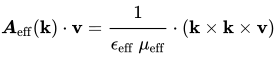
When the permittivity and permeability of the medium are isotropic,
equation (12) becomes
A
eff
(
k
)
⋅
v
=
1
ϵ
eff
μ
eff
⋅
(
k
×
k
×
v
)
{\displaystyle {\boldsymbol {A}}_{\text{eff}}(\mathbf {k} )\cdot \mathbf {v} ={\cfrac {1}{\epsilon _{\text{eff}}~\mu _{\text{eff}}}}\cdot \left(\mathbf {k} \times \mathbf {k} \times \mathbf {v} \right)}
or,
(14)
A
eff
(
k
)
⋅
v
=
1
ϵ
eff
μ
eff
⋅
[
(
k
⋅
k
)
v
−
(
k
⋅
v
)
k
]
.
{\displaystyle {\text{(14)}}\qquad {\boldsymbol {A}}_{\text{eff}}(\mathbf {k} )\cdot \mathbf {v} ={\cfrac {1}{\epsilon _{\text{eff}}~\mu _{\text{eff}}}}\cdot \left[(\mathbf {k} \cdot \mathbf {k} )~\mathbf {v} -(\mathbf {k} \cdot \mathbf {v} )~\mathbf {k} \right]~.}
Since
k
⋅
⟨
e
0
⟩
=
0
{\displaystyle \mathbf {k} \cdot \langle \mathbf {e} _{0}\rangle =0}
(15)
1
ϵ
eff
μ
eff
(
k
⋅
k
)
+
(
ω
0
j
)
2
=
0
.
{\displaystyle {\text{(15)}}\qquad {\cfrac {1}{\epsilon _{\text{eff}}~\mu _{\text{eff}}}}~(\mathbf {k} \cdot \mathbf {k} )+(\omega _{0}^{j})^{2}=0~.}
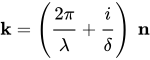
If we assume that
k
=
(
2
π
λ
+
i
δ
)
n
{\displaystyle \mathbf {k} =\left({\cfrac {2\pi }{\lambda }}+{\cfrac {i}{\delta }}\right)~\mathbf {n} }
where
λ
{\displaystyle \lambda }
δ
{\displaystyle \delta }
n
{\displaystyle \mathbf {n} }
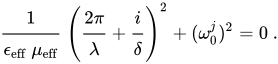
1
ϵ
eff
μ
eff
(
2
π
λ
+
i
δ
)
2
+
(
ω
0
j
)
2
=
0
.
{\displaystyle {\cfrac {1}{\epsilon _{\text{eff}}~\mu _{\text{eff}}}}~\left({\cfrac {2\pi }{\lambda }}+{\cfrac {i}{\delta }}\right)^{2}+(\omega _{0}^{j})^{2}=0~.}
Therefore for a given frequency, the wavelength and attenuation length are
determined by the complex permittivity
ϵ
eff
{\displaystyle \epsilon _{\text{eff}}}
μ
eff
{\displaystyle \mu _{\text{eff}}}
Elastic wave propagation in the quasistatic limit [ edit | edit source ] Let us now perform the exercise for linear elastic materials.
Recall that the momentum equation at fixed frequency is given by
∇
⋅
σ
(
x
)
=
−
ω
2
ρ
(
x
)
u
(
x
)
{\displaystyle {\boldsymbol {\nabla }}\cdot {\boldsymbol {\sigma }}(\mathbf {x} )=-\omega ^{2}~\rho (\mathbf {x} )~\mathbf {u} (\mathbf {x} )}
where
σ
{\displaystyle {\boldsymbol {\sigma }}}
ρ
{\displaystyle \rho }
u
{\displaystyle \mathbf {u} }
ϵ
(
x
)
=
1
2
{
∇
u
(
x
)
+
[
∇
u
(
x
)
]
T
}
.
{\displaystyle {\boldsymbol {\epsilon }}(\mathbf {x} )={\frac {1}{2}}\left\{{\boldsymbol {\nabla }}\mathbf {u} (\mathbf {x} )+[{\boldsymbol {\nabla }}\mathbf {u} (\mathbf {x} )]^{T}\right\}~.}
Also, the stress is related to the strain for linear elastic materials by
σ
(
x
)
=
C
(
x
)
:
ϵ
(
x
)
.
{\displaystyle {\boldsymbol {\sigma }}(\mathbf {x} )={\boldsymbol {\mathsf {C}}}(\mathbf {x} ):{\boldsymbol {\epsilon }}(\mathbf {x} )~.}
For a periodic medium, define
σ
η
(
x
)
=
σ
(
x
/
η
)
;
ϵ
η
(
x
)
=
ϵ
(
x
/
η
)
;
u
η
(
x
)
=
u
(
x
/
η
)
;
ρ
η
(
x
)
=
ρ
(
x
/
η
)
;
C
η
(
x
)
=
C
(
x
/
η
)
.
{\displaystyle {\boldsymbol {\sigma }}_{\eta }(\mathbf {x} )={\boldsymbol {\sigma }}(\mathbf {x} /\eta )~;~~{\boldsymbol {\epsilon }}_{\eta }(\mathbf {x} )={\boldsymbol {\epsilon }}(\mathbf {x} /\eta )~;~~\mathbf {u} _{\eta }(\mathbf {x} )=\mathbf {u} (\mathbf {x} /\eta )~;~~\rho _{\eta }(\mathbf {x} )=\rho (\mathbf {x} /\eta )~;~~{\boldsymbol {\mathsf {C}}}_{\eta }(\mathbf {x} )={\boldsymbol {\mathsf {C}}}(\mathbf {x} /\eta )~.}
Then the governing equations can be written as
(16)
∇
⋅
σ
η
(
x
)
=
−
ω
2
ρ
η
(
x
)
u
η
(
x
)
;
ϵ
η
(
x
)
=
1
2
{
∇
u
η
(
x
)
+
[
∇
u
η
(
x
)
]
T
}
;
σ
η
(
x
)
=
C
η
(
x
)
:
ϵ
η
(
x
)
.
{\displaystyle {\text{(16)}}\qquad {\boldsymbol {\nabla }}\cdot {\boldsymbol {\sigma }}_{\eta }(\mathbf {x} )=-\omega ^{2}~\rho _{\eta }(\mathbf {x} )~\mathbf {u} _{\eta }(\mathbf {x} )~;~~{\boldsymbol {\epsilon }}_{\eta }(\mathbf {x} )={\frac {1}{2}}\left\{{\boldsymbol {\nabla }}\mathbf {u} _{\eta }(\mathbf {x} )+[{\boldsymbol {\nabla }}\mathbf {u} _{\eta }(\mathbf {x} )]^{T}\right\}~;~~{\boldsymbol {\sigma }}_{\eta }(\mathbf {x} )={\boldsymbol {\mathsf {C}}}_{\eta }(\mathbf {x} ):{\boldsymbol {\epsilon }}_{\eta }(\mathbf {x} )~.}
Let us examine Bloch wave solutions to these equations of the form
(17)
σ
η
(
x
)
=
e
i
k
⋅
x
σ
^
η
(
x
)
;
ϵ
η
(
x
)
=
e
i
k
⋅
x
ϵ
^
η
(
x
)
;
u
η
(
x
)
=
e
i
k
⋅
x
u
^
η
(
x
)
.
{\displaystyle {\text{(17)}}\qquad {\boldsymbol {\sigma }}_{\eta }(\mathbf {x} )=e^{i~\mathbf {k} \cdot \mathbf {x} }~{\widehat {\boldsymbol {\sigma }}}_{\eta }(\mathbf {x} )~;~~{\boldsymbol {\epsilon }}_{\eta }(\mathbf {x} )=e^{i~\mathbf {k} \cdot \mathbf {x} }~{\widehat {\boldsymbol {\epsilon }}}_{\eta }(\mathbf {x} )~;~~\mathbf {u} _{\eta }(\mathbf {x} )=e^{i~\mathbf {k} \cdot \mathbf {x} }~{\widehat {\mathbf {u} }}_{\eta }(\mathbf {x} )~.}
Plug (17) into (16) to get
∇
⋅
(
e
i
k
⋅
x
σ
^
η
(
x
)
)
=
−
ω
2
ρ
η
(
x
)
e
i
k
⋅
x
u
^
η
(
x
)
e
i
k
⋅
x
ϵ
^
η
(
x
)
=
1
2
{
∇
(
e
i
k
⋅
x
u
^
η
(
x
)
)
+
[
∇
(
e
i
k
⋅
x
u
^
η
(
x
)
)
]
}
e
i
k
⋅
x
σ
^
η
(
x
)
=
C
η
(
x
)
:
(
e
i
k
⋅
x
ϵ
^
η
(
x
)
)
{\displaystyle {\begin{aligned}{\boldsymbol {\nabla }}\cdot \left(e^{i~\mathbf {k} \cdot \mathbf {x} }~{\widehat {\boldsymbol {\sigma }}}_{\eta }(\mathbf {x} )\right)&=-\omega ^{2}~\rho _{\eta }(\mathbf {x} )~e^{i~\mathbf {k} \cdot \mathbf {x} }~{\widehat {\mathbf {u} }}_{\eta }(\mathbf {x} )\\e^{i~\mathbf {k} \cdot \mathbf {x} }~{\widehat {\boldsymbol {\epsilon }}}_{\eta }(\mathbf {x} )&={\frac {1}{2}}\left\{{\boldsymbol {\nabla }}\left(e^{i~\mathbf {k} \cdot \mathbf {x} }~{\widehat {\mathbf {u} }}_{\eta }(\mathbf {x} )\right)+\left[{\boldsymbol {\nabla }}\left(e^{i~\mathbf {k} \cdot \mathbf {x} }~{\widehat {\mathbf {u} }}_{\eta }(\mathbf {x} )\right)\right]\right\}\\e^{i~\mathbf {k} \cdot \mathbf {x} }~{\widehat {\boldsymbol {\sigma }}}_{\eta }(\mathbf {x} )&={\boldsymbol {\mathsf {C}}}_{\eta }(\mathbf {x} ):\left(e^{i~\mathbf {k} \cdot \mathbf {x} }~{\widehat {\boldsymbol {\epsilon }}}_{\eta }(\mathbf {x} )\right)\end{aligned}}}
or,
e
i
k
⋅
x
(
∇
⋅
σ
^
η
+
i
σ
^
η
⋅
k
)
=
−
e
i
k
⋅
x
ω
2
ρ
η
u
^
η
e
i
k
⋅
x
ϵ
^
η
=
e
i
k
⋅
x
[
i
2
(
u
^
η
⊗
k
+
k
⊗
u
^
η
)
+
1
2
(
∇
u
^
η
+
[
∇
u
^
η
]
T
)
]
e
i
k
⋅
x
σ
^
η
=
e
i
k
⋅
x
C
η
:
ϵ
^
η
{\displaystyle {\begin{aligned}&e^{i~\mathbf {k} \cdot \mathbf {x} }~\left({\boldsymbol {\nabla }}\cdot {\widehat {\boldsymbol {\sigma }}}_{\eta }+i~{\widehat {\boldsymbol {\sigma }}}_{\eta }~\cdot \mathbf {k} \right)=-e^{i~\mathbf {k} \cdot \mathbf {x} }~\omega ^{2}~\rho _{\eta }~{\widehat {\mathbf {u} }}_{\eta }\\&e^{i~\mathbf {k} \cdot \mathbf {x} }~{\widehat {\boldsymbol {\epsilon }}}_{\eta }=e^{i~\mathbf {k} \cdot \mathbf {x} }~\left[{\cfrac {i}{2}}\left({\widehat {\mathbf {u} }}_{\eta }\otimes \mathbf {k} +\mathbf {k} \otimes {\widehat {\mathbf {u} }}_{\eta }\right)+{\frac {1}{2}}~\left({\boldsymbol {\nabla }}{\widehat {\mathbf {u} }}_{\eta }+[{\boldsymbol {\nabla }}{\widehat {\mathbf {u} }}_{\eta }]^{T}\right)\right]\\&e^{i~\mathbf {k} \cdot \mathbf {x} }~{\widehat {\boldsymbol {\sigma }}}_{\eta }=e^{i~\mathbf {k} \cdot \mathbf {x} }~{\boldsymbol {\mathsf {C}}}_{\eta }:{\widehat {\boldsymbol {\epsilon }}}_{\eta }\end{aligned}}}
or,
(18)
∇
⋅
σ
^
η
+
i
σ
^
η
⋅
k
+
ω
2
ρ
η
u
^
η
=
0
ϵ
^
η
=
i
2
(
u
^
η
⊗
k
+
k
⊗
u
^
η
)
+
1
2
(
∇
u
^
η
+
[
∇
u
^
η
]
T
)
σ
^
η
=
C
η
:
ϵ
^
η
.
{\displaystyle {\text{(18)}}\qquad {\begin{aligned}&{\boldsymbol {\nabla }}\cdot {\widehat {\boldsymbol {\sigma }}}_{\eta }+i~{\widehat {\boldsymbol {\sigma }}}_{\eta }~\cdot \mathbf {k} +\omega ^{2}~\rho _{\eta }~{\widehat {\mathbf {u} }}_{\eta }=0\\&{\widehat {\boldsymbol {\epsilon }}}_{\eta }={\cfrac {i}{2}}\left({\widehat {\mathbf {u} }}_{\eta }\otimes \mathbf {k} +\mathbf {k} \otimes {\widehat {\mathbf {u} }}_{\eta }\right)+{\frac {1}{2}}~\left({\boldsymbol {\nabla }}{\widehat {\mathbf {u} }}_{\eta }+[{\boldsymbol {\nabla }}{\widehat {\mathbf {u} }}_{\eta }]^{T}\right)\\&{\widehat {\boldsymbol {\sigma }}}_{\eta }={\boldsymbol {\mathsf {C}}}_{\eta }:{\widehat {\boldsymbol {\epsilon }}}_{\eta }~.\end{aligned}}}
Equations (18) have solutions if the frequency
ω
{\displaystyle \omega }
ω
η
j
(
k
)
{\displaystyle \omega _{\eta }^{j}(\mathbf {k} )}
j
=
1
,
2
,
…
{\displaystyle j=1,2,\dots }
η
{\displaystyle \eta }
(19)
σ
^
η
(
x
)
=
σ
0
(
y
)
+
η
σ
1
(
y
)
+
η
2
σ
2
(
y
)
+
…
ϵ
^
η
(
x
)
=
ϵ
0
(
y
)
+
η
ϵ
1
(
y
)
+
η
2
ϵ
2
(
y
)
+
…
u
^
η
(
x
)
=
u
0
(
y
)
+
η
u
1
(
y
)
+
η
2
u
2
(
y
)
+
…
{\displaystyle {\text{(19)}}\qquad {\begin{aligned}&{\widehat {\boldsymbol {\sigma }}}_{\eta }(\mathbf {x} )={\boldsymbol {\sigma }}_{0}(\mathbf {y} )+\eta ~{\boldsymbol {\sigma }}_{1}(\mathbf {y} )+\eta ^{2}~{\boldsymbol {\sigma }}_{2}(\mathbf {y} )+\dots \\&{\widehat {\boldsymbol {\epsilon }}}_{\eta }(\mathbf {x} )={\boldsymbol {\epsilon }}_{0}(\mathbf {y} )+\eta ~{\boldsymbol {\epsilon }}_{1}(\mathbf {y} )+\eta ^{2}~{\boldsymbol {\epsilon }}_{2}(\mathbf {y} )+\dots \\&{\widehat {\mathbf {u} }}_{\eta }(\mathbf {x} )=\mathbf {u} _{0}(\mathbf {y} )+\eta ~\mathbf {u} _{1}(\mathbf {y} )+\eta ^{2}~\mathbf {u} _{2}(\mathbf {y} )+\dots \end{aligned}}}
where the functions
σ
i
{\displaystyle {\boldsymbol {\sigma }}_{i}}
ϵ
i
{\displaystyle {\boldsymbol {\epsilon }}_{i}}
u
i
{\displaystyle \mathbf {u} _{i}}
ω
=
ω
η
j
(
k
)
=
ω
0
j
(
y
)
+
η
ω
1
j
(
y
)
+
η
2
ω
2
j
(
y
)
+
…
{\displaystyle \omega =\omega _{\eta }^{j}(\mathbf {k} )=\omega _{0}^{j}(\mathbf {y} )+\eta ~\omega _{1}^{j}(\mathbf {y} )+\eta ^{2}~\omega _{2}^{j}(\mathbf {y} )+\dots }
Plugging these expansions into (18) and using the definition
∇
y
:=
(
∂
∂
y
1
,
∂
∂
y
2
,
∂
∂
y
3
)
⟹
∇
=
1
η
∇
y
since
y
=
x
η
{\displaystyle {\boldsymbol {\nabla }}_{y}:=\left({\frac {\partial }{\partial y_{1}}},{\frac {\partial }{\partial y_{2}}},{\frac {\partial }{\partial y_{3}}}\right)\qquad \implies {\boldsymbol {\nabla }}={\cfrac {1}{\eta }}~{\boldsymbol {\nabla }}_{y}\quad {\text{since}}\quad \mathbf {y} ={\cfrac {\mathbf {x} }{\eta }}}
we get
(20)
1
η
∇
y
⋅
(
σ
0
+
η
σ
1
+
…
)
+
i
(
σ
0
+
η
σ
1
+
…
)
⋅
k
+
ρ
η
(
ω
0
j
+
η
ω
1
j
+
…
)
2
(
u
0
+
η
u
1
+
…
)
=
0
ϵ
0
+
η
ϵ
1
+
⋯
=
i
2
[
(
u
0
+
η
u
1
+
…
)
⊗
k
+
k
⊗
(
u
0
+
η
u
1
+
…
)
]
+
1
2
η
(
∇
y
(
u
0
+
η
u
1
+
…
)
+
[
∇
y
(
u
0
+
η
u
1
+
…
)
]
T
)
σ
0
+
η
σ
1
+
⋯
=
C
η
:
(
ϵ
0
+
η
ϵ
1
+
…
)
.
{\displaystyle {\text{(20)}}\qquad {\begin{aligned}&{\cfrac {1}{\eta }}{\boldsymbol {\nabla }}_{y}\cdot ({\boldsymbol {\sigma }}_{0}+\eta ~{\boldsymbol {\sigma }}_{1}+\dots )+i~({\boldsymbol {\sigma }}_{0}+\eta ~{\boldsymbol {\sigma }}_{1}+\dots )~\cdot \mathbf {k} +\rho _{\eta }~(\omega _{0}^{j}+\eta ~\omega _{1}^{j}+\dots )^{2}~(\mathbf {u} _{0}+\eta ~\mathbf {u} _{1}+\dots )=0\\&{\boldsymbol {\epsilon }}_{0}+\eta ~{\boldsymbol {\epsilon }}_{1}+\dots ={\cfrac {i}{2}}\left[(\mathbf {u} _{0}+\eta ~\mathbf {u} _{1}+\dots )\otimes \mathbf {k} +\mathbf {k} \otimes (\mathbf {u} _{0}+\eta ~\mathbf {u} _{1}+\dots )\right]+\\&\qquad \qquad \qquad \qquad {\cfrac {1}{2\eta }}~\left({\boldsymbol {\nabla }}_{y}(\mathbf {u} _{0}+\eta ~\mathbf {u} _{1}+\dots )+[{\boldsymbol {\nabla }}_{y}(\mathbf {u} _{0}+\eta ~\mathbf {u} _{1}+\dots )]^{T}\right)\\&{\boldsymbol {\sigma }}_{0}+\eta ~{\boldsymbol {\sigma }}_{1}+\dots ={\boldsymbol {\mathsf {C}}}_{\eta }:({\boldsymbol {\epsilon }}_{0}+\eta ~{\boldsymbol {\epsilon }}_{1}+\dots )~.\end{aligned}}}
Collecting terms containing
1
/
η
{\displaystyle 1/\eta }
∇
y
⋅
σ
0
=
0
(21)
∇
y
u
0
+
[
∇
y
u
0
]
T
=
0
.
(22)
{\displaystyle {\begin{aligned}&{{\boldsymbol {\nabla }}_{y}\cdot {\boldsymbol {\sigma }}_{0}=0}{\text{(21)}}\qquad \\&{{\boldsymbol {\nabla }}_{y}\mathbf {u} _{0}+[{\boldsymbol {\nabla }}_{y}\mathbf {u} _{0}]^{T}=0}~.{\text{(22)}}\qquad \end{aligned}}}
Collecting terms of order
η
0
{\displaystyle \eta ^{0}}
∇
y
⋅
σ
1
+
i
σ
0
⋅
k
+
ρ
η
(
ω
0
j
)
2
u
0
=
0
(23)
ϵ
0
=
i
2
(
u
0
⊗
k
+
k
⊗
u
0
)
+
1
2
(
∇
u
1
+
[
∇
u
1
]
T
)
(24)
σ
0
=
C
η
:
ϵ
0
(25)
.
{\displaystyle {\begin{aligned}&{{\boldsymbol {\nabla }}_{y}\cdot {\boldsymbol {\sigma }}_{1}+i~{\boldsymbol {\sigma }}_{0}\cdot \mathbf {k} +\rho _{\eta }~(\omega _{0}^{j})^{2}~\mathbf {u} _{0}=0}{\text{(23)}}\qquad \\&{{\boldsymbol {\epsilon }}_{0}={\cfrac {i}{2}}~(\mathbf {u} _{0}\otimes \mathbf {k} +\mathbf {k} \otimes \mathbf {u} _{0})+{\frac {1}{2}}~({\boldsymbol {\nabla }}\mathbf {u} _{1}+[{\boldsymbol {\nabla }}\mathbf {u} _{1}]^{T})}{\text{(24)}}\qquad \\&{{\boldsymbol {\sigma }}_{0}={\boldsymbol {\mathsf {C}}}_{\eta }:{\boldsymbol {\epsilon }}_{0}}{\text{(25)}}\qquad ~.\end{aligned}}}
From (22) we see that
u
0
(
y
)
{\displaystyle \mathbf {u} _{0}(\mathbf {y} )}
y
{\displaystyle \mathbf {y} }
u
0
(
y
)
{\displaystyle \mathbf {u} _{0}(\mathbf {y} )}
y
{\displaystyle \mathbf {y} }
u
0
(
y
)
=
u
^
0
=
constant
.
{\displaystyle \mathbf {u} _{0}(\mathbf {y} )={\widehat {\mathbf {u} }}_{0}=~{\text{constant}}~.}
Then we can write (24) in the form
(26)
ϵ
0
=
i
2
(
u
^
0
⊗
k
+
k
⊗
u
^
0
)
+
1
2
(
∇
u
1
+
[
∇
u
1
]
T
)
⟹
ϵ
0
=
1
2
(
∇
y
u
^
(
y
)
+
[
∇
y
u
^
(
y
)
]
T
)
{\displaystyle {\text{(26)}}\qquad {\boldsymbol {\epsilon }}_{0}={\cfrac {i}{2}}~({\widehat {\mathbf {u} }}_{0}\otimes \mathbf {k} +\mathbf {k} \otimes {\widehat {\mathbf {u} }}_{0})+{\frac {1}{2}}~({\boldsymbol {\nabla }}\mathbf {u} _{1}+[{\boldsymbol {\nabla }}\mathbf {u} _{1}]^{T})\qquad \implies {{\boldsymbol {\epsilon }}_{0}={\frac {1}{2}}~\left({\boldsymbol {\nabla }}_{y}{\widehat {\mathbf {u} }}(\mathbf {y} )+[{\boldsymbol {\nabla }}_{y}{\widehat {\mathbf {u} }}(\mathbf {y} )]^{T}\right)}}
where
u
^
(
y
)
=
i
(
k
⋅
y
)
u
^
0
+
u
1
(
y
)
.
{\displaystyle {\widehat {\mathbf {u} }}(\mathbf {y} )=i~(\mathbf {k} \cdot \mathbf {y} )~{\widehat {\mathbf {u} }}_{0}+\mathbf {u} _{1}(\mathbf {y} )~.}
Note that equations (21), (26), and
(25) have a form similar to that of the elasticity equations
in the absence of inertial and body forces.
The complex effective elasticity tensor may be defined via the relation
(27)
⟨
σ
0
⟩
=
C
eff
:
⟨
ϵ
0
⟩
.
{\displaystyle {\text{(27)}}\qquad {\langle {\boldsymbol {\sigma }}_{0}\rangle ={\boldsymbol {\mathsf {C}}}_{\text{eff}}:\langle {\boldsymbol {\epsilon }}_{0}\rangle ~.}}
Taking the average of (26) over the periodic cell, we get
⟨
ϵ
0
⟩
=
i
2
(
u
^
0
⊗
k
+
k
⊗
u
^
0
)
+
1
2
(
⟨
∇
u
1
⟩
+
⟨
[
∇
u
1
]
T
⟩
)
{\displaystyle \langle {\boldsymbol {\epsilon }}_{0}\rangle ={\cfrac {i}{2}}~({\widehat {\mathbf {u} }}_{0}\otimes \mathbf {k} +\mathbf {k} \otimes {\widehat {\mathbf {u} }}_{0})+{\frac {1}{2}}~\left(\langle {\boldsymbol {\nabla }}\mathbf {u} _{1}\rangle +\langle [{\boldsymbol {\nabla }}\mathbf {u} _{1}]^{T}\rangle \right)}
or
(28)
⟨
ϵ
0
⟩
=
i
2
(
u
^
0
⊗
k
+
k
⊗
u
^
0
)
.
{\displaystyle {\text{(28)}}\qquad {\langle {\boldsymbol {\epsilon }}_{0}\rangle ={\cfrac {i}{2}}~({\widehat {\mathbf {u} }}_{0}\otimes \mathbf {k} +\mathbf {k} \otimes {\widehat {\mathbf {u} }}_{0})~.}}
Also, taking the average of (23) we get
⟨
∇
y
⋅
σ
1
⟩
+
i
⟨
σ
0
⟩
⋅
k
+
⟨
ρ
η
⟩
(
ω
0
j
)
2
u
^
0
=
0
{\displaystyle \langle {\boldsymbol {\nabla }}_{y}\cdot {\boldsymbol {\sigma }}_{1}\rangle +i~\langle {\boldsymbol {\sigma }}_{0}\rangle \cdot \mathbf {k} +\langle \rho _{\eta }\rangle ~(\omega _{0}^{j})^{2}~{\widehat {\mathbf {u} }}_{0}=0}
or,
(29)
i
⟨
σ
0
⟩
⋅
k
+
⟨
ρ
η
⟩
(
ω
0
j
)
2
u
^
0
=
0
.
{\displaystyle {\text{(29)}}\qquad {i~\langle {\boldsymbol {\sigma }}_{0}\rangle \cdot \mathbf {k} +\langle \rho _{\eta }\rangle ~(\omega _{0}^{j})^{2}~{\widehat {\mathbf {u} }}_{0}=0~.}}
Plugging (28) into (27) gives
(30)
⟨
σ
0
⟩
=
i
2
C
eff
:
(
u
^
0
⊗
k
+
k
⊗
u
^
0
)
.
{\displaystyle {\text{(30)}}\qquad \langle {\boldsymbol {\sigma }}_{0}\rangle ={\cfrac {i}{2}}~{\boldsymbol {\mathsf {C}}}_{\text{eff}}:({\widehat {\mathbf {u} }}_{0}\otimes \mathbf {k} +\mathbf {k} \otimes {\widehat {\mathbf {u} }}_{0})~.}
Plugging (30) into (29) gives
−
1
2
[
C
eff
:
(
u
^
0
⊗
k
+
k
⊗
u
^
0
)
]
⋅
k
+
⟨
ρ
η
⟩
(
ω
0
j
)
2
u
^
0
=
0
.
{\displaystyle -{\frac {1}{2}}~\left[{\boldsymbol {\mathsf {C}}}_{\text{eff}}:({\widehat {\mathbf {u} }}_{0}\otimes \mathbf {k} +\mathbf {k} \otimes {\widehat {\mathbf {u} }}_{0})\right]\cdot \mathbf {k} +\langle \rho _{\eta }\rangle ~(\omega _{0}^{j})^{2}~{\widehat {\mathbf {u} }}_{0}=0~.}
From the minor symmetry of the tensor
C
eff
{\displaystyle {\boldsymbol {\mathsf {C}}}_{\text{eff}}}
C
i
j
k
l
eff
=
C
i
j
l
k
eff
{\displaystyle C_{ijkl}^{\text{eff}}=C_{ijlk}^{\text{eff}}}
we have
C
eff
:
(
u
^
0
⊗
k
)
=
C
eff
:
(
k
⊗
u
^
0
)
.
{\displaystyle {\boldsymbol {\mathsf {C}}}_{\text{eff}}:({\widehat {\mathbf {u} }}_{0}\otimes \mathbf {k} )={\boldsymbol {\mathsf {C}}}_{\text{eff}}:(\mathbf {k} \otimes {\widehat {\mathbf {u} }}_{0})~.}
Hence
[
C
eff
:
(
k
⊗
u
^
0
)
]
⋅
k
=
⟨
ρ
η
⟩
(
ω
0
j
)
2
u
^
0
{\displaystyle \left[{\boldsymbol {\mathsf {C}}}_{\text{eff}}:(\mathbf {k} \otimes {\widehat {\mathbf {u} }}_{0})\right]\cdot \mathbf {k} =\langle \rho _{\eta }\rangle ~(\omega _{0}^{j})^{2}~{\widehat {\mathbf {u} }}_{0}}
or,
A
eff
(
k
)
u
^
0
=
(
ω
0
j
)
2
u
^
0
{\displaystyle {{\boldsymbol {A}}_{\text{eff}}(\mathbf {k} )~{\widehat {\mathbf {u} }}_{0}=(\omega _{0}^{j})^{2}~{\widehat {\mathbf {u} }}_{0}}}
where, for any vector
v
{\displaystyle \mathbf {v} }
A
eff
(
k
)
v
=
1
⟨
ρ
η
⟩
[
C
eff
:
(
k
⊗
v
)
]
⋅
k
.
{\displaystyle {{\boldsymbol {A}}_{\text{eff}}(\mathbf {k} )~\mathbf {v} ={\cfrac {1}{\langle \rho _{\eta }\rangle }}~\left[{\boldsymbol {\mathsf {C}}}_{\text{eff}}:(\mathbf {k} \otimes \mathbf {v} )\right]\cdot \mathbf {k} ~.}}
The quantity
A
eff
{\displaystyle {\boldsymbol {A}}_{\text{eff}}}
effective acoustic tensor. The
dispersion relations may then be calculated in a manner similar to that
for electromagnetism.
Effective properties of bubbly fluid [ edit | edit source ] So far we have found that, in the quasistatic limit, the Bloch solutions
satisfy equations which are directly analogous to the electromagnetic or
elasticity equations but with complex fields and complex effective tensors.
This implies that if we have a formula for the effective tensor which is
valid for real tensors, then (by analytic continuation) we can use the
same formula when the tensors take complex values.
Let us examine one such situation which arises in bubbly fluids. We
can assume bubbly fluids to be an assembly of coated spheres. For such
a geometry, we have Hashin's relations Hashin62,Hashin62a when the
material properties are real. Let us now discuss how the Hashin relations
are obtained.
Hashin's relations for assemblages of coated spheres [ edit | edit source ] Consider the coated sphere shown in Figure~2. The
sphere has a permittivity
ϵ
1
{\displaystyle \epsilon _{1}}
ϵ
2
{\displaystyle \epsilon _{2}}
ϵ
0
{\displaystyle \epsilon _{0}}
Figure 2. Coated sphere in a matrix.
For certain choices of the permittivities,
current will tends to flow around the coated sphere while for other choices
current will be attracted toward the coated sphere. Therefore we expect that
there might be a situation in which the permittivities are such that the
coated sphere will have no effect on a current flowing through the matrix.
In such a situation, we could continue to add spheres and completely fill
space (except for a set of measure zero) without affecting the field as
can be seen in Figure 3. Clearly, in that case, the
effective permittivity of the assemblage of coated spheres is equal to that
of the matrix.
Figure 3. Assemblage of coated spheres.
In determining the effective properties of an assemblage of coated spheres
we make the following assumptions:
the coated spheres do not overlap the boundary of the unit cell.
fluxes and potentials at the boundary remain unaltered due to addition of coated spheres. The goal is to find a matrix whose properties are such that when a coated
sphere is added to it, the fields in the matrix remain unaltered.
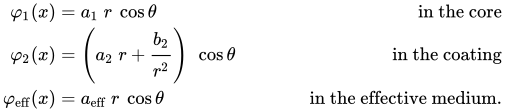
Consider the single coated sphere shown in Figure 2. Let
us assume that the sphere is centered at the origin. We look for a
solution to the time-independent Maxwell's equations
∇
×
E
=
0
;
∇
⋅
D
=
0
;
D
=
ϵ
E
{\displaystyle {\boldsymbol {\nabla }}\times \mathbf {E} =0~;~~{\boldsymbol {\nabla }}\cdot \mathbf {D} =0~;~~\mathbf {D} =\epsilon ~\mathbf {E} }
with potentials
φ
1
(
x
)
=
a
1
r
cos
θ
in the core
φ
2
(
x
)
=
(
a
2
r
+
b
2
r
2
)
cos
θ
in the coating
φ
eff
(
x
)
=
a
eff
r
cos
θ
in the effective medium.
{\displaystyle {\begin{aligned}\varphi _{1}(x)&=a_{1}~r~\cos \theta &\qquad {\text{in the core}}\\\varphi _{2}(x)&=\left(a_{2}~r+{\cfrac {b_{2}}{r^{2}}}\right)~\cos \theta &\qquad {\text{in the coating}}\\\varphi _{\text{eff}}(x)&=a_{\text{eff}}~r~\cos \theta &\qquad {\text{in the effective medium.}}\end{aligned}}}
Then the electric field is given by
E
1
=
∇
φ
1
(
x
)
=
a
1
[
cos
θ
e
r
−
sin
θ
e
θ
]
E
2
=
∇
φ
2
(
x
)
=
(
a
2
r
−
2
b
2
r
3
)
cos
θ
e
r
−
(
a
2
r
+
b
2
r
3
)
sin
θ
e
θ
E
eff
=
∇
φ
eff(x)
=
a
eff
[
cos
θ
e
r
−
sin
θ
e
θ
]
.
{\displaystyle {\begin{aligned}\mathbf {E} _{1}={\boldsymbol {\nabla }}\varphi _{1}(x)&=a_{1}~[\cos \theta ~\mathbf {e} _{r}-\sin \theta ~\mathbf {e} _{\theta }]\\\mathbf {E} _{2}={\boldsymbol {\nabla }}\varphi _{2}(x)&=\left(a_{2}~r-{\cfrac {2b_{2}}{r^{3}}}\right)~\cos \theta ~\mathbf {e} _{r}-\left(a_{2}~r+{\cfrac {b_{2}}{r^{3}}}\right)~\sin \theta ~\mathbf {e} _{\theta }\\\mathbf {E} _{\text{eff}}={\boldsymbol {\nabla }}\varphi _{\text{eff(x)}}&=a_{\text{eff}}~[\cos \theta ~\mathbf {e} _{r}-\sin \theta ~\mathbf {e} _{\theta }]~.\end{aligned}}}
The potentials satisfy Laplace's equations
∇
2
φ
1
=
∇
2
φ
2
=
∇
2
φ
eff
=
0
{\displaystyle \nabla ^{2}\varphi _{1}=\nabla ^{2}\varphi _{2}=\nabla ^{2}\varphi _{\text{eff}}=0}
and we only need to match the boundary conditions at the interfaces to
get a solution, i.e.,
(31)
a
1
r
c
=
a
2
r
c
+
b
2
r
c
2
;
a
eff
r
e
=
a
2
r
e
+
b
2
r
e
2
.
{\displaystyle {\text{(31)}}\qquad a_{1}~r_{c}=a_{2}~r_{c}+{\cfrac {b_{2}}{r_{c}^{2}}}~;~~a_{\text{eff}}~r_{e}=a_{2}~r_{e}+{\cfrac {b_{2}}{r_{e}^{2}}}~.}
Continuity of the tangential component of the electric field at the
interface implies that
(32)
ϵ
1
a
1
=
ϵ
2
[
a
2
−
2
b
2
r
c
3
]
;
ϵ
eff
a
eff
=
ϵ
2
[
a
2
−
2
b
2
r
e
3
]
.
{\displaystyle {\text{(32)}}\qquad \epsilon _{1}~a_{1}=\epsilon _{2}~\left[a_{2}-{\cfrac {2b_{2}}{r_{c}^{3}}}\right]~;~~\epsilon _{\text{eff}}~a_{\text{eff}}=\epsilon _{2}~\left[a_{2}-{\cfrac {2b_{2}}{r_{e}^{3}}}\right]~.}
Combining (31) and (32) gives
b
2
r
c
3
[
1
+
3
ϵ
2
ϵ
1
−
ϵ
2
]
=
b
2
r
e
3
[
1
+
3
ϵ
2
ϵ
eff
−
ϵ
2
]
.
{\displaystyle {\cfrac {b_{2}}{r_{c}^{3}}}\left[1+{\cfrac {3~\epsilon _{2}}{\epsilon _{1}-\epsilon _{2}}}\right]={\cfrac {b_{2}}{r_{e}^{3}}}\left[1+{\cfrac {3~\epsilon _{2}}{\epsilon _{\text{eff}}-\epsilon _{2}}}\right]~.}
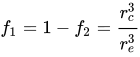
Defining the volume fraction
f
{\displaystyle f}
f
1
=
1
−
f
2
=
r
c
3
r
e
3
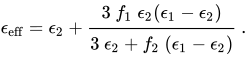
{\displaystyle f_{1}=1-f_{2}={\cfrac {r_{c}^{3}}{r_{e}^{3}}}}
leads to the following expression for
ϵ
eff
{\displaystyle \epsilon _{\text{eff}}}
ϵ
eff
=
ϵ
2
+
3
f
1
ϵ
2
(
ϵ
1
−
ϵ
2
)
3
ϵ
2
+
f
2
(
ϵ
1
−
ϵ
2
)
.
{\displaystyle {\epsilon _{\text{eff}}=\epsilon _{2}+{\cfrac {3~f_{1}~\epsilon _{2}(\epsilon _{1}-\epsilon _{2})}{3~\epsilon _{2}+f_{2}~(\epsilon _{1}-\epsilon _{2})}}~.}}
In this case, consider the coated sphere shown in Figure~2
with the difference that each material now has two properties- the bulk and
shear moduli. Let the bulk and shear moduli of the sphere be
κ
1
{\displaystyle \kappa _{1}}
μ
1
{\displaystyle \mu _{1}}
κ
2
{\displaystyle \kappa _{2}}
μ
2
{\displaystyle \mu _{2}}
κ
eff
{\displaystyle \kappa _{\text{eff}}}
μ
eff
{\displaystyle \mu _{\text{eff}}}
r
c
{\displaystyle r_{c}}
r
e
{\displaystyle r_{e}}
The governing equations are
∇
⋅
σ
=
0
;
ϵ
=
1
2
[
∇
u
+
(
∇
u
)
T
]
;
σ
=
λ
tr
ϵ
1
+
2
μ
ϵ
;
κ
=
λ
+
2
3
μ
.
{\displaystyle {\boldsymbol {\nabla }}\cdot {\boldsymbol {\sigma }}=0~;~~{\boldsymbol {\epsilon }}={\frac {1}{2}}\left[{\boldsymbol {\nabla }}\mathbf {u} +({\boldsymbol {\nabla }}\mathbf {u} )^{T}\right]~;~~{\boldsymbol {\sigma }}=\lambda ~{\text{tr}}{\boldsymbol {\epsilon }}~{\boldsymbol {\mathit {1}}}+2~\mu ~{\boldsymbol {\epsilon }}~;~~\kappa =\lambda +{\cfrac {2}{3}}~\mu ~.}
Let the matrix be subject to a hydrostatic state of stress, i.e.,
σ
=
−
p
1
.
{\displaystyle {\boldsymbol {\sigma }}=-p~{\boldsymbol {\mathit {1}}}~.}
Let us look for a solution that does not perturb this field when the
coated sphere is added to the matrix.
Therefore, we look for a solution with a radial displacement field
u
1
(
x
)
=
a
1
r
e
r
in the core
u
2
(
x
)
=
(
a
2
r
+
b
2
r
2
)
e
r
in the coating
u
eff
(
x
)
=
a
eff
r
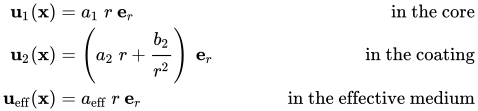
e
r
in the effective medium
{\displaystyle {\begin{aligned}\mathbf {u} _{1}(\mathbf {x} )&=a_{1}~r~\mathbf {e} _{r}&\qquad {\text{in the core}}\\\mathbf {u} _{2}(\mathbf {x} )&=\left(a_{2}~r+{\cfrac {b_{2}}{r^{2}}}\right)~\mathbf {e} _{r}&\qquad {\text{in the coating}}\\\mathbf {u} _{\text{eff}}(\mathbf {x} )&=a_{\text{eff}}~r~\mathbf {e} _{r}&\qquad {\text{in the effective medium}}\end{aligned}}}
From the continuity of displacements at the interfaces, we have
a
1
r
c
=
a
2
r
c
+
b
2
r
c
2
;
a
eff
r
e
=
a
2
r
e
+
b
2
r
e
2
.
{\displaystyle a_{1}~r_{c}=a_{2}~r_{c}+{\cfrac {b_{2}}{r_{c}^{2}}}~;~~a_{\text{eff}}~r_{e}=a_{2}~r_{e}+{\cfrac {b_{2}}{r_{e}^{2}}}~.}
And the continuity of radial tractions
σ
⋅
e
r
{\displaystyle {\boldsymbol {\sigma }}\cdot \mathbf {e} _{r}}
κ
1
a
1
=
κ
2
a
2
−
4
b
2
μ
2
3
r
c
3
;
κ
eff
a
eff
=
κ
2
a
2
−
4
b
2
μ
2
3
r
e
3
;
{\displaystyle \kappa _{1}~a_{1}=\kappa _{2}~a_{2}-{\cfrac {4~b_{2}~\mu _{2}}{3~r_{c}^{3}}}~;~~\kappa _{\text{eff}}~a_{\text{eff}}=\kappa _{2}~a_{2}-{\cfrac {4~b_{2}~\mu _{2}}{3~r_{e}^{3}}}~;~~}
From the continuity relations and using the definition
f
1
=
1
−
f
2
=
r
c
3
r
e
3
{\displaystyle f_{1}=1-f_{2}={\cfrac {r_{c}^{3}}{r_{e}^{3}}}}
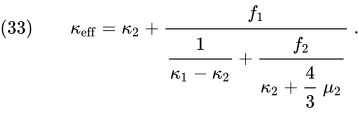
we can show that the effective bulk modulus is given by
(33)
κ
eff
=
κ
2
+
f
1
1
κ
1
−
κ
2
+
f
2
κ
2
+
4
3
μ
2
.
{\displaystyle {\text{(33)}}\qquad {\kappa _{\text{eff}}=\kappa _{2}+{\cfrac {f_{1}}{{\cfrac {1}{\kappa _{1}-\kappa _{2}}}+{\cfrac {f_{2}}{\kappa _{2}+{\cfrac {4}{3}}~\mu _{2}}}}}~.}}
For the assemblage of coated spheres, when the bulk and shear moduli of
the two phases are real, the effective bulk modulus is given by
equation (33). We can then use the Bloch wave solutions to
show that the same result holds when the moduli are complex.
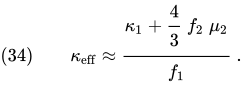
Returning to the bubbly fluid problem, suppose that phase 1 is gas and
phase 2 is water. The mixture is then a bubbly fluid. If we assume that
water is incompressible, then
κ
2
→
∞
{\displaystyle \kappa _{2}\rightarrow \infty }
(34)
κ
eff
≈
κ
1
+
4
3
f
2
μ
2
f
1
.
{\displaystyle {\text{(34)}}\qquad \kappa _{\text{eff}}\approx {\cfrac {\kappa _{1}+{\cfrac {4}{3}}~f_{2}~\mu _{2}}{f_{1}}}~.}
Also, assume that
κ
1
{\displaystyle \kappa _{1}}
Now consider a plane shear wave propagating into a bubbly fluid. Let the
frequency of the wave be
ω
{\displaystyle \omega }
k
{\displaystyle \mathbf {k} }
ϵ
(
x
,
ω
)
=
e
i
k
⋅
x
ϵ
^
(
ω
)
.
{\displaystyle {\boldsymbol {\epsilon }}(\mathbf {x} ,\omega )=e^{i~\mathbf {k} \cdot \mathbf {x} }~{\widehat {\boldsymbol {\epsilon }}}(\omega )~.}
The stress field is given by (assuming a Newtonian fluid)
σ
(
x
,
ω
)
=
−
i
ω
η
μ
e
i
k
⋅
x
ϵ
^
(
ω
)
=
−
i
ω
η
μ
ϵ
(
x
,
ω
)
{\displaystyle {\boldsymbol {\sigma }}(\mathbf {x} ,\omega )=-i~\omega ~\eta _{\mu }~e^{i~\mathbf {k} \cdot \mathbf {x} }~{\widehat {\boldsymbol {\epsilon }}}(\omega )=-i~\omega ~\eta _{\mu }~{\boldsymbol {\epsilon }}(\mathbf {x} ,\omega )}
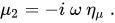
where
η
μ
{\displaystyle \eta _{\mu }}
μ
2
=
−
i
ω
η
μ
.
{\displaystyle \mu _{2}=-i~\omega ~\eta _{\mu }~.}
Plugging this in (34) gives
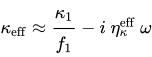
κ
eff
≈
κ
1
f
1
−
i
η
κ
eff
ω
{\displaystyle \kappa _{\text{eff}}\approx {\cfrac {\kappa _{1}}{f_{1}}}-i~\eta _{\kappa }^{\text{eff}}~\omega }
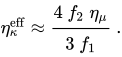
where the effective bulk viscosity is defined as
η
κ
eff
≈
4
f
2
η
μ
3
f
1
.
{\displaystyle \eta _{\kappa }^{\text{eff}}\approx {\cfrac {4~f_{2}~\eta _{\mu }}{3~f_{1}}}~.}
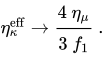
When
f
1
→
0
{\displaystyle f_{1}\rightarrow 0}
η
κ
eff
→
4
η
μ
3
f
1
.
{\displaystyle \eta _{\kappa }^{\text{eff}}\rightarrow {\cfrac {4~\eta _{\mu }}{3~f_{1}}}~.}
Therefore, the shear viscosity of water has been converted into the
bulk viscosity of the bubbly fluid. This is the reason that sound is
damped strongly in bubbly fluids.
↑ The following discussion is based on Milton02
Z. Hashin. The elastic moduli of heterogeneous materials. J. Appl. Mech. , 29:143--150, 1962.
Z. Hashin and S. Shtrikman. A variational approach to the theory of the effective magnetic permeability of multiphase materials. J. Appl. Phys. , 33(10):3125--3131, 1962.
G. W. Milton. Theory of Composites . Cambridge University Press, New York, 2002.
M. I. Hussein. Reduced Bloch mode expansion for periodic media band structure calculations. Proc. R. Soc. A , 465:2825-2848, 2009. 





















![{\displaystyle {\cfrac {1}{\omega _{0}^{j}}}~\mathbf {k} \times \left\{{\boldsymbol {\mu }}_{\text{eff}}^{-1}\cdot [\mathbf {k} \times \langle \mathbf {e} _{0}\rangle ]\right\}+\omega _{0}^{j}~{\boldsymbol {\epsilon }}_{\text{eff}}\cdot \langle \mathbf {e} _{0}\rangle ={\boldsymbol {0}}}](https://wikimedia.org/api/rest_v1/media/math/render/svg/7964069b93b05b4e04323e60c4ea4145320c8ad9)
![{\displaystyle {\text{(11)}}\qquad {\boldsymbol {\epsilon }}_{\text{eff}}^{-1}\cdot \left(\mathbf {k} \times \left\{{\boldsymbol {\mu }}_{\text{eff}}^{-1}\cdot [\mathbf {k} \times \langle \mathbf {e} _{0}\rangle ]\right\}\right)+(\omega _{0}^{j})^{2}~\langle \mathbf {e} _{0}\rangle ={\boldsymbol {0}}~.}](https://wikimedia.org/api/rest_v1/media/math/render/svg/71a0fef30c3daaecec64a204875d72c179ba1606)


![{\displaystyle {\text{(12)}}\qquad {\boldsymbol {A}}_{\text{eff}}(\mathbf {k} )\cdot \mathbf {v} ={\boldsymbol {\epsilon }}_{\text{eff}}^{-1}\cdot \left(\mathbf {k} \times \left\{{\boldsymbol {\mu }}_{\text{eff}}^{-1}\cdot [\mathbf {k} \times \mathbf {v} ]\right\}\right)~.}](https://wikimedia.org/api/rest_v1/media/math/render/svg/3014735622041b85f106cb993aaabbf90eacb6fd)



![{\displaystyle {\text{(14)}}\qquad {\boldsymbol {A}}_{\text{eff}}(\mathbf {k} )\cdot \mathbf {v} ={\cfrac {1}{\epsilon _{\text{eff}}~\mu _{\text{eff}}}}\cdot \left[(\mathbf {k} \cdot \mathbf {k} )~\mathbf {v} -(\mathbf {k} \cdot \mathbf {v} )~\mathbf {k} \right]~.}](https://wikimedia.org/api/rest_v1/media/math/render/svg/0b93df02db2785260f2c93985bde60cd8e61b53d)









![{\displaystyle {\boldsymbol {\epsilon }}(\mathbf {x} )={\frac {1}{2}}\left\{{\boldsymbol {\nabla }}\mathbf {u} (\mathbf {x} )+[{\boldsymbol {\nabla }}\mathbf {u} (\mathbf {x} )]^{T}\right\}~.}](https://wikimedia.org/api/rest_v1/media/math/render/svg/46713b747bdc7ada309ca545453aa7c5f3f5c631)


![{\displaystyle {\text{(16)}}\qquad {\boldsymbol {\nabla }}\cdot {\boldsymbol {\sigma }}_{\eta }(\mathbf {x} )=-\omega ^{2}~\rho _{\eta }(\mathbf {x} )~\mathbf {u} _{\eta }(\mathbf {x} )~;~~{\boldsymbol {\epsilon }}_{\eta }(\mathbf {x} )={\frac {1}{2}}\left\{{\boldsymbol {\nabla }}\mathbf {u} _{\eta }(\mathbf {x} )+[{\boldsymbol {\nabla }}\mathbf {u} _{\eta }(\mathbf {x} )]^{T}\right\}~;~~{\boldsymbol {\sigma }}_{\eta }(\mathbf {x} )={\boldsymbol {\mathsf {C}}}_{\eta }(\mathbf {x} ):{\boldsymbol {\epsilon }}_{\eta }(\mathbf {x} )~.}](https://wikimedia.org/api/rest_v1/media/math/render/svg/f549798ae64cc6f927b20b1a0dd98171e84ee26c)

![{\displaystyle {\begin{aligned}{\boldsymbol {\nabla }}\cdot \left(e^{i~\mathbf {k} \cdot \mathbf {x} }~{\widehat {\boldsymbol {\sigma }}}_{\eta }(\mathbf {x} )\right)&=-\omega ^{2}~\rho _{\eta }(\mathbf {x} )~e^{i~\mathbf {k} \cdot \mathbf {x} }~{\widehat {\mathbf {u} }}_{\eta }(\mathbf {x} )\\e^{i~\mathbf {k} \cdot \mathbf {x} }~{\widehat {\boldsymbol {\epsilon }}}_{\eta }(\mathbf {x} )&={\frac {1}{2}}\left\{{\boldsymbol {\nabla }}\left(e^{i~\mathbf {k} \cdot \mathbf {x} }~{\widehat {\mathbf {u} }}_{\eta }(\mathbf {x} )\right)+\left[{\boldsymbol {\nabla }}\left(e^{i~\mathbf {k} \cdot \mathbf {x} }~{\widehat {\mathbf {u} }}_{\eta }(\mathbf {x} )\right)\right]\right\}\\e^{i~\mathbf {k} \cdot \mathbf {x} }~{\widehat {\boldsymbol {\sigma }}}_{\eta }(\mathbf {x} )&={\boldsymbol {\mathsf {C}}}_{\eta }(\mathbf {x} ):\left(e^{i~\mathbf {k} \cdot \mathbf {x} }~{\widehat {\boldsymbol {\epsilon }}}_{\eta }(\mathbf {x} )\right)\end{aligned}}}](https://wikimedia.org/api/rest_v1/media/math/render/svg/34e1e977ccdd35c0257dcc12bcce4e9189fa533b)
![{\displaystyle {\begin{aligned}&e^{i~\mathbf {k} \cdot \mathbf {x} }~\left({\boldsymbol {\nabla }}\cdot {\widehat {\boldsymbol {\sigma }}}_{\eta }+i~{\widehat {\boldsymbol {\sigma }}}_{\eta }~\cdot \mathbf {k} \right)=-e^{i~\mathbf {k} \cdot \mathbf {x} }~\omega ^{2}~\rho _{\eta }~{\widehat {\mathbf {u} }}_{\eta }\\&e^{i~\mathbf {k} \cdot \mathbf {x} }~{\widehat {\boldsymbol {\epsilon }}}_{\eta }=e^{i~\mathbf {k} \cdot \mathbf {x} }~\left[{\cfrac {i}{2}}\left({\widehat {\mathbf {u} }}_{\eta }\otimes \mathbf {k} +\mathbf {k} \otimes {\widehat {\mathbf {u} }}_{\eta }\right)+{\frac {1}{2}}~\left({\boldsymbol {\nabla }}{\widehat {\mathbf {u} }}_{\eta }+[{\boldsymbol {\nabla }}{\widehat {\mathbf {u} }}_{\eta }]^{T}\right)\right]\\&e^{i~\mathbf {k} \cdot \mathbf {x} }~{\widehat {\boldsymbol {\sigma }}}_{\eta }=e^{i~\mathbf {k} \cdot \mathbf {x} }~{\boldsymbol {\mathsf {C}}}_{\eta }:{\widehat {\boldsymbol {\epsilon }}}_{\eta }\end{aligned}}}](https://wikimedia.org/api/rest_v1/media/math/render/svg/a19a54cfded2e88216623345905665047ee929f6)
![{\displaystyle {\text{(18)}}\qquad {\begin{aligned}&{\boldsymbol {\nabla }}\cdot {\widehat {\boldsymbol {\sigma }}}_{\eta }+i~{\widehat {\boldsymbol {\sigma }}}_{\eta }~\cdot \mathbf {k} +\omega ^{2}~\rho _{\eta }~{\widehat {\mathbf {u} }}_{\eta }=0\\&{\widehat {\boldsymbol {\epsilon }}}_{\eta }={\cfrac {i}{2}}\left({\widehat {\mathbf {u} }}_{\eta }\otimes \mathbf {k} +\mathbf {k} \otimes {\widehat {\mathbf {u} }}_{\eta }\right)+{\frac {1}{2}}~\left({\boldsymbol {\nabla }}{\widehat {\mathbf {u} }}_{\eta }+[{\boldsymbol {\nabla }}{\widehat {\mathbf {u} }}_{\eta }]^{T}\right)\\&{\widehat {\boldsymbol {\sigma }}}_{\eta }={\boldsymbol {\mathsf {C}}}_{\eta }:{\widehat {\boldsymbol {\epsilon }}}_{\eta }~.\end{aligned}}}](https://wikimedia.org/api/rest_v1/media/math/render/svg/15de511d16ab5e6615724781caac422f7ee08c59)







![{\displaystyle {\text{(20)}}\qquad {\begin{aligned}&{\cfrac {1}{\eta }}{\boldsymbol {\nabla }}_{y}\cdot ({\boldsymbol {\sigma }}_{0}+\eta ~{\boldsymbol {\sigma }}_{1}+\dots )+i~({\boldsymbol {\sigma }}_{0}+\eta ~{\boldsymbol {\sigma }}_{1}+\dots )~\cdot \mathbf {k} +\rho _{\eta }~(\omega _{0}^{j}+\eta ~\omega _{1}^{j}+\dots )^{2}~(\mathbf {u} _{0}+\eta ~\mathbf {u} _{1}+\dots )=0\\&{\boldsymbol {\epsilon }}_{0}+\eta ~{\boldsymbol {\epsilon }}_{1}+\dots ={\cfrac {i}{2}}\left[(\mathbf {u} _{0}+\eta ~\mathbf {u} _{1}+\dots )\otimes \mathbf {k} +\mathbf {k} \otimes (\mathbf {u} _{0}+\eta ~\mathbf {u} _{1}+\dots )\right]+\\&\qquad \qquad \qquad \qquad {\cfrac {1}{2\eta }}~\left({\boldsymbol {\nabla }}_{y}(\mathbf {u} _{0}+\eta ~\mathbf {u} _{1}+\dots )+[{\boldsymbol {\nabla }}_{y}(\mathbf {u} _{0}+\eta ~\mathbf {u} _{1}+\dots )]^{T}\right)\\&{\boldsymbol {\sigma }}_{0}+\eta ~{\boldsymbol {\sigma }}_{1}+\dots ={\boldsymbol {\mathsf {C}}}_{\eta }:({\boldsymbol {\epsilon }}_{0}+\eta ~{\boldsymbol {\epsilon }}_{1}+\dots )~.\end{aligned}}}](https://wikimedia.org/api/rest_v1/media/math/render/svg/1fc1456d640c64f951cdd52c546f3d1ae0156dcf)

![{\displaystyle {\begin{aligned}&{{\boldsymbol {\nabla }}_{y}\cdot {\boldsymbol {\sigma }}_{0}=0}{\text{(21)}}\qquad \\&{{\boldsymbol {\nabla }}_{y}\mathbf {u} _{0}+[{\boldsymbol {\nabla }}_{y}\mathbf {u} _{0}]^{T}=0}~.{\text{(22)}}\qquad \end{aligned}}}](https://wikimedia.org/api/rest_v1/media/math/render/svg/aca3ac590bb5d373fb102115f2a494f525c1bae0)

![{\displaystyle {\begin{aligned}&{{\boldsymbol {\nabla }}_{y}\cdot {\boldsymbol {\sigma }}_{1}+i~{\boldsymbol {\sigma }}_{0}\cdot \mathbf {k} +\rho _{\eta }~(\omega _{0}^{j})^{2}~\mathbf {u} _{0}=0}{\text{(23)}}\qquad \\&{{\boldsymbol {\epsilon }}_{0}={\cfrac {i}{2}}~(\mathbf {u} _{0}\otimes \mathbf {k} +\mathbf {k} \otimes \mathbf {u} _{0})+{\frac {1}{2}}~({\boldsymbol {\nabla }}\mathbf {u} _{1}+[{\boldsymbol {\nabla }}\mathbf {u} _{1}]^{T})}{\text{(24)}}\qquad \\&{{\boldsymbol {\sigma }}_{0}={\boldsymbol {\mathsf {C}}}_{\eta }:{\boldsymbol {\epsilon }}_{0}}{\text{(25)}}\qquad ~.\end{aligned}}}](https://wikimedia.org/api/rest_v1/media/math/render/svg/ae4fba5a750301ce3bd4dd6e16d07fb12c5edd2c)



![{\displaystyle {\text{(26)}}\qquad {\boldsymbol {\epsilon }}_{0}={\cfrac {i}{2}}~({\widehat {\mathbf {u} }}_{0}\otimes \mathbf {k} +\mathbf {k} \otimes {\widehat {\mathbf {u} }}_{0})+{\frac {1}{2}}~({\boldsymbol {\nabla }}\mathbf {u} _{1}+[{\boldsymbol {\nabla }}\mathbf {u} _{1}]^{T})\qquad \implies {{\boldsymbol {\epsilon }}_{0}={\frac {1}{2}}~\left({\boldsymbol {\nabla }}_{y}{\widehat {\mathbf {u} }}(\mathbf {y} )+[{\boldsymbol {\nabla }}_{y}{\widehat {\mathbf {u} }}(\mathbf {y} )]^{T}\right)}}](https://wikimedia.org/api/rest_v1/media/math/render/svg/7f0a8b0d2cf296879e2a0cbbbdc9851c8b9a3e5e)


![{\displaystyle \langle {\boldsymbol {\epsilon }}_{0}\rangle ={\cfrac {i}{2}}~({\widehat {\mathbf {u} }}_{0}\otimes \mathbf {k} +\mathbf {k} \otimes {\widehat {\mathbf {u} }}_{0})+{\frac {1}{2}}~\left(\langle {\boldsymbol {\nabla }}\mathbf {u} _{1}\rangle +\langle [{\boldsymbol {\nabla }}\mathbf {u} _{1}]^{T}\rangle \right)}](https://wikimedia.org/api/rest_v1/media/math/render/svg/da11b5b11296807f4abd6e9be62e1ab49a8c048e)




![{\displaystyle -{\frac {1}{2}}~\left[{\boldsymbol {\mathsf {C}}}_{\text{eff}}:({\widehat {\mathbf {u} }}_{0}\otimes \mathbf {k} +\mathbf {k} \otimes {\widehat {\mathbf {u} }}_{0})\right]\cdot \mathbf {k} +\langle \rho _{\eta }\rangle ~(\omega _{0}^{j})^{2}~{\widehat {\mathbf {u} }}_{0}=0~.}](https://wikimedia.org/api/rest_v1/media/math/render/svg/835b008c1aca13acfc441fb24b8c789c21cd7d9c)



![{\displaystyle \left[{\boldsymbol {\mathsf {C}}}_{\text{eff}}:(\mathbf {k} \otimes {\widehat {\mathbf {u} }}_{0})\right]\cdot \mathbf {k} =\langle \rho _{\eta }\rangle ~(\omega _{0}^{j})^{2}~{\widehat {\mathbf {u} }}_{0}}](https://wikimedia.org/api/rest_v1/media/math/render/svg/b00a4c3593380ba16c174b8ec9bdc0a25d745583)

![{\displaystyle {{\boldsymbol {A}}_{\text{eff}}(\mathbf {k} )~\mathbf {v} ={\cfrac {1}{\langle \rho _{\eta }\rangle }}~\left[{\boldsymbol {\mathsf {C}}}_{\text{eff}}:(\mathbf {k} \otimes \mathbf {v} )\right]\cdot \mathbf {k} ~.}}](https://wikimedia.org/api/rest_v1/media/math/render/svg/ba3d051b1af0c86e9badc18ae61b1969e7b45859)



![{\displaystyle {\begin{aligned}\mathbf {E} _{1}={\boldsymbol {\nabla }}\varphi _{1}(x)&=a_{1}~[\cos \theta ~\mathbf {e} _{r}-\sin \theta ~\mathbf {e} _{\theta }]\\\mathbf {E} _{2}={\boldsymbol {\nabla }}\varphi _{2}(x)&=\left(a_{2}~r-{\cfrac {2b_{2}}{r^{3}}}\right)~\cos \theta ~\mathbf {e} _{r}-\left(a_{2}~r+{\cfrac {b_{2}}{r^{3}}}\right)~\sin \theta ~\mathbf {e} _{\theta }\\\mathbf {E} _{\text{eff}}={\boldsymbol {\nabla }}\varphi _{\text{eff(x)}}&=a_{\text{eff}}~[\cos \theta ~\mathbf {e} _{r}-\sin \theta ~\mathbf {e} _{\theta }]~.\end{aligned}}}](https://wikimedia.org/api/rest_v1/media/math/render/svg/577671c82cdd478feb5c460cdfdf0179ef2ef724)


![{\displaystyle {\text{(32)}}\qquad \epsilon _{1}~a_{1}=\epsilon _{2}~\left[a_{2}-{\cfrac {2b_{2}}{r_{c}^{3}}}\right]~;~~\epsilon _{\text{eff}}~a_{\text{eff}}=\epsilon _{2}~\left[a_{2}-{\cfrac {2b_{2}}{r_{e}^{3}}}\right]~.}](https://wikimedia.org/api/rest_v1/media/math/render/svg/4dc05682f605b4a5dbbe5af7e4ca3821fc1a7e94)
![{\displaystyle {\cfrac {b_{2}}{r_{c}^{3}}}\left[1+{\cfrac {3~\epsilon _{2}}{\epsilon _{1}-\epsilon _{2}}}\right]={\cfrac {b_{2}}{r_{e}^{3}}}\left[1+{\cfrac {3~\epsilon _{2}}{\epsilon _{\text{eff}}-\epsilon _{2}}}\right]~.}](https://wikimedia.org/api/rest_v1/media/math/render/svg/72d7b2e535ec8bbe58a7a841565b200089f14f31)



![{\displaystyle {\boldsymbol {\nabla }}\cdot {\boldsymbol {\sigma }}=0~;~~{\boldsymbol {\epsilon }}={\frac {1}{2}}\left[{\boldsymbol {\nabla }}\mathbf {u} +({\boldsymbol {\nabla }}\mathbf {u} )^{T}\right]~;~~{\boldsymbol {\sigma }}=\lambda ~{\text{tr}}{\boldsymbol {\epsilon }}~{\boldsymbol {\mathit {1}}}+2~\mu ~{\boldsymbol {\epsilon }}~;~~\kappa =\lambda +{\cfrac {2}{3}}~\mu ~.}](https://wikimedia.org/api/rest_v1/media/math/render/svg/df0ce13b93fea3cd1866bf5e7dd8fd24987daa1d)