The content of these notes is based on the lectures by Prof. Graeme W. Milton (University of Utah) given in a course on metamaterials in Spring 2007.
In the previous lecture we showed that Maxwell's equations at fixed
frequency can be formulated in terms of the fields
D
{\displaystyle \mathbf {D} }
B
{\displaystyle \mathbf {B} }
[1]
(1)
∇
⋅
D
=
0
;
∇
⋅
B
=
0
;
i
∇
×
(
D
ϵ
)
=
ω
B
;
−
i
∇
×
(
B
μ
)
=
ω
D
.
{\displaystyle {\text{(1)}}\qquad {\boldsymbol {\nabla }}\cdot \mathbf {D} =0~;~~{\boldsymbol {\nabla }}\cdot \mathbf {B} =0~;~~i~{\boldsymbol {\nabla }}\times \left({\cfrac {\mathbf {D} }{\epsilon }}\right)=\omega ~\mathbf {B} ~;~~-i~{\boldsymbol {\nabla }}\times \left({\cfrac {\mathbf {B} }{\mu }}\right)=\omega ~\mathbf {D} ~.}
Equations (1) suggest that we should look for solutions
D
{\displaystyle \mathbf {D} }
B
{\displaystyle \mathbf {B} }
(2)
L
[
D
B
]
=
ω
[
D
B
]
or
(
L
−
ω
1
)
[
D
B
]
=
0
{\displaystyle {\text{(2)}}\qquad {\mathcal {L}}{\begin{bmatrix}\mathbf {D} \\\mathbf {B} \end{bmatrix}}=\omega ~{\begin{bmatrix}\mathbf {D} \\\mathbf {B} \end{bmatrix}}\qquad {\text{or}}\qquad {({\mathcal {L}}-\omega ~{\boldsymbol {1}}){\begin{bmatrix}\mathbf {D} \\\mathbf {B} \end{bmatrix}}={\boldsymbol {0}}}}
where the operator
L
{\displaystyle {\mathcal {L}}}
(3)
L
:=
[
0
−
i
∇
×
μ
−
1
i
∇
×
ϵ
−
1
0
]
.
{\displaystyle {\text{(3)}}\qquad {{\mathcal {L}}:={\begin{bmatrix}0&-i~{\boldsymbol {\nabla }}\times \mu ^{-1}\\i~{\boldsymbol {\nabla }}\times \epsilon ^{-1}&0\end{bmatrix}}~.}}
If the medium is such that the permittivity
ϵ
(
x
)
{\displaystyle \epsilon (\mathbf {x} )}
μ
(
x
)
{\displaystyle \mu (\mathbf {x} )}
ϵ
(
x
)
=
ϵ
(
x
+
R
)
;
μ
(
x
)
=
μ
(
x
+
R
)
{\displaystyle \epsilon (\mathbf {x} )=\epsilon (\mathbf {x} +\mathbf {R} )~;~~\mu (\mathbf {x} )=\mu (\mathbf {x} +\mathbf {R} )}
where
R
{\displaystyle \mathbf {R} }
L
{\displaystyle {\mathcal {L}}}
Figure 1. Lattice vector in a periodic medium.
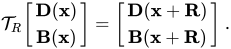
Also recall the translation operator
T
R
{\displaystyle {\mathcal {T}}_{R}}
T
R
[
D
(
x
)
B
(
x
)
]
=
[
D
(
x
+
R
)
B
(
x
+
R
)
]
.
{\displaystyle {{\mathcal {T}}_{R}{\begin{bmatrix}\mathbf {D} (\mathbf {x} )\\\mathbf {B} (\mathbf {x} )\end{bmatrix}}={\begin{bmatrix}\mathbf {D} (\mathbf {x} +\mathbf {R} )\\\mathbf {B} (\mathbf {x} +\mathbf {R} )\end{bmatrix}}~.}}
Periodicity of the medium implies that
T
R
{\displaystyle {\mathcal {T}}_{R}}
L
{\displaystyle {\mathcal {L}}}
T
R
L
=
L
T
R
.
{\displaystyle {{\mathcal {T}}_{R}~{\mathcal {L}}={\mathcal {L}}~{\mathcal {T}}_{R}~.}}
[2]
T
R
T
R
T
=
T
R
T
−
R
=
1
.
{\displaystyle {{\mathcal {T}}_{R}~{\mathcal {T}}_{R}^{T}={\mathcal {T}}_{R}~{\mathcal {T}}_{-R}={\boldsymbol {1}}~.}}
This means that the adjoint operator
T
R
T
{\displaystyle {\mathcal {T}}_{R}^{T}}
T
−
R
{\displaystyle {\mathcal {T}}_{-R}}
The translation operator also commutes, i.e.,
T
R
T
R
′
=
T
R
′
T
R
=
T
R
+
R
′
.
{\displaystyle {{\mathcal {T}}_{R}~{\mathcal {T}}_{R'}={\mathcal {T}}_{R'}~{\mathcal {T}}_{R}={\mathcal {T}}_{R+R'}~.}}
[3]
L
{\displaystyle {\mathcal {L}}}
T
R
{\displaystyle {\mathcal {T}}_{R}}
L
−
ω
1
{\displaystyle {\mathcal {L}}-\omega {\boldsymbol {1}}}
T
R
{\displaystyle {\mathcal {T}}_{R}}
T
R
(
L
−
ω
1
)
[
D
(
x
)
B
(
x
)
]
=
0
=
(
L
−
ω
1
)
T
R
[
D
(
x
)
B
(
x
)
]
=
(
L
−
ω
1
)
[
D
(
x
+
R
)
B
(
x
+
R
)
]
.
{\displaystyle {\mathcal {T}}_{R}~({\mathcal {L}}-\omega ~{\boldsymbol {1}})~{\begin{bmatrix}\mathbf {D} (\mathbf {x} )\\\mathbf {B} (\mathbf {x} )\end{bmatrix}}={\boldsymbol {0}}=({\mathcal {L}}-\omega ~{\boldsymbol {1}})~{\mathcal {T}}_{R}~{\begin{bmatrix}\mathbf {D} (\mathbf {x} )\\\mathbf {B} (\mathbf {x} )\end{bmatrix}}=({\mathcal {L}}-\omega ~{\boldsymbol {1}})~~{\begin{bmatrix}\mathbf {D} (\mathbf {x} +\mathbf {R} )\\\mathbf {B} (\mathbf {x} +\mathbf {R} )\end{bmatrix}}~.}
Hence the eigenstates of
L
−
ω
1
{\displaystyle {\mathcal {L}}-\omega ~{\boldsymbol {1}}}
T
R
{\displaystyle {\mathcal {T}}_{R}}
T
R
{\displaystyle {\mathcal {T}}_{R}}
(4)
[
T
R
−
c
(
R
)
1
]
[
D
(
x
)
B
(
x
)
]
=
0
.
{\displaystyle {\text{(4)}}\qquad {[{\mathcal {T}}_{R}-c(\mathbf {R} )~{\boldsymbol {1}}]{\begin{bmatrix}\mathbf {D} (\mathbf {x} )\\\mathbf {B} (\mathbf {x} )\end{bmatrix}}={\boldsymbol {0}}~.}}
Since
T
R
T
R
′
=
T
R
+
R
′
{\displaystyle {\mathcal {T}}_{R}~{\mathcal {T}}_{R'}={\mathcal {T}}_{R+R'}}
c
(
R
)
c
(
R
′
)
=
c
(
R
+
R
′
)
.
{\displaystyle c(\mathbf {R} )~c(\mathbf {R} ')=c(\mathbf {R} +\mathbf {R} ')~.}
So it suffices to know
c
(
R
)
{\displaystyle c(\mathbf {R} )}
R
=
a
1
,
a
2
,
a
3
{\displaystyle \mathbf {R} =\mathbf {a} _{1},\mathbf {a} _{2},\mathbf {a} _{3}}
a
i
{\displaystyle \mathbf {a} _{i}}
ϵ
(
x
+
a
j
)
=
ϵ
(
x
)
;
μ
(
x
+
a
j
)
=
μ
(
x
)
.
{\displaystyle \epsilon (\mathbf {x} +\mathbf {a} _{j})=\epsilon (\mathbf {x} )~;~~\mu (\mathbf {x} +\mathbf {a} _{j})=\mu (\mathbf {x} )~.}
Let us assume that
c
(
a
j
)
=
e
2
π
i
α
j
j
=
1
,
2
,
3
{\displaystyle c(\mathbf {a} _{j})=e^{2\pi ~i~\alpha _{j}}\qquad j=1,2,3}
for a suitable choice of
α
j
{\displaystyle \alpha _{j}}
Then for any lattice vector
R
=
n
1
a
1
+
n
2
a
2
+
n
3
a
3
{\displaystyle \mathbf {R} =n_{1}~\mathbf {a} _{1}+n_{2}~\mathbf {a} _{2}+n_{3}~\mathbf {a} _{3}}
we have
c
(
R
)
=
c
(
n
1
a
1
+
n
2
a
2
+
n
3
a
3
)
=
c
(
n
1
a
1
)
c
(
n
2
a
2
)
c
(
n
3
a
3
)
=
c
(
∑
i
=
1
n
1
a
1
)
c
(
∑
i
=
1
n
2
a
2
)
c
(
∑
i
=
1
n
3
a
3
)
=
[
c
(
a
1
)
]
n
1
[
c
(
a
2
)
]
n
2
[
c
(
a
3
)
]
n
3
=
e
2
π
i
α
1
n
1
e
2
π
i
α
2
n
2
e
2
π
i
α
3
n
3
=
e
2
π
i
(
α
1
n
1
+
α
2
n
2
+
α
3
n
3
)
{\displaystyle {\begin{aligned}c(\mathbf {R} )&=c(n_{1}~\mathbf {a} _{1}+n_{2}~\mathbf {a} _{2}+n_{3}~\mathbf {a} _{3})=c(n_{1}~\mathbf {a} _{1})~c(n_{2}~\mathbf {a} _{2})~c(n_{3}~\mathbf {a} _{3})\\&=c\left(\sum _{i=1}^{n_{1}}\mathbf {a} _{1}\right)~c\left(\sum _{i=1}^{n_{2}}\mathbf {a} _{2}\right)~c\left(\sum _{i=1}^{n_{3}}\mathbf {a} _{3}\right)=[c(\mathbf {a} _{1})]^{n_{1}}~[c(\mathbf {a} _{2})]^{n_{2}}~[c(\mathbf {a} _{3})]^{n_{3}}\\&=e^{2\pi i\alpha _{1}~n_{1}}~e^{2\pi i\alpha _{2}~n_{2}}~e^{2\pi i\alpha _{3}~n_{3}}=e^{2\pi i(\alpha _{1}~n_{1}+\alpha _{2}~n_{2}+\alpha _{3}~n_{3})}\end{aligned}}}
or,
c
(
R
)
=
e
2
π
i
(
α
1
n
1
+
α
2
n
2
+
α
3
n
3
)
.
{\displaystyle c(\mathbf {R} )=e^{2\pi i(\alpha _{1}~n_{1}+\alpha _{2}~n_{2}+\alpha _{3}~n_{3})}~.}
Define a vector
k
:=
α
1
b
1
+
α
2
b
2
+
α
3
b
3
{\displaystyle \mathbf {k} :=\alpha _{1}~\mathbf {b} _{1}+\alpha _{2}~\mathbf {b} _{2}+\alpha _{3}~\mathbf {b} _{3}}
where the vectors
b
i
{\displaystyle \mathbf {b} _{i}}
b
i
⋅
a
j
=
2
π
δ
i
j
.
{\displaystyle \mathbf {b} _{i}\cdot \mathbf {a} _{j}=2\pi ~\delta _{ij}~.}
Then,
k
⋅
R
=
(
α
1
b
1
+
α
2
b
2
+
α
3
b
3
)
⋅
(
n
1
a
1
+
n
2
a
2
+
n
3
a
3
)
=
α
1
n
1
2
π
+
α
2
n
2
2
π
+
α
3
n
3
2
π
{\displaystyle \mathbf {k} \cdot \mathbf {R} =(\alpha _{1}~\mathbf {b} _{1}+\alpha _{2}~\mathbf {b} _{2}+\alpha _{3}~\mathbf {b} _{3})\cdot (n_{1}~\mathbf {a} _{1}+n_{2}~\mathbf {a} _{2}+n_{3}~\mathbf {a} _{3})=\alpha _{1}~n_{1}~2~\pi +\alpha _{2}~n_{2}~2~\pi +\alpha _{3}~n_{3}~2~\pi }
or,
k
⋅
R
=
2
π
(
α
1
n
1
+
α
2
n
2
+
α
3
n
3
)
.
{\displaystyle \mathbf {k} \cdot \mathbf {R} =2\pi (\alpha _{1}~n_{1}+\alpha _{2}~n_{2}+\alpha _{3}~n_{3})~.}
Therefore, we have
c
(
R
)
=
e
i
k
⋅
R
.
{\displaystyle c(\mathbf {R} )=e^{i\mathbf {k} \cdot \mathbf {R} }~.}
Plugging this expression into (4), we get
[
T
R
−
e
i
k
⋅
R
1
]
[
D
(
x
)
B
(
x
)
]
=
0
{\displaystyle [{\mathcal {T}}_{R}-e^{i\mathbf {k} \cdot \mathbf {R} }~{\boldsymbol {1}}]{\begin{bmatrix}\mathbf {D} (\mathbf {x} )\\\mathbf {B} (\mathbf {x} )\end{bmatrix}}={\boldsymbol {0}}}
or,
(5)
[
D
(
x
+
R
)
B
(
x
+
R
)
]
=
e
i
k
⋅
R
[
D
(
x
)
B
(
x
)
]
.
{\displaystyle {\text{(5)}}\qquad {{\begin{bmatrix}\mathbf {D} (\mathbf {x} +\mathbf {R} )\\\mathbf {B} (\mathbf {x} +\mathbf {R} )\end{bmatrix}}=e^{i\mathbf {k} \cdot \mathbf {R} }~{\begin{bmatrix}\mathbf {D} (\mathbf {x} )\\\mathbf {B} (\mathbf {x} )\end{bmatrix}}~.}}
Equation (5) is called the Bloch condition.
In summary, the solutions to the electromagnetic equations in a periodic medium can be expressed in Bloch waves where each Bloch wave is a time harmonic solution to the electromagnetic equations which in addition satisfies the Bloch condition for all lattice vectors
R
{\displaystyle \mathbf {R} }
k
{\displaystyle \mathbf {k} }
Note that for any vector
x
{\displaystyle \mathbf {x} }
e
−
i
k
⋅
(
x
+
R
)
[
D
(
x
+
R
)
B
(
x
+
R
)
]
=
e
i
k
⋅
R
−
i
k
⋅
R
−
i
k
⋅
x
[
D
(
x
)
B
(
x
)
]
=
e
−
i
k
⋅
x
[
D
(
x
)
B
(
x
)
]
.
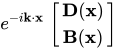
{\displaystyle e^{-i\mathbf {k} \cdot (\mathbf {x} +\mathbf {R} )}{\begin{bmatrix}\mathbf {D} (\mathbf {x} +\mathbf {R} )\\\mathbf {B} (\mathbf {x} +\mathbf {R} )\end{bmatrix}}=e^{i\mathbf {k} \cdot \mathbf {R} -i\mathbf {k} \cdot \mathbf {R} -i\mathbf {k} \cdot \mathbf {x} }~{\begin{bmatrix}\mathbf {D} (\mathbf {x} )\\\mathbf {B} (\mathbf {x} )\end{bmatrix}}=e^{-i\mathbf {k} \cdot \mathbf {x} }~{\begin{bmatrix}\mathbf {D} (\mathbf {x} )\\\mathbf {B} (\mathbf {x} )\end{bmatrix}}~.}
Therefore the quantity
e
−
i
k
⋅
x
[
D
(
x
)
B
(
x
)
]
{\displaystyle e^{-i\mathbf {k} \cdot \mathbf {x} }~{\begin{bmatrix}\mathbf {D} (\mathbf {x} )\\\mathbf {B} (\mathbf {x} )\end{bmatrix}}}
is periodic.
Let us now consider the solution of Maxwell's equation in periodic
media in the quasistatic limit. [4]
η
{\displaystyle \eta }
Figure 2. Periodic medium with
x
{\displaystyle x}
y
{\displaystyle y}
Define
ϵ
η
(
x
)
:=
ϵ
(
x
η
)
=
ϵ
(
y
)
;
μ
η
(
x
)
:=
μ
(
x
η
)
=
μ
(
y
)
.
{\displaystyle \epsilon _{\eta }(\mathbf {x} ):=\epsilon \left({\cfrac {\mathbf {x} }{\eta }}\right)=\epsilon (\mathbf {y} )~;~~\mu _{\eta }(\mathbf {x} ):=\mu \left({\cfrac {\mathbf {x} }{\eta }}\right)=\mu (\mathbf {y} )~.}
These are periodic functions, i.e.,
ϵ
(
y
+
a
i
)
=
ϵ
(
y
)
;
μ
(
y
+
a
i
)
=
μ
(
y
)
{\displaystyle \epsilon (\mathbf {y} +\mathbf {a} _{i})=\epsilon (\mathbf {y} )~;~~\mu (\mathbf {y} +\mathbf {a} _{i})=\mu (\mathbf {y} )}
where
a
i
{\displaystyle \mathbf {a} _{i}}
ϵ
η
(
x
+
η
a
i
)
=
ϵ
η
(
x
)
;
μ
η
(
x
+
η
a
i
)
=
μ
η
(
x
)
.
{\displaystyle \epsilon _{\eta }(\mathbf {x} +\eta \mathbf {a} _{i})=\epsilon _{\eta }(\mathbf {x} )~;~~\mu _{\eta }(\mathbf {x} +\eta \mathbf {a} _{i})=\mu _{\eta }(\mathbf {x} )~.}
Similarly, define
D
η
(
x
)
:=
D
(
y
)
;
B
η
(
x
)
:=
B
(
y
)
;
E
η
(
x
)
:=
E
(
y
)
;
H
η
(
x
)
:=
H
(
y
)
.
{\displaystyle \mathbf {D} _{\eta }(\mathbf {x} ):=\mathbf {D} (\mathbf {y} )~;~~\mathbf {B} _{\eta }(\mathbf {x} ):=\mathbf {B} (\mathbf {y} )~;~~\mathbf {E} _{\eta }(\mathbf {x} ):=\mathbf {E} (\mathbf {y} )~;~~\mathbf {H} _{\eta }(\mathbf {x} ):=\mathbf {H} (\mathbf {y} )~.}
Then Maxwell's equations can be written as
(6)
∇
⋅
D
η
=
0
;
∇
⋅
B
η
=
0
;
∇
×
E
η
−
i
ω
B
η
=
0
;
∇
×
H
η
+
i
ω
D
η
=
0
.
{\displaystyle {\text{(6)}}\qquad {\boldsymbol {\nabla }}\cdot \mathbf {D} _{\eta }=0~;~~{\boldsymbol {\nabla }}\cdot \mathbf {B} _{\eta }=0~;~~{\boldsymbol {\nabla }}\times \mathbf {E} _{\eta }-i\omega ~\mathbf {B} _{\eta }={\boldsymbol {0}}~;~~{\boldsymbol {\nabla }}\times \mathbf {H} _{\eta }+i\omega ~\mathbf {D} _{\eta }={\boldsymbol {0}}~.}
Let us look for Bloch wave solutions of the form
E
η
(
x
)
=
e
i
k
⋅
x
e
η
(
x
)
;
D
η
(
x
)
=
e
i
k
⋅
x
d
η
(
x
)
;
H
η
(
x
)
=
e
i
k
⋅
x
h
η
(
x
)
;
B
η
(
x
)
=
e
i
k
⋅
x
b
η
(
x
)
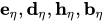
{\displaystyle \mathbf {E} _{\eta }(\mathbf {x} )=e^{i\mathbf {k} \cdot \mathbf {x} }~\mathbf {e} _{\eta }(\mathbf {x} )~;~~\mathbf {D} _{\eta }(\mathbf {x} )=e^{i\mathbf {k} \cdot \mathbf {x} }~\mathbf {d} _{\eta }(\mathbf {x} )~;~~\mathbf {H} _{\eta }(\mathbf {x} )=e^{i\mathbf {k} \cdot \mathbf {x} }~\mathbf {h} _{\eta }(\mathbf {x} )~;~~\mathbf {B} _{\eta }(\mathbf {x} )=e^{i\mathbf {k} \cdot \mathbf {x} }~\mathbf {b} _{\eta }(\mathbf {x} )}
where
e
η
,
d
η
,
h
η
,
b
η
{\displaystyle \mathbf {e} _{\eta },\mathbf {d} _{\eta },\mathbf {h} _{\eta },\mathbf {b} _{\eta }}
ϵ
{\displaystyle \epsilon }
μ
{\displaystyle \mu }
e
η
(
x
+
η
a
i
)
=
e
(
x
)
;
d
η
(
x
+
η
a
i
)
=
d
(
x
)
;
h
η
(
x
+
η
a
i
)
=
h
(
x
)
;
b
η
(
x
+
η
a
i
)
=
b
(
x
)
.
{\displaystyle \mathbf {e} _{\eta }(\mathbf {x} +\eta ~\mathbf {a} _{i})=\mathbf {e} (\mathbf {x} )~;~~\mathbf {d} _{\eta }(\mathbf {x} +\eta ~\mathbf {a} _{i})=\mathbf {d} (\mathbf {x} )~;~~\mathbf {h} _{\eta }(\mathbf {x} +\eta ~\mathbf {a} _{i})=\mathbf {h} (\mathbf {x} )~;~~\mathbf {b} _{\eta }(\mathbf {x} +\eta ~\mathbf {a} _{i})=\mathbf {b} (\mathbf {x} )~.}
From the constitutive relations, we get
d
η
(
x
)
=
ϵ
η
(
x
)
e
η
(
x
)
;
b
η
(
x
)
=
μ
η
(
x
)
h
η
(
x
)
.
{\displaystyle \mathbf {d} _{\eta }(\mathbf {x} )=\epsilon _{\eta }(\mathbf {x} )~\mathbf {e} _{\eta }(\mathbf {x} )~;~~\mathbf {b} _{\eta }(\mathbf {x} )=\mu _{\eta }(\mathbf {x} )~\mathbf {h} _{\eta }(\mathbf {x} )~.}
Recall that, for periodic media, Maxwell's equations may be expressed
as
(
L
−
ω
1
)
[
D
B
]
=
0
.
{\displaystyle ({\mathcal {L}}-\omega ~{\boldsymbol {1}}){\begin{bmatrix}\mathbf {D} \\\mathbf {B} \end{bmatrix}}={\boldsymbol {0}}~.}
Here
ω
{\displaystyle \omega }
L
{\displaystyle {\mathcal {L}}}
L
{\displaystyle {\mathcal {L}}}
ω
{\displaystyle \omega }
ϵ
(
ω
)
{\displaystyle \epsilon (\omega )}
μ
(
ω
)
{\displaystyle \mu (\omega )}
ω
{\displaystyle \omega }
Let these discrete values be
ω
=
ω
η
j
(
k
)
{\displaystyle \omega =\omega _{\eta }^{j}(\mathbf {k} )}
where the superscript
j
{\displaystyle j}
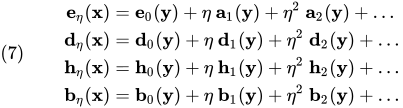
Let us see what the Bloch wave solutions reduce to as
η
→
0
{\displaystyle \eta \rightarrow 0}
(7)
e
η
(
x
)
=
e
0
(
y
)
+
η
a
1
(
y
)
+
η
2
a
2
(
y
)
+
…
d
η
(
x
)
=
d
0
(
y
)
+
η
d
1
(
y
)
+
η
2
d
2
(
y
)
+
…
h
η
(
x
)
=
h
0
(
y
)
+
η
h
1
(
y
)
+
η
2
h
2
(
y
)
+
…
b
η
(
x
)
=
b
0
(
y
)
+
η
b
1
(
y
)
+
η
2
b
2
(
y
)
+
…
{\displaystyle {\text{(7)}}\qquad {\begin{aligned}\mathbf {e} _{\eta }(\mathbf {x} )&=\mathbf {e} _{0}(\mathbf {y} )+\eta ~\mathbf {a} _{1}(\mathbf {y} )+\eta ^{2}~\mathbf {a} _{2}(\mathbf {y} )+\dots \\\mathbf {d} _{\eta }(\mathbf {x} )&=\mathbf {d} _{0}(\mathbf {y} )+\eta ~\mathbf {d} _{1}(\mathbf {y} )+\eta ^{2}~\mathbf {d} _{2}(\mathbf {y} )+\dots \\\mathbf {h} _{\eta }(\mathbf {x} )&=\mathbf {h} _{0}(\mathbf {y} )+\eta ~\mathbf {h} _{1}(\mathbf {y} )+\eta ^{2}~\mathbf {h} _{2}(\mathbf {y} )+\dots \\\mathbf {b} _{\eta }(\mathbf {x} )&=\mathbf {b} _{0}(\mathbf {y} )+\eta ~\mathbf {b} _{1}(\mathbf {y} )+\eta ^{2}~\mathbf {b} _{2}(\mathbf {y} )+\dots \end{aligned}}}
Let us also assume that the dependence of
ω
{\displaystyle \omega }
η
{\displaystyle \eta }
k
{\displaystyle \mathbf {k} }
(8)
ω
=
ω
η
j
(
k
)
=
ω
0
j
(
y
)
+
η
ω
1
j
(
y
)
+
η
2
ω
2
j
(
y
)
+
…
{\displaystyle {\text{(8)}}\qquad \omega =\omega _{\eta }^{j}(\mathbf {k} )=\omega _{0}^{j}(\mathbf {y} )+\eta ~\omega _{1}^{j}(\mathbf {y} )+\eta ^{2}~\omega _{2}^{j}(\mathbf {y} )+\dots }
Plugging (8) and (7) into (6)
gives
(9)
∇
⋅
(
e
i
η
k
⋅
y
[
d
0
(
y
)
+
η
d
1
(
y
)
+
…
]
)
=
0
∇
⋅
(
e
i
η
k
⋅
y
[
b
0
(
y
)
+
η
b
1
(
y
)
+
…
]
)
=
0
∇
×
(
e
i
η
k
⋅
y
[
e
0
(
y
)
+
η
e
1
(
y
)
+
…
]
)
−
i
[
ω
0
j
+
η
ω
1
j
+
…
]
[
b
0
(
y
)
+
η
b
1
(
y
)
+
…
]
=
0
∇
×
(
e
i
η
k
⋅
y
[
h
0
(
y
)
+
η
h
1
(
y
)
+
…
]
)
+
i
[
ω
0
j
+
η
ω
1
j
+
…
]
[
d
0
(
y
)
+
η
d
1
(
y
)
+
…
]
=
0
.
{\displaystyle {\text{(9)}}\qquad {\begin{aligned}{\boldsymbol {\nabla }}\cdot \left(e^{i\eta ~\mathbf {k} \cdot \mathbf {y} }~[\mathbf {d} _{0}(\mathbf {y} )+\eta ~\mathbf {d} _{1}(\mathbf {y} )+\dots ]\right)&=0\\{\boldsymbol {\nabla }}\cdot \left(e^{i\eta ~\mathbf {k} \cdot \mathbf {y} }~[\mathbf {b} _{0}(\mathbf {y} )+\eta ~\mathbf {b} _{1}(\mathbf {y} )+\dots ]\right)&=0\\{\boldsymbol {\nabla }}\times \left(e^{i\eta ~\mathbf {k} \cdot \mathbf {y} }~[\mathbf {e} _{0}(\mathbf {y} )+\eta ~\mathbf {e} _{1}(\mathbf {y} )+\dots ]\right)-i[\omega _{0}^{j}+\eta ~\omega _{1}^{j}+\dots ][\mathbf {b} _{0}(\mathbf {y} )+\eta ~\mathbf {b} _{1}(\mathbf {y} )+\dots ]&={\boldsymbol {0}}\\{\boldsymbol {\nabla }}\times \left(e^{i\eta ~\mathbf {k} \cdot \mathbf {y} }~[\mathbf {h} _{0}(\mathbf {y} )+\eta ~\mathbf {h} _{1}(\mathbf {y} )+\dots ]\right)+i[\omega _{0}^{j}+\eta ~\omega _{1}^{j}+\dots ][\mathbf {d} _{0}(\mathbf {y} )+\eta ~\mathbf {d} _{1}(\mathbf {y} )+\dots ]&={\boldsymbol {0}}~.\end{aligned}}}
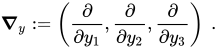
Define
∇
y
:=
(
∂
∂
y
1
,
∂
∂
y
2
,
∂
∂
y
3
)
.
{\displaystyle {\boldsymbol {\nabla }}_{y}:=\left({\frac {\partial }{\partial y_{1}}},{\frac {\partial }{\partial y_{2}}},{\frac {\partial }{\partial y_{3}}}\right)~.}
Then, for a vector field
v
(
y
)
{\displaystyle \mathbf {v} (\mathbf {y} )}
(10)
∇
⋅
v
(
y
)
=
1
η
∇
y
⋅
v
(
y
)
;
∇
×
v
(
y
)
=
1
η
∇
y
×
v
(
y
)
.
{\displaystyle {\text{(10)}}\qquad {\boldsymbol {\nabla }}\cdot \mathbf {v} (\mathbf {y} )={\cfrac {1}{\eta }}~{\boldsymbol {\nabla }}_{y}\cdot \mathbf {v} (\mathbf {y} )~;~~{\boldsymbol {\nabla }}\times \mathbf {v} (\mathbf {y} )={\cfrac {1}{\eta }}~{\boldsymbol {\nabla }}_{y}\times {\mathbf {v} (\mathbf {y} )}~.}
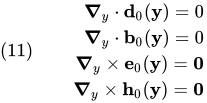
Using definitions (10) in (9) and collecting
terms of order
1
/
η
{\displaystyle 1/\eta }
(11)
∇
y
⋅
d
0
(
y
)
=
0
∇
y
⋅
b
0
(
y
)
=
0
∇
y
×
e
0
(
y
)
=
0
∇
y
×
h
0
(
y
)
=
0
{\displaystyle {\text{(11)}}\qquad {\begin{aligned}{\boldsymbol {\nabla }}_{y}\cdot \mathbf {d} _{0}(\mathbf {y} )=0\\{\boldsymbol {\nabla }}_{y}\cdot \mathbf {b} _{0}(\mathbf {y} )=0\\{\boldsymbol {\nabla }}_{y}\times {\mathbf {e} _{0}(\mathbf {y} )}={\boldsymbol {0}}\\{\boldsymbol {\nabla }}_{y}\times {\mathbf {h} _{0}(\mathbf {y} )}={\boldsymbol {0}}\end{aligned}}}
These are the solutions in the quasistatic limit .
Also, from the constitutive equations
d
0
(
y
)
=
ϵ
(
y
)
e
0
(
y
)
;
b
0
(
y
)
=
μ
(
y
)
h
0
(
y
)
.
{\displaystyle \mathbf {d} _{0}(\mathbf {y} )=\epsilon (\mathbf {y} )~\mathbf {e} _{0}(\mathbf {y} )~;~~\mathbf {b} _{0}(\mathbf {y} )=\mu (\mathbf {y} )~\mathbf {h} _{0}(\mathbf {y} )~.}
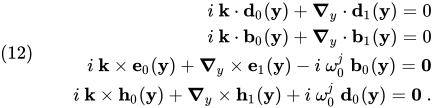
Similarly, collecting terms of order 1 from the expanded Maxwell's
equations (9) we get
(12)
i
k
⋅
d
0
(
y
)
+
∇
y
⋅
d
1
(
y
)
=
0
i
k
⋅
b
0
(
y
)
+
∇
y
⋅
b
1
(
y
)
=
0
i
k
×
e
0
(
y
)
+
∇
y
×
e
1
(
y
)
−
i
ω
0
j
b
0
(
y
)
=
0
i
k
×
h
0
(
y
)
+
∇
y
×
h
1
(
y
)
+
i
ω
0
j
d
0
(
y
)
=
0
.
{\displaystyle {\text{(12)}}\qquad {\begin{aligned}i~\mathbf {k} \cdot \mathbf {d} _{0}(\mathbf {y} )+{\boldsymbol {\nabla }}_{y}\cdot \mathbf {d} _{1}(\mathbf {y} )=0\\i~\mathbf {k} \cdot \mathbf {b} _{0}(\mathbf {y} )+{\boldsymbol {\nabla }}_{y}\cdot \mathbf {b} _{1}(\mathbf {y} )=0\\i~\mathbf {k} \times \mathbf {e} _{0}(\mathbf {y} )+{\boldsymbol {\nabla }}_{y}\times {\mathbf {e} _{1}(\mathbf {y} )}-i~\omega _{0}^{j}~\mathbf {b} _{0}(\mathbf {y} )={\boldsymbol {0}}\\i~\mathbf {k} \times \mathbf {h} _{0}(\mathbf {y} )+{\boldsymbol {\nabla }}_{y}\times {\mathbf {h} _{1}(\mathbf {y} )}+i~\omega _{0}^{j}~\mathbf {d} _{0}(\mathbf {y} )={\boldsymbol {0}}~.\end{aligned}}}
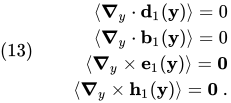
Since
d
1
(
y
)
,
b
1
(
y
)
,
e
1
(
y
)
,
h
1
(
y
)
{\displaystyle \mathbf {d} _{1}(\mathbf {y} ),\mathbf {b} _{1}(\mathbf {y} ),\mathbf {e} _{1}(\mathbf {y} ),\mathbf {h} _{1}(\mathbf {y} )}
(13)
⟨
∇
y
⋅
d
1
(
y
)
⟩
=
0
⟨
∇
y
⋅
b
1
(
y
)
⟩
=
0
⟨
∇
y
×
e
1
(
y
)
⟩
=
0
⟨
∇
y
×
h
1
(
y
)
⟩
=
0
.
{\displaystyle {\text{(13)}}\qquad {\begin{aligned}\langle {\boldsymbol {\nabla }}_{y}\cdot \mathbf {d} _{1}(\mathbf {y} )\rangle =0\\\langle {\boldsymbol {\nabla }}_{y}\cdot \mathbf {b} _{1}(\mathbf {y} )\rangle =0\\\langle {\boldsymbol {\nabla }}_{y}\times {\mathbf {e} _{1}(\mathbf {y} )}\rangle ={\boldsymbol {0}}\\\langle {\boldsymbol {\nabla }}_{y}\times {\mathbf {h} _{1}(\mathbf {y} )}\rangle ={\boldsymbol {0}}~.\end{aligned}}}
where
⟨
∙
⟩
{\displaystyle \langle \bullet \rangle }
(14)
i
k
⋅
⟨
d
0
(
y
)
⟩
=
0
i
k
⋅
⟨
b
0
(
y
)
⟩
=
0
i
k
×
⟨
e
0
(
y
)
⟩
−
i
ω
0
j
⟨
b
0
(
y
)
⟩
=
0
i
k
×
⟨
h
0
(
y
)
⟩
+
i
ω
0
j
⟨
d
0
(
y
)
⟩
=
0
.
{\displaystyle {\text{(14)}}\qquad {\begin{aligned}i~\mathbf {k} \cdot \langle \mathbf {d} _{0}(\mathbf {y} )\rangle =0\\i~\mathbf {k} \cdot \langle \mathbf {b} _{0}(\mathbf {y} )\rangle =0\\i~\mathbf {k} \times \langle \mathbf {e} _{0}(\mathbf {y} )\rangle -i~\omega _{0}^{j}~\langle \mathbf {b} _{0}(\mathbf {y} )\rangle ={\boldsymbol {0}}\\i~\mathbf {k} \times \langle \mathbf {h} _{0}(\mathbf {y} )\rangle +i~\omega _{0}^{j}~\langle \mathbf {d} _{0}(\mathbf {y} )\rangle ={\boldsymbol {0}}~.\end{aligned}}}
Note that the second pair of (14) implies the first
pair.
↑ The following discussion is based on Ashcroft76 (p. 133-139).
↑
We can see that the two operators commute by working out the operations. Thus,
T
R
L
[
D
B
]
=
T
R
[
−
i
∇
×
[
μ
−
1
(
x
)
B
(
x
)
]
i
∇
×
[
ϵ
−
1
(
x
)
D
(
x
)
]
]
=
[
−
i
∇
×
[
μ
−
1
(
x
+
R
)
B
(
x
+
R
)
]
i
∇
×
[
ϵ
−
1
(
x
+
R
)
D
(
x
+
R
)
]
]
=
L
[
D
(
x
+
R
)
B
(
x
+
R
)
]
=
L
T
R
[
D
B
]
.
{\displaystyle {\mathcal {T}}_{R}~{\mathcal {L}}~{\begin{bmatrix}\mathbf {D} \\\mathbf {B} \end{bmatrix}}={\mathcal {T}}_{R}~{\begin{bmatrix}-i~{\boldsymbol {\nabla }}\times [\mu ^{-1}(\mathbf {x} )~\mathbf {B} (\mathbf {x} )]\\i~{\boldsymbol {\nabla }}\times [\epsilon ^{-1}(\mathbf {x} )~\mathbf {D} (\mathbf {x} )]\end{bmatrix}}={\begin{bmatrix}-i~{\boldsymbol {\nabla }}\times [\mu ^{-1}(\mathbf {x} +\mathbf {R} )~\mathbf {B} (\mathbf {x} +\mathbf {R} )]\\i~{\boldsymbol {\nabla }}\times [\epsilon ^{-1}(\mathbf {x} +\mathbf {R} )~\mathbf {D} (\mathbf {x} +\mathbf {R} )]\end{bmatrix}}={\mathcal {L}}~{\begin{bmatrix}\mathbf {D} (\mathbf {x} +\mathbf {R} )\\\mathbf {B} (\mathbf {x} +\mathbf {R} )\end{bmatrix}}={\mathcal {L}}~{\mathcal {T}}_{R}~{\begin{bmatrix}\mathbf {D} \\\mathbf {B} \end{bmatrix}}~.}
↑
We can see that the translation operator commutes by working out the operations. Thus,
T
R
T
R
′
[
D
(
x
)
B
(
x
)
]
=
T
R
[
D
(
x
+
R
′
)
B
(
x
+
R
′
)
]
=
[
D
(
x
+
R
′
+
R
)
B
(
x
+
R
′
+
R
)
]
=
T
R
+
R
′
[
D
(
x
)
B
(
x
)
]
=
T
R
′
[
D
(
x
+
R
)
B
(
x
+
R
)
]
=
T
R
′
T
R
[
D
(
x
)
B
(
x
)
]
.
{\displaystyle {\mathcal {T}}_{R}~{\mathcal {T}}_{R'}~{\begin{bmatrix}\mathbf {D} (\mathbf {x} )\\\mathbf {B} (\mathbf {x} )\end{bmatrix}}={\mathcal {T}}_{R}~{\begin{bmatrix}\mathbf {D} (\mathbf {x} +\mathbf {R} ')\\\mathbf {B} (\mathbf {x} +\mathbf {R} ')\end{bmatrix}}={\begin{bmatrix}\mathbf {D} (\mathbf {x} +\mathbf {R} '+\mathbf {R} )\\\mathbf {B} (\mathbf {x} +\mathbf {R} '+\mathbf {R} )\end{bmatrix}}={\mathcal {T}}_{R+R'}~{\begin{bmatrix}\mathbf {D} (\mathbf {x} )\\\mathbf {B} (\mathbf {x} )\end{bmatrix}}={\mathcal {T}}_{R'}~{\begin{bmatrix}\mathbf {D} (\mathbf {x} +\mathbf {R} )\\\mathbf {B} (\mathbf {x} +\mathbf {R} )\end{bmatrix}}={\mathcal {T}}_{R'}~{\mathcal {T}}_{R}~{\begin{bmatrix}\mathbf {D} (\mathbf {x} )\\\mathbf {B} (\mathbf {x} )\end{bmatrix}}~.}
↑ The following discussion is
based on Milton02
N. W. Ashcroft and N. D. Mermin. Solid State Physics . Saunders, New York, 1976.
G. W. Milton. Theory of Composites . Cambridge University Press, New York, 2002. 
















![{\displaystyle {\text{(4)}}\qquad {[{\mathcal {T}}_{R}-c(\mathbf {R} )~{\boldsymbol {1}}]{\begin{bmatrix}\mathbf {D} (\mathbf {x} )\\\mathbf {B} (\mathbf {x} )\end{bmatrix}}={\boldsymbol {0}}~.}}](https://wikimedia.org/api/rest_v1/media/math/render/svg/33a73fdcdb2abf58c9b8b475d895088a633cf2c8)









![{\displaystyle {\begin{aligned}c(\mathbf {R} )&=c(n_{1}~\mathbf {a} _{1}+n_{2}~\mathbf {a} _{2}+n_{3}~\mathbf {a} _{3})=c(n_{1}~\mathbf {a} _{1})~c(n_{2}~\mathbf {a} _{2})~c(n_{3}~\mathbf {a} _{3})\\&=c\left(\sum _{i=1}^{n_{1}}\mathbf {a} _{1}\right)~c\left(\sum _{i=1}^{n_{2}}\mathbf {a} _{2}\right)~c\left(\sum _{i=1}^{n_{3}}\mathbf {a} _{3}\right)=[c(\mathbf {a} _{1})]^{n_{1}}~[c(\mathbf {a} _{2})]^{n_{2}}~[c(\mathbf {a} _{3})]^{n_{3}}\\&=e^{2\pi i\alpha _{1}~n_{1}}~e^{2\pi i\alpha _{2}~n_{2}}~e^{2\pi i\alpha _{3}~n_{3}}=e^{2\pi i(\alpha _{1}~n_{1}+\alpha _{2}~n_{2}+\alpha _{3}~n_{3})}\end{aligned}}}](https://wikimedia.org/api/rest_v1/media/math/render/svg/e36953112900fd3dadfe27a96343dbdfacd0db47)







![{\displaystyle [{\mathcal {T}}_{R}-e^{i\mathbf {k} \cdot \mathbf {R} }~{\boldsymbol {1}}]{\begin{bmatrix}\mathbf {D} (\mathbf {x} )\\\mathbf {B} (\mathbf {x} )\end{bmatrix}}={\boldsymbol {0}}}](https://wikimedia.org/api/rest_v1/media/math/render/svg/79b57203595cb44521a88978374daaca54dc5468)



















![{\displaystyle {\text{(9)}}\qquad {\begin{aligned}{\boldsymbol {\nabla }}\cdot \left(e^{i\eta ~\mathbf {k} \cdot \mathbf {y} }~[\mathbf {d} _{0}(\mathbf {y} )+\eta ~\mathbf {d} _{1}(\mathbf {y} )+\dots ]\right)&=0\\{\boldsymbol {\nabla }}\cdot \left(e^{i\eta ~\mathbf {k} \cdot \mathbf {y} }~[\mathbf {b} _{0}(\mathbf {y} )+\eta ~\mathbf {b} _{1}(\mathbf {y} )+\dots ]\right)&=0\\{\boldsymbol {\nabla }}\times \left(e^{i\eta ~\mathbf {k} \cdot \mathbf {y} }~[\mathbf {e} _{0}(\mathbf {y} )+\eta ~\mathbf {e} _{1}(\mathbf {y} )+\dots ]\right)-i[\omega _{0}^{j}+\eta ~\omega _{1}^{j}+\dots ][\mathbf {b} _{0}(\mathbf {y} )+\eta ~\mathbf {b} _{1}(\mathbf {y} )+\dots ]&={\boldsymbol {0}}\\{\boldsymbol {\nabla }}\times \left(e^{i\eta ~\mathbf {k} \cdot \mathbf {y} }~[\mathbf {h} _{0}(\mathbf {y} )+\eta ~\mathbf {h} _{1}(\mathbf {y} )+\dots ]\right)+i[\omega _{0}^{j}+\eta ~\omega _{1}^{j}+\dots ][\mathbf {d} _{0}(\mathbf {y} )+\eta ~\mathbf {d} _{1}(\mathbf {y} )+\dots ]&={\boldsymbol {0}}~.\end{aligned}}}](https://wikimedia.org/api/rest_v1/media/math/render/svg/3f8972b2be082034234d7576b1661a8a7c0fdb49)







![{\displaystyle {\mathcal {T}}_{R}~{\mathcal {L}}~{\begin{bmatrix}\mathbf {D} \\\mathbf {B} \end{bmatrix}}={\mathcal {T}}_{R}~{\begin{bmatrix}-i~{\boldsymbol {\nabla }}\times [\mu ^{-1}(\mathbf {x} )~\mathbf {B} (\mathbf {x} )]\\i~{\boldsymbol {\nabla }}\times [\epsilon ^{-1}(\mathbf {x} )~\mathbf {D} (\mathbf {x} )]\end{bmatrix}}={\begin{bmatrix}-i~{\boldsymbol {\nabla }}\times [\mu ^{-1}(\mathbf {x} +\mathbf {R} )~\mathbf {B} (\mathbf {x} +\mathbf {R} )]\\i~{\boldsymbol {\nabla }}\times [\epsilon ^{-1}(\mathbf {x} +\mathbf {R} )~\mathbf {D} (\mathbf {x} +\mathbf {R} )]\end{bmatrix}}={\mathcal {L}}~{\begin{bmatrix}\mathbf {D} (\mathbf {x} +\mathbf {R} )\\\mathbf {B} (\mathbf {x} +\mathbf {R} )\end{bmatrix}}={\mathcal {L}}~{\mathcal {T}}_{R}~{\begin{bmatrix}\mathbf {D} \\\mathbf {B} \end{bmatrix}}~.}](https://wikimedia.org/api/rest_v1/media/math/render/svg/185091fbf7f29fcbb4f3ca15a0905d089cba4890)
