Internal combustion engines
Internal Combustion Engines (or IC Engines or ICE as they may also be referred to) are used in everyday life and can be found in: cars; trucks; motorcycles; light planes; construction equipment and vehicles; railroad locomotives; stationary power systems; and boats and ships of all sizes. The study of Engines has evolved into a branch of Mechanical Engineering.
Types[edit | edit source]
There are two types of IC Engines:
- Four Stroke Engine, and
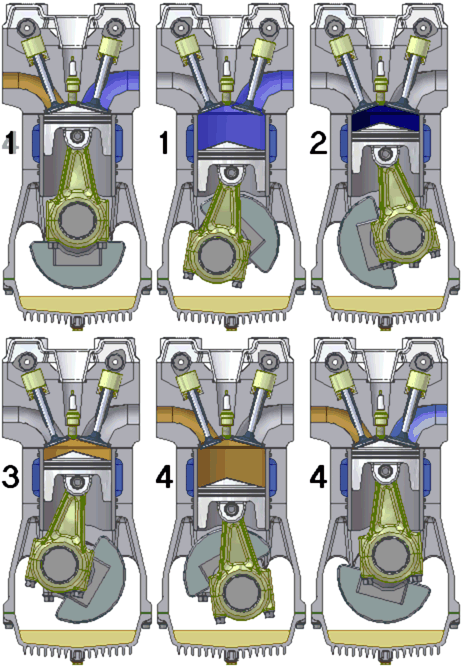
4-Stroke-Engine - Two Stroke Engine
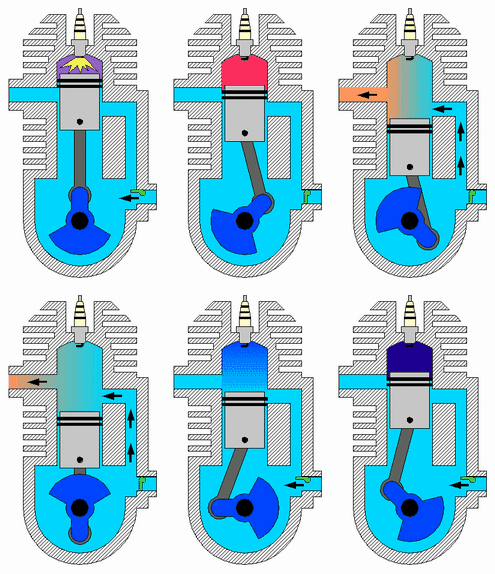
Two-Stroke Engine


Also the engines can also be classified on what cycles they follow, given below
- Diesel Engine
- Gasoline Engine
Four stroke engines, as the name suggests, have totally four different cycles, namely
- a. intake
- b. compression
- c. ignition/expansion
- d. exhaust
In the two stroke, there are just two cycles and each of them having two cycles running concurrently.
- a. intake/exhaust
- b. ignition/compression
A few definitions:
- TDC: Top Dead Centre. This is the top most part the piston can reach in a vertical engine.
- BDC: Bottom Dead Centre. This is the bottom most part the piston can reach in an vertical engine.
Compression Ratio An internal combustion engine is basically a pump which squeezes an air/fuel mixture (or just 'air' in the case of direct injection engines) and then ignites it so that it expands back and produces the mechanical energy. The compression ratio basically tells how much the engine squeezes a certain volume of air that it intakes. An engine with a compression ratio of 12:1 means that for every 12 unit volume of air that is sucked in, the piston squeezes that air to a 1 unit volume. The more air that is squeezed into the combustion chamber the more energy is produced per engine capacity on the expansion stroke.
One of the limiting factors in increasing the compression ratio is called detonation (known as engine knocking or pinging) where instead of burning in a controlled fashion, the air/fuel mixture explodes, potentially damaging the engine. Also, a higher compression engine tends to have less clearance between the piston at top dead center(TDC) and the valves fully opened, and running at a high rpm can lead to valve float which can leads to contact between the valves and piston.
Compression Ratio= (Swept volume + Clearance volume)/Clearance volume
Swept volume= Volume of piston traversed as it completes one full stroke from the TDC to BDC
Clearance volume= Volume of the combustion chamber, when piston is at TDC
Petrol Engine[edit | edit source]
Petrol Engines, also known as Spark Ignition engines, need an external source of energy to ignite the fuel for both starting and operation of the engine. As both names suggest, this engine uses spark plugs for providing an ignition spark, and petrol(gasoline) as the fuel.
Systems of the petrol engine[edit | edit source]
- 1. The fuel system pumps fuel from the petrol tank into the carburetor. There it mixes with air and is sucked into the engine cylinders. With an electronic fuel injection, it goes directly from the tank into the cylinders by means of an electronic computer.
- 2. The ignition system supplies the sparks to ignite the fuel mixture in the cylinders. By means of an ignition coil and contact breaker, it charges a 12-volt battery, which in the turn produces pulses of 20,000 volts. These go via a distributor to the spark plugs in the cylinders, where they create sparks. Ignition of the fuel in the cylinders produces temperatures of 700°C or more.
- 3. In water-cooling system which water circulates through channels in the cylinder block, thus extracting the heat. It flows through pipes in a radiator, which are cooled by fan-blown air.
- 4. The lubrication system also reduces some heat, but it's function job is to keep the moving parts coated with oil, which is pumped under pressure to the camshaft, crankshaft, and valve-operating gear.
- 5. Carburetor is the heart of petrol/gasoline engine. It meters the fuel and air mixture in precise proportions. Old carburetors do spark advance by measuring the difference in pressure between the outside and inside of the carburetor. The amount of throttle advance is also measured. The engine's remains which may be carbon monoxide or un-burned hydrocarbons shows how well the carburetor is working.
Classification of the petrol engines
Reciprocating engines are classified in a number of ways. Some of them are as:
- 1. According to the way they are cooled,
- a. Air-cooled Engines: Heat from the engine is radiated out to the surrounding air. Generally aluminium fins are provided as they are good conductors of heat. The fins increases the total surface area of contact with surrounding air, allowing maximum heat dissipation.
- b. Water-cooled Engines: These engines circulates a coolant/water through jackets provided on cylinder, to conduct heat.
- 2. According to the number of strokes,
- a. 2-stroke engines: It completes the thermodynamic cycle in two strokes of the piston(one crank revolution).
- b. 4-stroke engines: It completes the thermodynamic cycle in four strokes of the piston(two crank revolution).
- 3. According Cylinder arrangement,
- a. Inline cylinder arrangement: all the cylinders are arranged in a straight line.
- b. V-cylinder engine or V-engine: two cylinder inclined to each other at 90degree.
- 4. According to the valve arrangement,
- a. Single overhead camshaft (SOHC)
- b. Double overhead camshaft (DOHC)
Parts of the petrol engine[edit | edit source]
Following are the important parts of a petrol engine:
- 1. Cylinders
- 2. Cylinder block
- 3. Piston and Connecting rods
- 4. Cylinder head Crankcase
- 5. Valves
- 6. Crank shaft Flywheel
- 7. Exhaust system
- 8. Camshaft Fuel system
- 9. Lubrication system
- 10.Ignition system
Working of a petrol engine[edit | edit source]
Generally the vehicles using petrol/gasoline engine have four strokes as they are more efficient than two stroke engine and give complete a combustion of fuel to optimum use.The four-stroke cycle engine has four strokes namely the intake, compression, power, and exhaust strokes.
- 1. Suction or intake stroke- initially when engine is started piston moves downwards towards BDC of the cylinder which creates low pressure at top. Due to this intake valve opens and the a mixture containing petrol vapors and air are sucked in by the cylinder. It is through carburetor the ratio of gasoline/petrol and air is mixed.
- 2. The compression stroke- after this stroke the inlet valve gets closed. The piston now moves towards the top (TDC) of cylinder thereby compressing the fuel mixture to one tenth of its original volume. The temperature and pressure inside the cylinder increases due to compression.
- 3. The power stroke- during this stroke the inlet and exhaust valve remains closed. As the piston reaches near top position (TDC) spark plug produce an electric spark. Combustion is started by an ignition system that fires a high voltage spark through a field replaceable air gap called a spark plug. The spark produced causes explosion of fuel air mixture. The hot gases expand and force the piston to move downwards. The piston is linked to the piston rod and the piston rod to the crank shaft. They all move each other due to the link between them. The crank shaft is connected to the wheels of a car. As the crank shaft moves, the wheels rotate and move the car.
- 4. The exhaust stroke- in this stroke the exhaust valve remains open at the start. The piston is forced to move upwards because of the momentum gained. This forces gases to move through the exhaust valve into the atmosphere. Now the exhaust valve closes and the intake valve opens. After this the four strokes of the engine are repeated again and again.
Applications[edit | edit source]
These engines are widely used in vehicles, portable power plants to supply the power to run pumps and other machinery on farms. Many small boats, aeroplanes, trucks and buses also use it.
Future Scope: Continuous research is being carried to increase the fuel efficiency, reduce the pollutants and make it more light and compact. Recently engineers at the University of Birmingham have made the smallest petrol engine that can replace conventional batteries. The engine is so tiny that it can be handled on a fingertip.
Diesel engine[edit | edit source]
Like a petrol engine, a diesel is an internal combustion engine that converts chemical energy of the fuel to mechanical energy that causes the reciprocating motion inside the cylinders. The pistons are connected to the engine’s crankshaft, which provide the motion needed to propel the vehicle’s wheels. In both petrol and diesel engines, energy is released in a series of small explosions known as combustion. The fuel reacts chemically with oxygen from the air which is taken during intake stroke of the engine. Ignition in the Petrol engines takes place due to sparks from spark plugs, whereas in diesel engines, fuel ignites due to the heat of compression. Air gets heated up when it is compressed.
Types of Diesel Engines[edit | edit source]
Diesel engines can be four-stroke or two-stroke.
Four-Stoke Diesel Engine
The working of four stroke diesel engine is as follows:
- 1. The inlet or suction stroke begins when the piston draws air into the cylinder through an the inlet valve. When the piston reaches the bottom of the cylinder, the inlet valve closes, trapping the air inside the cylinder.
- 2. The compression stroke begins when the piston travels up the cylinder, compressing the trapped air. The pressure raises between 32 bar-50 bars and the temperature to 600 degree Celsius.
- 3. The injection stroke begins somewhere near the TDC of the compression stroke, fuel is sprayed into the hot air, ignites, and burns in a controlled manner due to the heat of compression, resulting in the power stroke.
- 4. The exhaust stroke begins when the piston BDC, the piston forces all the burned gases out through the open exhaust valve. At the top of the exhaust stroke, the exhaust valve closes and the inlet valve opens up, ready to admit a fresh charge of air which brings the engine back to the starting point. The cycle is repeated again.
Two-Stroke Diesel[edit | edit source]
A diesel engine operates in the same manner as a four stroke diesel engine, but reduces the four strokes of the piston into two-stroke once up and and once down of the cylinder.
- 1. When the piston is at the top of its cylinder it is on its compression stroke. The cylinder is filled with pressurized, super heated air. Diesel fuel is injected and ignites. The piston moves down the cylinder for its power stroke. When the piston is near to the bottom of its power stroke, the exhaust valves open and most of the burned gases rush out of the cylinder.
Now, as the piston continues to moves down the cylinder, it uncovers a series of ports, in the cylinder wall.Pressurized air is blown in through these ports, pushing the rest of the burned gases out of the cylinder and refilling it with fresh air charge.
- 2. As the piston moves back up, it blocks the inlet ports, trapping the charge of fresh air in the cylinder. Although the piston as only covered a little over one stroke, it has already completed its power stroke, the exhaust process, and the inlet cycle. As the piston comes back up the cylinder on its second stroke, it compresses the fresh air. When it reaches
the top of the cylinder, injection and combustion takes place, starting the cycle over again. A two stroke engine produces one power stroke in every complete cycle, while a four stroke produces one power stroke every for four strokes.