Definitions/Rigorous

What is a rigorous definition?
By collecting definitions from primary sources where it is claimed and hopefully defended that a particular definition is rigorous, it should be possible to provide relatively simple tests that demonstrate rigor (or rigour).
Hopefully, the rigorous definition will be a particular type of definition.
As the figure at the upper right suggests, a rigorous definition may be the limit of a series of definitions that are closer and closer approximations to the concept to be defined. This figure is a series of more accurate approximations to the area under the curve.
Definitions[edit | edit source]
Def. a "statement of the meaning of a word or word group or a sign or symbol"[1] is called a definition.
Rigorous[edit | edit source]
Def. "allowing no abatement or mitigation [unyielding or inflexible][2]"[3] is called rigorous.
Theory of rigorous definitions[edit | edit source]
“[D]efinitions are always of symbols, for only symbols have meanings for definitions to explain.”[4] “A definition can be expressed in either of two ways,”[4]
- writing “about the symbol to be defined, or”
- writing “about its referent.”[4]
In the theory of definition, “the symbol being defined is called the definiendum, and the symbol or set of symbols used to explain the meaning of the definiendum is called the definiens.”[4] “The definiens is not the meaning of the definiendum, but another symbol or group of symbols which, according to the definition, has the same meaning as the definiendum.”[4]
“Anyone who introduces a new symbol has complete freedom to stipulate what meaning is to be given it.”[4]
One reason for the introduction of a new symbol is that “[t]he emotive suggestions of familiar words are often disturbing to one interested only in their literal or informative meanings.”[4]
Def. "[m]anifesting, exercising, or favoring rigour; allowing no abatement or mitigation; scrupulously accurate; exact; strict; severe; relentless"[5] is called rigorous.
"[A]s, ... a rigorous definition or demonstration".[5]
Axiomatic definitions[edit | edit source]
It has been stated that "the rigorous definition of distance" fulfills "the three axioms that define an Euclidean metric" so that a "generalized metric can be defined using as distance an appropriate function ... that fulfills the three axioms of an Euclidean metric".[6] Having met these three axioms as a criteria of an Euclidean metric, the definition of the generalized metric is said to be a "rigorous definition of distance".[6]
An axiomatic definition is a rigorous definition: "the definition must clearly state the rules that are considered as binding, and on the other hand give the implementor enough freedom to achieve efficiency by leaving certain less important aspects undefined."[7] This rigorous definition is for "an axiomatic definition of the programming language PASCAL".[7]
Constipation[edit | edit source]
Def. “a bowel movement only every three days or less frequently”[8] is called constipation. This is a rigorous definition of constipation.[8]
Formal definition of limit[edit | edit source]
Def. (Formal definition of a limit)
Let be a function defined on an open interval that contains , except possibly at .


Let be a number.

If, for every , there exists a such that for all with



we have
- , then
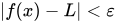
- is called a limit.

This precise definition of limit is a rigorous definition, the formal definition, from Wikibooks Calculus/Formal Definition of the Limit.
Infinitesimals[edit | edit source]
The Greek mathematician Archimedes (c.287 BC–c.212 BC), in The Method of Mechanical Theorems, was the first to propose a logically rigorous definition of infinitesimals.[9] His Archimedean property defines a number x as infinite if it satisfies the conditions |x|>1, |x|>1+1, |x|>1+1+1, ..., and infinitesimal if x≠0 and a similar set of conditions holds for 1/x and the reciprocals of the positive integers. A number system is said to be Archimedean if it contains no infinite or infinitesimal members.
Religion[edit | edit source]
Def. a "conjunction of ... a dogma, a moral law, and a cult or form of worship" is called a religion.[10]
René Guénon proposed a rigorous definition of the term "religion".
Riemann integral[edit | edit source]


The Riemann integral [is] the first rigorous definition of the integral of a function on an interval.[11]
"For Riemann's definition of his integral, see section 4, "Über der Begriff eines bestimmten Integrals und den Umfang seiner Gültigkeit", pages 101-103.[11]
Let be a non-negative real-valued function of the interval .

![{\displaystyle [a,b]}](https://wikimedia.org/api/rest_v1/media/math/render/svg/9c4b788fc5c637e26ee98b45f89a5c08c85f7935)
Let be the region of the plane under the graph of the function and above the interval [on the x-axis]. We are interested in measuring the area of


Def. a finite sequence of numbers of the form

is called a partition of an interval .
Def. each xi, xi+1 is called a subinterval of the partition.
Notation: let represent


Notation: let the symbol represent the area of the region .

Def. the length of the longest subinterval,

where 0 ≤ i ≤ n-1" is called "[t]he mesh or norm of a partition.
Def. a partition together with a finite sequence of numbers t0, tn−1 subject to the conditions that for each i, xi ≤ ti ≤ xi+1" is called a tagged partition of an interval [a,b].

Let the two partitions and be partitions of the interval [a,b].

Def. for each integer i with 0 ≤ i ≤ n there exists an integer r(i) such that xi = yr(i) and such that ti = sj for some j with r(i) ≤ j < r(i+1)" is called "a refinement of .
Def. one tagged partition is greater or equal to another when the former is a refinement of the latter is called a partial order on the set of all tagged partitions.
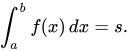
The Riemann integral of ƒ equals s if the following condition holds:
- For all , there exists "such that for any tagged partition and whose mesh is less than , we have


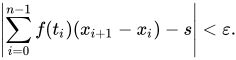
- is denoted by:

Stem cells[edit | edit source]
A rigorous definition of the term “stem cell” is as follows.[12]
A cell is a stem cell if and only if it has the properties:
- unlimited self-renewal and
- within-tissue multipotentiality.[12]
Def. a cell that has only "the properties [of] unlimited self-renewal and within-tissue multipotentiality" is called a stem cell.[12]
This definition has limited flexibility in that it “does not necessarily exclude cross-tissue plasticity.”[12]
Increasing rigor[edit | edit source]
The beam width is the single most important characteristic of a laser beam profile.
For astigmatic beams a more rigorous definition of the beam width is

and

This definition also incorporates information about x-y-correlation , but for circular symmetric beams, both definitions are the same.

σ is the standard deviation of the horizontal or vertical marginal distribution.
- "



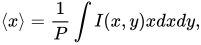
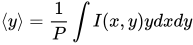
The beam power is
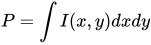
and

The beam profile is the intensity (I) of the beam as measured at specific rectilinear coordinates (x,y):

Hypotheses[edit | edit source]
- A rigorous definition should be possible for each word or symbol.
See also[edit | edit source]
References[edit | edit source]
- ↑ Merphant (22 December 2002). definition. San Francisco, California: Wikimedia Foundation, Inc. https://en.wiktionary.org/wiki/definition. Retrieved 2016-07-05.
- ↑ Mecsim (15 March 2005). rigour. San Francisco, California: Wikimedia Foundation, Inc. https://en.wiktionary.org/wiki/rigour. Retrieved 2015-07-02.
- ↑ Poccil (20 October 2004). rigorous. San Francisco, California: Wikimedia Foundation, Inc. https://en.wiktionary.org/wiki/rigorous. Retrieved 2015-07-02.
- ↑ 4.0 4.1 4.2 4.3 4.4 4.5 4.6 Irving M. Copi (1955). Introduction to Logic. New York: The MacMillan Company. pp. 472.
- ↑ 5.0 5.1 rigorous. San Francisco, California: Wikimedia Foundation, Inc. August 29, 2012. http://en.wiktionary.org/wiki/rigorous. Retrieved 2012-09-18.
- ↑ 6.0 6.1 Rosario N. Mantegna (1999). "Hierarchical Structure in Financial Markets". The European Physical Journal B - Condensed Matter and Complex Systems 11 (1): 193-7. doi:10.1007/s100510050929. http://arxiv.org/pdf/cond-mat/9802256. Retrieved 2011-09-15.
- ↑ 7.0 7.1 C. A. R. Hoare and N. Wirth (1973). "An axiomatic definition of the programming language PASCAL". Acta Informatica 2 (4): 335-55. doi:10.1007/BF00289504. http://www.springerlink.com/content/lk30hp0718778688/. Retrieved 2011-09-16.
- ↑ 8.0 8.1 A John Campbell, Wendy Busby, Caroline C Horwath (January 1993). "Factors associated with constipation in a community based sample of people aged 70 years and over". Journal of Epidemiology and Community Health 47 (1): 23-6. http://jech.bmj.com/content/47/1/23.full.pdf. Retrieved 2012-01-25.
- ↑ Archimedes, The Method of Mechanical Theorems; see Archimedes Palimpsest
- ↑ René Guénon, Marco Pallis (November 1, 2001). Tradition and Religion, In: Introduction to the Study of the Hindu Doctrines. Hillsdale, NY: Sophia Perennis. pp. 58-69. ISBN 090058873X. http://books.google.com/books?id=KmhvNFW_OmoC&printsec=frontcover&source=bl&ots=FHBtvYOh86&sig=fwgw39IcgvWBiav7NiKHxr1mNXM&hl=en#v=onepage&f=false. Retrieved 2012-09-16.
- ↑ 11.0 11.1 Bernard Riemann (1868). ""Über die Darstellbarkeit einer Function durch eine trigonometrische Reihe"". "Abhandlungen der Königlichen Gesellschaft der Wissenschaften zu Göttingen" 13: 87-132. http://books.google.com/books?id=PDVFAAAAcAAJ&pg=RA1-PA87#v=onepage&q&f=false.
- ↑ 12.0 12.1 12.2 12.3 Raewyn M. Seaberg and Derek van der Kooy (March 2003). "Stem and progenitor cells: the premature desertion of rigorous definitions". Trends in Neurosciences 26 (3): 125-31. doi:10.1016/S0166-2236(03)00031-6. http://www.keck.bioimaging.wisc.edu/neuro670/reqreading/StemProgenitor.pdf. Retrieved 2011-09-26.
Further reading[edit | edit source]
- Irving M. Copi (1955). Introduction to Logic. New York: The MacMillan Company. pp. 472.
External links[edit | edit source]
- African Journals Online
- Bing Advanced search
- Google Books
- Google scholar Advanced Scholar Search
- International Astronomical Union
- JSTOR
- Lycos search
- NASA's National Space Science Data Center
- NCBI All Databases Search
- Office of Scientific & Technical Information
- Questia - The Online Library of Books and Journals
- SAGE journals online
- The SAO/NASA Astrophysics Data System
- Scirus for scientific information only advanced search
- SpringerLink
- Taylor & Francis Online
- WikiDoc The Living Textbook of Medicine
- Wiley Online Library Advanced Search
- Yahoo Advanced Web Search
{{Dominant group}}{{Linguistics resources}}{{Reasoning}}
Learn more about Rigorous definition |


