In the total Lagrangian approach, the discrete equations are formulated with respect to the reference configuration. The independent variables are  and
and  . The dependent variable is the displacement
  .
.
Total Lagrangian Stress and Strain Measures[edit | edit source]
The strain is

For the reference configuration,

The Cauchy stress (force/current area) is

The engineering stress (force/initial area) is

The two stresses are related by
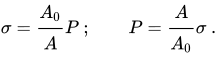
For the reference configuration,

Governing Equations in Total Lagrangian Form[edit | edit source]
The Total Lagrangian governing equations are:

- For the axially loaded bar,

- Conservation of Momentum:

- For the bar
 is constant. Therefore,
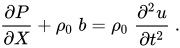
- In short form,

- If
 , we get the equilibrium equation

- For the bar:
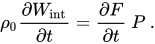
- In short form:
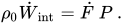
- For a linear elastic material:
![{\displaystyle {P(X,t)=E^{PF}~\varepsilon (X,t)=E^{PF}~u_{,X}=E^{PF}\left[F(X,t)-1\right]~.}}](https://wikimedia.org/api/rest_v1/media/math/render/svg/1cfb24606f76b7d5efff1072cc2bd663b236f494)
- The superscript
 refers to the fact that this function relates
  and
and  .
.
- For small strains:

- For a linear elastic material:

The momentum equation is
The total form constitutive equation is

Plug constitutive equation into momentum equation to get

If  is constant in the bar and the body force is zero,

This is the wave equation (hyperbolic PDE). The wave speed is  .
If acceleration is zero, the equation becomes elliptic.
.
If acceleration is zero, the equation becomes elliptic.
Initial and Boundary Conditions[edit | edit source]
The governing equation for the rod is second-order in time. So two initial conditions are needed.
![{\displaystyle {\begin{aligned}u(X,0)&=u_{0}(X)&~{\text{for}}~&X\in [0,L]\\{\dot {u}}(X,0)&=v_{0}(X)&~{\text{for}}~&X\in [0,L]\end{aligned}}}](https://wikimedia.org/api/rest_v1/media/math/render/svg/802afa88602d5196015a94d398be659173f68ef8)
The rod is initially at rest. Therefore, the initial conditions are
![{\displaystyle {\begin{aligned}u(X,0)&=0&~{\text{for}}~&X\in [0,L]\\{\dot {u}}(X,0)&=0&~{\text{for}}~&X\in [0,L]\end{aligned}}}](https://wikimedia.org/api/rest_v1/media/math/render/svg/0505f649b00ff5e69a78780f55327b9e80c9e17c)
Since the problem is one-dimensional, there are two boundary points.
Also, the momentum equation is second-order in the displacements.
Therefore, at each end, either  or
or  must be prescribed.
In mechanics, instead of , the traction is prescribed.
must be prescribed.
In mechanics, instead of , the traction is prescribed.
Let  be the part of the boundary where displacements are
prescribed. Let
be the part of the boundary where displacements are
prescribed. Let  be the part of the boundary where tractions
(force vector per unit area) are prescribed.
be the part of the boundary where tractions
(force vector per unit area) are prescribed.
Then the displacement boundary conditions are

The traction boundary conditions are

The unit normal to the boundary in the reference configuration is
 .
.
For the axially loaded bar, the displacement boundary condition is

The unit normal to the boundary is
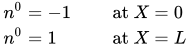
Therefore, the traction boundary condition is

For shock problems or fracture problems, an addition interior continuity or jump condition may be needed. This condition is
written as

where

Weak Form for Total Lagrangian[edit | edit source]
The momentum equation (in its full form) is

To get the weak form over an element, we multiply the equation by a
weighting function and integrate over the length of the element (from
 to
to  ).
).
![{\displaystyle \int _{X_{a}}^{X_{b}}w\left[(A_{0}P)_{,X}+\rho _{0}A_{0}b-\rho _{0}A_{0}{\ddot {u}}\right]~dX=0~.}](https://wikimedia.org/api/rest_v1/media/math/render/svg/ad88c1fe4102fc96acce314579fbe1544aba5d56)
Integrate the first term by parts to get
![{\displaystyle \int _{X_{a}}^{X_{b}}w(A_{0}P)_{,X}~dX=\left[wA_{0}P\right]_{X_{a}}^{X_{b}}-\int _{X_{a}}^{X_{b}}w_{,X}(A_{0}P)~dX~.}](https://wikimedia.org/api/rest_v1/media/math/render/svg/a07c8dba50326ddd1941c56397168cc0aa3e4a68)
Plug the above into the weak form and rearrange to get
![{\displaystyle \int _{X_{a}}^{X_{b}}w_{,X}(A_{0}P)~dX+\int _{X_{a}}^{X_{b}}w\rho _{0}A_{0}{\ddot {u}}~dX=\int _{X_{a}}^{X_{b}}w\rho _{0}A_{0}b~dX+\left[wA_{0}P\right]_{X_{a}}^{X_{b}}~.}](https://wikimedia.org/api/rest_v1/media/math/render/svg/49ba1ccc2daac0e84b578f50cc302359d18b38b6)
If we think of the weighting function  as a variation of that
satisfies the kinematic admissibility conditions, we get
as a variation of that
satisfies the kinematic admissibility conditions, we get
![{\displaystyle {\int _{X_{a}}^{X_{b}}(\delta u)_{,X}(A_{0}P)~dX+\int _{X_{a}}^{X_{b}}\delta u\rho _{0}A_{0}{\ddot {u}}~dX=\int _{X_{a}}^{X_{b}}\delta u\rho _{0}A_{0}b~dX+\left[\delta uA_{0}P\right]_{X_{a}}^{X_{b}}~.}}](https://wikimedia.org/api/rest_v1/media/math/render/svg/72f3f26dc8401269774083806d0a7f5361312cc3)
Recall that

Therefore,

Taking a derivative of this variation, we have

Also,
![{\displaystyle {\begin{aligned}\left[\delta uA_{0}P\right]_{X_{a}}^{X_{b}}&=[\delta uA_{0}P]_{X_{b}}-[\delta uA_{0}P]_{X_{a}}\\&=[\delta uA_{0}Pn_{0}]_{X_{b}}+[\delta uA_{0}Pn_{0}]_{X_{a}}\\&=[\delta uA_{0}t_{X}^{0}]_{X_{b}}+[\delta uA_{0}t_{X}^{0}]_{X_{a}}\\&=\left[\delta uA_{0}t_{X}^{0}\right]_{\Gamma _{t}}~.\end{aligned}}}](https://wikimedia.org/api/rest_v1/media/math/render/svg/6e07e840fd7b0d403202bbe9b735bb2e0ce0972b)
Therefore, we can alternatively write the weak form as
![{\displaystyle {\int _{X_{a}}^{X_{b}}\delta FA_{0}P~dX+\int _{X_{a}}^{X_{b}}\delta u\rho _{0}A_{0}{\ddot {u}}~dX=\int _{X_{a}}^{X_{b}}\delta u\rho _{0}A_{0}b~dX+\left[\delta uA_{0}t_{X}^{0}\right]_{\Gamma _{t}}~.}}](https://wikimedia.org/api/rest_v1/media/math/render/svg/a93881f236f31b5066589b0baa263cd74f0f8392)
Comparing with the energy equation, we see that the first term above is the internal virtual work and the weak form is the principle of virtual work for the 1-D problem. The weak form may also be written as

where,
![{\displaystyle {\begin{aligned}\delta W_{\text{int}}&=\int _{X_{a}}^{X_{b}}(\delta u)_{,X}(A_{0}P)~dX\\\delta W_{\text{ext}}&=\int _{X_{a}}^{X_{b}}\delta u\rho _{0}A_{0}b~dX+\left[\delta uA_{0}P\right]_{X_{a}}^{X_{b}}\\\delta W_{\text{kin}}&=\int _{X_{a}}^{X_{b}}\delta u\rho _{0}A_{0}{\ddot {u}}~dX\end{aligned}}}](https://wikimedia.org/api/rest_v1/media/math/render/svg/c5fe53bbf67f153cc06a652f7497bebbfdca6a82)
Finite Element Discretization for Total Lagrangian[edit | edit source]
The trial solution is
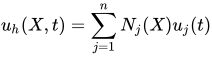
where  is the number of nodes. In matrix form,

The test (weighting) function is
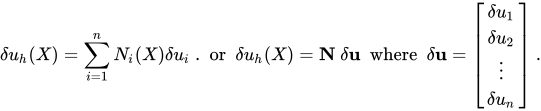
The derivatives of the test functions with respect to are

We will derive the finite element system of equations after substituting
these into the approximate weak form
![{\displaystyle \int _{X_{a}}^{X_{b}}(\delta u_{h})_{,X}(A_{0}P)~dX+\int _{X_{a}}^{X_{b}}\delta u_{h}\rho _{0}A_{0}{\ddot {u}}_{h}~dX=\int _{X_{a}}^{X_{b}}\delta u_{h}\rho _{0}A_{0}b+\left[\delta u_{h}A_{0}P\right]_{X_{a}}^{X_{b}}~.}](https://wikimedia.org/api/rest_v1/media/math/render/svg/a35bc9e1d485b4be37585874aa1c570b3c76722d)
Let us proceed term by term.
The first term represents the virtual internal work
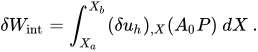
Plugging in the derivative of the test function, we get
~dX\\&=\sum _{i=1}^{n}\delta u_{i}\left[\int _{X_{a}}^{X_{b}}N_{i,X}(A_{0}P)~dX\right]\\&=\sum _{i=1}^{n}\delta u_{i}f_{i}^{\text{int}}~.\end{aligned}}}](https://wikimedia.org/api/rest_v1/media/math/render/svg/4a913231778d538aae00d91cb143e1e0676a712f)
The last substitution is made because the virtual internal work is the
work done by internal forces in moving through a virtual displacement.
The matrix form of the expression for virtual internal work is
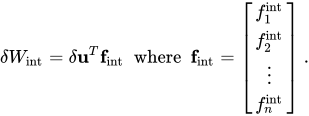
The internal force is

The second term represents the virtual kinetic work
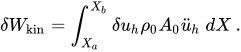
Plugging in the test function, we get
![{\displaystyle {\begin{aligned}\delta W_{\text{kin}}&=\int _{X_{a}}^{X_{b}}\left[\sum _{i=1}^{n}\delta u_{i}N_{i}\right]\rho _{0}A_{0}{\ddot {u}}_{h}~dX\\&=\sum _{i=1}^{n}\delta u_{i}\left[\int _{X_{a}}^{X_{b}}\rho _{0}A_{0}N_{i}{\ddot {u}}_{h}~dX\right]\\&=\sum _{i=1}^{n}\delta u_{i}f_{i}^{\text{kin}}~.\end{aligned}}}](https://wikimedia.org/api/rest_v1/media/math/render/svg/f9401ca8de0affc4aa663be426c40df1f08fb034)
The inertial (kinetic) force is

Now, plugging in the trial function into the expression for
the inertial force, we get
![{\displaystyle {\begin{aligned}f_{i}^{\text{kin}}&=\int _{X_{a}}^{X_{b}}\rho _{0}A_{0}N_{i}\left[\sum _{j=1}^{n}{\ddot {u}}_{j}N_{j}\right]~dX\\&=\sum _{j=1}^{n}\left[\int _{X_{a}}^{X_{b}}\rho _{0}A_{0}N_{i}N_{j}~dX\right]{\ddot {u}}_{j}\\&=\sum _{j=1}^{n}M_{ij}a_{j}\end{aligned}}}](https://wikimedia.org/api/rest_v1/media/math/render/svg/9036ac002e9f85633f48dedce0bc9ccce845712b)
where

and

Note that the mass matrix is independent of time!
In matrix form,
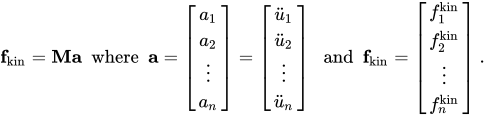
The consistent mass matrix in matrix notation is

Plugging the expression for the inertial force into the expression
for virtual kinetic work, we get
![{\displaystyle {\begin{aligned}\delta W_{\text{kin}}&=\sum _{i=1}^{n}\delta u_{i}\left[\sum _{j=1}^{n}M_{ij}a_{j}\right]\\&=\sum _{i=1}^{n}\sum _{j=1}^{n}\delta u_{i}M_{ij}a_{j}\end{aligned}}}](https://wikimedia.org/api/rest_v1/media/math/render/svg/e569381be196a8cd71cf709deba60d5e754b2c5f)
In matrix form,

The right hand side terms represent the virtual external work
![{\displaystyle \delta W_{\text{ext}}=\int _{X_{a}}^{X_{b}}\delta u_{h}\rho _{0}A_{0}b~dX+\left[\delta u_{h}A_{0}t_{X}^{0}\right]_{\Gamma _{t}}~.}](https://wikimedia.org/api/rest_v1/media/math/render/svg/819705acf0193c5bc4167bd40dbc939e42470681)
Plugging in the test function into the above expression gives
![{\displaystyle {\begin{aligned}\delta W_{\text{ext}}&=\int _{X_{a}}^{X_{b}}\left[\sum _{i=1}^{n}N_{i}\delta u_{i}\right]\rho _{0}A_{0}b~dX+\left[\left(\sum _{i=1}^{n}N_{i}\delta u_{i}\right)A_{0}t_{X}^{0}\right]_{\Gamma _{t}}\\&=\sum _{i=1}^{n}\delta u_{i}\left[\int _{X_{a}}^{X_{b}}N_{i}\rho _{0}A_{0}b~dX\right]+\left[\sum _{i=1}^{n}\delta u_{i}N_{i}A_{0}t_{X}^{0}\right]_{\Gamma _{t}}\\&=\sum _{i=1}^{n}\delta u_{i}\left[\int _{X_{a}}^{X_{b}}N_{i}\rho _{0}A_{0}b~dX+\left[N_{i}A_{0}t_{X}^{0}\right]_{\Gamma _{t}}\right]\\&=\sum _{i=1}^{n}\delta u_{i}~f_{i}^{\text{ext}}~.\end{aligned}}}](https://wikimedia.org/api/rest_v1/media/math/render/svg/0a48548409a0922990a691ed75eef09e7a0bf7dc)
In matrix notation,
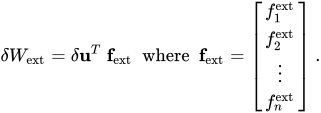
The external force is given by
![{\displaystyle {f_{i}^{\text{ext}}=\int _{X_{a}}^{X_{b}}N_{i}\rho _{0}A_{0}b~dX+\left[N_{i}A_{0}t_{X}^{0}\right]_{\Gamma _{t}}~.}}](https://wikimedia.org/api/rest_v1/media/math/render/svg/e8eb24350e00a0f4173eca446f6c2f296fa67139)
In matrix notation,
![{\displaystyle {\mathbf {f} _{\text{ext}}=\int _{X_{a}}^{X_{b}}\mathbf {N} ^{T}\rho _{0}A_{0}b~dX+\left[\mathbf {N} ^{T}A_{0}t_{X}^{0}\right]_{\Gamma _{t}}}~~{\text{or}}~~{\mathbf {f} _{\text{ext}}=\int _{\Omega _{0}}\rho _{0}~\mathbf {N} ^{T}~b~d\Omega _{0}+\left[\mathbf {N} ^{T}A_{0}t_{X}^{0}\right]_{\Gamma _{t}}~.}}](https://wikimedia.org/api/rest_v1/media/math/render/svg/7a38afd7980e5e364fca4fcda91f51d3b979d011)
Collecting the terms, we get the finite element system of equations
![{\displaystyle \sum _{i=1}^{n}\delta u_{i}\left[f_{i}^{\text{int}}+f_{i}^{\text{kin}}-f_{i}^{\text{ext}}\right]=0}](https://wikimedia.org/api/rest_v1/media/math/render/svg/53c19e601dc9211a013c619a4c63dd272e1d5664)
Now, the weighting function is arbitrary except at nodes where displacement
BCs are prescribed. At these nodes the weighting function is zero.
For the bar, let us assume that a displacement is prescribed at node  .
Then, the finite element system of equations becomes
.
Then, the finite element system of equations becomes

or,

Since the displacement at node is known, the acceleration at node is
also known. Note that we have to differentiate the displacement twice
to get the acceleration and hence the prescribed displacement must be
a  function.
We can take the known acceleration  to the RHS to get

The above equation shows that prescribed boundary accelerations (and hence
prescribed boundary displacements) contribute to nodes which are not on
the boundary.
We can avoid that issue by making the mass matrix diagonal (using ad-hoc
procedures that conserve momentum). If the mass matrix is diagonal, we get

In matrix form,

One way of generating a diagonal mass matrix or lumped mass matrix
is the row-sum technique. The rows of the mass matrix are summed at
lumped at the diagonal of the matrix. Thus,
![{\displaystyle {\begin{aligned}M_{ii}^{\text{diagonal}}&=\sum _{j=1}^{n}M_{ij}^{\text{consistent}}\\&=\sum _{j=1}^{n}\int _{X_{a}}^{X_{b}}\rho _{0}N_{i}N_{j}A_{0}~dX\\&=\int _{X_{a}}^{X_{b}}\rho _{0}N_{i}\left[\sum _{j=1}^{n}N_{j}\right]A_{0}~dX\\&=\int _{X_{a}}^{X_{b}}\rho _{0}N_{i}A_{0}~dX\qquad {\text{since}}~\sum _{j=1}^{n}N_{j}=1~.\end{aligned}}}](https://wikimedia.org/api/rest_v1/media/math/render/svg/63c903c5cb6fcf10f18dbedff4e507288cb0307b)
Discrete Equations for Total Lagrangian[edit | edit source]
The finite element equations in total Lagrangian form are:
![{\displaystyle {\begin{aligned}u(X,t)&=\sum _{i}N_{i}(X)~u_{i}^{e}(t)=\mathbf {N} ~\mathbf {u} ^{e}\\\varepsilon (X,t)&=\sum _{i}N_{i,X}~u_{i}^{e}(t)=\mathbf {B} _{0}~\mathbf {u} ^{e}\\F(X,t)&=\sum _{i}N_{i,X}~x_{i}^{e}(t)=\mathbf {B} _{0}~\mathbf {x} ^{e}\\\mathbf {f} _{\text{int}}^{e}&=\int _{\Omega _{0}^{e}}\mathbf {B} _{0}^{T}P~d\Omega _{0}\\\mathbf {f} _{\text{ext}}^{e}&=\int _{\Omega _{0}^{e}}\rho _{0}\mathbf {N} ^{T}b~d\Omega _{0}+\left[\mathbf {N} ^{T}A_{0}t_{X}^{0}\right]_{\Gamma _{t}^{e}}\\\mathbf {M} ^{e}&=\int _{\Omega _{0}^{e}}\rho _{0}\mathbf {N} ^{T}\mathbf {N} ~d\Omega _{0}\\\mathbf {M} ~{\ddot {\mathbf {u} }}&=\mathbf {f} _{\text{ext}}-\mathbf {f} _{\text{int}}~.\end{aligned}}}](https://wikimedia.org/api/rest_v1/media/math/render/svg/39cce2d50f357f5d1fad521c20da575d9f3803e4)