Nonlinear finite elements/Steady state heat conduction

From Wikiversity
Jump to: navigation, search
Logo physics.svg Subject classification: this is a physics resource .
Smiley green alien big eyes.svg Completion status: the completion status of this resource is unknown. Please help!
Smiley green alien whatface.svg Resource type: please help Wikiversity by tagging this resource with a resource type.
Smiley green alien big eyes.svg Educational level: this resource has not yet been assigned an educational level. Please help!

Contents

Steady state heat conduction [edit]

If the problem does not depend on time and the material is isotropic, we get the boundary value problem for steady state heat conduction.
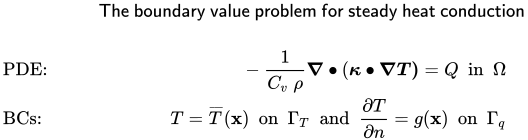

{
\begin{align}
& &\mathsf{ The~ boundary~ value~ problem ~for~ steady~ heat ~conduction}\\
& & \\
& \text{PDE:}~~~ &~~~- \frac{1}{C_v~\rho}
\boldsymbol{\nabla} \bullet (\boldsymbol{\kappa}\bullet\boldsymbol{\nabla T)} = Q
 ~~\text{in}~~\Omega\quad\\
& \text{BCs:}~~~ &~~~ T = \overline{T}(\mathbf{x})~~\text{on}~~\Gamma_T
 ~~\text{and}~~
\frac{\partial T}{\partial n} = g(\mathbf{x})~~\text{on}~~\Gamma_q\quad\\
\end{align}
}

Poisson's equation [edit]

If the material is homogeneous the density, heat capacity, and the thermal conductivity are constant. Define the thermal diffusivity as


k := \frac{\kappa}{C_v~\rho}

Then, the boundary value problem becomes
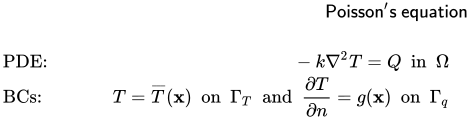

{
\begin{align}
& &\mathsf{ Poisson's~ equation}\\
& & \\
& \text{PDE:}~~~ &~~~- k \nabla^2 T = Q
 ~~\text{in}~~\Omega\quad\\
& \text{BCs:}~~~ &~~~ T = \overline{T}(\mathbf{x})~~\text{on}~~\Gamma_T
 ~~\text{and}~~
\frac{\partial T}{\partial n} = g(\mathbf{x})~~\text{on}~~\Gamma_q\quad\\
\end{align}
}

where \nabla^2 T is the Laplacian


 \nabla^2 T := \boldsymbol{\nabla} \bullet \boldsymbol{\nabla T}

Laplace's equation [edit]

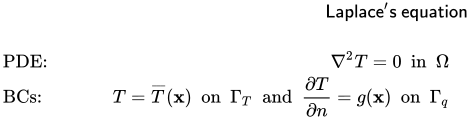
Finally, if there is no internal source of heat, the value of Q is zero, and we get Laplace's equation.


{
\begin{align}
& &\mathsf{ Laplace's~ equation}\\
& & \\
& \text{PDE:}~~~ &~~~\nabla^2 T = 0
 ~~\text{in}~~\Omega\quad\\
& \text{BCs:}~~~ &~~~ T = \overline{T}(\mathbf{x})~~\text{on}~~\Gamma_T
 ~~\text{and}~~
\frac{\partial T}{\partial n} = g(\mathbf{x})~~\text{on}~~\Gamma_q\quad\\
\end{align}
}

The Analogous Membrane Problem [edit]

The thin elastic membrane problem is another similar problem. See Figure 1 for the geometry of the membrane.

The membrane is thin and elastic. It is initially planar and occupies the 2D domain \Omega. It is fixed along part of its boundary \Gamma_u. A transverse force \mathbf{f} per unit area is applied. The final shape at equilibrium is nonplanar. The final displacement of a point \mathbf{x} on the membrane is \mathbf{u}(\mathbf{x}). There is no dependence on time.

The goal is to find the displacement \mathbf{u}(\mathbf{x}) at equilibrium.

Figure 1. The membrane problem.

It turns out that the equations for this problem are the same as those for the heat conduction problem - with the following changes:

  • The time derivatives vanish.
  • The balance of energy is replaced by the balance of forces.
  • The constitutive equation is replaced by a relation that states that the vertical force depends on the displacement gradient (\boldsymbol{\nabla} \mathbf{u}).

If the membrane if inhomogeneous, the boundary value problem is:
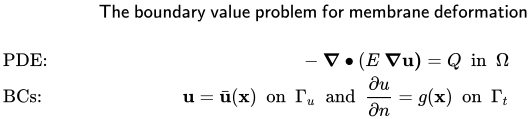

{
\begin{align}
& &\mathsf{ The~boundary~ value~ problem~ for~ membrane~ deformation}\\
& & \\
& \text{PDE:}~~~ &~~~- \boldsymbol{\nabla} \bullet (E~\boldsymbol{\nabla \mathbf{u})} = Q 
 ~~\text{in}~~\Omega\quad\\
& \text{BCs:}~~~ &~~~ \mathbf{u} = \bar{\mathbf{u}}(\mathbf{x})~~\text{on}~~\Gamma_u
 ~~\text{and}~~
\frac{\partial u}{\partial n} = g(\mathbf{x})~~\text{on}~~\Gamma_t\quad\\
\end{align}
}

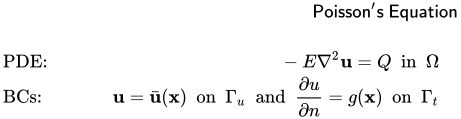
For a homogeneous membrane, we get


{
\begin{align}
& &\mathsf{ Poisson's~ Equation}\\
& & \\
& \text{PDE:}~~~ &~~~- E \nabla^2 \mathbf{u} = Q 
 ~~\text{in}~~\Omega\quad\\
& \text{BCs:}~~~ &~~~ \mathbf{u} = \bar{\mathbf{u}}(\mathbf{x})~~\text{on}~~\Gamma_u
 ~~\text{and}~~
\frac{\partial u}{\partial n} = g(\mathbf{x})~~\text{on}~~\Gamma_t\quad\\
\end{align}
}

Note that the membrane problem can be formulated in terms of a problem of minimization of potential energy.