Construction of Approximate Solutions[edit | edit source]
If we know that the problem is well-posed but does not have a closed
form solution, we can go ahead and try to get an approximate solution.
The finite element method is one way of getting at approximate solutions
(among many other numerical methods).
The finite element method starts off with the variational form (or the
weak form) of the BVP. The method is a special case of a class of
methods called Galerkin methods.
Finite element solution for the Poisson equation[edit | edit source]
Recall the variational boundary value problem for the Poisson equation:

The space  is continuous and an infinite number of functions could
be chosen from this space of functions. In the finite element
method, we choose a trial function from the space of approximate
solutions
is continuous and an infinite number of functions could
be chosen from this space of functions. In the finite element
method, we choose a trial function from the space of approximate
solutions  where
where  . A defining feature
of these approximate trial solutions is that they are associated with
a mesh or discretization of the domain
. A defining feature
of these approximate trial solutions is that they are associated with
a mesh or discretization of the domain  . These
functions also have the feature that they are finite dimensional with
each dimension being associated with a node on the mesh.
. These
functions also have the feature that they are finite dimensional with
each dimension being associated with a node on the mesh.
Assume that we are given . Let us choose a weighting function
 that satisfies
  on
on  . We can
choose another function
. We can
choose another function  as our trial solution. Since
the boundary condition on is
as our trial solution. Since
the boundary condition on is  , both
  and
and  can have the same form. In the next section, we will look at the
general form of the heat equation where
can have the same form. In the next section, we will look at the
general form of the heat equation where  on the boundary.
In finite element methods we choose trial solutions of the form

where  ,
,  ,
,  ,
,  are nodal temperatures which are
constant on
are nodal temperatures which are
constant on  . The functions
  form a
basis that spans the subspace and are known as
basis functions or shape functions.
Note that
form a
basis that spans the subspace and are known as
basis functions or shape functions.
Note that  is the total number of nodes minus the number of nodes
on where
is the total number of nodes minus the number of nodes
on where  is specified.
Since the functions come from the same space of functions, we can
represent them as

where  ,
,  , ,
, ,  are arbitrary constant on
with the restriction that on .
are arbitrary constant on
with the restriction that on .
If we plug in these finite dimensional forms of  and into the
variational BVP, we get an approximate form of the variational BVP
which can be stated as:
and into the
variational BVP, we get an approximate form of the variational BVP
which can be stated as:
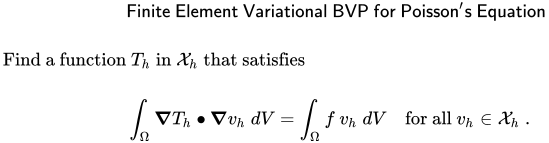
After substituting the expressions for and in the variational BVP
we get
![{\displaystyle {\begin{aligned}0&=\int _{\Omega }{\boldsymbol {\nabla }}T_{h}\bullet {\boldsymbol {\nabla }}v_{h}~dV-\int _{\Omega }f~v_{h}~dV\\&=\int _{\Omega }{\boldsymbol {\nabla }}(T_{1}N_{1}+\dots +T_{n}N_{n})\bullet {\boldsymbol {\nabla }}(b_{1}N_{1}+\dots +b_{n}N_{n})~dV-\int _{\Omega }f~(b_{1}N_{1}+\dots +b_{n}N_{n})~dV\\&=\int _{\Omega }(T_{1}{\boldsymbol {\nabla }}N_{1}+\dots +T_{n}{\boldsymbol {\nabla }}N_{n})\bullet (b_{1}{\boldsymbol {\nabla }}N_{1}+\dots +b_{n}{\boldsymbol {\nabla }}N_{n})~dV-\int _{\Omega }f~(b_{1}N_{1}+\dots +b_{n}N_{n})~dV\\&=\sum _{i,j=1}^{n}K_{ij}T_{i}b_{j}-\sum _{j=1}^{n}f_{j}b_{j}\\&=\sum _{j=1}^{n}b_{j}\left[\sum _{i=1}^{n}K_{ij}T_{i}-f_{j}\right]\\\end{aligned}}}](https://wikimedia.org/api/rest_v1/media/math/render/svg/100634388d258912d27bee75966a9ddab7ba8833)
where,

In matrix form, we have
![{\displaystyle {\text{(38)}}\qquad \mathbf {b} ^{T}\left[\mathbf {K} \mathbf {T} -\mathbf {f} \right]=\mathbf {0} }](https://wikimedia.org/api/rest_v1/media/math/render/svg/af646aed2923de4ebd6ea6a32f45337c225742ba)
where ![{\displaystyle \mathbf {b} ^{T}=[b_{1},b_{2},\dots ,b_{n}]}](https://wikimedia.org/api/rest_v1/media/math/render/svg/aa221930b6f2bafb7e317b5c06281bd2f8f41698) ,
,  is a
is a  symmetric matrix,
 ![{\displaystyle \mathbf {T} =[T_{1},T_{2},\dots ,T_{n}]}](https://wikimedia.org/api/rest_v1/media/math/render/svg/1d4e837369a6237c5f3af3f47739bf8ce3e8a191) is a
is a  vector, and
  is a vector.
Since  can be arbitrary, equation (38) can be further
simplified to the form
can be arbitrary, equation (38) can be further
simplified to the form

This system of equations has a solution since is positive-definite
and therefore has an inverse. Once the  s are known, the approximate
solution can be found using
s are known, the approximate
solution can be found using

The functions  have special forms in the finite
element method that have the property that the quality of the approximation
improves with an increase in the dimension of the basis.
have special forms in the finite
element method that have the property that the quality of the approximation
improves with an increase in the dimension of the basis.