There are two types models of nonlinear elastic behavior that are in common use. These are :
- Hyperelasticity
- Hypoelasticity
Hyperelastic materials are truly elastic in the sense that if a load is applied to such a material and then removed, the material returns to its original shape without any dissipation of energy in the process. In other word, a hyperelastic material stores energy during loading and releases exactly the same amount of energy during unloading. There is no path dependence.
If  is the Helmholtz free energy, then the stress-strain behavior for such a material is given by

where  is the Cauchy stress,
  is the current mass density,
  is the deformation gradient,
  is the Lagrangian Green strain tensor, and
  is the left Cauchy-Green deformation tensor.
We can use the relationship between the Cauchy stress and the 2nd Piola-Kirchhoff stress to obtain an alternative relation between stress and strain.
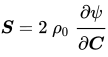
where  is the 2nd Piola-Kirchhoff stress and
  is the mass density in the reference configuration.
For isotropic materials, the free energy must be an isotropic function of . This also mean that the free energy must depend only on the principal invariants of which are
![{\displaystyle {\begin{aligned}I_{\boldsymbol {C}}=I_{1}&={\text{tr}}(\mathbf {C} )=C_{ii}=\lambda _{1}^{2}+\lambda _{2}^{2}+\lambda _{3}^{2}\\II_{\boldsymbol {C}}=I_{2}&={\tfrac {1}{2}}\left[{\text{tr}}(\mathbf {C} ^{2})-({\text{tr}}~\mathbf {C} )^{2}\right]={\tfrac {1}{2}}\left[C_{ik}C_{ki}-C_{jj}^{2}\right]=\lambda _{1}^{2}\lambda _{2}^{2}+\lambda _{2}^{2}\lambda _{3}^{2}+\lambda _{3}^{2}\lambda _{1}^{2}\\III_{\boldsymbol {C}}=I_{3}&=\det(\mathbf {C} )=\lambda _{1}^{2}\lambda _{2}^{2}\lambda _{3}^{2}\end{aligned}}}](https://wikimedia.org/api/rest_v1/media/math/render/svg/d3508ccb1fa33db50635d8f31163982b0ec0d0ba)
In other words,

Therefore, from the chain rule,

From the Cayley-Hamilton theorem we can show that

Hence we can also write
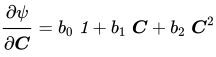
The stress-strain relation can then be written as
![{\displaystyle {\boldsymbol {S}}=2~\rho _{0}~\left[b_{0}~{\boldsymbol {\mathit {1}}}+b_{1}~{\boldsymbol {C}}+b_{2}~{\boldsymbol {C}}^{2}\right]}](https://wikimedia.org/api/rest_v1/media/math/render/svg/fd7d81ac2f0d6f4eebd154d617b9df9e17da67c7)
A similar relation can be obtained for the Cauchy stress which has the form
![{\displaystyle {\boldsymbol {\sigma }}=2~\rho ~\left[a_{2}~{\boldsymbol {\mathit {1}}}+a_{0}~{\boldsymbol {B}}+a_{1}~{\boldsymbol {B}}^{2}\right]}](https://wikimedia.org/api/rest_v1/media/math/render/svg/35b19b12af043c759204fbe0fc18a57d6a0163c8)
where  is the right Cauchy-Green deformation tensor.
Cauchy stress in terms of invariants[edit | edit source]
For w:isotropic hyperelastic materials, the Cauchy stress can be expressed in terms of the invariants of the left Cauchy-Green deformation tensor (or right Cauchy-Green deformation tensor). If the w:strain energy density function is  , then
![{\displaystyle {\begin{aligned}{\boldsymbol {\sigma }}&={\cfrac {2}{\sqrt {I_{3}}}}\left[\left({\cfrac {\partial {\hat {W}}}{\partial I_{1}}}+I_{1}~{\cfrac {\partial {\hat {W}}}{\partial I_{2}}}\right){\boldsymbol {B}}-{\cfrac {\partial {\hat {W}}}{\partial I_{2}}}~{\boldsymbol {B}}\cdot {\boldsymbol {B}}\right]+2{\sqrt {I_{3}}}~{\cfrac {\partial {\hat {W}}}{\partial I_{3}}}~{\boldsymbol {\mathit {1}}}\\&={\cfrac {2}{J}}\left[{\cfrac {1}{J^{2/3}}}\left({\cfrac {\partial {\bar {W}}}{\partial {\bar {I}}_{1}}}+{\bar {I}}_{1}~{\cfrac {\partial {\bar {W}}}{\partial {\bar {I}}_{2}}}\right){\boldsymbol {B}}-{\cfrac {1}{3}}\left({\bar {I}}_{1}~{\cfrac {\partial {\bar {W}}}{\partial {\bar {I}}_{1}}}+2~{\bar {I}}_{2}~{\cfrac {\partial {\bar {W}}}{\partial {\bar {I}}_{2}}}\right){\boldsymbol {\mathit {1}}}-\right.\\&\qquad \qquad \qquad \left.{\cfrac {1}{J^{4/3}}}~{\cfrac {\partial {\bar {W}}}{\partial {\bar {I}}_{2}}}~{\boldsymbol {B}}\cdot {\boldsymbol {B}}\right]+{\cfrac {\partial {\bar {W}}}{\partial J}}~{\boldsymbol {\mathit {1}}}\\&={\cfrac {\lambda _{1}}{\lambda _{1}\lambda _{2}\lambda _{3}}}~{\cfrac {\partial {\tilde {W}}}{\partial \lambda _{1}}}~\mathbf {n} _{1}\otimes \mathbf {n} _{1}+{\cfrac {\lambda _{2}}{\lambda _{1}\lambda _{2}\lambda _{3}}}~{\cfrac {\partial {\tilde {W}}}{\partial \lambda _{2}}}~\mathbf {n} _{2}\otimes \mathbf {n} _{2}+{\cfrac {\lambda _{3}}{\lambda _{1}\lambda _{2}\lambda _{3}}}~{\cfrac {\partial {\tilde {W}}}{\partial \lambda _{3}}}~\mathbf {n} _{3}\otimes \mathbf {n} _{3}\end{aligned}}}](https://wikimedia.org/api/rest_v1/media/math/render/svg/6c51b0c026b5a14d015b49862bfa1d157f8b0b76)
(See the page on the left Cauchy-Green deformation tensor for the definitions of these symbols).
| Proof 2:
|
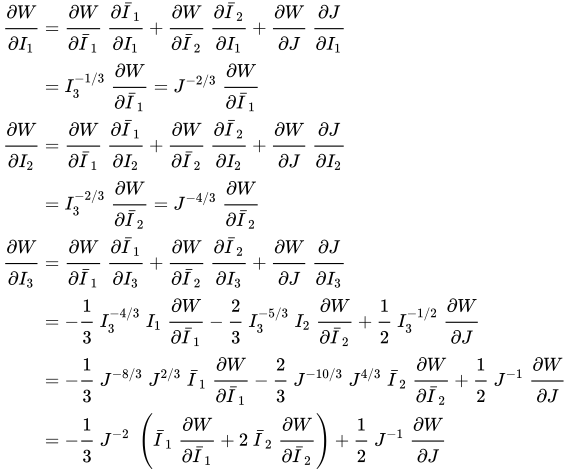
To express the Cauchy stress in terms of the invariants  recall that recall that

The chain rule of differentiation gives us
Recall that the Cauchy stress is given by
![{\displaystyle {\boldsymbol {\sigma }}={\cfrac {2}{\sqrt {I_{3}}}}~\left[\left({\cfrac {\partial W}{\partial I_{1}}}+I_{1}~{\cfrac {\partial W}{\partial I_{2}}}\right)~{\boldsymbol {B}}-{\cfrac {\partial W}{\partial I_{2}}}~{\boldsymbol {B}}\cdot {\boldsymbol {B}}\right]+2~{\sqrt {I_{3}}}~{\cfrac {\partial W}{\partial I_{3}}}~{\boldsymbol {\mathit {1}}}~.}](https://wikimedia.org/api/rest_v1/media/math/render/svg/bb1ee0c6cf0b91150820746d66e9a5e38e7cfe65)
In terms of the invariants we have
![{\displaystyle {\boldsymbol {\sigma }}={\cfrac {2}{J}}~\left[\left({\cfrac {\partial W}{\partial I_{1}}}+J^{2/3}~{\bar {I}}_{1}~{\cfrac {\partial W}{\partial I_{2}}}\right)~{\boldsymbol {B}}-{\cfrac {\partial W}{\partial I_{2}}}~{\boldsymbol {B}}\cdot {\boldsymbol {B}}\right]+2~J~{\cfrac {\partial W}{\partial I_{3}}}~{\boldsymbol {\mathit {1}}}~.}](https://wikimedia.org/api/rest_v1/media/math/render/svg/d4f30443899568890a1c8f543ec6a9524c996172)
Plugging in the expressions for the derivatives of  in terms of , we have in terms of , we have
![{\displaystyle {\begin{aligned}{\boldsymbol {\sigma }}&={\cfrac {2}{J}}~\left[\left(J^{-2/3}~{\cfrac {\partial W}{\partial {\bar {I}}_{1}}}+J^{-2/3}~{\bar {I}}_{1}~{\cfrac {\partial W}{\partial {\bar {I}}_{2}}}\right)~{\boldsymbol {B}}-J^{-4/3}~{\cfrac {\partial W}{\partial {\bar {I}}_{2}}}~{\boldsymbol {B}}\cdot {\boldsymbol {B}}\right]+\\&\qquad 2~J~\left[-{\cfrac {1}{3}}~J^{-2}~\left({\bar {I}}_{1}~{\cfrac {\partial W}{\partial {\bar {I}}_{1}}}+2~{\bar {I}}_{2}~{\cfrac {\partial W}{\partial {\bar {I}}_{2}}}\right)+{\cfrac {1}{2}}~J^{-1}~{\cfrac {\partial W}{\partial J}}\right]~{\boldsymbol {\mathit {1}}}\end{aligned}}}](https://wikimedia.org/api/rest_v1/media/math/render/svg/942d309f640a99c84f20f0f4d241b013e1a933d6)
or,
![{\displaystyle {\begin{aligned}{\boldsymbol {\sigma }}&={\cfrac {2}{J}}~\left[{\cfrac {1}{J^{2/3}}}~\left({\cfrac {\partial W}{\partial {\bar {I}}_{1}}}+{\bar {I}}_{1}~{\cfrac {\partial W}{\partial {\bar {I}}_{2}}}\right)~{\boldsymbol {B}}-{\cfrac {1}{3}}\left({\bar {I}}_{1}~{\cfrac {\partial W}{\partial {\bar {I}}_{1}}}+2~{\bar {I}}_{2}~{\cfrac {\partial W}{\partial {\bar {I}}_{2}}}\right){\boldsymbol {\mathit {1}}}-\right.\\&\qquad \left.{\cfrac {1}{J^{4/3}}}~{\cfrac {\partial W}{\partial {\bar {I}}_{2}}}~{\boldsymbol {B}}\cdot {\boldsymbol {B}}\right]+{\cfrac {\partial W}{\partial J}}~{\boldsymbol {\mathit {1}}}\end{aligned}}}](https://wikimedia.org/api/rest_v1/media/math/render/svg/dcce371d66dc4cd58d17e2814c59455367e1eb2f)
|
| Proof 3:
|
To express the Cauchy stress in terms of the stretches  recall that recall that

The chain rule gives
![{\displaystyle {\begin{aligned}{\cfrac {\partial W}{\partial {\boldsymbol {C}}}}&={\cfrac {\partial W}{\partial \lambda _{1}}}~{\cfrac {\partial \lambda _{1}}{\partial {\boldsymbol {C}}}}+{\cfrac {\partial W}{\partial \lambda _{2}}}~{\cfrac {\partial \lambda _{2}}{\partial {\boldsymbol {C}}}}+{\cfrac {\partial W}{\partial \lambda _{3}}}~{\cfrac {\partial \lambda _{3}}{\partial {\boldsymbol {C}}}}\\&={\boldsymbol {R}}^{T}\cdot \left[{\cfrac {1}{2\lambda _{1}}}~{\cfrac {\partial W}{\partial \lambda _{1}}}~\mathbf {n} _{1}\otimes \mathbf {n} _{1}+{\cfrac {1}{2\lambda _{2}}}~{\cfrac {\partial W}{\partial \lambda _{2}}}~\mathbf {n} _{2}\otimes \mathbf {n} _{2}+{\cfrac {1}{2\lambda _{3}}}~{\cfrac {\partial W}{\partial \lambda _{3}}}~\mathbf {n} _{3}\otimes \mathbf {n} _{3}\right]\cdot {\boldsymbol {R}}\end{aligned}}}](https://wikimedia.org/api/rest_v1/media/math/render/svg/7525fe32c1f006a7800f672d51035a43e2802c90)
The Cauchy stress is given by

Plugging in the expression for the derivative of leads to
![{\displaystyle {\boldsymbol {\sigma }}={\cfrac {2}{J}}~{\boldsymbol {V}}\cdot \left[{\cfrac {1}{2\lambda _{1}}}~{\cfrac {\partial W}{\partial \lambda _{1}}}~\mathbf {n} _{1}\otimes \mathbf {n} _{1}+{\cfrac {1}{2\lambda _{2}}}~{\cfrac {\partial W}{\partial \lambda _{2}}}~\mathbf {n} _{2}\otimes \mathbf {n} _{2}+{\cfrac {1}{2\lambda _{3}}}~{\cfrac {\partial W}{\partial \lambda _{3}}}~\mathbf {n} _{3}\otimes \mathbf {n} _{3}\right]\cdot {\boldsymbol {V}}}](https://wikimedia.org/api/rest_v1/media/math/render/svg/977230f6bcdfd24e95c31388332eadf83658fca3)
Using the spectral decomposition of  we have we have

Also note that

Therefore the expression for the Cauchy stress can be written as
![{\displaystyle {\boldsymbol {\sigma }}={\cfrac {1}{\lambda _{1}\lambda _{2}\lambda _{3}}}~\left[\lambda _{1}~{\cfrac {\partial W}{\partial \lambda _{1}}}~\mathbf {n} _{1}\otimes \mathbf {n} _{1}+\lambda _{2}~{\cfrac {\partial W}{\partial \lambda _{2}}}~\mathbf {n} _{2}\otimes \mathbf {n} _{2}+\lambda _{3}~{\cfrac {\partial W}{\partial \lambda _{3}}}~\mathbf {n} _{3}\otimes \mathbf {n} _{3}\right]}](https://wikimedia.org/api/rest_v1/media/math/render/svg/98f1a3e0369450e0ee8ec83c6917e96874302e62)
|
Saint-Venant–Kirchhoff material[edit | edit source]
The simplest constitutive relationship that satisfies the requirements of hyperelasticity is the Saint-Venant–Kirchhoff material, which has a response function of the form

where  and
and  are material constants that have to be determined by experiments. Such a linear relation is physically possible only for small strains.








![{\displaystyle {\boldsymbol {\sigma }}={\cfrac {2}{J}}~\left[{\cfrac {\partial W}{\partial I_{1}}}~{\boldsymbol {F}}\cdot {\boldsymbol {F}}^{T}+{\cfrac {\partial W}{\partial I_{2}}}~(I_{1}~{\boldsymbol {F}}\cdot {\boldsymbol {F}}^{T}-{\boldsymbol {F}}\cdot {\boldsymbol {F}}^{T}\cdot {\boldsymbol {F}}\cdot {\boldsymbol {F}}^{T})+{\cfrac {\partial W}{\partial I_{3}}}~I_{3}~{\boldsymbol {\mathit {1}}}\right]}](https://wikimedia.org/api/rest_v1/media/math/render/svg/6e14aca126ea518e5e3e0132e4fd899deadbc3ad)

