The Bubnov-Galerkin method is the most widely used weighted average method. This method is the basis of most finite element methods.
The finite-dimensional Galerkin form of the problem statement of our second order ODE is :
Since the basis functions () are known and linearly independent, the approximate solution is completely determined once the constants () are known.
The Galerkin method provides a great way of constructing solutions. But the question is: how do we choose so that these functions are not only linearly independent but arbitrary? Since the solution is expressed as a sum of these functions, the accuracy of our result depends strongly on the choice of .
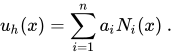
Let the trial solution take the form,
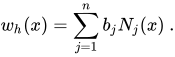
According to the Bubnov-Galerkin approach, the weighting function also takes a similar form
Plug these values into the weak form to get
or
or
Taking the sums and constants outside the integrals and rearranging, we get
Since the s are arbitrary, the quantity inside the square brackets must be zero. That is
Let us define
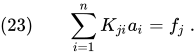
Then we get a set of simultaneous linear equations



![{\displaystyle \int _{0}^{1}\left[\left(\sum _{i=1}^{n}a_{i}{\cfrac {dN_{i}}{dx}}\right)\left(\sum _{j=1}^{n}b_{j}{\cfrac {dN_{j}}{dx}}\right)+\left(\sum _{i=1}^{n}a_{i}N_{i}\right)\left(\sum _{j=1}^{n}b_{j}N_{j}\right)-x\left(\sum _{j=1}^{n}b_{j}N_{j}\right)\right]~dx=0}](https://wikimedia.org/api/rest_v1/media/math/render/svg/45b2cfd0ce79becb728c0381e52c983cf2ff4b1a)
![{\displaystyle \int _{0}^{1}\left[\sum _{j=1}^{n}b_{j}\left({\cfrac {dN_{j}}{dx}}\sum _{i=1}^{n}a_{i}{\cfrac {dN_{i}}{dx}}+N_{j}\sum _{i=1}^{n}a_{i}N_{i}-x~N_{j}\right)\right]~dx=0}](https://wikimedia.org/api/rest_v1/media/math/render/svg/e56a43f8052ccfcccf8a09e6f962ce5d3161938c)
![{\displaystyle \int _{0}^{1}\left[\sum _{j=1}^{n}b_{j}\left(\sum _{i=1}^{n}\left(a_{i}{\cfrac {dN_{j}}{dx}}{\cfrac {dN_{i}}{dx}}+a_{i}N_{j}N_{i}\right)-x~N_{j}\right)\right]~dx=0~.}](https://wikimedia.org/api/rest_v1/media/math/render/svg/785fcfc807948a2115aa1499dc791be17da02a03)
![{\displaystyle \sum _{j=1}^{n}b_{j}\left[\sum _{i=1}^{n}a_{i}\int _{0}^{1}\left({\cfrac {dN_{i}}{dx}}{\cfrac {dN_{j}}{dx}}+N_{i}N_{j}\right)~dx-\int _{0}^{1}x~N_{j}~dx\right]=0~.}](https://wikimedia.org/api/rest_v1/media/math/render/svg/18717a03b11275700133463305404649b147a646)