Axially loaded bar: The Finite Element Solution [ edit | edit source ] The finite element method is a type of Galerkin method that has the
following advantages:
The functions
φ
i
{\displaystyle \varphi _{i}}
The functions
φ
i
{\displaystyle \varphi _{i}}
The functions
φ
i
{\displaystyle \varphi _{i}}
The functions
φ
i
{\displaystyle \varphi _{i}}
As a result, computations can be done in a modular manner that is suitable for computer implementation.
The first step in the finite element approach is to divide the domain into elements and nodes , i.e., to create the finite element mesh .
Let us consider a simple situation and divide the rod into 3 elements and 4 nodes as shown in Figure 6.
Figure 6. Finite element mesh and basis functions for the bar.
The functions
φ
i
{\displaystyle \varphi _{i}}
N
i
{\displaystyle N_{i}}
basis functions , shape functions , or interpolation functions .
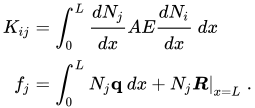
Therefore, we may write
K
i
j
=
∫
0
L
d
N
j
d
x
A
E
d
N
i
d
x
d
x
f
j
=
∫
0
L
N
j
q
d
x
+
N
j
R
|
x
=
L
.
{\displaystyle {\begin{aligned}K_{ij}&=\int _{0}^{L}{\cfrac {dN_{j}}{dx}}AE{\cfrac {dN_{i}}{dx}}~dx\\f_{j}&=\int _{0}^{L}N_{j}\mathbf {q} ~dx+\left.N_{j}{\boldsymbol {R}}\right|_{x=L}~.\end{aligned}}}
The finite element basis functions are chosen such that they have the
following properties:
The functions
N
i
{\displaystyle N_{i}}
If there are
n
{\displaystyle n}
n
{\displaystyle n}
Each function
N
i
{\displaystyle N_{i}}
i
{\displaystyle i}
N
i
{\displaystyle N_{i}}
i
{\displaystyle i}
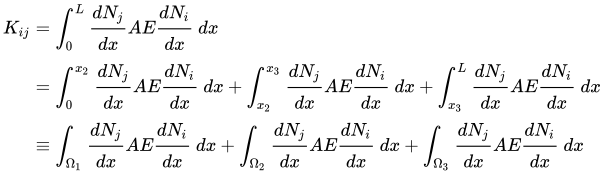
Let us compute the values of
K
i
j
{\displaystyle K_{ij}}
K
i
j
=
∫
0
L
d
N
j
d
x
A
E
d
N
i
d
x
d
x
=
∫
0
x
2
d
N
j
d
x
A
E
d
N
i
d
x
d
x
+
∫
x
2
x
3
d
N
j
d
x
A
E
d
N
i
d
x
d
x
+
∫
x
3
L
d
N
j
d
x
A
E
d
N
i
d
x
d
x
≡
∫
Ω
1
d
N
j
d
x
A
E
d
N
i
d
x
d
x
+
∫
Ω
2
d
N
j
d
x
A
E
d
N
i
d
x
d
x
+
∫
Ω
3
d
N
j
d
x
A
E
d
N
i
d
x
d
x
{\displaystyle {\begin{aligned}K_{ij}&=\int _{0}^{L}{\cfrac {dN_{j}}{dx}}AE{\cfrac {dN_{i}}{dx}}~dx\\&=\int _{0}^{x_{2}}{\cfrac {dN_{j}}{dx}}AE{\cfrac {dN_{i}}{dx}}~dx+\int _{x_{2}}^{x_{3}}{\cfrac {dN_{j}}{dx}}AE{\cfrac {dN_{i}}{dx}}~dx+\int _{x_{3}}^{L}{\cfrac {dN_{j}}{dx}}AE{\cfrac {dN_{i}}{dx}}~dx\\&\equiv \int _{\Omega _{1}}{\cfrac {dN_{j}}{dx}}AE{\cfrac {dN_{i}}{dx}}~dx+\int _{\Omega _{2}}{\cfrac {dN_{j}}{dx}}AE{\cfrac {dN_{i}}{dx}}~dx+\int _{\Omega _{3}}{\cfrac {dN_{j}}{dx}}AE{\cfrac {dN_{i}}{dx}}~dx\end{aligned}}}
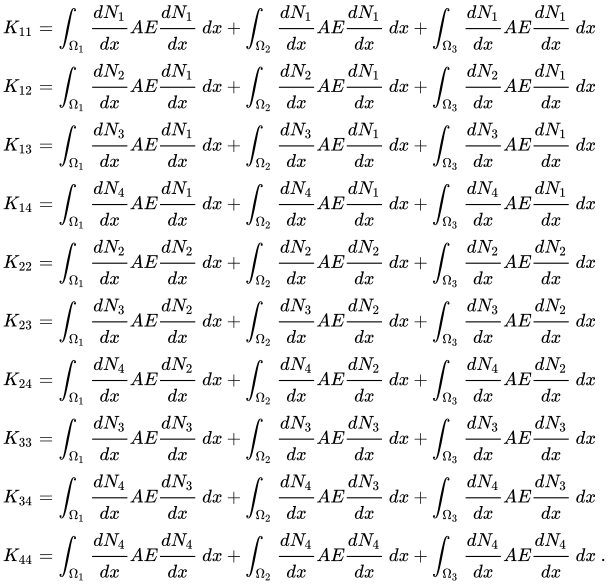
The components of
K
{\displaystyle \mathbf {K} }
K
11
=
∫
Ω
1
d
N
1
d
x
A
E
d
N
1
d
x
d
x
+
∫
Ω
2
d
N
1
d
x
A
E
d
N
1
d
x
d
x
+
∫
Ω
3
d
N
1
d
x
A
E
d
N
1
d
x
d
x
K
12
=
∫
Ω
1
d
N
2
d
x
A
E
d
N
1
d
x
d
x
+
∫
Ω
2
d
N
2
d
x
A
E
d
N
1
d
x
d
x
+
∫
Ω
3
d
N
2
d
x
A
E
d
N
1
d
x
d
x
K
13
=
∫
Ω
1
d
N
3
d
x
A
E
d
N
1
d
x
d
x
+
∫
Ω
2
d
N
3
d
x
A
E
d
N
1
d
x
d
x
+
∫
Ω
3
d
N
3
d
x
A
E
d
N
1
d
x
d
x
K
14
=
∫
Ω
1
d
N
4
d
x
A
E
d
N
1
d
x
d
x
+
∫
Ω
2
d
N
4
d
x
A
E
d
N
1
d
x
d
x
+
∫
Ω
3
d
N
4
d
x
A
E
d
N
1
d
x
d
x
K
22
=
∫
Ω
1
d
N
2
d
x
A
E
d
N
2
d
x
d
x
+
∫
Ω
2
d
N
2
d
x
A
E
d
N
2
d
x
d
x
+
∫
Ω
3
d
N
2
d
x
A
E
d
N
2
d
x
d
x
K
23
=
∫
Ω
1
d
N
3
d
x
A
E
d
N
2
d
x
d
x
+
∫
Ω
2
d
N
3
d
x
A
E
d
N
2
d
x
d
x
+
∫
Ω
3
d
N
3
d
x
A
E
d
N
2
d
x
d
x
K
24
=
∫
Ω
1
d
N
4
d
x
A
E
d
N
2
d
x
d
x
+
∫
Ω
2
d
N
4
d
x
A
E
d
N
2
d
x
d
x
+
∫
Ω
3
d
N
4
d
x
A
E
d
N
2
d
x
d
x
K
33
=
∫
Ω
1
d
N
3
d
x
A
E
d
N
3
d
x
d
x
+
∫
Ω
2
d
N
3
d
x
A
E
d
N
3
d
x
d
x
+
∫
Ω
3
d
N
3
d
x
A
E
d
N
3
d
x
d
x
K
34
=
∫
Ω
1
d
N
4
d
x
A
E
d
N
3
d
x
d
x
+
∫
Ω
2
d
N
4
d
x
A
E
d
N
3
d
x
d
x
+
∫
Ω
3
d
N
4
d
x
A
E
d
N
3
d
x
d
x
K
44
=
∫
Ω
1
d
N
4
d
x
A
E
d
N
4
d
x
d
x
+
∫
Ω
2
d
N
4
d
x
A
E
d
N
4
d
x
d
x
+
∫
Ω
3
d
N
4
d
x
A
E
d
N
4
d
x
d
x
.
{\displaystyle {\begin{aligned}K_{11}&=\int _{\Omega _{1}}{\cfrac {dN_{1}}{dx}}AE{\cfrac {dN_{1}}{dx}}~dx+\int _{\Omega _{2}}{\cfrac {dN_{1}}{dx}}AE{\cfrac {dN_{1}}{dx}}~dx+\int _{\Omega _{3}}{\cfrac {dN_{1}}{dx}}AE{\cfrac {dN_{1}}{dx}}~dx\\K_{12}&=\int _{\Omega _{1}}{\cfrac {dN_{2}}{dx}}AE{\cfrac {dN_{1}}{dx}}~dx+\int _{\Omega _{2}}{\cfrac {dN_{2}}{dx}}AE{\cfrac {dN_{1}}{dx}}~dx+\int _{\Omega _{3}}{\cfrac {dN_{2}}{dx}}AE{\cfrac {dN_{1}}{dx}}~dx\\K_{13}&=\int _{\Omega _{1}}{\cfrac {dN_{3}}{dx}}AE{\cfrac {dN_{1}}{dx}}~dx+\int _{\Omega _{2}}{\cfrac {dN_{3}}{dx}}AE{\cfrac {dN_{1}}{dx}}~dx+\int _{\Omega _{3}}{\cfrac {dN_{3}}{dx}}AE{\cfrac {dN_{1}}{dx}}~dx\\K_{14}&=\int _{\Omega _{1}}{\cfrac {dN_{4}}{dx}}AE{\cfrac {dN_{1}}{dx}}~dx+\int _{\Omega _{2}}{\cfrac {dN_{4}}{dx}}AE{\cfrac {dN_{1}}{dx}}~dx+\int _{\Omega _{3}}{\cfrac {dN_{4}}{dx}}AE{\cfrac {dN_{1}}{dx}}~dx\\K_{22}&=\int _{\Omega _{1}}{\cfrac {dN_{2}}{dx}}AE{\cfrac {dN_{2}}{dx}}~dx+\int _{\Omega _{2}}{\cfrac {dN_{2}}{dx}}AE{\cfrac {dN_{2}}{dx}}~dx+\int _{\Omega _{3}}{\cfrac {dN_{2}}{dx}}AE{\cfrac {dN_{2}}{dx}}~dx\\K_{23}&=\int _{\Omega _{1}}{\cfrac {dN_{3}}{dx}}AE{\cfrac {dN_{2}}{dx}}~dx+\int _{\Omega _{2}}{\cfrac {dN_{3}}{dx}}AE{\cfrac {dN_{2}}{dx}}~dx+\int _{\Omega _{3}}{\cfrac {dN_{3}}{dx}}AE{\cfrac {dN_{2}}{dx}}~dx\\K_{24}&=\int _{\Omega _{1}}{\cfrac {dN_{4}}{dx}}AE{\cfrac {dN_{2}}{dx}}~dx+\int _{\Omega _{2}}{\cfrac {dN_{4}}{dx}}AE{\cfrac {dN_{2}}{dx}}~dx+\int _{\Omega _{3}}{\cfrac {dN_{4}}{dx}}AE{\cfrac {dN_{2}}{dx}}~dx\\K_{33}&=\int _{\Omega _{1}}{\cfrac {dN_{3}}{dx}}AE{\cfrac {dN_{3}}{dx}}~dx+\int _{\Omega _{2}}{\cfrac {dN_{3}}{dx}}AE{\cfrac {dN_{3}}{dx}}~dx+\int _{\Omega _{3}}{\cfrac {dN_{3}}{dx}}AE{\cfrac {dN_{3}}{dx}}~dx\\K_{34}&=\int _{\Omega _{1}}{\cfrac {dN_{4}}{dx}}AE{\cfrac {dN_{3}}{dx}}~dx+\int _{\Omega _{2}}{\cfrac {dN_{4}}{dx}}AE{\cfrac {dN_{3}}{dx}}~dx+\int _{\Omega _{3}}{\cfrac {dN_{4}}{dx}}AE{\cfrac {dN_{3}}{dx}}~dx\\K_{44}&=\int _{\Omega _{1}}{\cfrac {dN_{4}}{dx}}AE{\cfrac {dN_{4}}{dx}}~dx+\int _{\Omega _{2}}{\cfrac {dN_{4}}{dx}}AE{\cfrac {dN_{4}}{dx}}~dx+\int _{\Omega _{3}}{\cfrac {dN_{4}}{dx}}AE{\cfrac {dN_{4}}{dx}}~dx~.\end{aligned}}}
The matrix
K
{\displaystyle \mathbf {K} }
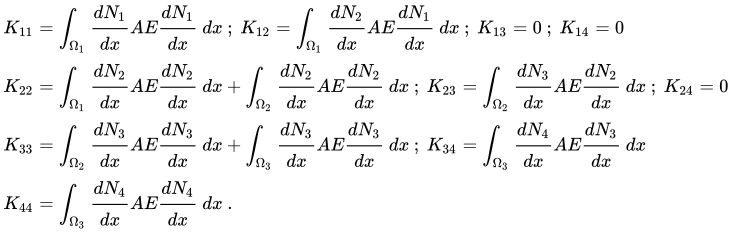
From Figure 6, we see that
N
1
{\displaystyle N_{1}}
N
2
{\displaystyle N_{2}}
N
3
{\displaystyle N_{3}}
N
4
{\displaystyle N_{4}}
d
N
i
/
d
x
{\displaystyle dN_{i}/dx}
Therefore, the coefficients of the
K
{\displaystyle \mathbf {K} }
K
11
=
∫
Ω
1
d
N
1
d
x
A
E
d
N
1
d
x
d
x
;
K
12
=
∫
Ω
1
d
N
2
d
x
A
E
d
N
1
d
x
d
x
;
K
13
=
0
;
K
14
=
0
K
22
=
∫
Ω
1
d
N
2
d
x
A
E
d
N
2
d
x
d
x
+
∫
Ω
2
d
N
2
d
x
A
E
d
N
2
d
x
d
x
;
K
23
=
∫
Ω
2
d
N
3
d
x
A
E
d
N
2
d
x
d
x
;
K
24
=
0
K
33
=
∫
Ω
2
d
N
3
d
x
A
E
d
N
3
d
x
d
x
+
∫
Ω
3
d
N
3
d
x
A
E
d
N
3
d
x
d
x
;
K
34
=
∫
Ω
3
d
N
4
d
x
A
E
d
N
3
d
x
d
x
K
44
=
∫
Ω
3
d
N
4
d
x
A
E
d
N
4
d
x
d
x
.
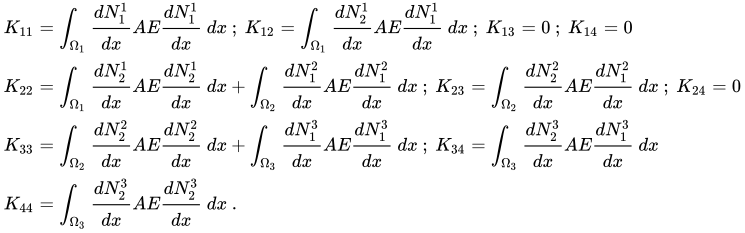
{\displaystyle {\begin{aligned}K_{11}&=\int _{\Omega _{1}}{\cfrac {dN_{1}}{dx}}AE{\cfrac {dN_{1}}{dx}}~dx~;~K_{12}=\int _{\Omega _{1}}{\cfrac {dN_{2}}{dx}}AE{\cfrac {dN_{1}}{dx}}~dx~;~K_{13}=0~;~K_{14}=0\\K_{22}&=\int _{\Omega _{1}}{\cfrac {dN_{2}}{dx}}AE{\cfrac {dN_{2}}{dx}}~dx+\int _{\Omega _{2}}{\cfrac {dN_{2}}{dx}}AE{\cfrac {dN_{2}}{dx}}~dx~;~K_{23}=\int _{\Omega _{2}}{\cfrac {dN_{3}}{dx}}AE{\cfrac {dN_{2}}{dx}}~dx~;~K_{24}=0\\K_{33}&=\int _{\Omega _{2}}{\cfrac {dN_{3}}{dx}}AE{\cfrac {dN_{3}}{dx}}~dx+\int _{\Omega _{3}}{\cfrac {dN_{3}}{dx}}AE{\cfrac {dN_{3}}{dx}}~dx~;~K_{34}=\int _{\Omega _{3}}{\cfrac {dN_{4}}{dx}}AE{\cfrac {dN_{3}}{dx}}~dx\\K_{44}&=\int _{\Omega _{3}}{\cfrac {dN_{4}}{dx}}AE{\cfrac {dN_{4}}{dx}}~dx~.\end{aligned}}}
We can simplify our calculation further by letting
N
k
e
{\displaystyle N_{k}^{e}}
e
{\displaystyle e}
2
{\displaystyle 2}
N
1
2
{\displaystyle N_{1}^{2}}
N
2
2
{\displaystyle N_{2}^{2}}
1
{\displaystyle 1}
2
{\displaystyle 2}
2
{\displaystyle 2}
3
{\displaystyle 3}
K
11
=
∫
Ω
1
d
N
1
1
d
x
A
E
d
N
1
1
d
x
d
x
;
K
12
=
∫
Ω
1
d
N
2
1
d
x
A
E
d
N
1
1
d
x
d
x
;
K
13
=
0
;
K
14
=
0
K
22
=
∫
Ω
1
d
N
2
1
d
x
A
E
d
N
2
1
d
x
d
x
+
∫
Ω
2
d
N
1
2
d
x
A
E
d
N
1
2
d
x
d
x
;
K
23
=
∫
Ω
2
d
N
2
2
d
x
A
E
d
N
1
2
d
x
d
x
;
K
24
=
0
K
33
=
∫
Ω
2
d
N
2
2
d
x
A
E
d
N
2
2
d
x
d
x
+
∫
Ω
3
d
N
1
3
d
x
A
E
d
N
1
3
d
x
d
x
;
K
34
=
∫
Ω
3
d
N
2
3
d
x
A
E
d
N
1
3
d
x
d
x
K
44
=
∫
Ω
3
d
N
2
3
d
x
A
E
d
N
2
3
d
x
d
x
.
{\displaystyle {\begin{aligned}K_{11}&=\int _{\Omega _{1}}{\cfrac {dN_{1}^{1}}{dx}}AE{\cfrac {dN_{1}^{1}}{dx}}~dx~;~K_{12}=\int _{\Omega _{1}}{\cfrac {dN_{2}^{1}}{dx}}AE{\cfrac {dN_{1}^{1}}{dx}}~dx~;~K_{13}=0~;~K_{14}=0\\K_{22}&=\int _{\Omega _{1}}{\cfrac {dN_{2}^{1}}{dx}}AE{\cfrac {dN_{2}^{1}}{dx}}~dx+\int _{\Omega _{2}}{\cfrac {dN_{1}^{2}}{dx}}AE{\cfrac {dN_{1}^{2}}{dx}}~dx~;~K_{23}=\int _{\Omega _{2}}{\cfrac {dN_{2}^{2}}{dx}}AE{\cfrac {dN_{1}^{2}}{dx}}~dx~;~K_{24}=0\\K_{33}&=\int _{\Omega _{2}}{\cfrac {dN_{2}^{2}}{dx}}AE{\cfrac {dN_{2}^{2}}{dx}}~dx+\int _{\Omega _{3}}{\cfrac {dN_{1}^{3}}{dx}}AE{\cfrac {dN_{1}^{3}}{dx}}~dx~;~K_{34}=\int _{\Omega _{3}}{\cfrac {dN_{2}^{3}}{dx}}AE{\cfrac {dN_{1}^{3}}{dx}}~dx\\K_{44}&=\int _{\Omega _{3}}{\cfrac {dN_{2}^{3}}{dx}}AE{\cfrac {dN_{2}^{3}}{dx}}~dx~.\end{aligned}}}
Let
K
k
l
e
{\displaystyle K_{kl}^{e}}
K
i
j
{\displaystyle K_{ij}}
e
{\displaystyle e}
k
l
{\displaystyle kl}
i
j
{\displaystyle ij}
K
11
=
K
11
1
;
K
12
=
K
12
1
;
K
13
=
0
;
K
14
=
0
K
22
=
K
22
1
+
K
11
2
;
K
23
=
K
12
2
;
K
24
=
0
K
33
=
K
22
2
+
K
11
3
;
K
34
=
K
12
3
K
44
=
K
22
3
{\displaystyle {\begin{aligned}K_{11}&=K_{11}^{1}~;~K_{12}=K_{12}^{1}~;~K_{13}=0~;~K_{14}=0\\K_{22}&=K_{22}^{1}+K_{11}^{2}~;~~K_{23}=K_{12}^{2}~;~~K_{24}=0\\K_{33}&=K_{22}^{2}+K_{11}^{3}~;~K_{34}=K_{12}^{3}\\K_{44}&=K_{22}^{3}\\\end{aligned}}}
We can therefore see that if we compute the stiffness matrices over
each element and assemble them in an appropriate manner, we can get the
global stiffness matrix
K
{\displaystyle \mathbf {K} }
Stiffness matrix for two-noded elements [ edit | edit source ] For our problem, if we consider an element
e
{\displaystyle e}
N
1
e
(
x
)
=
x
2
−
x
h
e
;
N
2
e
(
x
)
=
x
−
x
1
h
e
{\displaystyle N_{1}^{e}(\mathbf {x} )={\cfrac {\mathbf {x} _{2}-\mathbf {x} }{h_{e}}}~;~~N_{2}^{e}(\mathbf {x} )={\cfrac {\mathbf {x} -\mathbf {x} _{1}}{h_{e}}}}
where
h
e
{\displaystyle h_{e}}
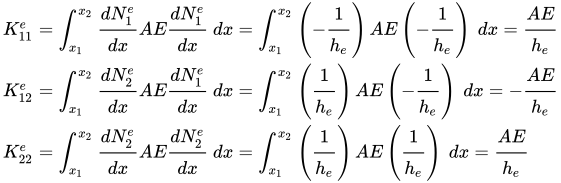
Then, the components of the element stiffness matrix are
K
11
e
=
∫
x
1
x
2
d
N
1
e
d
x
A
E
d
N
1
e
d
x
d
x
=
∫
x
1
x
2
(
−
1
h
e
)
A
E
(
−
1
h
e
)
d
x
=
A
E
h
e
K
12
e
=
∫
x
1
x
2
d
N
2
e
d
x
A
E
d
N
1
e
d
x
d
x
=
∫
x
1
x
2
(
1
h
e
)
A
E
(
−
1
h
e
)
d
x
=
−
A
E
h
e
K
22
e
=
∫
x
1
x
2
d
N
2
e
d
x
A
E
d
N
2
e
d
x
d
x
=
∫
x
1
x
2
(
1
h
e
)
A
E
(
1
h
e
)
d
x
=
A
E
h
e
{\displaystyle {\begin{aligned}K_{11}^{e}&=\int _{x_{1}}^{x_{2}}{\cfrac {dN_{1}^{e}}{dx}}AE{\cfrac {dN_{1}^{e}}{dx}}~dx=\int _{x_{1}}^{x_{2}}\left(-{\cfrac {1}{h_{e}}}\right)AE\left(-{\cfrac {1}{h_{e}}}\right)~dx={\cfrac {AE}{h_{e}}}\\K_{12}^{e}&=\int _{x_{1}}^{x_{2}}{\cfrac {dN_{2}^{e}}{dx}}AE{\cfrac {dN_{1}^{e}}{dx}}~dx=\int _{x_{1}}^{x_{2}}\left({\cfrac {1}{h_{e}}}\right)AE\left(-{\cfrac {1}{h_{e}}}\right)~dx=-{\cfrac {AE}{h_{e}}}\\K_{22}^{e}&=\int _{x_{1}}^{x_{2}}{\cfrac {dN_{2}^{e}}{dx}}AE{\cfrac {dN_{2}^{e}}{dx}}~dx=\int _{x_{1}}^{x_{2}}\left({\cfrac {1}{h_{e}}}\right)AE\left({\cfrac {1}{h_{e}}}\right)~dx={\cfrac {AE}{h_{e}}}\end{aligned}}}
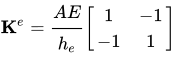
In matrix form,
K
e
=
A
E
h
e
[
1
−
1
−
1
1
]
{\displaystyle {\mathbf {K} ^{e}={\cfrac {AE}{h_{e}}}{\begin{bmatrix}1&-1\\-1&1\end{bmatrix}}}}
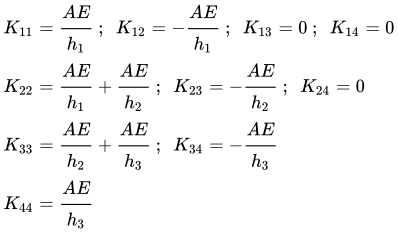
The components of the global stiffness matrix are
K
11
=
A
E
h
1
;
K
12
=
−
A
E
h
1
;
K
13
=
0
;
K
14
=
0
K
22
=
A
E
h
1
+
A
E
h
2
;
K
23
=
−
A
E
h
2
;
K
24
=
0
K
33
=
A
E
h
2
+
A
E
h
3
;
K
34
=
−
A
E
h
3
K
44
=
A
E
h
3
{\displaystyle {\begin{aligned}K_{11}&={\cfrac {AE}{h_{1}}}~;~~K_{12}=-{\cfrac {AE}{h_{1}}}~;~~K_{13}=0~;~~K_{14}=0\\K_{22}&={\cfrac {AE}{h_{1}}}+{\cfrac {AE}{h_{2}}}~;~~K_{23}=-{\cfrac {AE}{h_{2}}}~;~~K_{24}=0\\K_{33}&={\cfrac {AE}{h_{2}}}+{\cfrac {AE}{h_{3}}}~;~~K_{34}=-{\cfrac {AE}{h_{3}}}\\K_{44}&={\cfrac {AE}{h_{3}}}\\\end{aligned}}}
In matrix form,
K
=
A
E
[
1
h
1
−
1
h
1
0
0
1
h
1
+
1
h
2
−
1
h
2
0
1
h
2
+
1
h
3
−
1
h
3
Symm.
1
h
3
]
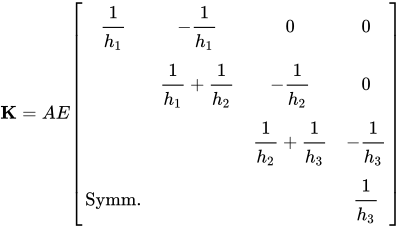
{\displaystyle {\mathbf {K} =AE{\begin{bmatrix}{\cfrac {1}{h_{1}}}&-{\cfrac {1}{h_{1}}}&0&0\\&{\cfrac {1}{h_{1}}}+{\cfrac {1}{h_{2}}}&-{\cfrac {1}{h_{2}}}&0\\&&{\cfrac {1}{h_{2}}}+{\cfrac {1}{h_{3}}}&-{\cfrac {1}{h_{3}}}\\{\text{Symm.}}&&&{\cfrac {1}{h_{3}}}\\\end{bmatrix}}}}
Similarly, for the load vector
f
{\displaystyle \mathbf {f} }
f
j
=
∫
0
L
N
j
q
d
x
+
N
j
R
|
x
=
L
=
∫
Ω
1
N
j
q
d
x
+
∫
Ω
2
N
j
q
d
x
+
∫
Ω
3
N
j
q
d
x
+
N
j
R
|
x
=
L
{\displaystyle {\begin{aligned}f_{j}&=\int _{0}^{L}N_{j}\mathbf {q} ~dx+\left.N_{j}{\boldsymbol {R}}\right|_{x=L}\\&=\int _{\Omega _{1}}N_{j}\mathbf {q} ~dx+\int _{\Omega _{2}}N_{j}\mathbf {q} ~dx+\int _{\Omega _{3}}N_{j}\mathbf {q} ~dx+\left.N_{j}{\boldsymbol {R}}\right|_{x=L}\end{aligned}}}
The components of the load vector are
f
1
=
∫
Ω
1
N
1
q
d
x
+
∫
Ω
2
N
1
q
d
x
+
∫
Ω
3
N
1
q
d
x
+
N
1
R
|
x
=
L
f
2
=
∫
Ω
1
N
2
q
d
x
+
∫
Ω
2
N
2
q
d
x
+
∫
Ω
3
N
2
q
d
x
+
N
2
R
|
x
=
L
f
3
=
∫
Ω
1
N
3
q
d
x
+
∫
Ω
2
N
3
q
d
x
+
∫
Ω
3
N
3
q
d
x
+
N
3
R
|
x
=
L
f
4
=
∫
Ω
1
N
4
q
d
x
+
∫
Ω
2
N
4
q
d
x
+
∫
Ω
3
N
4
q
d
x
+
N
4
R
|
x
=
L
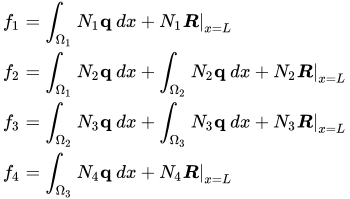
{\displaystyle {\begin{aligned}f_{1}&=\int _{\Omega _{1}}N_{1}\mathbf {q} ~dx+\int _{\Omega _{2}}N_{1}\mathbf {q} ~dx+\int _{\Omega _{3}}N_{1}\mathbf {q} ~dx+\left.N_{1}{\boldsymbol {R}}\right|_{x=L}\\f_{2}&=\int _{\Omega _{1}}N_{2}\mathbf {q} ~dx+\int _{\Omega _{2}}N_{2}\mathbf {q} ~dx+\int _{\Omega _{3}}N_{2}\mathbf {q} ~dx+\left.N_{2}{\boldsymbol {R}}\right|_{x=L}\\f_{3}&=\int _{\Omega _{1}}N_{3}\mathbf {q} ~dx+\int _{\Omega _{2}}N_{3}\mathbf {q} ~dx+\int _{\Omega _{3}}N_{3}\mathbf {q} ~dx+\left.N_{3}{\boldsymbol {R}}\right|_{x=L}\\f_{4}&=\int _{\Omega _{1}}N_{4}\mathbf {q} ~dx+\int _{\Omega _{2}}N_{4}\mathbf {q} ~dx+\int _{\Omega _{3}}N_{4}\mathbf {q} ~dx+\left.N_{4}{\boldsymbol {R}}\right|_{x=L}\end{aligned}}}
Once again, since
N
1
{\displaystyle N_{1}}
N
2
{\displaystyle N_{2}}
N
3
{\displaystyle N_{3}}
N
4
{\displaystyle N_{4}}
f
1
=
∫
Ω
1
N
1
q
d
x
+
N
1
R
|
x
=
L
f
2
=
∫
Ω
1
N
2
q
d
x
+
∫
Ω
2
N
2
q
d
x
+
N
2
R
|
x
=
L
f
3
=
∫
Ω
2
N
3
q
d
x
+
∫
Ω
3
N
3
q
d
x
+
N
3
R
|
x
=
L
f
4
=
∫
Ω
3
N
4
q
d
x
+
N
4
R
|
x
=
L
{\displaystyle {\begin{aligned}f_{1}&=\int _{\Omega _{1}}N_{1}\mathbf {q} ~dx+\left.N_{1}{\boldsymbol {R}}\right|_{x=L}\\f_{2}&=\int _{\Omega _{1}}N_{2}\mathbf {q} ~dx+\int _{\Omega _{2}}N_{2}\mathbf {q} ~dx+\left.N_{2}{\boldsymbol {R}}\right|_{x=L}\\f_{3}&=\int _{\Omega _{2}}N_{3}\mathbf {q} ~dx+\int _{\Omega _{3}}N_{3}\mathbf {q} ~dx+\left.N_{3}{\boldsymbol {R}}\right|_{x=L}\\f_{4}&=\int _{\Omega _{3}}N_{4}\mathbf {q} ~dx+\left.N_{4}{\boldsymbol {R}}\right|_{x=L}\end{aligned}}}
Now, the boundary
x
=
L
{\displaystyle \mathbf {x} =L}
N
4
{\displaystyle N_{4}}
f
1
=
∫
Ω
1
N
1
q
d
x
f
2
=
∫
Ω
1
N
2
q
d
x
+
∫
Ω
2
N
2
q
d
x
f
3
=
∫
Ω
2
N
3
q
d
x
+
∫
Ω
3
N
3
q
d
x
f
4
=
∫
Ω
3
N
4
q
d
x
+
N
4
R
|
x
=
L
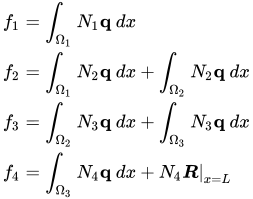
{\displaystyle {\begin{aligned}f_{1}&=\int _{\Omega _{1}}N_{1}\mathbf {q} ~dx\\f_{2}&=\int _{\Omega _{1}}N_{2}\mathbf {q} ~dx+\int _{\Omega _{2}}N_{2}\mathbf {q} ~dx\\f_{3}&=\int _{\Omega _{2}}N_{3}\mathbf {q} ~dx+\int _{\Omega _{3}}N_{3}\mathbf {q} ~dx\\f_{4}&=\int _{\Omega _{3}}N_{4}\mathbf {q} ~dx+\left.N_{4}{\boldsymbol {R}}\right|_{x=L}\end{aligned}}}
In terms of element shape functions, the above equations can be written
as
f
1
=
∫
Ω
1
N
1
1
q
d
x
=
f
1
1
f
2
=
∫
Ω
1
N
2
1
q
d
x
+
∫
Ω
2
N
1
2
q
d
x
=
f
2
1
+
f
1
2
f
3
=
∫
Ω
2
N
2
2
q
d
x
+
∫
Ω
3
N
1
3
q
d
x
=
f
2
2
+
f
1
3
f
4
=
∫
Ω
3
N
2
3
q
d
x
+
N
2
3
R
|
x
=
L
=
f
2
3
+
R
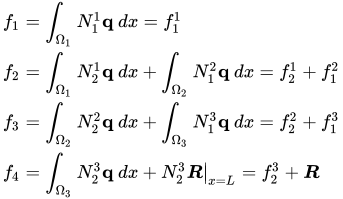
{\displaystyle {\begin{aligned}f_{1}&=\int _{\Omega _{1}}N_{1}^{1}\mathbf {q} ~dx=f_{1}^{1}\\f_{2}&=\int _{\Omega _{1}}N_{2}^{1}\mathbf {q} ~dx+\int _{\Omega _{2}}N_{1}^{2}\mathbf {q} ~dx=f_{2}^{1}+f_{1}^{2}\\f_{3}&=\int _{\Omega _{2}}N_{2}^{2}\mathbf {q} ~dx+\int _{\Omega _{3}}N_{1}^{3}\mathbf {q} ~dx=f_{2}^{2}+f_{1}^{3}\\f_{4}&=\int _{\Omega _{3}}N_{2}^{3}\mathbf {q} ~dx+\left.N_{2}^{3}{\boldsymbol {R}}\right|_{x=L}=f_{2}^{3}+{\boldsymbol {R}}\end{aligned}}}
The above shows that the global load vector can also be assembled from the
element load vectors if we use finite element shape functions.
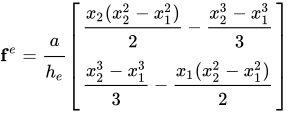
Load vector for two-noded elements [ edit | edit source ] Using the linear shape functions discussed earlier and replacing
q
{\displaystyle \mathbf {q} }
a
x
{\displaystyle a\mathbf {x} }
f
e
{\displaystyle \mathbf {f} ^{e}}
f
1
e
=
∫
x
1
x
2
N
1
e
a
x
d
x
=
∫
x
1
x
2
(
x
2
−
x
h
e
)
a
x
d
x
=
a
h
e
(
x
2
(
x
2
2
−
x
1
2
)
2
−
x
2
3
−
x
1
3
3
)
f
2
e
=
∫
x
1
x
2
N
2
e
a
x
d
x
=
∫
x
1
x
2
(
x
−
x
1
h
e
)
a
x
d
x
=
−
a
h
e
(
x
1
(
x
2
2
−
x
1
2
)
2
−
x
2
3
−
x
1
3
3
)
{\displaystyle {\begin{aligned}f_{1}^{e}&=\int _{x_{1}}^{x_{2}}N_{1}^{e}a\mathbf {x} ~dx=\int _{x_{1}}^{x_{2}}\left({\cfrac {x_{2}-x}{h_{e}}}\right)a\mathbf {x} ~dx={\cfrac {a}{h_{e}}}\left({\cfrac {x_{2}(x_{2}^{2}-x_{1}^{2})}{2}}-{\cfrac {x_{2}^{3}-x_{1}^{3}}{3}}\right)\\f_{2}^{e}&=\int _{x_{1}}^{x_{2}}N_{2}^{e}a\mathbf {x} ~dx=\int _{x_{1}}^{x_{2}}\left({\cfrac {x-x_{1}}{h_{e}}}\right)a\mathbf {x} ~dx=-{\cfrac {a}{h_{e}}}\left({\cfrac {x_{1}(x_{2}^{2}-x_{1}^{2})}{2}}-{\cfrac {x_{2}^{3}-x_{1}^{3}}{3}}\right)\end{aligned}}}
In matrix form, the element load vector is written
f
e
=
a
h
e
[
x
2
(
x
2
2
−
x
1
2
)
2
−
x
2
3
−
x
1
3
3
x
2
3
−
x
1
3
3
−
x
1
(
x
2
2
−
x
1
2
)
2
]
{\displaystyle {\mathbf {f} ^{e}={\cfrac {a}{h_{e}}}{\begin{bmatrix}{\cfrac {x_{2}(x_{2}^{2}-x_{1}^{2})}{2}}-{\cfrac {x_{2}^{3}-x_{1}^{3}}{3}}\\{\cfrac {x_{2}^{3}-x_{1}^{3}}{3}}-{\cfrac {x_{1}(x_{2}^{2}-x_{1}^{2})}{2}}\end{bmatrix}}}}
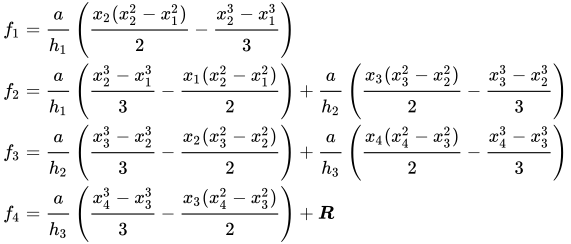
Therefore, the components of the global load vector are
f
1
=
a
h
1
(
x
2
(
x
2
2
−
x
1
2
)
2
−
x
2
3
−
x
1
3
3
)
f
2
=
a
h
1
(
x
2
3
−
x
1
3
3
−
x
1
(
x
2
2
−
x
1
2
)
2
)
+
a
h
2
(
x
3
(
x
3
2
−
x
2
2
)
2
−
x
3
3
−
x
2
3
3
)
f
3
=
a
h
2
(
x
3
3
−
x
2
3
3
−
x
2
(
x
3
2
−
x
2
2
)
2
)
+
a
h
3
(
x
4
(
x
4
2
−
x
3
2
)
2
−
x
4
3
−
x
3
3
3
)
f
4
=
a
h
3
(
x
4
3
−
x
3
3
3
−
x
3
(
x
4
2
−
x
3
2
)
2
)
+
R
{\displaystyle {\begin{aligned}f_{1}&={\cfrac {a}{h_{1}}}\left({\cfrac {x_{2}(x_{2}^{2}-x_{1}^{2})}{2}}-{\cfrac {x_{2}^{3}-x_{1}^{3}}{3}}\right)\\f_{2}&={\cfrac {a}{h_{1}}}\left({\cfrac {x_{2}^{3}-x_{1}^{3}}{3}}-{\cfrac {x_{1}(x_{2}^{2}-x_{1}^{2})}{2}}\right)+{\cfrac {a}{h_{2}}}\left({\cfrac {x_{3}(x_{3}^{2}-x_{2}^{2})}{2}}-{\cfrac {x_{3}^{3}-x_{2}^{3}}{3}}\right)\\f_{3}&={\cfrac {a}{h_{2}}}\left({\cfrac {x_{3}^{3}-x_{2}^{3}}{3}}-{\cfrac {x_{2}(x_{3}^{2}-x_{2}^{2})}{2}}\right)+{\cfrac {a}{h_{3}}}\left({\cfrac {x_{4}(x_{4}^{2}-x_{3}^{2})}{2}}-{\cfrac {x_{4}^{3}-x_{3}^{3}}{3}}\right)\\f_{4}&={\cfrac {a}{h_{3}}}\left({\cfrac {x_{4}^{3}-x_{3}^{3}}{3}}-{\cfrac {x_{3}(x_{4}^{2}-x_{3}^{2})}{2}}\right)+{\boldsymbol {R}}\end{aligned}}}
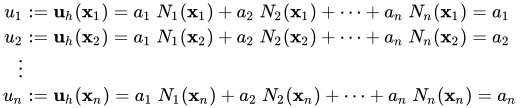
Displacement trial function [ edit | edit source ] Recall that we assumed that the displacement can be written as
u
h
(
x
)
=
a
1
φ
1
(
x
)
+
a
2
φ
2
(
x
)
+
⋯
+
a
n
φ
n
(
x
)
=
∑
i
=
1
n
a
i
φ
i
(
x
)
.
{\displaystyle \mathbf {u} _{h}(\mathbf {x} )=a_{1}\varphi _{1}(\mathbf {x} )+a_{2}\varphi _{2}(\mathbf {x} )+\dots +a_{n}\varphi _{n}(\mathbf {x} )=\sum _{i=1}^{n}a_{i}\varphi _{i}(\mathbf {x} )~.}
If we use finite element shape functions, we can write the above as
u
h
(
x
)
=
a
1
N
1
(
x
)
+
a
2
N
2
(
x
)
+
⋯
+
a
n
N
n
(
x
)
=
∑
i
=
1
n
a
i
N
i
(
x
)
{\displaystyle \mathbf {u} _{h}(\mathbf {x} )=a_{1}~N_{1}(\mathbf {x} )+a_{2}~N_{2}(\mathbf {x} )+\dots +a_{n}~N_{n}(\mathbf {x} )=\sum _{i=1}^{n}a_{i}~N_{i}(\mathbf {x} )}
where
n
{\displaystyle n}
N
i
{\displaystyle N_{i}}
i
{\displaystyle i}
u
1
:=
u
h
(
x
1
)
=
a
1
N
1
(
x
1
)
+
a
2
N
2
(
x
1
)
+
⋯
+
a
n
N
n
(
x
1
)
=
a
1
u
2
:=
u
h
(
x
2
)
=
a
1
N
1
(
x
2
)
+
a
2
N
2
(
x
2
)
+
⋯
+
a
n
N
n
(
x
2
)
=
a
2
⋮
u
n
:=
u
h
(
x
n
)
=
a
1
N
1
(
x
n
)
+
a
2
N
2
(
x
n
)
+
⋯
+
a
n
N
n
(
x
n
)
=
a
n
{\displaystyle {\begin{aligned}u_{1}&:=\mathbf {u} _{h}(\mathbf {x} _{1})=a_{1}~N_{1}(\mathbf {x} _{1})+a_{2}~N_{2}(\mathbf {x} _{1})+\dots +a_{n}~N_{n}(\mathbf {x} _{1})=a_{1}\\u_{2}&:=\mathbf {u} _{h}(\mathbf {x} _{2})=a_{1}~N_{1}(\mathbf {x} _{2})+a_{2}~N_{2}(\mathbf {x} _{2})+\dots +a_{n}~N_{n}(\mathbf {x} _{2})=a_{2}\\\vdots \\u_{n}&:=\mathbf {u} _{h}(\mathbf {x} _{n})=a_{1}~N_{1}(\mathbf {x} _{n})+a_{2}~N_{2}(\mathbf {x} _{n})+\dots +a_{n}~N_{n}(\mathbf {x} _{n})=a_{n}\\\end{aligned}}}
Therefore, the trial function can be written as
u
h
(
x
)
=
u
1
N
1
(
x
)
+
u
2
N
2
(
x
)
+
⋯
+
u
n
N
n
(
x
)
=
∑
i
=
1
n
u
i
N
i
(
x
)
{\displaystyle \mathbf {u} _{h}(\mathbf {x} )=u_{1}~N_{1}(\mathbf {x} )+u_{2}~N_{2}(\mathbf {x} )+\dots +u_{n}~N_{n}(\mathbf {x} )=\sum _{i=1}^{n}u_{i}~N_{i}(\mathbf {x} )}
where
u
i
{\displaystyle u_{i}}
nodal displacements .
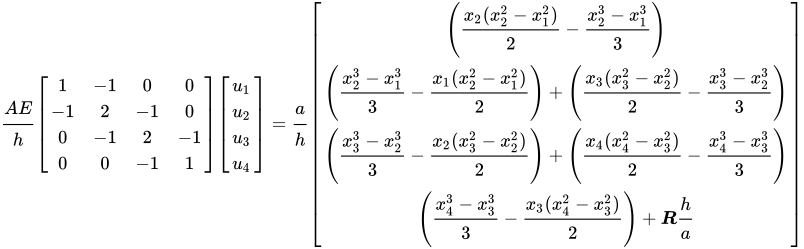
Finite element system of equations [ edit | edit source ] If all the elements are assumed to be of the same length
h
{\displaystyle h}
K
a
=
f
{\displaystyle \mathbf {K} \mathbf {a} =\mathbf {f} }
A
E
h
[
1
−
1
0
0
−
1
2
−
1
0
0
−
1
2
−
1
0
0
−
1
1
]
[
u
1
u
2
u
3
u
4
]
=
a
h
[
(
x
2
(
x
2
2
−
x
1
2
)
2
−
x
2
3
−
x
1
3
3
)
(
x
2
3
−
x
1
3
3
−
x
1
(
x
2
2
−
x
1
2
)
2
)
+
(
x
3
(
x
3
2
−
x
2
2
)
2
−
x
3
3
−
x
2
3
3
)
(
x
3
3
−
x
2
3
3
−
x
2
(
x
3
2
−
x
2
2
)
2
)
+
(
x
4
(
x
4
2
−
x
3
2
)
2
−
x
4
3
−
x
3
3
3
)
(
x
4
3
−
x
3
3
3
−
x
3
(
x
4
2
−
x
3
2
)
2
)
+
R
h
a
]
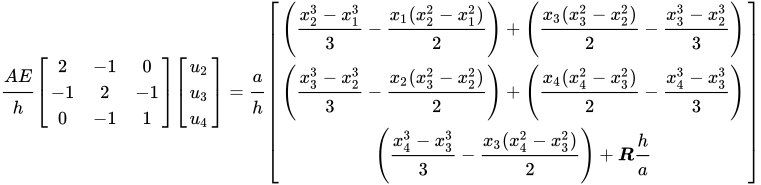
{\displaystyle {\cfrac {AE}{h}}{\begin{bmatrix}1&-1&0&0\\-1&2&-1&0\\0&-1&2&-1\\0&0&-1&1\end{bmatrix}}{\begin{bmatrix}u_{1}\\u_{2}\\u_{3}\\u_{4}\end{bmatrix}}={\cfrac {a}{h}}{\begin{bmatrix}\left({\cfrac {x_{2}(x_{2}^{2}-x_{1}^{2})}{2}}-{\cfrac {x_{2}^{3}-x_{1}^{3}}{3}}\right)\\\left({\cfrac {x_{2}^{3}-x_{1}^{3}}{3}}-{\cfrac {x_{1}(x_{2}^{2}-x_{1}^{2})}{2}}\right)+\left({\cfrac {x_{3}(x_{3}^{2}-x_{2}^{2})}{2}}-{\cfrac {x_{3}^{3}-x_{2}^{3}}{3}}\right)\\\left({\cfrac {x_{3}^{3}-x_{2}^{3}}{3}}-{\cfrac {x_{2}(x_{3}^{2}-x_{2}^{2})}{2}}\right)+\left({\cfrac {x_{4}(x_{4}^{2}-x_{3}^{2})}{2}}-{\cfrac {x_{4}^{3}-x_{3}^{3}}{3}}\right)\\\left({\cfrac {x_{4}^{3}-x_{3}^{3}}{3}}-{\cfrac {x_{3}(x_{4}^{2}-x_{3}^{2})}{2}}\right)+{\boldsymbol {R}}{\cfrac {h}{a}}\end{bmatrix}}}
Essential boundary conditions [ edit | edit source ] To solve this system of equations we have to apply the essential boundary condition
u
=
0
{\displaystyle \mathbf {u} =0}
x
=
0
{\displaystyle \mathbf {x} =0}
u
1
=
0
{\displaystyle u_{1}=0}
A
E
h
[
2
−
1
0
−
1
2
−
1
0
−
1
1
]
[
u
2
u
3
u
4
]
=
a
h
[
(
x
2
3
−
x
1
3
3
−
x
1
(
x
2
2
−
x
1
2
)
2
)
+
(
x
3
(
x
3
2
−
x
2
2
)
2
−
x
3
3
−
x
2
3
3
)
(
x
3
3
−
x
2
3
3
−
x
2
(
x
3
2
−
x
2
2
)
2
)
+
(
x
4
(
x
4
2
−
x
3
2
)
2
−
x
4
3
−
x
3
3
3
)
(
x
4
3
−
x
3
3
3
−
x
3
(
x
4
2
−
x
3
2
)
2
)
+
R
h
a
]
{\displaystyle {\cfrac {AE}{h}}{\begin{bmatrix}2&-1&0\\-1&2&-1\\0&-1&1\end{bmatrix}}{\begin{bmatrix}u_{2}\\u_{3}\\u_{4}\end{bmatrix}}={\cfrac {a}{h}}{\begin{bmatrix}\left({\cfrac {x_{2}^{3}-x_{1}^{3}}{3}}-{\cfrac {x_{1}(x_{2}^{2}-x_{1}^{2})}{2}}\right)+\left({\cfrac {x_{3}(x_{3}^{2}-x_{2}^{2})}{2}}-{\cfrac {x_{3}^{3}-x_{2}^{3}}{3}}\right)\\\left({\cfrac {x_{3}^{3}-x_{2}^{3}}{3}}-{\cfrac {x_{2}(x_{3}^{2}-x_{2}^{2})}{2}}\right)+\left({\cfrac {x_{4}(x_{4}^{2}-x_{3}^{2})}{2}}-{\cfrac {x_{4}^{3}-x_{3}^{3}}{3}}\right)\\\left({\cfrac {x_{4}^{3}-x_{3}^{3}}{3}}-{\cfrac {x_{3}(x_{4}^{2}-x_{3}^{2})}{2}}\right)+{\boldsymbol {R}}{\cfrac {h}{a}}\end{bmatrix}}}
This system of equations can be solved for
u
2
{\displaystyle u_{2}}
u
3
{\displaystyle u_{3}}
u
4
{\displaystyle u_{4}}
Assume that
A
{\displaystyle A}
E
{\displaystyle E}
L
{\displaystyle L}
a
{\displaystyle a}
R
{\displaystyle R}
x
1
=
0
{\displaystyle x_{1}=0}
x
2
=
1
/
3
{\displaystyle x_{2}=1/3}
x
3
=
2
/
3
{\displaystyle x_{3}=2/3}
x
4
=
1
{\displaystyle x_{4}=1}
h
=
1
/
3
{\displaystyle h=1/3}
[
2
−
1
0
−
1
2
−
1
0
−
1
1
]
[
u
2
u
3
u
4
]
=
[
0.037
0.074
0.383
]
⟹
[
u
1
u
2
u
3
u
4
]
=
[
0.0
0.494
0.951
1.333
]
{\displaystyle {\begin{bmatrix}2&-1&0\\-1&2&-1\\0&-1&1\end{bmatrix}}{\begin{bmatrix}u_{2}\\u_{3}\\u_{4}\end{bmatrix}}={\begin{bmatrix}0.037\\0.074\\0.383\end{bmatrix}}\qquad \implies \qquad {\begin{bmatrix}u_{1}\\u_{2}\\u_{3}\\u_{4}\end{bmatrix}}={\begin{bmatrix}0.0\\0.494\\0.951\\1.333\end{bmatrix}}}
Computing element strains and stresses [ edit | edit source ] From the above, it is clear that the displacement field within an element
e
{\displaystyle e}
u
e
=
u
1
e
N
1
e
(
x
)
+
u
2
e
N
2
e
(
x
)
.
{\displaystyle \mathbf {u} ^{e}=u_{1}^{e}N_{1}^{e}(\mathbf {x} )+u_{2}^{e}N_{2}^{e}(\mathbf {x} )~.}
Therefore, the strain within an element is
ε
e
=
∂
u
e
∂
x
=
u
1
e
∂
N
1
e
∂
x
+
u
2
e
∂
N
2
e
∂
x
.
{\displaystyle {\boldsymbol {\varepsilon }}^{e}={\frac {\partial \mathbf {u} ^{e}}{\partial x}}=u_{1}^{e}{\frac {\partial N_{1}^{e}}{\partial x}}+u_{2}^{e}{\frac {\partial N_{2}^{e}}{\partial x}}~.}
In matrix notation,
ε
e
=
B
e
u
e
=
[
∂
N
1
e
∂
x
∂
N
2
e
∂
x
]
[
u
1
e
u
2
e
]
=
[
−
1
h
1
h
]
[
u
1
e
u
2
e
]
{\displaystyle {\boldsymbol {\varepsilon }}^{e}=\mathbf {B} ^{e}\mathbf {u} ^{e}=\left[{\frac {\partial N_{1}^{e}}{\partial x}}~~{\frac {\partial N_{2}^{e}}{\partial x}}\right]{\begin{bmatrix}u_{1}^{e}\\u_{2}^{e}\end{bmatrix}}=\left[-{\cfrac {1}{h}}~~{\cfrac {1}{h}}\right]{\begin{bmatrix}u_{1}^{e}\\u_{2}^{e}\end{bmatrix}}}
The stress in the element is given by
σ
e
=
E
ε
e
.
{\displaystyle {\boldsymbol {\sigma }}^{e}=E{\boldsymbol {\varepsilon }}^{e}~.}
For our discretization, the element stresses are
σ
1
=
1.48
σ
2
=
1.37
σ
3
=
1.15
{\displaystyle {\begin{aligned}{\boldsymbol {\sigma }}^{1}&=1.48\\{\boldsymbol {\sigma }}^{2}&=1.37\\{\boldsymbol {\sigma }}^{3}&=1.15\end{aligned}}}
A plot of this solution is shown in Figure 7.
Figure 7(a). FEM vs exact solutions for displacements of an axially loaded bar.
Figure 7(b). FEM vs exact solutions for stresses in an axially loaded bar.
The finite element code (Matlab) used to compute this solution is given below.
    function AxialBarFEM

      A = 1.0;
      L = 1.0;
      E = 1.0;
      a = 1.0;
      R = 1.0;

      e = 3;
      h = L/e;
      n = e+1;
      for i=1:n
        node(i) = (i-1)*h;
      end
      for i=1:e
        elem(i,:) = [i i+1];
      end

      K = zeros(n);
      f = zeros(n,1);
      for i=1:e
        node1 = elem(i,1);
        node2 = elem(i,2);
        Ke = elementStiffness(A, E, h);
        fe = elementLoad(node(node1),node(node2), a, h);
        K(node1:node2,node1:node2) = K(node1:node2,node1:node2) + Ke;
        f(node1:node2) = f(node1:node2) + fe;
      end

      f(n) = f(n) + R;

      Kred = K(2:n,2:n);
      fred = f(2:n);

      d = inv(Kred)*fred;

      dsol = [0 d'];

      fsol = K*dsol';
      sum(fsol)

      figure;
      p0 = plotDisp(E, A, L, R, a);
      p1 = plot(node, dsol, 'ro--', 'LineWidth', 3); hold on;
      legend([p0 p1],'Exact','FEM');

      for i=1:e
        node1 = elem(i,1);
        node2 = elem(i,2);
        u1 = dsol(node1);
        u2 = dsol(node2);
        [eps(i), sig(i)] = elementStrainStress(u1, u2, E, h);
      end

      figure;
      p0 = plotStress(E, A, L, R, a);
      for i=1:e
        node1 = node(elem(i,1));
        node2 = node(elem(i,2));
        p1 = plot([node1 node2], [sig(i) sig(i)], 'r-','LineWidth',3); hold on;
      end
      legend([p0 p1],'Exact','FEM');

    function [p] = plotDisp(E, A, L, R, a)

      dx = 0.01;
      nseg = L/dx;
      for i=1:nseg+1
        x(i) = (i-1)*dx;
        u(i) = (1/(6*A*E))*(-a*x(i)^3 + (6*R + 3*a*L^2)*x(i));
      end
      p = plot(x, u, 'LineWidth', 3); hold on;
      xlabel('x', 'FontName', 'palatino', 'FontSize', 18);
      ylabel('u(x)', 'FontName', 'palatino', 'FontSize', 18);
      set(gca, 'LineWidth', 3, 'FontName', 'palatino', 'FontSize', 18);

    function [p] = plotStress(E, A, L, R, a)

      dx = 0.01;
      nseg = L/dx;
      for i=1:nseg+1
        x(i) = (i-1)*dx;
        sig(i) = (1/(2*A))*(-a*x(i)^2 + (2*R + a*L^2));
      end
      p = plot(x, sig, 'LineWidth', 3); hold on;
      xlabel('x', 'FontName', 'palatino', 'FontSize', 18);
      ylabel('\sigma(x)', 'FontName', 'palatino', 'FontSize', 18);
      set(gca, 'LineWidth', 3, 'FontName', 'palatino', 'FontSize', 18);

    function [Ke] = elementStiffness(A, E, h)

      Ke = (A*E/h)*[[1 -1];[-1 1]];

    function [fe] = elementLoad(node1, node2, a, h)

      x1 = node1;
      x2 = node2;

      fe1 = a*x2/(2*h)*(x2^2-x1^2) - a/(3*h)*(x2^3-x1^3);
      fe2 = -a*x1/(2*h)*(x2^2-x1^2) + a/(3*h)*(x2^3-x1^3);
      fe = [fe1;fe2];

    function [eps, sig] = elementStrainStress(u1, u2, E, h)

      B = [-1/h 1/h];
      u = [u1; u2];
      eps = B*u
      sig = E*eps;































![{\displaystyle {\boldsymbol {\varepsilon }}^{e}=\mathbf {B} ^{e}\mathbf {u} ^{e}=\left[{\frac {\partial N_{1}^{e}}{\partial x}}~~{\frac {\partial N_{2}^{e}}{\partial x}}\right]{\begin{bmatrix}u_{1}^{e}\\u_{2}^{e}\end{bmatrix}}=\left[-{\cfrac {1}{h}}~~{\cfrac {1}{h}}\right]{\begin{bmatrix}u_{1}^{e}\\u_{2}^{e}\end{bmatrix}}}](https://wikimedia.org/api/rest_v1/media/math/render/svg/5f1f783ea96d0e15005c760b1beae5fa281788ef)


