Approximate Solution: The Galerkin Approach[edit | edit source]
To find the finite element solution, we can either start with the
strong form and derive the weak form, or we can start with a weak form
derived from a variational principle.
Let us assume that the approximate solution is  and plug
it into the ODE. We get
and plug
it into the ODE. We get
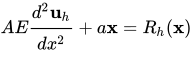
where  is the residual. We now try to minimize the residual in a weighted average sense
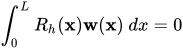
where  is a weighting function. Notice that this equation is similar to equation (5) (see 'Weak form: integral equation') with
  in place of the variation
  . For the two equations to be equivalent, the weighting function must also be such that
  .
.
Therefore the approximate weak form can be written as

In Galerkin's method we assume that the approximate solution can
be expressed as

In the Bubnov-Galerkin method, the weighting function is chosen to be of the same form as the approximate solution (but with arbitrary coefficients),

If we plug the approximate solution and the weighting functions into
the approximate weak form, we get

This equation can be rewritten as
![{\displaystyle \sum _{j=1}^{n}b_{j}\left[\int _{0}^{L}AE\left(\sum _{i=1}^{n}a_{i}{\cfrac {d\varphi _{i}}{dx}}{\cfrac {d\varphi _{j}}{dx}}\right)~dx\right]=\sum _{j=1}^{n}b_{j}\left[\int _{0}^{L}\mathbf {q} \varphi _{j}~dx+\left.\left({\boldsymbol {R}}~\varphi _{j}\right)\right|_{x=L}\right]~.}](https://wikimedia.org/api/rest_v1/media/math/render/svg/08eb686776c56bd4516969ddbf1bf2d5056f4f42)
From the above, since  is arbitrary, we have

After reorganizing, we get
![{\displaystyle \sum _{i=1}^{n}\left[\int _{0}^{L}{\cfrac {d\varphi _{j}}{dx}}AE{\cfrac {d\varphi _{i}}{dx}}~dx\right]a_{i}=\int _{0}^{L}\varphi _{j}\mathbf {q} ~dx+\left.\varphi _{j}{\boldsymbol {R}}\right|_{x=L}~,~j=1\dots n}](https://wikimedia.org/api/rest_v1/media/math/render/svg/52e2732f97d7b1db49e5bb7d99fbea509f424821)
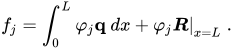
which is a system of  equations that can be solved for the unknown coefficients
  . Once we know the s, we can use them to compute approximate solution. The above equation can be written in matrix form as

where

and
The problem with the general form of the Galerkin method is that the
functions  are difficult to determine for complex domains.