Motion in one dimension
Motion in One Dimension is among the earliest lessons in Classical Mechanics. This page first introduces the terms and then shows how they are applied to different forms of motion in one dimension.
Definition[edit | edit source]
Motion is defined as change in position of a body over time with respect to the surrounding. For the concept of motion in one direction, consider a motion of a body along a straight track. The subject of motion in physics is called a, "body".
Displacement[edit | edit source]
Displacement is defined as the shortest distance (x) a one-dimensional object is from a center point, or an origin. Displacement is plotted against time in a curved graph. A body, in motion in one dimension, can only move left and right.
Picture a train that travels along a straight track. The origin is a point on that track, and as the body moves, the distance between the body and the origin is its displacement. If displacement of our train, given the variable (x), is worked out to be negative, then the train is |x| meters on the left hand side of the origin. If (x) is worked out to be positive, then the train is x meters on the right hand side of the origin.
Now consider a train moving along a curved path from A to B. when the train reaches B, its distance travelled will be the total length of the curve. But the displacement of the train will be the shortest distance from A to B i.e the length of the straight path from A to B
Velocity[edit | edit source]
Velocity is defined as the rate at which displacement changes over time. The higher the velocity, the faster a body is moving. It is a vector quantity i.e. it requires both magnitude and direction.Velocity can be zero also if the total displacement is zero, and this is only when the body after travelling a certain distance in any direction comes to rest at the same point where it started. The instantaneous velocity can also be zero when the sign of its magnitude changes; for example, a body experiencing constant acceleration against its direction of travel will eventually switch directions and move in the direction of the acceleration, and at that instant, its velocity is zero.
In terms of mathematics, the most general definition of velocity is:

What this means is that velocity is the derivative of displacement with respect to time.
Acceleration[edit | edit source]
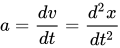
Acceleration is the rate of change of velocity with time. A body with a positive acceleration is gaining velocity over time. A body with a negative acceleration is losing velocity over time. The mathematical definition is:
Motion with Constant Velocity[edit | edit source]
This is the simplest type of motion in one dimension. A body will have motion with constant velocity if it is sliding over a horizontal surface with minimal friction. A puck sliding across a hockey rink, or a square block of ice traveling along a flat kitchen floor are two examples of bodies, which have motion of constant velocity. Motion with constant velocity is plotted on a graph of displacement vs. time.
The equation for the line is: x = x0 + vt, where (x0) is the displacement, (v) is the velocity, and (t) is the time.
The slope of the line in the graph, or dx/dt calculates the velocity, which is constant. Obviously the acceleration (a) in the equation is equal to d²x/dt², and "0", because the velocity of the body is constant, and therefore not increasing, or decreasing.