Micromechanics of composites/Infinitesimal deformations

From Wikiversity
Jump to: navigation, search

Infinitesimal Deformations [edit]

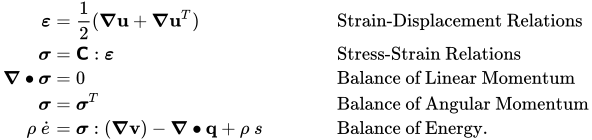
Let us first consider only infinitesimal strains and linear elasticity. If we assume that the RVE is small enough, we can neglect inertial and body forces. In addition, if the RVE is in equilibrium, conservation of mass automatically holds. Then the equations that govern the motion of the RVE can be written as:


{
\begin{align}
\boldsymbol{\varepsilon} & = \frac{1}{2}(\boldsymbol{\nabla}\mathbf{u} + \boldsymbol{\nabla}\mathbf{u}^T) 
 & & \qquad \text{Strain-Displacement Relations} \\ 
\boldsymbol{\sigma} & = \boldsymbol{\mathsf{C}}:\boldsymbol{\varepsilon} & & \qquad \text{Stress-Strain Relations} \\
\boldsymbol{\nabla} \bullet \boldsymbol{\sigma} & = 0& & \qquad \text{Balance of Linear Momentum} \\
\boldsymbol{\sigma} & = \boldsymbol{\sigma}^T& & \qquad \text{Balance of Angular Momentum} \\ 
\rho~\dot{e} & = \boldsymbol{\sigma}:(\boldsymbol{\nabla}\mathbf{v}) - \boldsymbol{\nabla} \bullet \mathbf{q} + \rho~s 
& & \qquad\text{Balance of Energy.} \\
\end{align}
}

In the above equations, \boldsymbol{\varepsilon}(\mathbf{x}) is the strain tensor (small strain), \mathbf{u}(\mathbf{x}) is the displacement vector, and \boldsymbol{\mathsf{C}}(\mathbf{x}) is the fourth-order tensor of elastic moduli at the point \mathbf{x} \in \Omega.

To get a unique solution of the governing equations, we need boundary conditions on \partial{\Omega}. These boundary conditions may be in the form of applied tractions:


\boldsymbol{\sigma}\bullet\mathbf{n} = \bar{\mathbf{t}} ~;\qquad \sigma_{ij}~n_j = \bar{t_i}

where \mathbf{n}(\mathbf{x}) is the outward normal vector to the surface \partial{\Omega} and \bar{\mathbf{t}}(\mathbf{x}) is the applied traction.

Alternatively, the boundary conditions may be in the form of applied displacements:


\mathbf{u}= \bar{\mathbf{u}} ~;\qquad u_i = \bar{u_i}

where \bar{\mathbf{u}}(\mathbf{x}) is the applied displacement.

We usually assume that the portions of the boundary on which tractions and displacements are applied are nonoverlapping, i.e., \partial{\Omega} = \partial{\Omega}_t \cup \partial{\Omega}_u and \partial{\Omega}_t \cap \partial{\Omega}_u = \varnothing.

If we need to solve the energy equation, we also have to specify heat flux or specified temperature boundary conditions on the RVE.