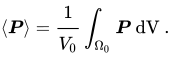
The average nominal (first Piola-Kirchhoff ) stress is defined as
⟨
P
⟩
=
1
V
0
∫
Ω
0
P
dV
.
{\displaystyle {\langle {\boldsymbol {P}}\rangle ={\cfrac {1}{V_{0}}}\int _{\Omega _{0}}{\boldsymbol {P}}~{\text{dV}}~.}}
Recall the relation (see Appendix)
∫
∂
Ω
v
⊗
(
S
T
∙
n
)
dA
=
∫
Ω
[
∇
v
⋅
S
+
v
⊗
(
∇
∙
S
T
)
]
dV
.
{\displaystyle \int _{\partial {\Omega }}\mathbf {v} \otimes ({\boldsymbol {S}}^{T}\bullet \mathbf {n} )~{\text{dA}}=\int _{\Omega }[{\boldsymbol {\nabla }}\mathbf {v} \cdot {\boldsymbol {S}}+\mathbf {v} \otimes ({\boldsymbol {\nabla }}\bullet {\boldsymbol {S}}^{T})]~{\text{dV}}~.}
In the above equation, let the volume integral be over
Ω
0
{\displaystyle \Omega _{0}}
∂
Ω
0
{\displaystyle \partial {\Omega }_{0}}
∂
Ω
0
{\displaystyle \partial {\Omega }_{0}}
N
{\displaystyle \mathbf {N} }
v
→
X
{\displaystyle \mathbf {v} \rightarrow \mathbf {X} }
S
→
P
{\displaystyle {\boldsymbol {S}}\rightarrow {\boldsymbol {P}}}
∫
∂
Ω
0
X
⊗
(
P
T
∙
N
)
dA
=
∫
Ω
0
[
∇
0
X
⋅
P
+
X
⊗
(
∇
0
∙
P
T
)
]
dV
=
∫
Ω
0
[
1
⋅
P
+
X
⊗
(
∇
0
∙
P
T
)
]
dV
=
∫
Ω
0
[
P
+
X
⊗
(
∇
0
∙
P
T
)
]
dV
.
{\displaystyle \int _{\partial {\Omega }_{0}}\mathbf {X} \otimes ({\boldsymbol {P}}^{T}\bullet \mathbf {N} )~{\text{dA}}=\int _{\Omega _{0}}[{\boldsymbol {\nabla }}_{0}~\mathbf {X} \cdot {\boldsymbol {P}}+\mathbf {X} \otimes ({\boldsymbol {\nabla }}_{0}\bullet {\boldsymbol {P}}^{T})]~{\text{dV}}=\int _{\Omega _{0}}[{\boldsymbol {\mathit {1}}}\cdot {\boldsymbol {P}}+\mathbf {X} \otimes ({\boldsymbol {\nabla }}_{0}\bullet {\boldsymbol {P}}^{T})]~{\text{dV}}=\int _{\Omega _{0}}[{\boldsymbol {P}}+\mathbf {X} \otimes ({\boldsymbol {\nabla }}_{0}\bullet {\boldsymbol {P}}^{T})]~{\text{dV}}~.}
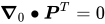
If we assume that there are no inertial forces or body forces , then
∇
0
∙
P
T
=
0
{\displaystyle {\boldsymbol {\nabla }}_{0}\bullet {\boldsymbol {P}}^{T}=0}
∫
∂
Ω
0
X
⊗
(
P
T
∙
N
)
dA
=
∫
Ω
0
P
dV
=
V
0
⟨
P
⟩
.
{\displaystyle \int _{\partial {\Omega }_{0}}\mathbf {X} \otimes ({\boldsymbol {P}}^{T}\bullet \mathbf {N} )~{\text{dA}}=\int _{\Omega _{0}}{\boldsymbol {P}}~{\text{dV}}=V_{0}~\langle {\boldsymbol {P}}\rangle ~.}
Let
T
¯
{\displaystyle {\bar {\mathbf {T} }}}
self equilibrating traction that is applied to
the RVE, i.e., it does not lead to any inertial forces. Then, Cauchy's law
states that
T
¯
=
P
T
⋅
N
{\displaystyle {\bar {\mathbf {T} }}={\boldsymbol {P}}^{T}\cdot \mathbf {N} }
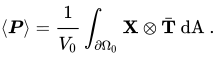
∂
Ω
0
{\displaystyle \partial {\Omega }_{0}}
⟨
P
⟩
=
1
V
0
∫
∂
Ω
0
X
⊗
T
¯
dA
.
{\displaystyle {\langle {\boldsymbol {P}}\rangle ={\cfrac {1}{V_{0}}}\int _{\partial {\Omega }_{0}}\mathbf {X} \otimes {\bar {\mathbf {T} }}~{\text{dA}}~.}}
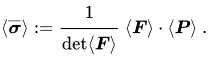
Given the above, the average Cauchy stress in the RVE is defined as
⟨
σ
¯
⟩
:=
1
det
⟨
F
⟩
⟨
F
⟩
⋅
⟨
P
⟩
.
{\displaystyle {\langle {\overline {\boldsymbol {\sigma }}}\rangle :={\cfrac {1}{\det \langle {\boldsymbol {F}}\rangle }}~\langle {\boldsymbol {F}}\rangle \cdot \langle {\boldsymbol {P}}\rangle ~.}}
Note that, in general,
⟨
σ
¯
⟩
≠
⟨
σ
⟩
{\displaystyle \langle {\overline {\boldsymbol {\sigma }}}\rangle \neq \langle {\boldsymbol {\sigma }}\rangle }
The Kirchhoff stress is defined as
τ
:=
det
F
σ
{\displaystyle {\boldsymbol {\tau }}:=\det {\boldsymbol {F}}~{\boldsymbol {\sigma }}}
⟨
τ
¯
⟩
:=
det
⟨
F
⟩
⟨
σ
¯
⟩
=
⟨
F
⟩
⋅
⟨
P
⟩
.
{\displaystyle {\langle {\overline {\boldsymbol {\tau }}}\rangle :=\det \langle {\boldsymbol {F}}\rangle ~\langle {\overline {\boldsymbol {\sigma }}}\rangle =\langle {\boldsymbol {F}}\rangle \cdot \langle {\boldsymbol {P}}\rangle ~.}}
In general,
⟨
τ
¯
⟩
≠
⟨
τ
⟩
{\displaystyle \langle {\overline {\boldsymbol {\tau }}}\rangle \neq \langle {\boldsymbol {\tau }}\rangle }
![{\displaystyle \int _{\partial {\Omega }}\mathbf {v} \otimes ({\boldsymbol {S}}^{T}\bullet \mathbf {n} )~{\text{dA}}=\int _{\Omega }[{\boldsymbol {\nabla }}\mathbf {v} \cdot {\boldsymbol {S}}+\mathbf {v} \otimes ({\boldsymbol {\nabla }}\bullet {\boldsymbol {S}}^{T})]~{\text{dV}}~.}](https://wikimedia.org/api/rest_v1/media/math/render/svg/aefca55477be1bff6e3f02bf6e0d9167e7f256cd)


![{\displaystyle \int _{\partial {\Omega }_{0}}\mathbf {X} \otimes ({\boldsymbol {P}}^{T}\bullet \mathbf {N} )~{\text{dA}}=\int _{\Omega _{0}}[{\boldsymbol {\nabla }}_{0}~\mathbf {X} \cdot {\boldsymbol {P}}+\mathbf {X} \otimes ({\boldsymbol {\nabla }}_{0}\bullet {\boldsymbol {P}}^{T})]~{\text{dV}}=\int _{\Omega _{0}}[{\boldsymbol {\mathit {1}}}\cdot {\boldsymbol {P}}+\mathbf {X} \otimes ({\boldsymbol {\nabla }}_{0}\bullet {\boldsymbol {P}}^{T})]~{\text{dV}}=\int _{\Omega _{0}}[{\boldsymbol {P}}+\mathbf {X} \otimes ({\boldsymbol {\nabla }}_{0}\bullet {\boldsymbol {P}}^{T})]~{\text{dV}}~.}](https://wikimedia.org/api/rest_v1/media/math/render/svg/c47f222fb081751c06aa06d1528d7097471b7bd2)