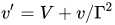
Light in moving media
Jump to navigation
Jump to search
Requisites[edit | edit source]
Relativistic addition of velocities
Problem[edit | edit source]
Light moves through a slowly moving medium with refractive index n. That medium moves with a speed v in parallel with the direction of light. What speed will be measured for that light by a rest observer?
Solution[edit | edit source]
If we have a medium with refractive index n, the speed of light relative to that medium is c/n.
Using relativistic addition of velocities, we get for the rest observer:
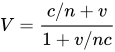
But as , we can expand that expression in terms of :


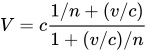

The factor was known as the Fresnel drag coefficient. It is easily measured with interference experiments.