Example 2 : Elliptical cylinder [ edit | edit source ] Choose warping function
ψ
(
x
1
,
x
2
)
=
k
x
1
x
2
{\displaystyle \psi (x_{1},x_{2})=kx_{1}x_{2}\,}
where
k
{\displaystyle k\,}
∇
2
ψ
=
0
{\displaystyle \nabla ^{2}{\psi }=0}
(
k
x
2
−
x
2
)
d
x
2
d
s
−
(
k
x
1
+
x
1
)
d
x
1
d
s
=
0
∀
(
x
1
,
x
2
)
∈
∂
S
{\displaystyle (kx_{2}-x_{2}){\frac {dx_{2}}{ds}}-(kx_{1}+x_{1}){\frac {dx_{1}}{ds}}=0~~~~\forall (x_{1},x_{2})\in \partial {\text{S}}}
Integrating,
x
1
2
+
1
−
k
1
+
k
x
2
2
=
a
2
∀
(
x
1
,
x
2
)
∈
∂
S
{\displaystyle x_{1}^{2}+{\frac {1-k}{1+k}}x_{2}^{2}=a^{2}~~~~\forall (x_{1},x_{2})\in \partial {\text{S}}}
where
a
{\displaystyle a\,}
a
{\displaystyle a\,}
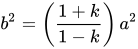
b
{\displaystyle b\,}
b
2
=
(
1
+
k
1
−
k
)
a
2
{\displaystyle b^{2}=\left({\frac {1+k}{1-k}}\right)a^{2}}
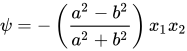
The warping function is
ψ
=
−
(
a
2
−
b
2
a
2
+
b
2
)
x
1
x
2
{\displaystyle \psi =-\left({\frac {a^{2}-b^{2}}{a^{2}+b^{2}}}\right)x_{1}x_{2}}
The torsion constant is
J
~
=
2
b
2
a
2
+
b
2
I
2
+
2
a
2
a
2
+
b
2
I
1
=
π
a
3
b
3
a
2
+
b
2
{\displaystyle {\tilde {J}}={\frac {2b^{2}}{a^{2}+b^{2}}}I_{2}+{\frac {2a^{2}}{a^{2}+b^{2}}}I_{1}={\frac {\pi a^{3}b^{3}}{a^{2}+b^{2}}}}
where
I
1
=
∫
S
x
1
2
d
A
=
π
a
b
3
4
;
I
2
=
∫
S
x
2
2
d
A
=
π
a
3
b
4
{\displaystyle I_{1}=\int _{S}x_{1}^{2}dA={\frac {\pi ab^{3}}{4}}~~;~~I_{2}=\int _{S}x_{2}^{2}dA={\frac {\pi a^{3}b}{4}}}
If you compare
J
~
{\displaystyle {\tilde {J}}}
and
J
{\displaystyle J\,}
for the ellipse, you will find that
J
~
<
J
{\displaystyle {\tilde {J}}<J}
This implies that the torsional rigidity is less than that predicted with the assumption that plane sections remain plane.
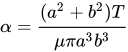
α
=
(
a
2
+
b
2
)
T
μ
π
a
3
b
3
{\displaystyle \alpha ={\frac {(a^{2}+b^{2})T}{\mu \pi a^{3}b^{3}}}}
The non-zero stresses are
σ
13
=
−
2
μ
α
a
2
x
2
a
2
+
b
2
;
σ
23
=
−
2
μ
α
b
2
x
1
a
2
+
b
2
{\displaystyle \sigma _{13}=-{\frac {2\mu \alpha a^{2}x_{2}}{a^{2}+b^{2}}}~~;~~\sigma _{23}=-{\frac {2\mu \alpha b^{2}x_{1}}{a^{2}+b^{2}}}}
The projected shear traction is
τ
=
2
μ
α
a
2
+
b
2
b
4
x
1
2
+
a
4
x
2
2
⇒
τ
max
=
2
μ
α
a
2
b
a
2
+
b
2
(
b
<
a
)
{\displaystyle \tau ={\frac {2\mu \alpha }{a^{2}+b^{2}}}{\sqrt {b^{4}x_{1}^{2}+a^{4}x_{2}^{2}}}~~\Rightarrow ~~\tau _{\text{max}}={\frac {2\mu \alpha a^{2}b}{a^{2}+b^{2}}}~~(b<a)}
Shear stresses in the cross section of an elliptical cylinder under torsion
For any torsion problem where
∂
S
{\displaystyle \partial S\,}
is convex, the maximum projected shear traction occurs at the point on
∂
S
{\displaystyle \partial S\,}
that is nearest the centroid of
S
{\displaystyle S\,}
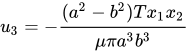
The displacement
u
3
{\displaystyle u_{3}\,}
u
3
=
−
(
a
2
−
b
2
)
T
x
1
x
2
μ
π
a
3
b
3
{\displaystyle u_{3}=-{\frac {(a^{2}-b^{2})Tx_{1}x_{2}}{\mu \pi a^{3}b^{3}}}}
Displacements (
u
3
{\displaystyle u_{3}\,}