Solution strategy using the Prandtl stress function[edit | edit source]
The equation 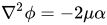 is a Poisson equation.
Since the equation is inhomogeneous, the solution can be written as
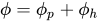
where  is a particular solution and
  is the solution of the homogeneous equation.
Examples of particular solutions are, in rectangular coordinates,

and, in cylindrical co-ordinates,
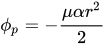
The homogeneous equation is the Laplace equation  ,
which is satisfied by both the real and the imaginary parts of
any analytic function
,
which is satisfied by both the real and the imaginary parts of
any analytic function  of the complex variable

Thus,

Suppose  . Then, examples of are

where  ,
,  ,
,  ,
,  are constants.
Each of the above can be expressed as polynomial expansions in the
 and
and  coordinates.
Approximate solutions of the torsion problem for a particular cross-section
can be obtained by combining the particular and homogeneous solutions
and adjusting the constants so as to match the required shape.
Only a few shapes allow closed-form solutions. Examples are
- Circular cross-section.
- Elliptical cross-section.
- Circle with semicircular groove.
- Equilateral triangle.