Introduction to Elasticity/Polynomial solutions

From Wikiversity

Jump to: navigation, search

Contents

[edit] Using the Airy Stress Function : Polynomial Solutions

[edit] Example 1

Given:


     \varphi = a~x_1^2 + b~x_1~x_2 + c~x_2^2

Find the problem which fits this solution.


     \sigma_{11} = \varphi_{,22} = 2c ~;~~                        
     \sigma_{22} = \varphi_{,11} = 2a ~;~~                        
     \sigma_{12} = -\varphi_{,12} = -b

This is a homogeneous stress field. An infinite number of problems can satisfy these conditions.

[edit] Example 2

Given:


     \varphi = a~x_1^3 + b~x_1^2~x_2 + c~x_1~x_2^2 + d~x_2^3

Find the problem which fits this solution.


     \sigma_{11} = 2cx_1 + 6dx_2 ~;~~                        
     \sigma_{22} = 6ax_1 + 2bx_2 ~;~~                        
     \sigma_{12} = -2bx_1 - 2cx_2

An infinite set of problems can have this stress field as a solution.

If a = b = c = 0, then


     \sigma_{11} =  6dx_2 ~;~~ \sigma_{22} = 0 ~;~~                        
     \sigma_{12} = 0

which corresponds to a plane stress beam under pure bending.

Pure bending of an elastic beam

[edit] Example 3

Consider a cantilevered beam that is fixed at one end and has a vertical force F applied at the free end.

Bending of a cantilevered beam

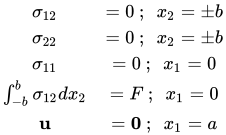
The boundary conditions on the beam are

\begin{matrix}
    \sigma_{12} & = 0 ~;~~ x_2 = \pm b \\
    \sigma_{22} & = 0 ~;~~ x_2 = \pm b \\
    \sigma_{11} & = 0 ~;~~ x_1 = 0 \\
    \int_{-b}^{b}\sigma_{12} dx_2 & = F ~;~~ x_1 = 0 \\
    \mathbf{u} & = \mathbf{0} ~;~~ x_1 = a
  \end{matrix}

We will use Maple to solve the problem.

First, assume a polynomial Airy stress function that has a high enough order. In this case a fourth order polynomial will suffice
phi:=C1*x^2+C2*x*y+C3*y^2+C4*x^3+C5*x^2*y+C6*x*y^2+ C7*y^3+C8*x^4+C9*x^3*y+C10*x^2*y^2+C11*x*y^3+C12*y^4;


\begin{align}
\phi &:= \mathit{C1}\,x^{2} + \mathit{C2}\,x\,y + \mathit{C3}\,y
^{2} + \mathit{C4}\,x^{3} + \mathit{C5}\,x^{2}\,y + \mathit{C6}\,
x\,y^{2} + \mathit{C7}\,y^{3} \\
& + \mathit{C8}\,x^{4} +\mathit{C9}\,x^{3}\,y + \mathit{C10}\,x^{2}\,y^{2} + \mathit{C11}\,x\,y^{3} + \mathit{C12}\,y^{4} 
\end{align}

Take the derivatives of the stress function to obtain the expressions for the stresses.
sxx1:= diff(phi,y,y); syy1:= diff(phi,x,x); sxy1:= -diff(phi,x,y);


\begin{align}
\mathit{sxx1} & := 2\,\mathit{C3} + 2\,\mathit{C6}\,x + 6\,\mathit{
C7}\,y + 2\,\mathit{C10}\,x^{2} + 6\,\mathit{C11}\,x\,y + 12\,
\mathit{C12}\,y^{2} \\
\mathit{syy1} & := 2\,\mathit{C1} + 6\,\mathit{C4}\,x + 2\,\mathit{
C5}\,y + 12\,\mathit{C8}\,x^{2} + 6\,\mathit{C9}\,x\,y + 2\,
\mathit{C10}\,y^{2} \\
\mathit{sxy1} & :=  - \mathit{C2} - 2\,\mathit{C5}\,x - 2\,\mathit{
C6}\,y - 3\,\mathit{C9}\,x^{2} - 4\,\mathit{C10}\,x\,y - 3\,
\mathit{C11}\,y^{2}
\end{align}

Next, use the command unapply(...,x,y) to configure the stresses as functions of x,y so that we can find the value at various points, e.g., y = b.
sxx2:=unapply(sxx1,x,y): syy2:=unapply(syy1,x,y): sxy2:=unapply(sxy1,x,y):

We now find the tractions on y = b as
t1:=syy2(x,b); t2:=sxy2(x,b);


\begin{align}
\mathit{t1} &:= 2\,\mathit{C1} + 6\,\mathit{C4}\,x + 2\,\mathit{C5
}\,b + 12\,\mathit{C8}\,x^{2} + 6\,\mathit{C9}\,x\,b + 2\,
\mathit{C10}\,b^{2}\\
\mathit{t2} &:=  - \mathit{C2} - 2\,\mathit{C5}\,x - 2\,\mathit{C6
}\,b - 3\,\mathit{C9}\,x^{2} - 4\,\mathit{C10}\,x\,b - 3\,
\mathit{C11}\,b^{2}
\end{align}

and on y = − b
t3:=syy2(x,-b); t4:=sxy2(x,-b);


\begin{align}
\mathit{t3} &:= 2\,\mathit{C1} + 6\,\mathit{C4}\,x - 2\,\mathit{C5
}\,b + 12\,\mathit{C8}\,x^{2} - 6\,\mathit{C9}\,x\,b + 2\,
\mathit{C10}\,b^{2}\\
\mathit{t4} &:=  - \mathit{C2} - 2\,\mathit{C5}\,x + 2\,\mathit{C6
}\,b - 3\,\mathit{C9}\,x^{2} + 4\,\mathit{C10}\,x\,b - 3\,
\mathit{C11}\,b^{2}
\end{align}

On x = 0, we have
t5:=sxx2(0,y); t6:=sxy2(0,y);


\begin{align}
\mathit{t5} &:= 2\,\mathit{C3} + 6\,\mathit{C7}\,y + 12\,\mathit{C12}\,y^{2} \\
\mathit{t6} &:=  - \mathit{C2} - 2\,\mathit{C6}\,y - 3\,\mathit{C11}\,y^{2}
\end{align}

The stress function is order 4, so the stresses are order 2 in x and y. The tractions on y = + b or b might therefore be polynomials in x of order 2.

We calculate the coefficients of each power of x in these expressions as
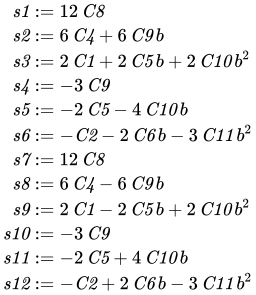
s1:=coeff(t1,x,2); s2:=coeff(t1,x,1); s3:=coeff(t1,x,0); s4:=coeff(t2,x,2); s5:=coeff(t2,x,1); s6:=coeff(t2,x,0); s7:=coeff(t3,x,2); s8:=coeff(t3,x,1); s9:=coeff(t3,x,0); s10:=coeff(t4,x,2); s11:=coeff(t4,x,1); s12:=coeff(t4,x,0);


\begin{align}
\mathit{s1} &:= 12\,\mathit{C8} \\
\mathit{s2} &:= 6\,\mathit{C4} + 6\,\mathit{C9}\,b \\
\mathit{s3} &:= 2\,\mathit{C1} + 2\,\mathit{C5}\,b + 2\,\mathit{
C10}\,b^{2} \\
\mathit{s4} &:=  - 3\,\mathit{C9} \\
\mathit{s5} &:=  - 2\,\mathit{C5} - 4\,\mathit{C10}\,b \\
\mathit{s6} &:=  - \mathit{C2} - 2\,\mathit{C6}\,b - 3\,\mathit{
C11}\,b^{2} \\
\mathit{s7} &:= 12\,\mathit{C8} \\
\mathit{s8} &:= 6\,\mathit{C4} - 6\,\mathit{C9}\,b \\
\mathit{s9} &:= 2\,\mathit{C1} - 2\,\mathit{C5}\,b + 2\,\mathit{
C10}\,b^{2} \\
\mathit{s10} &:=  - 3\,\mathit{C9} \\
\mathit{s11} &:=  - 2\,\mathit{C5} + 4\,\mathit{C10}\,b \\
\mathit{s12} &:=  - \mathit{C2} + 2\,\mathit{C6}\,b - 3\,\mathit{
C11}\,b^{2}
\end{align}

The biharmonic equation is 4th order, so applying it to a 4th order polynomial generates a constant. And this constant must be equal to zero.
biharm:=diff(phi,x$4)+diff(phi,y$4)+2*diff(phi,x,x,y,y);


\mathit{biharm} := 24\,\mathit{C8} + 24\,\mathit{C12} + 8\,\mathit{C10}

We also calculate the three force resultants on x=0 by integrating over y:
Fx:=int(t5, y=-b..b): Fy:=int(t6, y=-b..b): M:=int(t5*y, y=-b..b):

We now solve for the constants so as to satisfy (i) the strong boundary conditions, (ii) the biharmonic equation and (iii) the weak boundary conditions.
solution:=solve({s1=0,s2=0,s3=0,s4=0,s5=0,s6=0,s7=0, s8=0,s9=0,s10=0,s11=0,s12=0,biharm=0,Fx=0,M=0,Fy=F}, {C1,C2,C3,C4,C5,C6,C7,C8,C9,C10,C11,C12});


\begin{align}
\text{solution} & := \{ \mathit{C7}=0, \,\mathit{C8}=0, \,\mathit{C9}=0, \,\mathit{C4}=0, \,\mathit{C10}=0, 
\,\mathit{C5}=0, \\
& \mathit{C12}=0, \,\mathit{C1}=0, \,\mathit{C3}=0,  \,
\mathit{C6}=0, \,\mathit{C11}= \cfrac {F}{4\,b^{3}} , \,\mathit{C2}= - \cfrac {3\,F}{4\,b} \} 
\end{align}

Notice that there are more equations than there are constants. Some of the equations are not linearly independent. However, Maple can handle this if there is a solution.

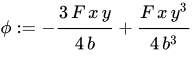
Substitute the solution into the original stress function and calculate the final stresses.
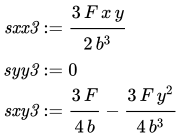
phi:=subs(solution,phi); sxx3:=diff(phi,y,y); syy3:=diff(phi,x,x); sxy3:=-diff(phi,x,y);


\phi  :=  - { \cfrac {3\,F\,x\,y}{4\,b}}  + 
{ \cfrac {F\,x\,y^{3}}{4\,b^{3}}}

and


\begin{align}
\mathit{sxx3} & := { \cfrac {3\,F\,x\,y}{2\,b^{3}}} \\
\mathit{syy3} & := 0 \\
\mathit{sxy3} & := { \cfrac {3\,F}{4\,b}}  - 
{ \cfrac {3\,F\,y^{2}}{4\,b^{3}}} 
\end{align}
Stress distribution in an elastic cantilevered beam.

Displacement Boundary Condition

The displacement potential function must satisfy the relations \psi_{,12} = \nabla^2{\varphi} and \nabla^2{\psi} = 0.

In this problem,


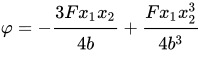
   \varphi =  - \cfrac{3Fx_1x_2}{4b} + \cfrac{Fx_1x_2^{3}}{4b^{3}}

Therefore,


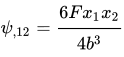
    \psi_{,12} = \cfrac{6Fx_1x_2}{4b^3}

Integrating,


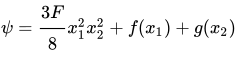
    \psi = \cfrac{3F}{8}x_1^2x_2^2 + f(x_1) + g(x_2)

\nabla^2{\psi} = 0 only if


    \cfrac{3F}{4}(x_1^2 + x_2^2) + f^{''}(x_1) + g^{''}(x_2) = 0

which means that


    f^{''}(x_1) = -\cfrac{3F}{4}x_1^2 + G ~;~~
    g^{''}(x_2) = -\cfrac{3F}{4}x_2^2 - G ~;~~

These can be integrated to find f(x1) and g(x2) in terms of x1, x2 and constants. The constants can be determined from the displacement BCs applied so as to fix rigid body motion.

The displacements are given by

\begin{matrix}
    u_1 &= -\cfrac{P}{2EI}(a^2-x_1^2)x_2 -\cfrac{P(2+\nu)}{6EI}x_2^3
          +\cfrac{P(1+\nu)b^2}{8EI}x_2\\
    u_2 &= -\cfrac{Pa^3}{6EI}\left[2
           -\cfrac{3x_1}{a}\left(1-\cfrac{\nu x_2^2}{a^2}\right) 
           + \cfrac{x_1^3}{a^3} +
           \cfrac{3b^2(1+\nu)}{4a^2}\left(1-\cfrac{x_1}{a}\right)\right]
  \end{matrix}

where I = (1/12)wb^3 \,, and w = thickness of the beam.

  • Since u1 is no a linear function of x2, plane sections do not remain plane.

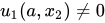
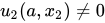
  • u_1(a,x_2) \ne 0 and u_2(a,x_2) \ne 0, but St. Venant's principle can be applied.
  • The deflection of the neutral axis (x2 = 0) is
              
u_2(x_1,0) = -\cfrac{Pa^3}{6EI}\left[2 -\cfrac{3x_1}{a} + \cfrac{x_1^3}{a^3} +             \cfrac{3b^2(1+\nu)}{4a^2}\left(1-\cfrac{x_1}{a}\right)\right]
If b/a \rightarrow 0, this prediction approaches beam theory.
  • The maximum deflection is
 
 u_2(0,0) = -\cfrac{Pa^3}{3EI} -\cfrac{Pa^3}{6EI}\cfrac{3b^2(1+\nu)}{4a^2}

[edit] General Approach For Beam Problems

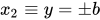
  • Find the highest order polynomial terms n and m for the normal and shear tractions on x_2 \equiv y = \pm b.
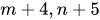
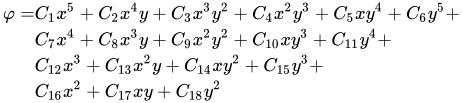
  • Use a polynomial of order max(m + 4,n + 5) excluding constant and linear terms. For example, for a polynomial of order 5
\begin{align}        \varphi = & C_1 x^5 + C_2 x^4 y + C_3 x^3 y^2 + C_4 x^2 y^3 + C_5 x y^4 +                 C_6 y^5 + \\        & C_7 x^4 + C_8 x^3 y + C_9 x^2 y^2 + C_{10} x y^3 + C_{11} y^4 +\\        & C_{12} x^3 + C_{13} x^2 y + C_{14} x y^2 + C_{15} y^3 + \\        & C_{16} x^2 + C_{17} x y + C_{18} y^2       \end{align}
  • Substitute (\varphi) into the biharmonic equation to get a set of constraint equations. Also compute the stresses.
  • Apply boundary conditions to obtain the tractions at the boundary.
  • For the strong BCs, find the coefficients of powers of x and y and equate with expressions for the tractions.
  • For the weak BCs, find algebraic expressions.
  • Solve the set of equations and back-substitute.