Introduction to Elasticity/Polar coordinates

From Wikiversity

Jump to: navigation, search

Contents

[edit] The Edge Dislocation Problem

Stress due to an edge dislocation

Assume that stresses vanish at r = ri and that ri is the radius of an undeformed cylindrical hole. Also stresses vanish at r_o\rightarrow\infty. Relative displacement b is prescribed on each face of the cut.

The edge dislocation problem is a plane strain problem. However, it is not axisymmetric.

It is probable that σrr and σθθ are symmetric about the x2x3 plane. Similarly, it is probable that σrθ is symmetric about the x1x3 plane.

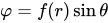
These probable symmetries suggest that we can use a stress function of the form


     \varphi = f(r) \sin\theta

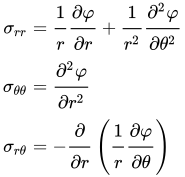
In cylindrical co-ordinates, the Airy stress function leads to

\begin{align}
    \sigma_{rr} & = \cfrac{1}{r}\cfrac{\partial\varphi}{\partial r} +
                  \cfrac{1}{r^2}\cfrac{\partial^2\varphi}{\partial \theta^2} \\
    \sigma_{\theta\theta} & = \cfrac{\partial^2\varphi}{\partial r^2} \\
    \sigma_{r\theta} & = -\cfrac{\partial}{\partial r}
                       \left(\cfrac{1}{r}\cfrac{\partial\varphi}{\partial \theta}\right) 
  \end{align}

    \nabla^4\varphi = \nabla^2{(\nabla^2{\varphi})}
     = \left(\cfrac{\partial^2}{\partial r^2}+\cfrac{1}{r}\cfrac{\partial}{\partial r}+
             \cfrac{1}{r^2}\cfrac{\partial^2}{\partial \theta^2}\right)
      \left(\cfrac{\partial^2\varphi}{\partial r^2}+\cfrac{1}{r}\cfrac{\partial\varphi}{\partial r}+
             \cfrac{1}{r^2}\cfrac{\partial^2\varphi}{\partial \theta^2}\right)

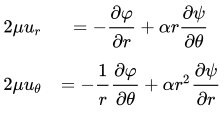
and

\begin{matrix}
    2\mu u_r & = -\cfrac{\partial\varphi}{\partial r} + \alpha r \cfrac{\partial\psi}{\partial \theta} \\
    2\mu u_{\theta} & = -\cfrac{1}{r}\cfrac{\partial\varphi}{\partial \theta} + 
                \alpha r^2 \cfrac{\partial\psi}{\partial r} 
  \end{matrix}

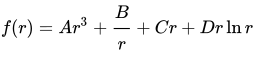
Proceeding as usual, after plugging the value of \varphi in to the biharmonic equation, we get


     f(r) = Ar^3 + \cfrac{B}{r} + Cr + Dr \ln r

Applying the stress boundary conditions and neglecting terms containing 1 / r3, we get


    \sigma_{rr} = \sigma_{\theta\theta} = \cfrac{D}{r} \sin\theta ~;~~
    \sigma_{r\theta} = -\cfrac{D}{r} \cos\theta

Next we compute the displacements, in a manner similar to that shown for the cantilever beam problem. The displacement BCs are ur = 0 at θ = 0 + and ur = b at θ = 2π − . We can use these to determine D and hence the stresses.

Rigid body motions are eliminated next by enforcing zero displacements and rotations at r = ri and θ = 0 + . The final expressions for the displacements can then be obtained.

[edit] Sample homework problems

[edit] Problem 1

Consider the Airy stress function


  \varphi = C~r^2~(\alpha + \theta - \sin\theta\cos\theta - \cos^2\theta\tan\alpha)
  • Show that this stress function provides an approximate solution for a cantilevered triangular beam with a uniform traction p applied to the upper surface. The angle α is the angle subtended by the free edges of the triangle.
A cantilevered triangular beam with uniform normal traction
  • Find the value of the constant C in terms of p and α.

[edit] Solution:

Given:


  \varphi = Cr^2(\alpha + \theta - \sin\theta\cos\theta - \cos^2\theta\tan\alpha)

Using a cylindrical co-ordinate system, the stresses are

\begin{align}
  \sigma_{rr} & = 2C\left(\alpha + \theta + \sin\theta\cos\theta - \tan\alpha +
    \cos^2\theta\tan\alpha\right) \\
  \sigma_{r\theta} & = -2C + \cos^2\theta - \sin\theta\cos\theta\tan\alpha \\
  \sigma_{\theta\theta} & = 2C\left(\alpha + \theta - \sin\theta\cos\theta
       - \cos^2\theta\tan\alpha\right)
\end{align}

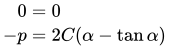
At θ = 0, tr = 0, tθ = − p, \widehat{\mathbf{n}}{} = \widehat{\mathbf{e}}{\theta}. Therefore, σθθ = − p and σrθ = 0.

\begin{align}
  0 & = 0 \\
  -p & = 2C(\alpha - \tan\alpha)
\end{align}

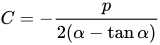
Hence, the shear traction BC is satisfied and the normal traction BC is satisfied if


   {C = -\frac{p}{2(\alpha - \tan\alpha)}}

At θ = − alpha, tr = 0, tθ = 0, \widehat{\mathbf{n}}{} = -\widehat{\mathbf{e}}{\theta}. Therefore, σθθ = 0 and σrθ = 0. Both these BCs are identically satisfied by the stresses (after substituting for C). Hence, equilibrium is satisfied.

  \varphi = -\frac{pr^2}{2(\alpha - \tan\alpha)}
    (\alpha + \theta - \sin\theta\cos\theta - \cos^2\theta\tan\alpha)

To satisfy compatibility, \nabla^4{\phi} = 0. Use Maple to verify that this is indeed true.

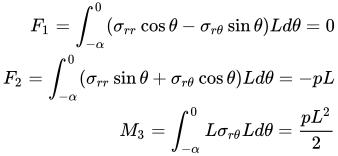
The remaining BC is the fixed displacement BC at the wall. We replace this BC with weak BCs at r = L. The traction distribution on the surface r = L are tr = σrr and tθ = σrθ. The statically equivalent forces and moments are

\begin{align}
  F_1 = \int_{-\alpha}^0 (\sigma_{rr}\cos\theta - \sigma_{r\theta}\sin\theta) L d\theta = 0 \\
  F_2 = \int_{-\alpha}^0 (\sigma_{rr}\sin\theta + \sigma_{r\theta}\cos\theta) L d\theta = -pL\\
  M_3 = \int_{-\alpha}^0 L \sigma_{r\theta} L d\theta = \frac{pL^2}{2}
\end{align}

You can verify these using Maple.

Hence, the given stress function provides an approximate solution for the cantilevered beam (in the St. Venant sense).