Elasticity/Plane stress
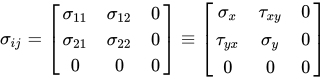
A state of plane stress exists when one of the three principal , stresses is zero. This usually occurs where one dimension is very small compared to the other two, i.e. the element is flat or thin. In this case, the stresses are negligible with respect to the smaller dimension as they are not able to develop within the material and are small compared to the in-plane stresses. Therefore, the face of the element is not acted by loads and the structural element can be analyzed as two-dimensional, e.g. thin-walled structures such as plates subject to in-plane loading or thin cylinders subject to pressure loading. The other three non-zero components remain constant over the thickness of the plate. The stress tensor can then be approximated by:

- .
The corresponding strain tensor is:
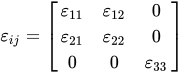
in which the non-zero term arises from the Poisson's effect. This strain term can be temporarily removed from the stress analysis to leave only the in-plane terms, effectively reducing the analysis to two dimensions.
