Given:
The plane strain solution for the stresses in a rectangular block
with
0
<
x
1
<
a
{\displaystyle 0<x_{1}<a}
−
b
<
x
2
<
b
{\displaystyle -b<x_{2}<b}
−
c
<
x
3
<
c
{\displaystyle -c<x_{3}<c}
σ
11
=
3
F
x
1
x
2
2
b
3
;
σ
12
=
3
F
(
b
2
−
x
2
2
)
4
b
3
;
σ
22
=
0
;
σ
33
=
−
3
ν
F
x
1
x
2
2
b
3
.
{\displaystyle \sigma _{11}={\frac {3Fx_{1}x_{2}}{2b^{3}}}~;~~\sigma _{12}={\frac {3F(b^{2}-x_{2}^{2})}{4b^{3}}}~;~~\sigma _{22}=0~;~~\sigma _{33}=-{\frac {3\nu Fx_{1}x_{2}}{2b^{3}}}.}
Find:
Find the tractions on the surfaces of the block and illustrate the results on a sketch of the block.
We wish to use this solution to solve the corresponding problem in which the surfaces
x
3
=
±
c
{\displaystyle x_{3}=\pm c}
Find the maximum error in the stress
σ
33
{\displaystyle \sigma _{33}}
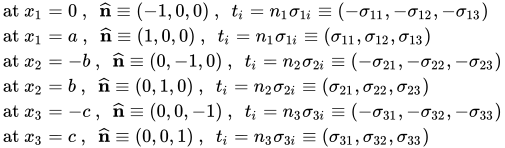
The tractions acting on the block are:
at
x
1
=
0
,
n
^
≡
(
−
1
,
0
,
0
)
,
t
i
=
n
1
σ
1
i
≡
(
−
σ
11
,
−
σ
12
,
−
σ
13
)
at
x
1
=
a
,
n
^
≡
(
1
,
0
,
0
)
,
t
i
=
n
1
σ
1
i
≡
(
σ
11
,
σ
12
,
σ
13
)
at
x
2
=
−
b
,
n
^
≡
(
0
,
−
1
,
0
)
,
t
i
=
n
2
σ
2
i
≡
(
−
σ
21
,
−
σ
22
,
−
σ
23
)
at
x
2
=
b
,
n
^
≡
(
0
,
1
,
0
)
,
t
i
=
n
2
σ
2
i
≡
(
σ
21
,
σ
22
,
σ
23
)
at
x
3
=
−
c
,
n
^
≡
(
0
,
0
,
−
1
)
,
t
i
=
n
3
σ
3
i
≡
(
−
σ
31
,
−
σ
32
,
−
σ
33
)
at
x
3
=
c
,
n
^
≡
(
0
,
0
,
1
)
,
t
i
=
n
3
σ
3
i
≡
(
σ
31
,
σ
32
,
σ
33
)
{\displaystyle {\begin{aligned}{\text{at}}~x_{1}&=0~,~~{\widehat {\mathbf {n} }}{}\equiv (-1,0,0)~,~~t_{i}=n_{1}\sigma _{1i}\equiv (-\sigma _{11},-\sigma _{12},-\sigma _{13})\\{\text{at}}~x_{1}&=a~,~~{\widehat {\mathbf {n} }}{}\equiv (1,0,0)~,~~t_{i}=n_{1}\sigma _{1i}\equiv (\sigma _{11},\sigma _{12},\sigma _{13})\\{\text{at}}~x_{2}&=-b~,~~{\widehat {\mathbf {n} }}{}\equiv (0,-1,0)~,~~t_{i}=n_{2}\sigma _{2i}\equiv (-\sigma _{21},-\sigma _{22},-\sigma _{23})\\{\text{at}}~x_{2}&=b~,~~{\widehat {\mathbf {n} }}{}\equiv (0,1,0)~,~~t_{i}=n_{2}\sigma _{2i}\equiv (\sigma _{21},\sigma _{22},\sigma _{23})\\{\text{at}}~x_{3}&=-c~,~~{\widehat {\mathbf {n} }}{}\equiv (0,0,-1)~,~~t_{i}=n_{3}\sigma _{3i}\equiv (-\sigma _{31},-\sigma _{32},-\sigma _{33})\\{\text{at}}~x_{3}&=c~,~~{\widehat {\mathbf {n} }}{}\equiv (0,0,1)~,~~t_{i}=n_{3}\sigma _{3i}\equiv (\sigma _{31},\sigma _{32},\sigma _{33})\end{aligned}}}
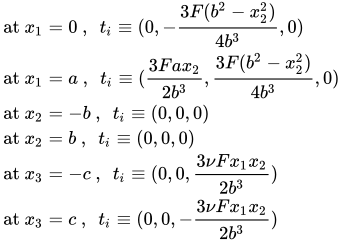
Plugging in the expressions for stress,
at
x
1
=
0
,
t
i
≡
(
0
,
−
3
F
(
b
2
−
x
2
2
)
4
b
3
,
0
)
at
x
1
=
a
,
t
i
≡
(
3
F
a
x
2
2
b
3
,
3
F
(
b
2
−
x
2
2
)
4
b
3
,
0
)
at
x
2
=
−
b
,
t
i
≡
(
0
,
0
,
0
)
at
x
2
=
b
,
t
i
≡
(
0
,
0
,
0
)
at
x
3
=
−
c
,
t
i
≡
(
0
,
0
,
3
ν
F
x
1
x
2
2
b
3
)
at
x
3
=
c
,
t
i
≡
(
0
,
0
,
−
3
ν
F
x
1
x
2
2
b
3
)
{\displaystyle {\begin{aligned}{\text{at}}~x_{1}&=0~,~~t_{i}\equiv (0,-{\frac {3F(b^{2}-x_{2}^{2})}{4b^{3}}},0)\\{\text{at}}~x_{1}&=a~,~~t_{i}\equiv ({\frac {3Fax_{2}}{2b^{3}}},{\frac {3F(b^{2}-x_{2}^{2})}{4b^{3}}},0)\\{\text{at}}~x_{2}&=-b~,~~t_{i}\equiv (0,0,0)\\{\text{at}}~x_{2}&=b~,~~t_{i}\equiv (0,0,0)\\{\text{at}}~x_{3}&=-c~,~~t_{i}\equiv (0,0,{\frac {3\nu Fx_{1}x_{2}}{2b^{3}}})\\{\text{at}}~x_{3}&=c~,~~t_{i}\equiv (0,0,-{\frac {3\nu Fx_{1}x_{2}}{2b^{3}}})\end{aligned}}}
These tractions are illustrated in the following figure
Tractions on the beam
To unload the tractions on the faces
x
3
=
±
c
{\displaystyle x_{3}=\pm c}
Let us first consider the force distribution required for the superposed problem. Since the loading is antisymmetric at
x
3
=
±
c
{\displaystyle x_{3}=\pm c}
x
3
{\displaystyle x_{3}}
x
2
{\displaystyle x_{2}}
However, there is a net moment about the
x
1
{\displaystyle x_{1}}
σ
33
=
C
x
2
{\displaystyle \sigma _{33}=Cx_{2}}
C
{\displaystyle C}
x
3
−
x
2
{\displaystyle x_{3}-x_{2}}
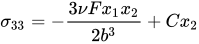
The total stress for the corrected problem is
σ
33
=
−
3
ν
F
x
1
x
2
2
b
3
+
C
x
2
{\displaystyle \sigma _{33}=-{\frac {3\nu Fx_{1}x_{2}}{2b^{3}}}+Cx_{2}}
The bending moment for a cross-section of the beam in the
x
3
−
x
2
{\displaystyle x_{3}-x_{2}}
x
1
{\displaystyle x_{1}}
M
=
−
σ
33
I
/
x
2
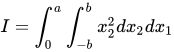
{\displaystyle M=-\sigma _{33}I/x_{2}\,}
I
=
∫
0
a
∫
−
b
b
x
2
2
d
x
2
d
x
1
{\displaystyle I=\int _{0}^{a}\int _{-b}^{b}x_{2}^{2}dx_{2}dx_{1}}
Since
σ
33
{\displaystyle \sigma _{33}}
x
1
{\displaystyle x_{1}}
M
=
∫
0
a
∫
−
b
b
(
−
σ
33
x
2
)
x
2
2
d
x
2
d
x
1
=
∫
0
a
∫
−
b
b
(
3
ν
F
x
1
x
2
2
b
3
−
C
x
2
)
x
2
d
x
2
d
x
1
=
∫
0
a
[
3
ν
F
x
1
x
2
3
6
b
3
−
C
x
2
3
3
]
−
b
b
d
x
1
=
∫
0
a
[
ν
F
x
1
b
3
b
3
−
2
C
b
3
3
]
d
x
1
=
[
ν
F
x
1
2
b
3
2
b
3
−
2
C
x
1
b
3
3
]
0
a
=
ν
F
a
2
b
3
2
b
3
−
2
C
a
b
3
3
{\displaystyle {\begin{aligned}M&=\int _{0}^{a}\int _{-b}^{b}\left({\frac {-\sigma _{33}}{x_{2}}}\right)x_{2}^{2}dx_{2}dx_{1}\\&=\int _{0}^{a}\int _{-b}^{b}\left({\frac {3\nu Fx_{1}x_{2}}{2b^{3}}}-Cx_{2}\right)x_{2}dx_{2}dx_{1}\\&=\int _{0}^{a}\left[{\frac {3\nu Fx_{1}x_{2}^{3}}{6b^{3}}}-{\frac {Cx_{2}^{3}}{3}}\right]_{-b}^{b}dx_{1}\\&=\int _{0}^{a}\left[{\frac {\nu Fx_{1}b^{3}}{b^{3}}}-{\frac {2Cb^{3}}{3}}\right]dx_{1}\\&=\left[{\frac {\nu Fx_{1}^{2}b^{3}}{2b^{3}}}-{\frac {2Cx_{1}b^{3}}{3}}\right]_{0}^{a}\\&={\frac {\nu Fa^{2}b^{3}}{2b^{3}}}-{\frac {2Cab^{3}}{3}}\end{aligned}}}
Setting the bending moment to zero, we have
C
=
3
ν
F
a
4
b
3
{\displaystyle C={\frac {3\nu Fa}{4b^{3}}}}
Therefore, the corrected solution is
σ
33
=
−
3
ν
F
x
1
x
2
2
b
3
+
3
ν
F
a
x
2
4
b
3
{\displaystyle {\sigma _{33}=-{\frac {3\nu Fx_{1}x_{2}}{2b^{3}}}+{\frac {3\nu Fax_{2}}{4b^{3}}}}}
Ideally, for a problem with zero tractions on
x
3
=
±
c
{\displaystyle x_{3}=\pm c}
σ
33
=
0
{\displaystyle \sigma _{33}=0}
σ
33
err
=
abs
(
3
ν
F
x
1
x
2
2
b
3
−
3
ν
F
a
x
2
4
b
3
)
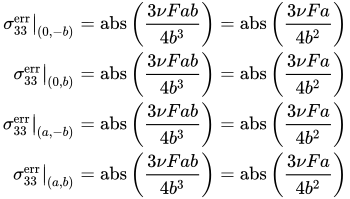
{\displaystyle \sigma _{33}^{\text{err}}={\text{abs}}\left({\frac {3\nu Fx_{1}x_{2}}{2b^{3}}}-{\frac {3\nu Fax_{2}}{4b^{3}}}\right)}
The error is maximum at
(
0
,
−
b
)
{\displaystyle (0,-b)}
(
0
,
b
)
{\displaystyle (0,b)}
(
a
,
−
b
)
{\displaystyle (a,-b)}
(
a
,
b
)
{\displaystyle (a,b)}
σ
33
err
|
(
0
,
−
b
)
=
abs
(
3
ν
F
a
b
4
b
3
)
=
abs
(
3
ν
F
a
4
b
2
)
σ
33
err
|
(
0
,
b
)
=
abs
(
3
ν
F
a
b
4
b
3
)
=
abs
(
3
ν
F
a
4
b
2
)
σ
33
err
|
(
a
,
−
b
)
=
abs
(
3
ν
F
a
b
4
b
3
)
=
abs
(
3
ν
F
a
4
b
2
)
σ
33
err
|
(
a
,
b
)
=
abs
(
3
ν
F
a
b
4
b
3
)
=
abs
(
3
ν
F
a
4
b
2
)
{\displaystyle {\begin{aligned}\left.\sigma _{33}^{\text{err}}\right|_{(0,-b)}&={\text{abs}}\left({\frac {3\nu Fab}{4b^{3}}}\right)={\text{abs}}\left({\frac {3\nu Fa}{4b^{2}}}\right)\\\left.\sigma _{33}^{\text{err}}\right|_{(0,b)}&={\text{abs}}\left({\frac {3\nu Fab}{4b^{3}}}\right)={\text{abs}}\left({\frac {3\nu Fa}{4b^{2}}}\right)\\\left.\sigma _{33}^{\text{err}}\right|_{(a,-b)}&={\text{abs}}\left({\frac {3\nu Fab}{4b^{3}}}\right)={\text{abs}}\left({\frac {3\nu Fa}{4b^{2}}}\right)\\\left.\sigma _{33}^{\text{err}}\right|_{(a,b)}&={\text{abs}}\left({\frac {3\nu Fab}{4b^{3}}}\right)={\text{abs}}\left({\frac {3\nu Fa}{4b^{2}}}\right)\end{aligned}}}
The maximum error is
3
ν
F
a
4
b
2
{\displaystyle {\frac {3\nu Fa}{4b^{2}}}}
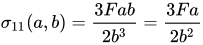
The maximum tensile stress is
σ
11
(
a
,
b
)
=
3
F
a
b
2
b
3
=
3
F
a
2
b
2
{\displaystyle \sigma _{11}(a,b)={\frac {3Fab}{2b^{3}}}={\frac {3Fa}{2b^{2}}}}
Therefore, the ratio of the maximum error in
σ
33
{\displaystyle \sigma _{33}}
Ratio
=
ν
2
{\displaystyle {{\text{Ratio}}={\frac {\nu }{2}}}}








![{\displaystyle {\begin{aligned}M&=\int _{0}^{a}\int _{-b}^{b}\left({\frac {-\sigma _{33}}{x_{2}}}\right)x_{2}^{2}dx_{2}dx_{1}\\&=\int _{0}^{a}\int _{-b}^{b}\left({\frac {3\nu Fx_{1}x_{2}}{2b^{3}}}-Cx_{2}\right)x_{2}dx_{2}dx_{1}\\&=\int _{0}^{a}\left[{\frac {3\nu Fx_{1}x_{2}^{3}}{6b^{3}}}-{\frac {Cx_{2}^{3}}{3}}\right]_{-b}^{b}dx_{1}\\&=\int _{0}^{a}\left[{\frac {\nu Fx_{1}b^{3}}{b^{3}}}-{\frac {2Cb^{3}}{3}}\right]dx_{1}\\&=\left[{\frac {\nu Fx_{1}^{2}b^{3}}{2b^{3}}}-{\frac {2Cx_{1}b^{3}}{3}}\right]_{0}^{a}\\&={\frac {\nu Fa^{2}b^{3}}{2b^{3}}}-{\frac {2Cab^{3}}{3}}\end{aligned}}}](https://wikimedia.org/api/rest_v1/media/math/render/svg/6079621d9aea306a992c2e3f51524a67a3389841)