Elasticity/Kinematics example 4
(Redirected from Introduction to Elasticity/Kinematics example 4)
Example 4[edit | edit source]
Given:
Displacement field .

Find:
- The Lagrangian Green strain tensor .
- The infinitesimal strain tensor .
- The infintesimal rotation tensor .
- The infinitesimal rotation vector .
- The exact longitudinal strain in the reference material direction .
- The approximate longitudinal strain in the direction based on the infinitesimal strain tensor .


Solution[edit | edit source]
The Maple output of the computations are shown below:
  with(linalg): with(LinearAlgebra):
  X := array(1..3): x := array(1..3):
  e1 := array(1..3,[1,0,0]):
  e2 := array(1..3,[0,1,0]):
  e3 := array(1..3,[0,0,1]):
  u := evalm(k*X[2]*e1 + k*X[1]*e2);
![{\displaystyle u:=\left[\!k\,{X_{2}},\,k\,{X_{1}},\,0\!\right]}](https://wikimedia.org/api/rest_v1/media/math/render/svg/c2d790123680b979a667a778c756f9b536dc7e09)
x := evalm(u + X);
![{\displaystyle x:=\left[\!k\,{X_{2}}+{X_{1}},\,k\,{X_{1}}+{X_{2}},\,{X_{3}}\!\right]}](https://wikimedia.org/api/rest_v1/media/math/render/svg/0fd6b764de1d7c2baed70a1a2db98925bc95aad5)
  F := linalg[matrix](3,3):
  for i from 1 to 3 do
    for j from 1 to 3 do
      F[i,j] := diff(x[i],X[j]);
    end do;
  end do;
  evalm(F);
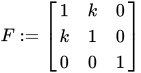
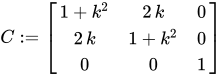
  Id := IdentityMatrix(3): C := evalm(transpose(F)&*F);
  E := evalm((1/2)*(C - Id));
![{\displaystyle E:={\begin{bmatrix}{\frac {k^{2}}{2}}&k&0\\[2ex]k&{\frac {k^{2}}{2}}&0\\[2ex]0&0&0\end{bmatrix}}}](https://wikimedia.org/api/rest_v1/media/math/render/svg/73ea9676745953dbb0aac06aa6aeedab366f7f92)
  gradu := linalg[matrix](3,3):
  for i from 1 to 3 do
    for j from 1 to 3 do
      gradu[i,j] := diff(u[i],X[j]);
    end do;
  end do;
  evalm(gradu);
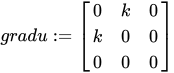
epsilon := evalm((1/2)*(gradu + transpose(gradu)));
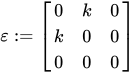
omega := evalm((1/2)*(gradu - transpose(gradu)));
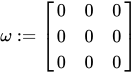
  stretch1 :=  sqrt(evalm(evalm(e1&*C)&*transpose(e1))[1,1]):
  longStrain1 := stretch1 - 1;


approxLongStrain1 := evalm(evalm(e1&*epsilon)&*transpose(e1))[1,1];

The geometrical difference between the large strain and small strain cases can be observed by looking at the figures from the previous examples.