Elasticity/Homogeneous and inhomogeneous displacements
Homogeneous and inhomogeneous displacements[edit | edit source]
Homogeneous Displacement Field[edit | edit source]
A displacement field is called homogeneous if

![{\displaystyle \mathbf {u} (\mathbf {X} )=\mathbf {u} _{0}+{\boldsymbol {A}}\bullet [\mathbf {X} -\mathbf {X} _{0}]}](https://wikimedia.org/api/rest_v1/media/math/render/svg/ae2a88f2c6d9709e1046eb6a6bb1fb450fab44c6)
where are independent of .


Pure Strain[edit | edit source]
If and , then is called a pure strain from , i.e.,


![{\displaystyle \mathbf {u} (\mathbf {X} )={\boldsymbol {\varepsilon }}\bullet [\mathbf {X} -\mathbf {X} _{0}]}](https://wikimedia.org/api/rest_v1/media/math/render/svg/224dae63649a29a8c27676090c2679ef47d3012c)
|
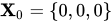
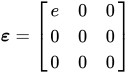
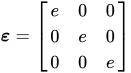
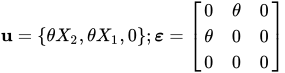
Examples of pure strain If is a given point, , and is an orthonormal basis, then Simple Extension[edit | edit source]For a simple extension in the direction of the unit vector and If and , then (in matrix notation) and The volume change is given by . Uniform Dilatation[edit | edit source]For a uniform dilatation , and If and , then (in matrix notation) and The volume change is given by . Simple Shear[edit | edit source]For a simple shear with respect to the perpendicular unit vectors and , and If , , , and , then (in matrix notation) The volume change is given by . |













![{\displaystyle \mathbf {u} =\theta [({\mathbf {m} }\bullet {\mathbf {p} _{0}})\mathbf {n} +({\mathbf {n} }\bullet {\mathbf {p} _{0}})\mathbf {m} ]}](https://wikimedia.org/api/rest_v1/media/math/render/svg/1c0e957f207d6fb29bfb6e3b8087295cfde63639)
![{\displaystyle {\boldsymbol {\varepsilon }}=\theta [{\mathbf {m} }\otimes {\mathbf {n} }+{\mathbf {n} }\otimes {\mathbf {m} }]}](https://wikimedia.org/api/rest_v1/media/math/render/svg/fa3cca277276fc2ed3592a20b5cce241e8d7c7e8)



|
Properties of homogeneous displacement fields
|


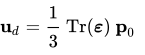
![{\displaystyle \textstyle \mathbf {u} _{c}=[{\boldsymbol {\varepsilon }}-{\cfrac {1}{3}}~{\text{Tr}}({\boldsymbol {\varepsilon }})~{\boldsymbol {\it {1}}}]\bullet \mathbf {p} _{0}}](https://wikimedia.org/api/rest_v1/media/math/render/svg/d0326326f8b46d7630277c8bbbba897dd45b12da)



Inhomogeneous Displacement Field[edit | edit source]
Any displacement field that does not satisfy the condition of homogeneity is inhomogenous. Most deformations in engineering materials lead to inhomogeneous displacements.
|
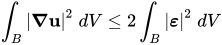
Properties of inhomogeneous displacement fields Average strain[edit | edit source]Let be a displacement field, be the corresponding strain field. Let and be continuous on B. Then, the mean strain depends only on the boundary values of . where is the unit normal to the infinitesimal surface area . Korn's Inequality[edit | edit source]Let be a displacement field on B that is continuous and let on . Then, |