Using the Airy Stress Function : Fourier Series Solutions [ edit | edit source ] Useful for more general boundary conditions.
Suppose
φ
=
f
(
x
2
)
cos
(
λ
x
1
)
=
o
r
=
φ
=
f
(
x
2
)
sin
(
λ
x
1
)
{\displaystyle \varphi =f(x_{2})\cos(\lambda x_{1})~~=or=~~\varphi =f(x_{2})\sin(\lambda x_{1})}
Substitute into the biharmonic equation. Then,
f
(
x
2
)
=
(
A
+
B
x
2
)
e
λ
x
2
+
(
C
+
D
x
2
)
e
−
λ
x
2
{\displaystyle f(x_{2})=(A+Bx_{2})e^{\lambda x_{2}}+(C+Dx_{2})e^{-\lambda x_{2}}}
or, equivalently,
f
(
x
2
)
=
(
A
+
B
x
2
)
cosh
λ
x
2
+
(
C
+
D
x
2
)
sinh
λ
x
2
{\displaystyle f(x_{2})=(A+Bx_{2})\cosh {\lambda x_{2}}+(C+Dx_{2})\sinh {\lambda x_{2}}\,}
The hyperbolic form allows us to take advantage of symmetry about the
x
2
=
0
{\displaystyle x_{2}=0}
If
φ
=
f
(
x
2
)
cos
(
λ
x
1
)
{\displaystyle \varphi =f(x_{2})\cos(\lambda x_{1})}
σ
11
=
−
λ
2
f
(
x
2
)
cos
(
λ
x
1
)
;
σ
22
=
f
″
(
x
2
)
cos
(
λ
x
1
)
;
σ
12
=
λ
f
′
(
x
2
)
sin
(
λ
x
1
)
{\displaystyle \sigma _{11}=-\lambda ^{2}f(x_{2})\cos(\lambda x_{1})~;~~\sigma _{22}=f^{''}(x_{2})\cos(\lambda x_{1})~;~~\sigma _{12}=\lambda f^{'}(x_{2})\sin(\lambda x_{1})}
Example of Fourier Series Technique [ edit | edit source ]
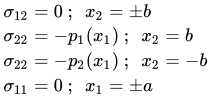
Bending of an elastic beam on a foundation
The traction boundary conditions are
σ
12
=
0
;
x
2
=
±
b
σ
22
=
−
p
1
(
x
1
)
;
x
2
=
b
σ
22
=
−
p
2
(
x
1
)
;
x
2
=
−
b
σ
11
=
0
;
x
1
=
±
a
{\displaystyle {\begin{aligned}\sigma _{12}&=0~;~~x_{2}=\pm b\\\sigma _{22}&=-p_{1}(x_{1})~;~~x_{2}=b\\\sigma _{22}&=-p_{2}(x_{1})~;~~x_{2}=-b\\\sigma _{11}&=0~;~~x_{1}=\pm a\end{aligned}}}
The problem is broken up into four subproblems which are superposed.
The subproblems are chosen so that the even/odd properties of
hyperbolic functions can be exploited.
The loads for the four subproblems are chosen to be
f
1
(
x
1
)
=
f
1
(
−
x
1
)
=
1
4
[
p
1
(
x
1
)
+
p
1
(
−
x
1
)
+
p
2
(
x
1
)
+
p
2
(
−
x
1
)
]
f
2
(
x
1
)
=
−
f
2
(
−
x
1
)
=
1
4
[
p
1
(
x
1
)
−
p
1
(
−
x
1
)
+
p
2
(
x
1
)
−
p
2
(
−
x
1
)
]
f
3
(
x
1
)
=
f
3
(
−
x
1
)
=
1
4
[
p
1
(
x
1
)
+
p
1
(
−
x
1
)
−
p
2
(
x
1
)
−
p
2
(
−
x
1
)
]
f
4
(
x
1
)
=
−
f
4
(
−
x
1
)
=
1
4
[
p
1
(
x
1
)
−
p
1
(
−
x
1
)
−
p
2
(
x
1
)
+
p
2
(
−
x
1
)
]
{\displaystyle {\begin{aligned}f_{1}(x_{1})=f_{1}(-x_{1})&={\cfrac {1}{4}}\left[p_{1}(x_{1})+p_{1}(-x_{1})+p_{2}(x_{1})+p_{2}(-x_{1})\right]\\f_{2}(x_{1})=-f_{2}(-x_{1})&={\cfrac {1}{4}}\left[p_{1}(x_{1})-p_{1}(-x_{1})+p_{2}(x_{1})-p_{2}(-x_{1})\right]\\f_{3}(x_{1})=f_{3}(-x_{1})&={\cfrac {1}{4}}\left[p_{1}(x_{1})+p_{1}(-x_{1})-p_{2}(x_{1})-p_{2}(-x_{1})\right]\\f_{4}(x_{1})=-f_{4}(-x_{1})&={\cfrac {1}{4}}\left[p_{1}(x_{1})-p_{1}(-x_{1})-p_{2}(x_{1})+p_{2}(-x_{1})\right]\end{aligned}}}
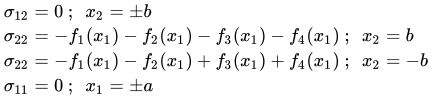
The new boundary conditions are
σ
12
=
0
;
x
2
=
±
b
σ
22
=
−
f
1
(
x
1
)
−
f
2
(
x
1
)
−
f
3
(
x
1
)
−
f
4
(
x
1
)
;
x
2
=
b
σ
22
=
−
f
1
(
x
1
)
−
f
2
(
x
1
)
+
f
3
(
x
1
)
+
f
4
(
x
1
)
;
x
2
=
−
b
σ
11
=
0
;
x
1
=
±
a
{\displaystyle {\begin{aligned}\sigma _{12}&=0~;~~x_{2}=\pm b\\\sigma _{22}&=-f_{1}(x_{1})-f_{2}(x_{1})-f_{3}(x_{1})-f_{4}(x_{1})~;~~x_{2}=b\\\sigma _{22}&=-f_{1}(x_{1})-f_{2}(x_{1})+f_{3}(x_{1})+f_{4}(x_{1})~;~~x_{2}=-b\\\sigma _{11}&=0~;~~x_{1}=\pm a\end{aligned}}}
Let us look at the subproblem with loads
±
f
3
(
x
1
)
{\displaystyle \pm f_{3}(x_{1})}
x
1
{\displaystyle x_{1}}
x
2
{\displaystyle x_{2}}
φ
=
∑
n
=
1
∞
f
n
(
x
2
)
cos
(
λ
n
x
1
)
=
∑
n
=
1
∞
[
A
n
x
2
cosh
(
λ
n
x
2
)
+
B
n
sinh
(
λ
n
x
2
)
]
cos
(
λ
n
x
1
)
{\displaystyle {\begin{aligned}\varphi &=\sum _{n=1}^{\infty }f_{n}(x_{2})\cos(\lambda _{n}x_{1})\\&=\sum _{n=1}^{\infty }\left[A_{n}x_{2}\cosh(\lambda _{n}x_{2})+B_{n}\sinh(\lambda _{n}x_{2})\right]\cos(\lambda _{n}x_{1})\end{aligned}}}
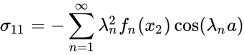
At
x
1
=
a
{\displaystyle x_{1}=a}
σ
11
=
−
∑
n
=
1
∞
λ
n
2
f
n
(
x
2
)
cos
(
λ
n
a
)
{\displaystyle \sigma _{11}=-\sum _{n=1}^{\infty }\lambda _{n}^{2}f_{n}(x_{2})\cos(\lambda _{n}a)}
Hence
σ
11
=
0
{\displaystyle \sigma _{11}=0}
λ
n
=
(
2
n
−
1
)
π
/
2
a
{\displaystyle \lambda _{n}=(2n-1)\pi /2a}
We can substitute
φ
{\displaystyle \varphi }
Applying the boundary conditions of
x
2
=
±
b
{\displaystyle x_{2}=\pm b}
∑
n
=
1
∞
[
A
n
λ
n
cosh
(
λ
n
b
)
+
A
n
λ
n
2
b
sinh
(
λ
n
b
)
+
B
n
λ
n
2
cosh
(
λ
n
b
)
]
sin
(
λ
n
x
1
)
=
0
∑
n
=
1
∞
[
A
n
λ
n
2
b
cosh
(
λ
n
b
)
+
B
n
λ
n
2
sinh
(
λ
n
b
)
]
cos
(
λ
n
x
1
)
=
f
3
(
x
1
)
{\displaystyle {\begin{aligned}\sum _{n=1}^{\infty }\left[A_{n}\lambda _{n}\cosh(\lambda _{n}b)+A_{n}\lambda _{n}^{2}b\sinh(\lambda _{n}b)+B_{n}\lambda _{n}^{2}\cosh(\lambda _{n}b)\right]\sin(\lambda _{n}x_{1})&=0\\\sum _{n=1}^{\infty }\left[A_{n}\lambda _{n}^{2}b\cosh(\lambda _{n}b)+B_{n}\lambda _{n}^{2}\sinh(\lambda _{n}b)\right]\cos(\lambda _{n}x_{1})&=f_{3}(x_{1})\end{aligned}}}
The first equation is satisfied if
A
m
λ
m
cosh
(
λ
m
b
)
+
A
m
λ
m
2
b
sinh
(
λ
m
b
)
+
B
m
λ
m
2
cosh
(
λ
m
b
)
=
0
(
1
)
{\displaystyle A_{m}\lambda _{m}\cosh(\lambda _{m}b)+A_{m}\lambda _{m}^{2}b\sinh(\lambda _{m}b)+B_{m}\lambda _{m}^{2}\cosh(\lambda _{m}b)=0\qquad (1)}
Integrate the second equation from
−
a
{\displaystyle -a}
a
{\displaystyle a}
cos
(
λ
m
x
1
)
{\displaystyle \cos(\lambda _{m}x_{1})}
All the odd functions are zero, except the
case where
n
=
m
{\displaystyle n=m}
Therefore, all that remains is
[
A
m
λ
m
2
b
cosh
(
λ
m
b
)
+
B
m
λ
m
2
sinh
(
λ
m
b
)
]
a
=
∫
−
a
a
f
3
(
x
1
)
cos
(
λ
m
x
1
)
d
x
1
(
2
)
{\displaystyle \left[A_{m}\lambda _{m}^{2}b\cosh(\lambda _{m}b)+B_{m}\lambda _{m}^{2}\sinh(\lambda _{m}b)\right]a=\int _{-a}^{a}f_{3}(x_{1})\cos(\lambda _{m}x_{1})dx_{1}\qquad (2)}
We can calculate
A
m
{\displaystyle A_{m}}
B
m
{\displaystyle B_{m}}
We do the same thing for the other subproblems.
The Fourier series approach is particularly useful if we have discontinuous or point loads.







![{\displaystyle {\begin{aligned}f_{1}(x_{1})=f_{1}(-x_{1})&={\cfrac {1}{4}}\left[p_{1}(x_{1})+p_{1}(-x_{1})+p_{2}(x_{1})+p_{2}(-x_{1})\right]\\f_{2}(x_{1})=-f_{2}(-x_{1})&={\cfrac {1}{4}}\left[p_{1}(x_{1})-p_{1}(-x_{1})+p_{2}(x_{1})-p_{2}(-x_{1})\right]\\f_{3}(x_{1})=f_{3}(-x_{1})&={\cfrac {1}{4}}\left[p_{1}(x_{1})+p_{1}(-x_{1})-p_{2}(x_{1})-p_{2}(-x_{1})\right]\\f_{4}(x_{1})=-f_{4}(-x_{1})&={\cfrac {1}{4}}\left[p_{1}(x_{1})-p_{1}(-x_{1})-p_{2}(x_{1})+p_{2}(-x_{1})\right]\end{aligned}}}](https://wikimedia.org/api/rest_v1/media/math/render/svg/20dafc05d48753ee06bbe6ddd06460897ab57395)


![{\displaystyle {\begin{aligned}\varphi &=\sum _{n=1}^{\infty }f_{n}(x_{2})\cos(\lambda _{n}x_{1})\\&=\sum _{n=1}^{\infty }\left[A_{n}x_{2}\cosh(\lambda _{n}x_{2})+B_{n}\sinh(\lambda _{n}x_{2})\right]\cos(\lambda _{n}x_{1})\end{aligned}}}](https://wikimedia.org/api/rest_v1/media/math/render/svg/2f9dee62557c79468ac5b786064a87450911c02c)





![{\displaystyle {\begin{aligned}\sum _{n=1}^{\infty }\left[A_{n}\lambda _{n}\cosh(\lambda _{n}b)+A_{n}\lambda _{n}^{2}b\sinh(\lambda _{n}b)+B_{n}\lambda _{n}^{2}\cosh(\lambda _{n}b)\right]\sin(\lambda _{n}x_{1})&=0\\\sum _{n=1}^{\infty }\left[A_{n}\lambda _{n}^{2}b\cosh(\lambda _{n}b)+B_{n}\lambda _{n}^{2}\sinh(\lambda _{n}b)\right]\cos(\lambda _{n}x_{1})&=f_{3}(x_{1})\end{aligned}}}](https://wikimedia.org/api/rest_v1/media/math/render/svg/8121081f7c29133b34d07ad69a8ae556251423ce)



![{\displaystyle \left[A_{m}\lambda _{m}^{2}b\cosh(\lambda _{m}b)+B_{m}\lambda _{m}^{2}\sinh(\lambda _{m}b)\right]a=\int _{-a}^{a}f_{3}(x_{1})\cos(\lambda _{m}x_{1})dx_{1}\qquad (2)}](https://wikimedia.org/api/rest_v1/media/math/render/svg/5a80b182f6bdd9c539417520a42a621d0b56f06f)

