The Michell solution is a general solution to the elasticity equations in polar coordinates ( r , θ {\displaystyle r,\theta \,} ). The solution is such that the stress components are in the form of a Fourier series in θ {\displaystyle \theta \,} .
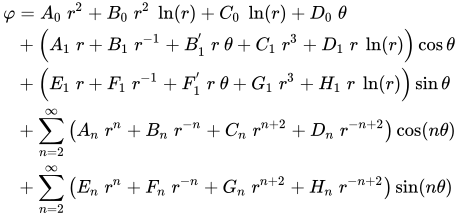
Michell[1] showed that the general solution can be expressed in terms of an Airy stress function of the form
The terms A 1 r cos θ {\displaystyle A_{1}~r~\cos \theta \,} and E 1 r sin θ {\displaystyle E_{1}~r~\sin \theta \,} define a trivial null state of stress and are ignored.
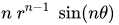
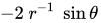
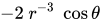
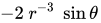
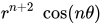
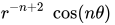
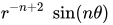
The stress components can be obtained by substituting the Michell solution into the equations for stress in terms of the Airy stress function (in cylindrical coordinates). A table of stress components is shown below [from J. R. Barber (2002) [2]].
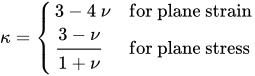
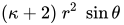
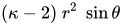
Displacements can be obtained from the Michell solution by using the stress-strain and strain-displacement relations. A table of displacement components corresponding the the terms in the Airy stress function for the Michell solution is given below. In this table
Note that you can superpose a rigid body displacement on the Michell solution of the form
to obtain an admissible displacement field.
Introduction to Elasticity





































![{\displaystyle {\frac {1}{2}}[(\kappa -1)\theta ~\cos \theta +\{1-(\kappa +1)\ln r\}~\sin \theta ]\,}](https://wikimedia.org/api/rest_v1/media/math/render/svg/72d52f8fbf58d30a9ced87e77083af68e7b73f75)
![{\displaystyle -{\frac {1}{2}}[(\kappa -1)\theta ~\sin \theta +\{1+(\kappa +1)\ln r\}~\cos \theta ]\,}](https://wikimedia.org/api/rest_v1/media/math/render/svg/1c8660b2da72a1b66968da214f52e32d37d34151)
![{\displaystyle {\frac {1}{2}}[(\kappa +1)\theta ~\sin \theta -\{1-(\kappa -1)\ln r\}~\cos \theta ]\,}](https://wikimedia.org/api/rest_v1/media/math/render/svg/ce23838da9a43c20d63e5b7cd0f409e4093909e7)
![{\displaystyle {\frac {1}{2}}[(\kappa +1)\theta ~\cos \theta -\{1+(\kappa -1)\ln r\}~\sin \theta ]\,}](https://wikimedia.org/api/rest_v1/media/math/render/svg/328058bddbd04de898ee7bd98b3a2585819f1b09)



![{\displaystyle {\frac {1}{2}}[(\kappa -1)\theta ~\sin \theta -\{1-(\kappa +1)\ln r\}~\cos \theta ]\,}](https://wikimedia.org/api/rest_v1/media/math/render/svg/ba2e9838deb55221958680d51ee52d9c253dc91e)
![{\displaystyle {\frac {1}{2}}[(\kappa -1)\theta ~\cos \theta -\{1+(\kappa +1)\ln r\}~\sin \theta ]\,}](https://wikimedia.org/api/rest_v1/media/math/render/svg/61b1cef19ff52eed8609a3627e2f2fbad2d40653)
![{\displaystyle -{\frac {1}{2}}[(\kappa +1)\theta ~\cos \theta +\{1-(\kappa -1)\ln r\}~\sin \theta ]\,}](https://wikimedia.org/api/rest_v1/media/math/render/svg/40ac842a5c3308ac40af79da8a4cdf62e596b419)
![{\displaystyle {\frac {1}{2}}[(\kappa +1)\theta ~\sin \theta +\{1+(\kappa -1)\ln r\}~\cos \theta ]\,}](https://wikimedia.org/api/rest_v1/media/math/render/svg/6fbccd63a7977e2c989b9206fcb0d60913a714eb)