Fourier Transform represents a function  as a "linear combination" of complex sinusoids at different frequencies
  . Fourier proposed that a function may be written in terms of a sum of complex sine and cosine functions with weighted amplitudes.
In Euler notation the complex exponential may be represented as:

Thus, the definition of a Fourier transform is usually represented in complex exponential notation.
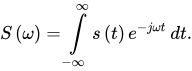
The Fourier transform of s(t) is defined by
Under appropriate conditions original function can be recovered by:
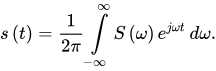
The function  is the Fourier transform of . This is often denoted with the operator
  , in the case above,
The function must satisfy the Dirichlet conditions in order for for the integral defining Fourier transform to converge.
Forward Fourier Transform(FT)/Anaysis Equation
Inverse Fourier Transform(IFT)/Synthesis Equation
Explanation coming from Linear Algebra[edit | edit source]
According to linear algebra, for every orthogonal B of a vector space H, and every element x of H
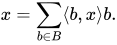
holds true.

is an orthonormal basis as can be confirmed by calculating the scalar products. This means that
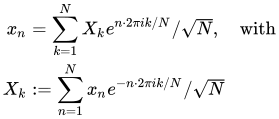
( denotes the n'th component of the vector x)
holds true for every N-dimensional vector x.
denotes the n'th component of the vector x)
holds true for every N-dimensional vector x.  is exactly the discrete Fourier transform, and we just proved that the inverse discrete Fourier transform of the discrete Fourier transform of a vector x is the vector x, which is the central theorem of discrete Fourier theory.
Discrete Fourier theory essentially means writing something in the Fourierbasis B. This also explains the linearity of the Fourier transformation.
is exactly the discrete Fourier transform, and we just proved that the inverse discrete Fourier transform of the discrete Fourier transform of a vector x is the vector x, which is the central theorem of discrete Fourier theory.
Discrete Fourier theory essentially means writing something in the Fourierbasis B. This also explains the linearity of the Fourier transformation.
Relation to the Laplace Transform[edit | edit source]
In fact, the Fourier Transform can be viewed as a special case of the bilateral Laplace Transform. If the complex Laplace variable s were written as  , then the Fourier transform is just the bilateral Laplace transform evaluated at
  . This justification is not mathematically rigorous, but for most applications in engineering the correspondence holds.
| × |
Time Function |
Fourier Transform |
Property
|
| 1
|
 |
 |
Linearity
|
| 2
|
 |
 |
Duality
|
| 3
|
 , c = constant , c = constant |
 |
Scalar Multiplication
|
| 4
|
 |
 |
Differentiation in time domain
|
| 5
|
 |
 , if , if 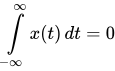 |
Integration in Time domain
|
| 6
|
 |
 |
Differentiation in Frequency Domain
|
| 7
|
 |
 |
Time reversal
|
| 8
|
 |
 |
Time Scaling
|
| 9
|
 |
 |
Time shifting
|
| 10
|
 |
![{\displaystyle {\frac {1}{2}}\left[X(\omega \,+\,\omega _{0})\,+\,X(\omega \,-\,\omega _{0})\right]}](https://wikimedia.org/api/rest_v1/media/math/render/svg/ed8edeb172b8e9cb2cdce9e16c8e6e43d0dba120) |
Modulation
|
| 11
|
 |
![{\displaystyle {\frac {1}{2j}}\left[X(\omega \,-\,\omega _{0})\,-\,X(\omega \,+\,\omega _{0})\right]}](https://wikimedia.org/api/rest_v1/media/math/render/svg/e0861ba7650e6730c8ca96ec05cca6d618fe3e0a) |
Modulation
|
| 12
|
 |
 |
Frequency shifting
|
| 13
|
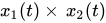 |
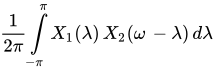 |
Convolution
|