Statement of the balance of mass [ edit | edit source ] The balance of mass can be expressed as:
              ρ
              ˙


        +
        ρ


          ∇

        ∙

          v

        =
        0


    {\displaystyle {\dot {\rho }}+\rho ~{\boldsymbol {\nabla }}\bullet \mathbf {v} =0}
where
ρ
(
x
,
t
)
{\displaystyle \rho (\mathbf {x} ,t)}
ρ
˙
{\displaystyle {\dot {\rho }}}
ρ
{\displaystyle \rho }
v
(
x
,
t
)
{\displaystyle \mathbf {v} (\mathbf {x} ,t)}
Ω
{\displaystyle \Omega }
∂
Ω
{\displaystyle \partial {\Omega }}
We can show how this relation is derived by recalling that the general equation for the balance of a physical quantity
f
(
x
,
t
)
{\displaystyle f(\mathbf {x} ,t)}
d
d
t
[
∫
Ω
f
(
x
,
t
)
dV
]
=
∫
∂
Ω
f
(
x
,
t
)
[
u
n
(
x
,
t
)
−
v
(
x
,
t
)
⋅
n
(
x
,
t
)
]
dA
+
∫
∂
Ω
g
(
x
,
t
)
dA
+
∫
Ω
h
(
x
,
t
)
dV
.
{\displaystyle {\cfrac {d}{dt}}\left[\int _{\Omega }f(\mathbf {x} ,t)~{\text{dV}}\right]=\int _{\partial {\Omega }}f(\mathbf {x} ,t)[u_{n}(\mathbf {x} ,t)-\mathbf {v} (\mathbf {x} ,t)\cdot \mathbf {n} (\mathbf {x} ,t)]~{\text{dA}}+\int _{\partial {\Omega }}g(\mathbf {x} ,t)~{\text{dA}}+\int _{\Omega }h(\mathbf {x} ,t)~{\text{dV}}~.}
To derive the equation for the balance of mass, we assume that the
physical quantity of interest is the mass density
ρ
(
x
,
t
)
{\displaystyle \rho (\mathbf {x} ,t)}
g
(
x
,
t
)
=
h
(
x
,
t
)
=
0
{\displaystyle g(\mathbf {x} ,t)=h(\mathbf {x} ,t)=0}
d
d
t
[
∫
Ω
ρ
(
x
,
t
)
dV
]
=
∫
∂
Ω
ρ
(
x
,
t
)
[
u
n
(
x
,
t
)
−
v
(
x
,
t
)
⋅
n
(
x
,
t
)
]
dA
.
{\displaystyle {\cfrac {d}{dt}}\left[\int _{\Omega }\rho (\mathbf {x} ,t)~{\text{dV}}\right]=\int _{\partial {\Omega }}\rho (\mathbf {x} ,t)[u_{n}(\mathbf {x} ,t)-\mathbf {v} (\mathbf {x} ,t)\cdot \mathbf {n} (\mathbf {x} ,t)]~{\text{dA}}~.}
Let us assume that the volume
Ω
{\displaystyle \Omega }
∂
Ω
{\displaystyle \partial {\Omega }}
u
n
=
0
{\displaystyle u_{n}=0}
∫
Ω
∂
ρ
∂
t
dV
=
−
∫
∂
Ω
ρ
(
v
⋅
n
)
dA
.
{\displaystyle \int _{\Omega }{\frac {\partial \rho }{\partial t}}~{\text{dV}}=-\int _{\partial {\Omega }}\rho ~(\mathbf {v} \cdot \mathbf {n} )~{\text{dA}}~.}
Using the divergence theorem
∫
Ω
∇
∙
v
dV
=
∫
∂
Ω
v
⋅
n
dA
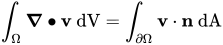
{\displaystyle \int _{\Omega }{\boldsymbol {\nabla }}\bullet \mathbf {v} ~{\text{dV}}=\int _{\partial {\Omega }}\mathbf {v} \cdot \mathbf {n} ~{\text{dA}}}
we get
∫
Ω
∂
ρ
∂
t
dV
=
−
∫
Ω
∇
∙
(
ρ
v
)
dV
.
{\displaystyle \int _{\Omega }{\frac {\partial \rho }{\partial t}}~{\text{dV}}=-\int _{\Omega }{\boldsymbol {\nabla }}\bullet (\rho ~\mathbf {v} )~{\text{dV}}.}
or,
∫
Ω
[
∂
ρ
∂
t
+
∇
∙
(
ρ
v
)
]
dV
=
0
.
{\displaystyle \int _{\Omega }\left[{\frac {\partial \rho }{\partial t}}+{\boldsymbol {\nabla }}\bullet (\rho ~\mathbf {v} )\right]~{\text{dV}}=0~.}
Since
Ω
{\displaystyle \Omega }
∂
ρ
∂
t
+
∇
∙
(
ρ
v
)
=
0
.
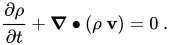
{\displaystyle {\frac {\partial \rho }{\partial t}}+{\boldsymbol {\nabla }}\bullet (\rho ~\mathbf {v} )=0~.}
Using the identity
∇
∙
(
φ
v
)
=
φ
∇
∙
v
+
∇
φ
⋅
v
{\displaystyle {\boldsymbol {\nabla }}\bullet (\varphi ~\mathbf {v} )=\varphi ~{\boldsymbol {\nabla }}\bullet \mathbf {v} +{\boldsymbol {\nabla }}\varphi \cdot \mathbf {v} }
we have
∂
ρ
∂
t
+
ρ
∇
∙
v
+
∇
ρ
⋅
v
=
0
.
{\displaystyle {\frac {\partial \rho }{\partial t}}+\rho ~{\boldsymbol {\nabla }}\bullet \mathbf {v} +{\boldsymbol {\nabla }}\rho \cdot \mathbf {v} =0~.}
Now, the material time derivative of
ρ
{\displaystyle \rho }
ρ
˙
=
∂
ρ
∂
t
+
∇
ρ
⋅
v
.
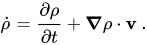
{\displaystyle {\dot {\rho }}={\frac {\partial \rho }{\partial t}}+{\boldsymbol {\nabla }}\rho \cdot \mathbf {v} ~.}
Therefore,
ρ
˙
+
ρ
∇
∙
v
=
0
.
{\displaystyle {{\dot {\rho }}+\rho ~{\boldsymbol {\nabla }}\bullet \mathbf {v} =0~.}}



![{\displaystyle {\cfrac {d}{dt}}\left[\int _{\Omega }f(\mathbf {x} ,t)~{\text{dV}}\right]=\int _{\partial {\Omega }}f(\mathbf {x} ,t)[u_{n}(\mathbf {x} ,t)-\mathbf {v} (\mathbf {x} ,t)\cdot \mathbf {n} (\mathbf {x} ,t)]~{\text{dA}}+\int _{\partial {\Omega }}g(\mathbf {x} ,t)~{\text{dA}}+\int _{\Omega }h(\mathbf {x} ,t)~{\text{dV}}~.}](https://wikimedia.org/api/rest_v1/media/math/render/svg/fcb120ab19e9001d85370ccb115c509cec72cf33)

![{\displaystyle {\cfrac {d}{dt}}\left[\int _{\Omega }\rho (\mathbf {x} ,t)~{\text{dV}}\right]=\int _{\partial {\Omega }}\rho (\mathbf {x} ,t)[u_{n}(\mathbf {x} ,t)-\mathbf {v} (\mathbf {x} ,t)\cdot \mathbf {n} (\mathbf {x} ,t)]~{\text{dA}}~.}](https://wikimedia.org/api/rest_v1/media/math/render/svg/03f94d594114f237d5c144e08d373bc8cc993585)



![{\displaystyle \int _{\Omega }\left[{\frac {\partial \rho }{\partial t}}+{\boldsymbol {\nabla }}\bullet (\rho ~\mathbf {v} )\right]~{\text{dV}}=0~.}](https://wikimedia.org/api/rest_v1/media/math/render/svg/991491fdad14216d8c35799c2f7deb776e4a3089)