Algebra/Proofs

From Wikiversity

Jump to: navigation, search
Crystal Clear app kaddressbook.png
Please help develop this page

This page was created, but so far, little content has been added. Everyone is invited to help expand and create educational content for Wikiversity. If you need help learning how to add content, see the editing tutorial and the MediaWiki syntax reference.

To help you get started with content, we have automatically added references below to other Wikimedia Foundation projects. This will help you find materials such as information, media and quotations on which to base the development of "Algebra/Proofs" as an educational resource. However, please do not simply copy-and-paste large chunks from other projects. You can also use the links in the blue box to help you classify this page by subject, educational level and resource type.

Wikipedia-logo.png Run a search on Algebra/Proofs at Wikipedia.
Commons-logo.svg Search Wikimedia Commons for images, sounds and other media related to: Algebra/Proofs
Wikimedia-logo.svg Search for Algebra/Proofs on the following projects:
Smiley green alien whatface.svg Lost on Wikiversity? Please help by choosing project boxes to classify this resource by:

An Algebraic Proof is a proof of a Theorem (or Lemma or Corollary) that relies highly on symbolic manipulation of equations to go from the assumption(s) to the conclusion(s). An algebraic proof may be contrasted with a combinatorial proof, which involves more discussion of the objects themselves, rather than the symbols representing them.

[edit] Example

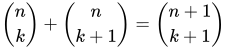
Theorem:  {n \choose k} + {n \choose k+1} = {n+1 \choose k+1}.

Proof:

  LHS = \frac{n!}{k!(n-k)!} + \frac{n!}{(k+1)!(n-k-1)!} 
 = \frac{n!(k+1)}{(k+1)!(n-k)!} + \frac{n!(n-k)}{(k+1)!(n-k)!}
 = \frac{(k+1+n-k)n!}{(k+1)!(n-k)!} = \frac{(n+1)n!}{(k+1)!(n-k)!}=RHS