Airy stress function with body force

From Wikiversity

Jump to: navigation, search

Contents

[edit] Airy stress function with body force potential

If a body force exists, the Airy stress function (\varphi) has to be combined with a body force potential (V). Thus,


     \sigma_{11} = \varphi_{,22} + V ~;~~
     \sigma_{22} = \varphi_{,11} + V ~;~~
     \sigma_{12} = -\varphi_{,12} \qquad \text{(3)}

or,


     \sigma_{11} = \cfrac{\partial^2\varphi}{\partial x_2^2} + V ~;~~
     \sigma_{22} = \cfrac{\partial^2\varphi}{\partial x_1^2} + V ~;~~
     \sigma_{12} = -\cfrac{\partial^2\varphi}{\partial x_1 \partial Tx_2}
     \qquad \text{(4)}

[edit] Is equilibrium still satisfied ?

Recall the equilibrium equation in two dimensions:


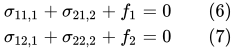
     \boldsymbol{\nabla}\bullet{\boldsymbol{\sigma}} + \mathbf{f} = 0 ~;~~ \sigma_{\beta\alpha, \beta} + f_{\alpha} = 0 \qquad \text{(5)}

or,


\begin{align}
    \sigma_{11,1} + \sigma_{21,2} + f_1 & = 0 \qquad \text{(6)}\\
    \sigma_{12,1} + \sigma_{22,2} + f_2 & = 0 \qquad \text{(7)}
\end{align}

In terms of \varphi,

\begin{align}
    \varphi_{,122} + V_{,1} - \varphi_{,212} + f_1 & = 0 \qquad \text{(8)}\\
    -\varphi_{,112} + \varphi_{,211} + V_{,2} + f_2 & = 0 \qquad \text{(9)}
\end{align}

or,

\begin{align}
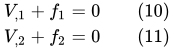
    V_{,1} + f_1 & = 0 \qquad \text{(10)}\\
    V_{,2} + f_2 & = 0 \qquad \text{(11)}
\end{align}

Therefore,


    f_1 = - V_{,1} ~;~~ f_2 = - V_{,2} \qquad \text{(12)}

or,


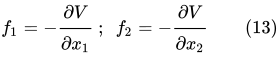
    f_1 = - \cfrac{\partial V}{\partial x_1} ~;~~ f_2 = - \cfrac{\partial V}{\partial x_2}\qquad \text{(13)}

Hence,


    \mathbf{f} = -\boldsymbol{\nabla}{V}\qquad \text{(14)}
  • Equilibrium is satisfied only if the body force field can be expressed as the gradient of a scalar potential.
  • A force field that can be expressed as the gradient of a scalar potential is called conservative.

[edit] What condition is needed to satisfy compatibility ?

Recall that the compatibility condition in terms of the stresses can be written as
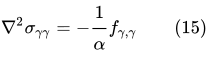

    \nabla^2{\sigma_{\gamma\gamma}} = -\cfrac{1}{\alpha} f_{\gamma,\gamma} \qquad \text{(15)}

where,


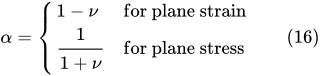
     \alpha = \begin{cases}
                1-\nu &  \rm{for~ plane~ strain} \\
                \cfrac{1}{1+\nu} & \rm{for~ plane~ stress}
              \end{cases} \qquad \text{(16)}

or,


    \nabla^2{(\sigma_{11}+\sigma_{22})} + \cfrac{1}{\alpha}(f_{1,1}+f_{2,2}) = 0
    \qquad \text{(17)}

or,


    \sigma_{11,11}+\sigma_{11,22}+\sigma_{22,11}+\sigma_{22,22} +
       \cfrac{1}{\alpha}(f_{1,1}+f_{2,2}) = 0 \qquad \text{(18)}

which is the same as,


    \cfrac{\partial^2\sigma_{11}}{\partial x_1^2}+ \cfrac{\partial^2\sigma_{11}}{\partial x_2^2}+
    \cfrac{\partial^2\sigma_{22}}{\partial x_1^2}+ \cfrac{\partial^2\sigma_{22}}{\partial x_2^2}+
       \cfrac{1}{\alpha}(\cfrac{\partial f_1}{\partial x_1}+\cfrac{\partial f_2}{\partial x_2}) = 0
    \qquad \text{(19)}

Plug in the stress potential and the body force potential in equation (18) to get


    \varphi_{,2211}+V_{,11}+\varphi_{,2222}+V_{,22}+
    \varphi_{,1111}+V_{,11}+\varphi_{,1122}+V_{,22}+
       \cfrac{1}{\alpha}(-V_{,11}-V_{,22}) = 0 \qquad \text{(20)}

or,


    2\varphi_{,2211}+2V_{,11}+\varphi_{,2222}+2V_{,22}+
    \varphi_{,1111}+ \cfrac{1}{\alpha}(-V_{,11}-V_{,22}) = 0 \qquad \text{(21)}

Rearrange to get


    \varphi_{,1111} + 2\varphi_{,2211} + \varphi_{,2222} +
    \left(2 - \cfrac{1}{\alpha}\right) (V_{,11} + V_{,22}) = 0 \qquad \text{(22)}

which is the same as,


    \cfrac{\partial^4\varphi}{\partial x_1^4} + 2\cfrac{\partial^4 \varphi}{\partial x_1^2 \partial x_2^2} +
    \cfrac{\partial^4\varphi}{\partial x_2^4} +
    \left(2 - \cfrac{1}{\alpha}\right)
    \left(\cfrac{\partial^2 V}{\partial x_1^2} + \cfrac{\partial^2 V}{\partial x_2^2}\right) = 0
    \qquad \text{(23)}

Therefore,


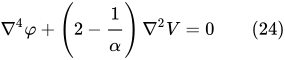
    \nabla^4{\varphi} + \left(2 - \cfrac{1}{\alpha}\right) \nabla^2{V} = 0 \qquad \text{(24)}

Compatibility is satisfied only if equation (24) is satisfied.

[edit] Equations for Airy stress function with body force potential

The relation between the Cauchy stress and the Airy stress function is (in direct tensor notation)


  \boldsymbol{\sigma} =   \boldsymbol{\nabla}\times{\boldsymbol{\nabla}\times{\varphi}}

The relation between the body force and the body force potential is


   \mathbf{f} = -\boldsymbol{\nabla}{V}

We also have to satisfy the compatibility condition for the Airy stress function to be a true stress potential, i.e.,
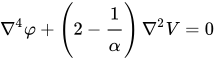

   \nabla^4{\varphi} + \left(2 - \cfrac{1}{\alpha}\right) \nabla^2{V} = 0

[edit] In rectangular Cartesian coordinates

In rectangular Cartesian coordinates, the relation between the Cauchy stress components and the Airy stress function + body force potential can be written as


   \sigma_{11} = \varphi_{,22} + V ~;~~
   \sigma_{22} = \varphi_{,11} + V ~;~~
   \sigma_{12} = -\varphi_{,12}

or,


   \sigma_{xx} = \cfrac{\partial^2\varphi}{\partial y^2} + V ~;~~
   \sigma_{yy} = \cfrac{\partial^2\varphi}{\partial x^2} + V ~;~~
   \sigma_{xy} = -\cfrac{\partial^2\varphi}{\partial x \partial y}

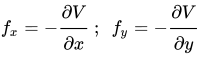
The relation between the body force components and the body force potential are:


    f_1 = - V_{,1} ~;~~ f_2 = - V_{,2}

or,


    f_x = - \cfrac{\partial V}{x} ~;~~ f_y = - \cfrac{\partial V}{y}

The compatibility condition is written as


    \varphi_{,1111} + 2\varphi_{,2211} + \varphi_{,2222} +
    \left(2 - \cfrac{1}{\alpha}\right) (V_{,11} + V_{,22}) = 0

or,


    \cfrac{\partial^4 \varphi}{\partial x^4} + 2\cfrac{\partial^4 \varphi}{\partial x^2 \partial y^2} + \cfrac{\partial^4 \varphi}{\partial y^4} +
    \left(2 - \cfrac{1}{\alpha}\right) \left(\cfrac{\partial^2 V}{\partial x^2} + \cfrac{\partial^2 V}{\partial y^2}\right) = 0

[edit] In cylindrical coordinates

In cylindrical coordinates, the relation between the Cauchy stresses and the Airy stress function + body force potential can be written as

 
     \sigma_{rr} = \cfrac{1}{r}\cfrac{\partial\varphi}{\partial r} +
                   \cfrac{1}{r^2}\cfrac{\partial^2\varphi}{\partial \theta^2} + V ~;~~
     \sigma_{\theta\theta} =
                   \cfrac{\partial^2\varphi}{\partial r^2} + V ~;~~
     \sigma_{r\theta} = -\cfrac{\partial}{\partial r}
          \left(\cfrac{1}{r}\cfrac{\partial\varphi}{\partial \theta}\right)
    \qquad \text{(25)}

The components of the body force are related to the body force potential via
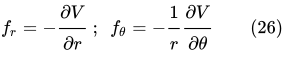

    f_r = - \cfrac{\partial V}{\partial r} ~;~~ f_{\theta} = - \cfrac{1}{r}\cfrac{\partial V}{\partial \theta}  \qquad \text{(26)}

The compatibility condition can be expressed as

\begin{align}
    \left(\cfrac{\partial^2}{\partial r^2} + \cfrac{1}{r}\cfrac{\partial}{\partial r} +
          \cfrac{1}{r^2}\cfrac{\partial^2}{\partial \theta^2}\right) &
    \left(\cfrac{\partial^2\varphi}{\partial r^2} + \cfrac{1}{r}\cfrac{\partial\varphi}{\partial r} +
          \cfrac{1}{r^2}\cfrac{\partial^2\varphi}{\partial \theta^2}\right) + \\
    &\left(2 - \cfrac{1}{\alpha}\right)
    \left(\cfrac{\partial^2 V}{\partial r^2} + \cfrac{1}{r}\cfrac{\partial V}{\partial r} +
          \cfrac{1}{r^2}\cfrac{\partial^2 V}{\partial \theta^2}\right) = 0 \qquad \text{(27)}
  \end{align}


[edit] Related Content

Introduction to Elasticity

Personal tools